INDUSTRY TRENDS

German Salami Supply Chain Map (for Quality/Safety Procurement): Flow, Specs, and 2026 Cost/Risk Drivers

Author
Team Tridge
DATE
July 29, 2026
8 min read
german-salami Cover
German SalamiHS 160100
Powered by Tridge Eye
🇺🇦 Ukraine↑ 43.7%
$6.59/kg
Wholesale reference prices across 136 markets

This guide maps how German-style salami moves from pork inputs to packed finished goods, with an emphasis on where quality/safety risk and cost become structurally “locked in.” It’s written for procurement teams who already know supplier assurance—but need a clear mental model of salami’s fermentation/drying realities, and why sliced formats behave like a different risk category than whole sticks.

Executive Summary

  • Cost locks in early: lean/fat consistency and cold-chain history drive yield, texture, and drying predictability—problems here surface later as shrink loss or holds.
  • Fermentation/drying is a capacity business: output is constrained by room-days and energy-intensive climate control; you can’t surge volume quickly.
  • Slicing/packing is the highest hygiene leverage point for RTE meats due to post-process exposure (Listeria control and environmental monitoring discipline matter disproportionately).
  • 2026 watch-outs (EU-facing supply): ASF volatility in Europe and packaging compliance change (PPWR applies from 12 Aug 2026) raise continuity and packaging-spec governance stakes.
Annotated supply chain flow for German-style salami from hogs/slaughter through trim and back fat, ingredients, grind/mix/stuff, fermentation (pH drop), drying/ripening (aw drop and shrink), optional smoking/equalization, whole-stick packing or slicing with MAP/vacuum, QA release, and chilled distribution, with callouts showing three structural lock-in points: raw material variability, room-days/energy constraints in fermentation and drying, and highest hygiene leverage at slicing/packing (Listeria/EMP).

1) How German Salami Physically Flows—and Where Cost Gets “Locked In”

German salami is a cured/fermented pork product where biology (pH drop), physics (moisture loss), and hygiene (post-process RTE handling) determine both feasibility and cost. Unlike many fresh-meat categories, a meaningful share of cost is structurally “baked in” by time in rooms (fermentation/drying), shrink (weight loss), and slicing/packing sanitation intensity.

Insight

The supply chain is built around a few irreversible steps—lean/fat selection, fermentation control, and drying shrink—so early-stage variability propagates into yield, safety margins, and downstream pack-out.

Data

Typical flows run: pork trim/back fat → grind/mix with salt/cure/spices/starter → stuff into casing → fermentation (pH down) → drying/ripening (aw down; weight loss) → optional smoking/equalization → whole-stick pack or slice/MAP/vacuum pack → chilled distribution (especially sliced/semi-dry).

Procurement Impact

The “fixed” cost drivers are not negotiable levers; they are structural: pork input quality, process time/capacity, energy for climate control, and packaging-line hygiene. Any variance here shows up later as yield loss, shelf-life failures, or microbiological exposure.

2) Where Value Is Added (and Lost): Cost & Margin Structure by Node

Insight

German-salami economics accumulate through (1) meat yields and formulation, (2) controlled environment processing time, (3) shrink during drying, and (4) high-spec packaging/QA for sliced formats.

Data

Across the chain, the biggest “hard” cost buckets are typically pork lean + fat, labor, energy/HVAC + refrigeration, packaging materials, and quality assurance (testing, sanitation, compliance). Shrink converts the same input kg into fewer sellable kg; dry/semi-dry fermented sausage processes commonly see ~25–50% moisture loss depending on style, caliber, and endpoints.

Procurement Impact

To understand supplier cost structure and performance, you need node-level visibility: which node owns shrink, which node owns CCPs, and where the highest rework/hold risk sits (often slicing/packing).
1. Upstream / Raw Material (Hogs → Pork Trim & Back Fat)

  • Insight: Pork trim and back fat are the dominant cost driver; their microbiological status and lean/fat consistency determine both safety margins and yield.
  • Data: Salami formulations are highly sensitive to lean-to-fat ratio and raw material temperature history (chilled vs frozen blocks). Variability increases rework, fat smear risk, and inconsistent drying behavior.
  • Procurement Impact: Even before processing, cost and risk are “set” by spec compliance on trim class, fat firmness, and cold-chain integrity. Poor incoming control tends to surface later as texture defects, oxidation, or process deviations.

2. Ingredient System (Salt/Cure, Spices, Starter Cultures, Functional Additives)

  • Insight: These inputs are a small share of cost but a disproportionate share of compliance and defect exposure (allergens, foreign matter, and microbiological load in spices).
  • Data: Starter cultures drive predictable fermentation kinetics (pH trajectory). Spices can introduce allergen cross-contact (e.g., mustard/celery in EU-style blends) and occasional microbiological concerns; cure systems must match label declarations and market rules.
  • Procurement Impact: Ingredient governance is where “paper compliance” often breaks: misaligned allergen statements, spec versions, or additive declarations can force relabel/hold even when the meat is fine.

3. Casings & Closures (Natural Hog / Collagen + Clips)

  • Insight: Casing choice is a hidden capacity and yield lever because it affects drying rate, caliber uniformity, peelability, and defect rates.
  • Data: Natural casings carry size variability and higher sorting labor; collagen offers uniform caliber and predictable drying but can have different bite/appearance. Clips/closures are low-cost but critical for integrity (bursting/leakers).
  • Procurement Impact: Casing specs influence downstream waste: split casings, wrinkling, or poor adhesion drive downgrades and line stops—costs that show up as OEE loss and scrap.

4. Fermentation & Drying/Ripening (Core Manufacturing Value Add)

  • Insight: This is the cost “engine”: controlled rooms convert raw batter into a stable product through pH reduction and water activity reduction, but time and shrink dominate economics.
  • Data: Fermentation requires tight control of temperature, humidity, airflow, and time to hit pH targets; drying/ripening drives weight loss (shrink) that can be material and varies by caliber and target aw. For many dry salami styles, end-state controls often land in the neighborhood of pH <~5.0–5.3 and aw <~0.85–0.91 depending on style and whether the product is intended to be shelf-stable vs chilled.
  • Procurement Impact: Capacity is constrained by room-days, not just kg/day. Any deviation (slow pH drop, uneven drying) creates hold time, rework, or safety risk—directly impacting service levels and inventory aging.

5. Slicing & Packaging (MAP/Vacuum) + QA Release

  • Insight: Sliced RTE salami is often the highest hygiene burden node; it concentrates microbiological risk and packaging material cost.
  • Data: Slicing rooms require rigorous sanitation, environmental monitoring, and temperature control to manage post-process contamination risk (notably Listeria in RTE meat environments). Packaging formats (MAP trays/films vs vacuum) drive material cost and shelf-life performance; seal integrity and oxygen transmission influence oxidation and discoloration.
  • Procurement Impact: This node is where minor issues become major: post-process contamination, seal failures, or label/spec mismatches can trigger holds, withdrawals, or recalls—often with the largest downstream cost.

6. Cold Chain Logistics & Distribution (Chilled Handling, Warehousing)

  • Insight: Logistics cost is structurally tied to temperature regime and cube efficiency; sliced/semi-dry products are less forgiving than true-dry sticks.
  • Data: Chilled distribution adds reefer freight, temperature logging, and tighter handling windows. Poor temperature control accelerates quality degradation (fat oxidation notes, surface sweating) and can shorten usable shelf life.
  • Procurement Impact: Service level and waste are often logistics-shaped: the same product can perform very differently depending on temperature excursions, dwell times, and palletization density.

Product-Level Cost Breakdown

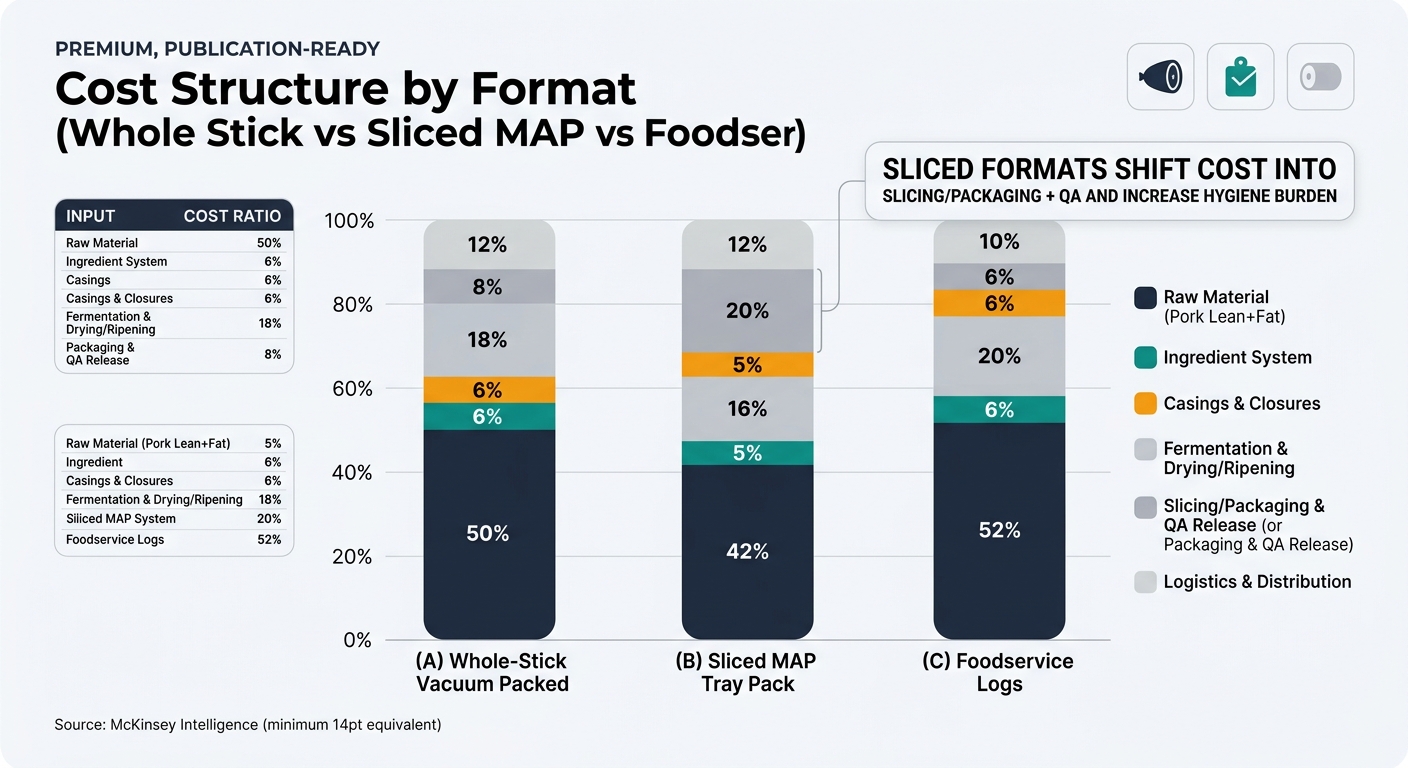
Grouped 100% stacked bar chart comparing cost structure by format: whole-stick vacuum packed (50/6/6/18/8/12), sliced MAP tray pack (42/5/5/16/20/12), and foodservice logs (52/6/6/20/6/10) across raw materials, ingredients, casings, fermentation/drying, slicing/packaging and QA (or packaging and QA), and logistics, highlighting that sliced formats shift more cost into slicing/packaging and increase hygiene burden.

A) Whole-Stick German Salami (Vacuum Packed)

Supply Chain Node Cost Ratio (% of Final Cost) Notes
Raw Material Cost (pork lean + fat) 50% Dominant driver; formulation and trim quality set yield and defect risk.
Ingredient System (spices/cure/cultures) 6% Low cost share; high compliance leverage (allergens/label declarations).
Casings & Closures 6% Natural vs collagen affects labor, defects, and drying behavior.
Fermentation & Drying/Ripening 18% Room time + energy + shrink conversion into sellable kg.
Packaging & QA Release 8% Vacuum bags/labels + testing; lower than sliced formats.
Logistics & Distribution 12% Chilled freight and warehousing; less packaging cube penalty than trays.

B) Sliced German Salami (MAP Tray Pack)

Supply Chain Node Cost Ratio (% of Final Cost) Notes
Raw Material Cost (pork lean + fat) 42% Still largest share, but diluted by packaging and slicing costs.
Ingredient System (spices/cure/cultures) 5% Allergen and spec governance remain critical.
Casings & Closures 5% Caliber uniformity matters for slice count and grammage control.
Fermentation & Drying/Ripening 16% Same structural room-time + shrink economics.
Slicing/Packaging & QA Release 20% Hygiene programs, labor/OEE, trays/films/gas, seal integrity, EM swabs/testing.
Logistics & Distribution 12% Chilled chain + higher cube/weight penalty from trays.

C) Foodservice Logs (Bulk, for In-House Slicing)

Supply Chain Node Cost Ratio (% of Final Cost) Notes
Raw Material Cost (pork lean + fat) 52% Higher share due to simpler packaging and fewer retail requirements.
Ingredient System (spices/cure/cultures) 6% Similar to whole-stick; batch-to-batch consistency is key.
Casings & Closures 6% Larger calibers can change drying time and shrink profile.
Fermentation & Drying/Ripening 20% Bulk formats can be room-time intensive depending on diameter targets.
Packaging & QA Release 6% Bulk bags/labels; fewer components than retail.
Logistics & Distribution 10% Often more pallet-efficient than trays; still typically chilled.
Sourcing Window Radar
German Salami — Global Harvest Calendar
SPAIN SEASON ACTIVE
🇪🇸 Spain
JUL — JUL
🇺🇸 United St.
JAN — DEC
🇷🇺 Russia
SEP — SEP
🇧🇾 BY
JUL — NOV
🇦🇹 Austria
NOV — DEC
JanFebMarAprMayJunJulAugSepOctNovDec

3) Structural Realities You Can’t Wish Away (and Why They Matter)

Reality 1: Shrink Is Not a “Loss”—It’s the Product Specification

Insight

Drying shrink is the physical mechanism that creates stability (lower aw) and texture; you cannot eliminate it without changing the product.

Data

Drying removes water to reach target aw; tighter targets and smaller calibers typically change drying kinetics and yield. Over-drying increases hardness and slicing losses; under-drying increases spoilage risk and shortens shelf life.

Procurement Impact

Any spec change that touches aw, diameter, or drying profile will move cost structurally through yield and room capacity—not just through ingredient usage.

Reality 2: Slicing/Packaging Is the Highest Hygiene-Leverage Node

Insight

The most serious microbiological exposure for RTE cured meats often concentrates after the core kill/controls—during slicing and packing.

Data

High sanitation frequency, environmental monitoring, and controlled temperatures are required to manage post-process contamination. Packaging integrity and oxygen control affect oxidation and sensory shelf life.

Procurement Impact

A supplier can be strong at fermentation/drying yet weak at slicing hygiene; performance must be evaluated as two different operational competencies.

Reality 3: Capacity Is Measured in “Room-Days,” Not Just Tons

Insight

Fermentation and drying rooms create a hard ceiling on output; you can’t instantly add capacity when demand spikes.

Data

Each batch occupies controlled space for defined time; disruptions (equipment downtime, off-spec pH/aw trajectories) consume room-days and push back schedules.

Procurement Impact

Lead times and allocation behavior are structurally linked to maturation time + room availability, making this category more like cheese/aged products than like fresh meat.

Key Insights (What to Remember When You Read a Spec or Plant Flow)

  • Insight: German-salami cost is structurally anchored by pork inputs, controlled-environment processing time, and shrink; sliced formats add a second cost engine: hygiene-intensive packaging.
  • Data: The chain’s highest fixed burdens cluster in (1) raw material consistency, (2) fermentation/drying energy + room-days, and (3) slicing/packaging materials + sanitation/QA release.
  • Procurement Impact: When quality, safety, or service issues occur, they usually trace back to a small set of physical failure modes: incoming trim variability, pH/aw misses, casing defects, slicing-room hygiene gaps, seal integrity failures, or cold-chain excursions.

4) The Bottom Line for Your Next Contract

(Analyzed at: Jul, 2026)

Write your next salami contract like a two-node risk problem: (1) fermentation/drying capability and (2) post-process slicing/packing hygiene + packaging compliance. That focus works because room-days and shrink make supply tight when anything drifts, while post-lethality exposure is where the highest-severity RTE incidents tend to originate—especially in sliced formats.

In 2026, add two explicit governance clauses: (a) ASF-driven origin/availability change notification (with agreed alternates for trim classes) and (b) packaging material change control aligned to PPWR application from 12 Aug 2026. Teams that lock these controls typically avoid the most expensive outcomes—multi-day holds, relabel/repack, and chilled waste—often worth mid-single digits of annual category value when problems hit at scale.

German SalamiSupply Chain Intelligence
136 countries tracked
10
Exporters
10
Importers
$962M
Top Export Value
Top Exporters (2024)
🇮🇹
Italy
$962M
🇺🇸
United States
$866M
🇪🇸
Spain
$729M
🇵🇱
Poland
$678M
🇩🇪
Germany
$676M
+131 more
Top Buyers
🇬🇧 United Kingdom $1.00B🇩🇪 Germany $619M🇧🇪 Belgium $372M🇨🇦 Canada $322M🇳🇱 Netherlands $315M

Related Contents

Subscribe
→
By subscribing you agree to with our Privacy Policy and provide consent to receive updates from our company.
Thank you! Your submission has been received!
Oops! Something went wrong while submitting the form.
Subscribe to receive the latest blog posts, updates, promotions, and announcements from Tridge.
