
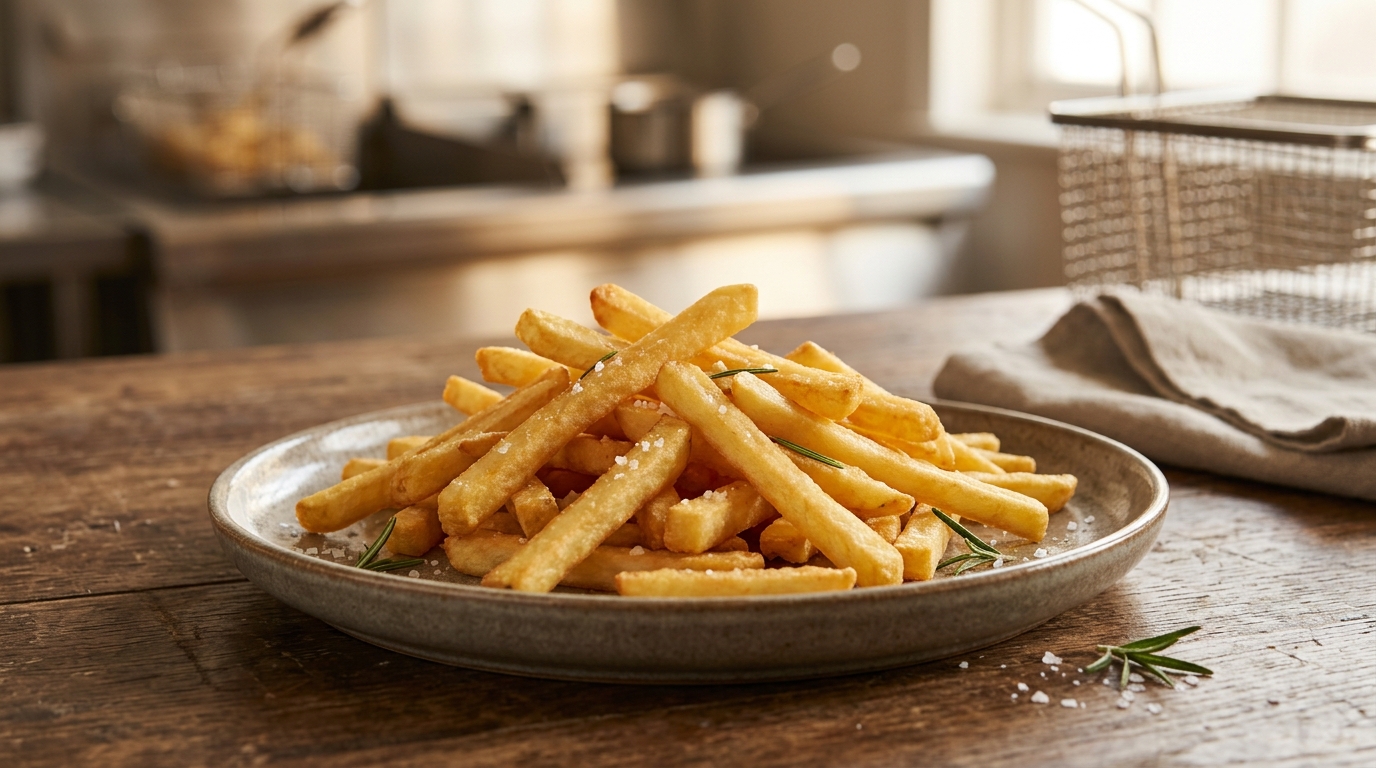
Frozen straight-cut fries look “simple,” but the supply chain is engineered to turn a biologically variable crop into a uniform, audit-ready, cold-chain product. This guide maps the physical flow, explains where cost structurally locks in, and highlights what procurement + QSC teams should monitor and contract for to protect service, quality consistency, and governance.
Frozen straight-cut potato fries are a tightly engineered, capital-intensive cold-chain product: value is created by converting a highly variable raw crop into a uniform, IQF frozen format that must stay at 0°F / −18°C or colder end-to-end for best quality. (This −18°C benchmark is consistent with U.S. food safety guidance for freezer storage and quality preservation.)
The biggest “fixed” cost drivers are set by (1) contracted potato supply + storage, (2) high-throughput processing assets (water, heat, frying, freezing), and (3) refrigerated logistics and warehousing.
Insight: The physical chain is short, but each node is high consequence: small deviations in raw solids/sugars, par-fry conditions, or freezer integrity show up downstream as color drift, texture complaints, clumping, or yield loss.
Data: Industrial fry potatoes are selected for high dry matter and low reducing sugars because sugars drive fry color and browning; processors manage this via variety choice and storage/conditioning.
Procurement Impact: The practical “map” to understand is: contracted potatoes → storage/conditioning → wash/peel/cut/sort → blanch → par-fry → de-oil/cool → IQF freeze → pack → frozen distribution. Each step adds cost mainly through yield loss, energy, oil, packaging, and refrigeration.

Insight: Fries economics are dominated by conversion efficiency: every percent of yield loss (peel loss, trim, slivers, off-spec color/length) and every kWh/MJ used for heating/freezing compounds into the final case cost.
Data (validated directionally): Frying and freezing are consistently identified as major energy nodes in industrial potato processing. Published industry analyses show wide ranges depending on plant design, heat recovery, line rate, and product specs; treat any single “MJ/kg” or “kWh/tonne” figure as scenario-dependent, not a universal benchmark.
Procurement Impact: When comparing supply options, the “cost story” is usually embedded in physical realities: potato solids/sugars (yield + color), line OEE (throughput), oil management, and cold-chain footprint.

| Supply Chain Node | Cost Ratio (% of Final Cost) | Notes |
|---|---|---|
| Raw Material + Storage Program | 25% | Variety/solids/sugars + storage losses set baseline yield and color risk. |
| Primary Processing | 15% | Peel/cut/sort yield loss + labor + water/wastewater. |
| Blanching/Thermal Conditioning | 10% | Steam/heat + water + wastewater; stabilizes texture/color. |
| Par-Fry (Oil + Energy) | 18% | Oil purchase/turnover + fryer energy + line efficiency. |
| IQF Freezing + Packaging & QA | 17% | Electricity-intensive freezing + film/corrugate + metal detection/QA. |
| Cold-Chain Logistics & Distribution | 15% | Frozen warehousing + reefer freight + handling. |
| Supply Chain Node | Cost Ratio (% of Final Cost) | Notes |
|---|---|---|
| Raw Material + Storage Program | 23% | Similar potato needs; coating can mask minor surface defects but not color drift. |
| Primary Processing | 14% | Sorting still required; length/defect specs remain cost drivers. |
| Blanching/Thermal Conditioning | 9% | Process tuning needed to support coating adhesion and texture. |
| Par-Fry (Oil + Energy) | 17% | Oil uptake dynamics change with coating; fryer control is critical. |
| Coating/Seasoning Application | 7% | Added ingredient + dosing + dust control/housekeeping. |
| IQF Freezing + Packaging & QA | 16% | Similar freezing load; more QA checks for coating uniformity. |
| Cold-Chain Logistics & Distribution | 14% | Same cold-chain requirements; damage can increase coating break-off fines. |
| Supply Chain Node | Cost Ratio (% of Final Cost) | Notes |
|---|---|---|
| Raw Material + Storage Program | 22% | Similar agronomic constraints; retail often emphasizes visual consistency. |
| Primary Processing | 13% | Cut uniformity + defect removal drives consumer appearance. |
| Blanching/Thermal Conditioning | 9% | Texture/color control remains central. |
| Par-Fry (Oil + Energy) | 16% | Similar to foodservice; yield and oil management drive unit cost. |
| IQF Freezing + Packaging & QA | 22% | Branded film, print complexity, sealing performance, and retail QA add cost. |
| Cold-Chain Logistics & Distribution | 18% | More nodes (DCs, retail freezers) increase handling and refrigeration burden. |
Insight: Three constraints shape fries availability and cost structure regardless of supplier: raw potato biology, plant-scale economics, and the non-negotiable cold chain.
Data: (1) Reducing sugars are a core determinant of fry color; varieties intended for processing must maintain low sugars in field and storage. (2) Industrial potato products plants rely on high-throughput sorting/frying/freezing assets; frying + freezing are consistently material energy nodes. (3) Frozen foods are commonly handled at 0°F / −18°C or lower, making cold-chain integrity a physical requirement, not a preference.
Procurement Impact:
Insight: Most fries specs are proxies for three physical truths: potato solids/sugars, conversion yield, and cold-chain integrity.
Data (validated): USDA maintains grade and color standards for frozen French fried potatoes, underscoring how central color/defect control is to the category.
Procurement Impact:
(Analyzed at: Aug, 2026)
Write your fries contract like a manufacturing + cold-chain control plan, not just a price sheet. In 2025–2026, major processors have been actively restructuring footprints and curtailing/closing capacity in parts of their networks, which makes allocation risk and lane reliability more consequential than a small unit-price win. Tie at least 20–30% of award decisions to evidence you can audit: documented potato storage/conditioning approach (to manage reducing sugars), IQF/freezer throughput constraints, and end-to-end temperature-control expectations (0°F / −18°C handling with defensible records). It works because most “supplier quality” disputes in fries are really yield + temperature problems—and the cost of one rejected or heavily claimed lane can erase months of negotiated savings.


