
This report is powered by Tridge Eye Data Intelligence.
Every data point, price signal, and supply risk insight in this analysis comes from the same platform that procurement and sourcing leaders worldwide rely on daily. As you read, consider what this level of market intelligence could do for your sourcing decisions.
Frozen sprat is a deceptively “simple” frozen seafood buy that behaves more like a policy- and capacity-constrained commodity than a negotiable, stable protein input. If you’re a procurement leader coming from other categories, the fastest way to improve outcomes is to manage sprat as a system: quotas and short fishing windows set the supply ceiling, freezing/cold storage set the throughput constraint, and your spec + governance set the size of your eligible supplier pool and your hidden cost exposure.
(Analyzed at: Apr, 2026)
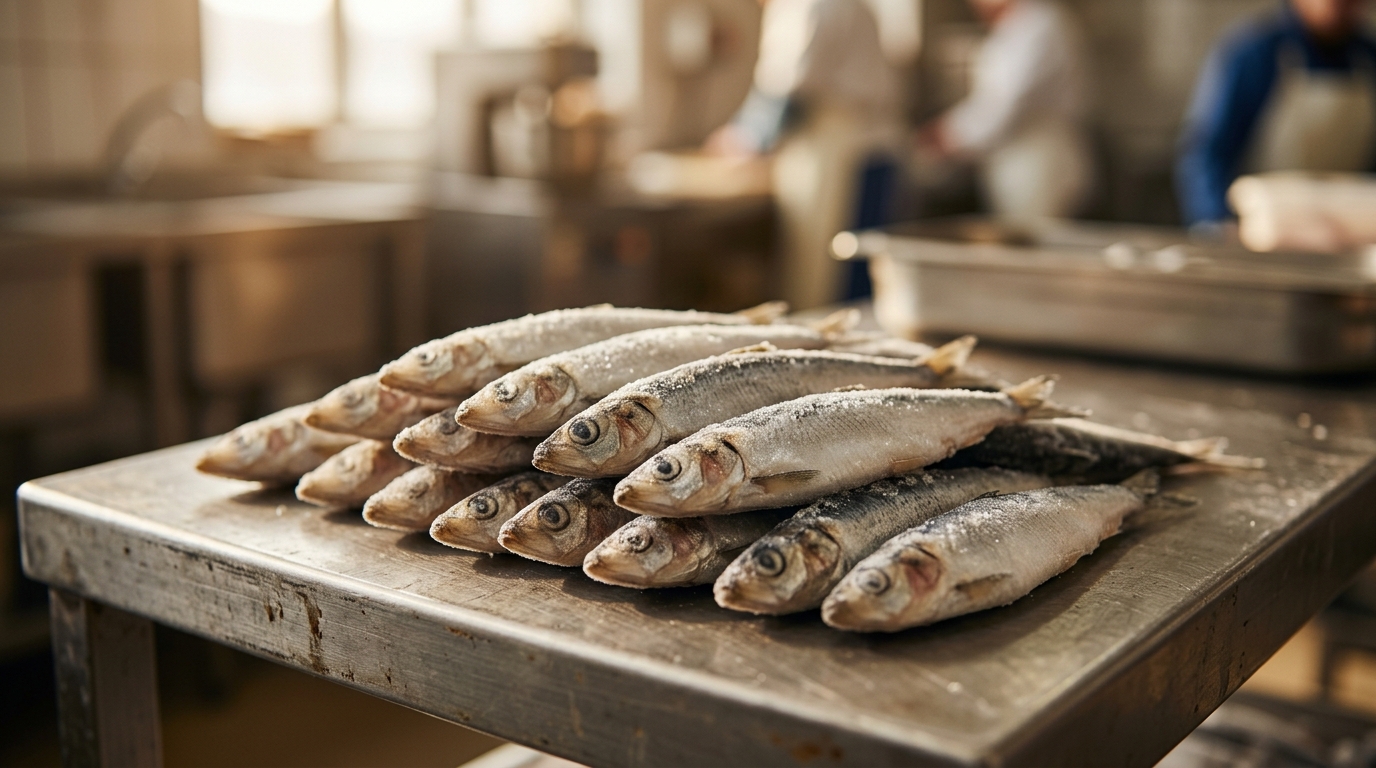
Frozen sprat (typically Sprattus sprattus) is a wild-caught small pelagic category where procurement outcomes are driven less by “supplier negotiation skill” and more by quota regimes, short fishing windows, freezing capacity, and cold-chain discipline.

Key insight: In frozen sprat, cost concentration shifts by product form. Bulk frozen blocks are dominated by raw material + energy/freezing + logistics; secondary-processed products (smoked/marinated/canned) shift cost into labor, packaging, QA, and downstream margin.
When quota tightens or weather compresses fishing days, ex-vessel prices can spike fast; frozen market prices may follow with a lag depending on cold-store inventory and contract coverage.
Energy shocks don’t just raise “processing cost”—they change supplier behavior (minimum runs, MOQ, willingness to hold inventory).
The “same fish” can have very different economics depending on whether it’s destined for retail-ready vs industrial/bait—so you must benchmark on truly comparable specs.
QA cost is usually a small % of spend, but it protects against high-severity losses (rework, recalls, customer chargebacks).
Don’t negotiate only FOB price—control total landed cost via lane strategy, lead-time variance, and temperature governance.
If you’re buying for a downstream business unit, align on when margin recovery is feasible (quarterly vs immediate) before you lock in forward coverage.

Modeled figures to show relative cost concentration by product form. Actual ratios vary by origin, season, energy, freight, and spec tightness. These ratios are directionally realistic for frozen seafood, but should be validated against your own landed-cost model and Incoterms.
| Supply Chain Node | Cost Ratio (% of final delivered cost) | What typically moves it |
|---|---|---|
| Upstream raw material (ex-vessel + landing) | 45% | Quota/seasonality, weather, fuel |
| Primary processing (grading + freezing + cold store) | 18% | Electricity, plant capacity, yield loss |
| Secondary processing | 0% | N/A |
| Packaging & QA | 6% | Lot coding, documentation, testing intensity |
| Logistics & distribution | 21% | Reefer rates, port dwell, inland cold chain |
| Importer/wholesale margin | 10% | Working capital, shrink/claims expectations |
| Supply Chain Node | Cost Ratio (% of final delivered cost) | What typically moves it |
|---|---|---|
| Upstream raw material | 40% | Same as above, plus grade scarcity |
| Primary processing | 22% | Sorting intensity, yield loss from tight grades |
| Secondary processing | 0% | N/A |
| Packaging & QA | 7% | Spec verification, tighter acceptance |
| Logistics & distribution | 20% | Same lanes, higher rejection risk |
| Importer/wholesale margin | 11% | Risk premium for spec compliance |
| Supply Chain Node | Cost Ratio (% of final delivered cost) | What typically moves it |
|---|---|---|
| Upstream raw material | 18% | Fish cost still matters, but diluted |
| Primary processing | 10% | Freezing/thaw control, grading |
| Secondary processing (manufacturing) | 28% | Labor, brine/smoke/marinade inputs |
| Packaging & QA | 16% | Cans/jars, labeling, testing, traceability |
| Logistics & distribution | 12% | Mixed ambient/frozen legs depending on format |
| Brand/retail margin | 16% | Promo, shrink, channel margin |
Important structural fact: Baltic sprat availability is directly shaped by annual fishing opportunities (TAC/quota) decisions.
The critical insight: Frozen sprat pricing often reflects a two-speed system:
This section maps procurement decisions → intelligence inputs → measurable outcomes (not a feature list).
Frozen sprat is a clean example of a broader procurement truth: risk is often the hidden driver of total cost.
Frozen sprat forces procurement teams to operationalize best practice because:
If you align those inputs, the category becomes manageable: you can trade price, continuity, and governance deliberately—rather than reacting under pressure.

Make Faster, Data-Driven Sourcing Decisions
The insights in this report are just the starting point. Tridge Eye is the data intelligence solution that gives procurement and sourcing leaders real-time market signals, price benchmarks, and supply risk alerts — so you can act before the market moves.