
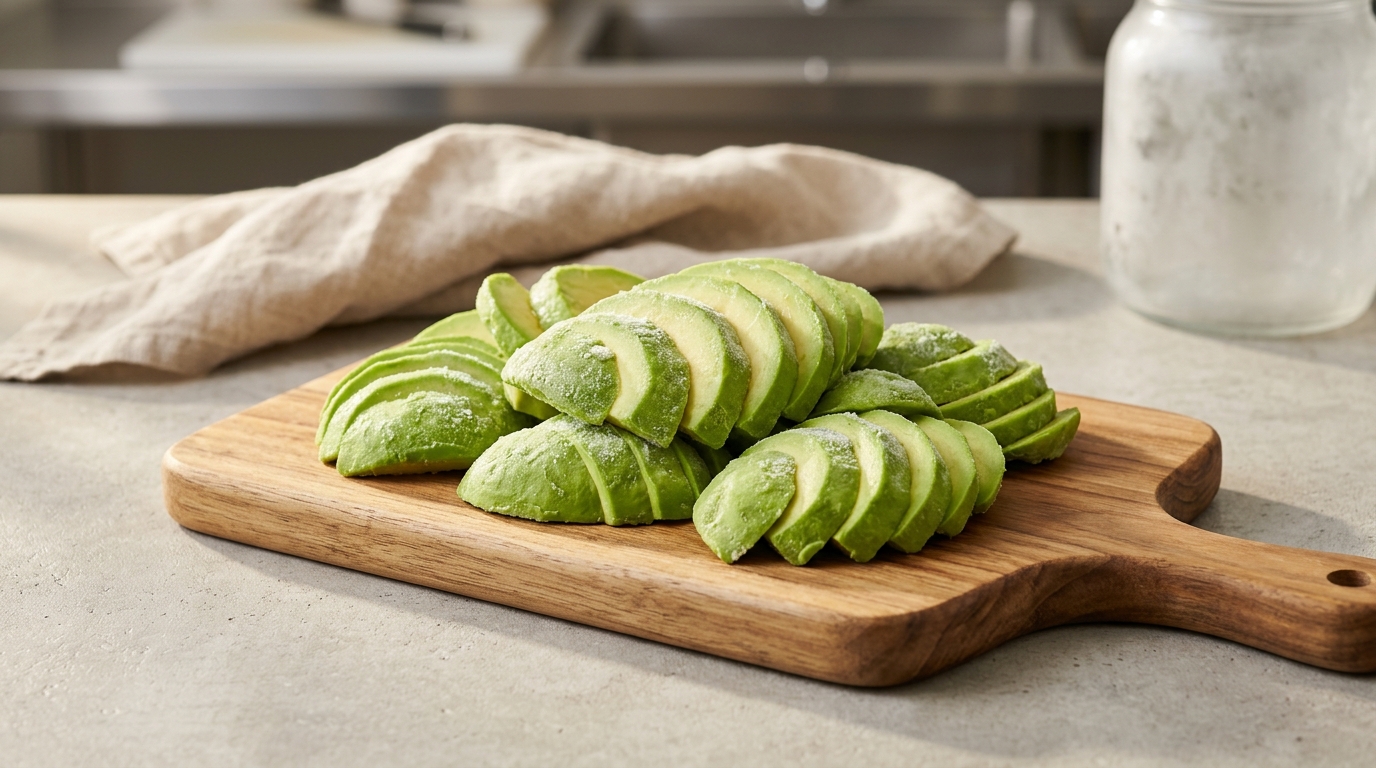
Frozen sliced avocado looks like a short supply chain, but it behaves like a precision process: once the fruit is cut and frozen, you can’t “buy back” texture or color later—only argue about it. This guide maps where cost becomes structurally fixed, where quality gets set, and which procurement levers actually reduce holds, complaints, and compliance friction.

Frozen sliced avocado is built on a simple physical reality: once fruit is peeled, cut, treated for browning, and frozen, most downstream cost becomes fixed (energy, yield loss, packaging, frozen storage, and reefer logistics). Quality is also “set” at the moment of processing—ripeness, dry matter/oil content, and cut integrity largely determine thaw performance.
Insight: Frozen sliced avocado cost accumulates through three structural mechanisms: (1) yield loss from peel/pit/trimming, (2) energy intensity of freezing and frozen storage, and (3) high-spec packaging plus coding/traceability. Margins typically concentrate where capability is scarce: consistent ripening control, hygienic slicing lines, and reliable frozen logistics.
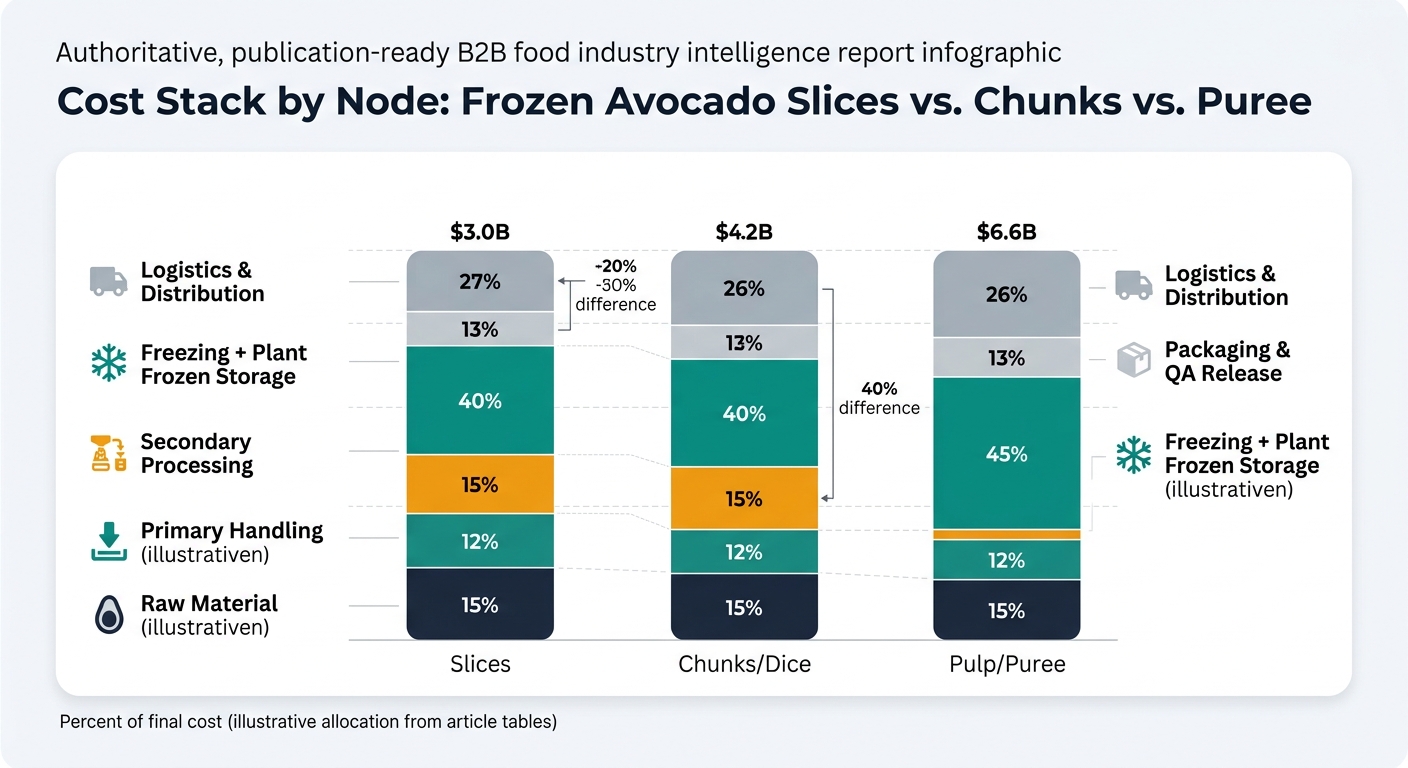
| Supply Chain Node | Cost Ratio (% of Final Cost) | Notes |
|---|---|---|
| Raw Material Cost (fresh avocado) | 35% | Driven by maturity/size mix and effective yield. |
| Primary Handling (sorting/ripening) | 6% | Ripening energy + shrink + labor. |
| Secondary Processing (peel/pit/slice + treatment) | 22% | Labor + yield loss + sanitation controls + ingredients. |
| Freezing + Plant Frozen Storage | 12% | High electricity load; capacity constraints raise unit cost. |
| Packaging & QA Release | 10% | High-barrier film, coding, lab/QA overhead. |
| Logistics & Distribution | 15% | Frozen warehousing + reefer transport + handling. |
| Supply Chain Node | Cost Ratio (% of Final Cost) | Notes |
|---|---|---|
| Raw Material Cost | 32% | More tolerant of size variation; still maturity-sensitive. |
| Primary Handling | 5% | Similar receiving/ripening needs. |
| Secondary Processing | 18% | Lower precision cutting; uses trim/downgrade stream. |
| Freezing + Plant Frozen Storage | 13% | Similar energy intensity per kg. |
| Packaging & QA Release | 9% | Often bulk packs; still needs barrier performance. |
| Logistics & Distribution | 23% | Bulk formats often move through industrial channels with longer storage dwell. |
| Supply Chain Node | Cost Ratio (% of Final Cost) | Notes |
|---|---|---|
| Raw Material Cost | 28% | Can absorb cosmetic defects; internal quality still matters. |
| Primary Handling | 5% | Sorting removes decay; ripening to workable texture. |
| Secondary Processing (pulping + treatment) | 25% | Additional equipment/cleaning; oxidation control is critical. |
| Freezing + Plant Frozen Storage | 14% | Often packed in blocks/tubs; freezing load remains high. |
| Packaging & QA Release | 8% | Tubs/liners; seal integrity matters. |
| Logistics & Distribution | 20% | Industrial storage and distribution; temperature stability critical for color. |
(Analyzed at: Aug, 2026)
Write cold-chain evidence into the deal: require lot-level temperature records (at minimum, shipper release temp plus in-transit logger summary and receiving temp) and make “excursion ownership” explicit by custody point. This works because the article’s core reality holds—once slices are frozen, quality can’t be repaired, and a single thaw/refreeze event can turn into a full-load texture claim that looks like a plant failure. In today’s market, continuity risk is also real: the recent U.S. suspension of avocado export inspections in Michoacán (Aug 2026) shows how quickly lanes can tighten and dwell time can spike. [2] If you don’t contract for evidence, you typically pay twice—first in disputed credits and QA labor, then again in expedited freight or emergency substitutions when the lane slips.


