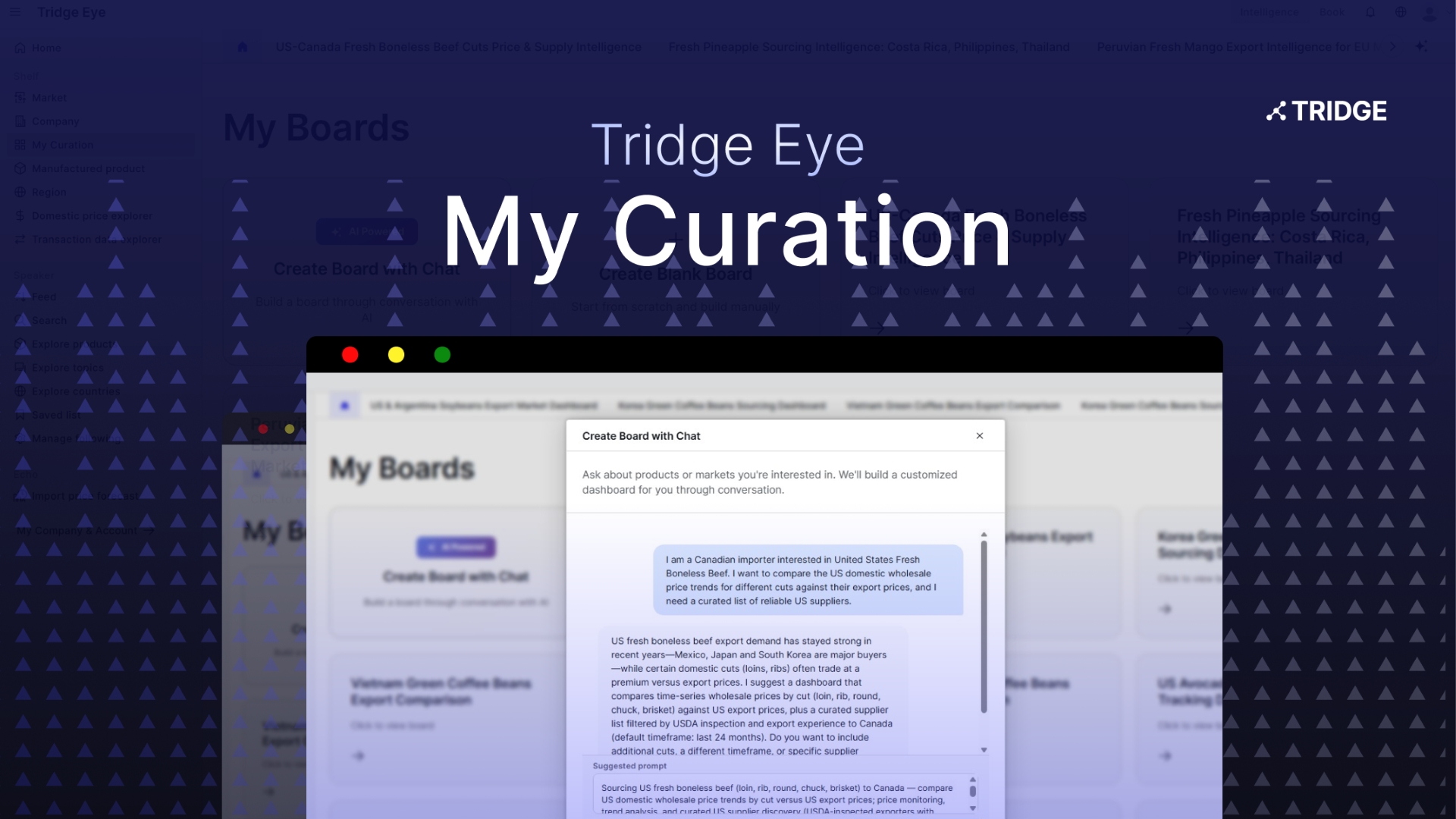

This report is powered by Tridge Eye Data Intelligence.
Every data point, price signal, and supply risk insight in this analysis comes from the same platform that procurement and sourcing leaders worldwide rely on daily. As you read, consider what this level of market intelligence could do for your sourcing decisions.
Frozen sardines can look like a simple commodity line-item, but the outcomes procurement leaders are judged on—service levels, true landed cost, and audit-ready compliance—are determined upstream by seasonality, freezing capacity, glaze/net weight terms, and cold-chain execution. This guide translates those realities into practical buying decisions (contract timing, supplier selection, spec flexibility, and contingency planning) using evidence you can operationalize with QA, Ops, and Finance.
(Analyzed at: Apr, 2026)
Frozen sardines look like a simple commodity, but procurement outcomes are determined by a few hard constraints that sit upstream of the quote.

Below is the practical cost-and-margin logic procurement teams can use to separate real market pressure from avoidable leakage.
Key insight: The true raw material cost is driven more by catch rates, fuel, and access rules than by processing efficiency. When landings fall, everything downstream tightens with a lag.
Key insight: This is the node where spec decisions create hidden cost. The same “sardine” can price very differently once you lock in size count, freezing format, and glaze/net weight terms.
Key insight: Cold storage is where working capital and claims risk build quietly. Delays here increase oxidation risk and can push sellers to prefer buyers with faster lift schedules.
Key insight: “Frozen” is usually managed around -18°C or colder in international standards and practice, but performance depends on container condition, port dwell time, and power/plug availability.
Key insight: This node often becomes the “shock absorber” for seasonality—meaning it drives inventory carrying cost and can hide fill-rate problems until they become urgent.
Key insight: If QA checks are not designed around sardine-specific failure modes (glaze, oxidation, temperature history), procurement will keep paying for avoidable defects.
Food safety reminder (not legal advice): Histamine risk is managed primarily by time-temperature control; FDA guidance emphasizes preventive controls and that freezing/cooking does not destroy histamine already formed [3].
Modeled to show where cost concentrates; actual ratios vary by origin, season, freight cycle, and contract terms. These are intentionally “order-of-magnitude” ratios for management discussions—not a market price index.

| Supply Chain Node | Cost Ratio (% of Final Cost) | Notes |
|---|---|---|
| Fishing & landing (raw material) | 45% | Catch rates/fuel/seasonality dominate |
| Primary processing & freezing | 18% | Sorting, freezing energy, cartons |
| Origin cold storage & export prep | 7% | Cold store + documentation + stuffing |
| Ocean freight & import handling | 15% | Reefer rates + port dwell/fees |
| Destination cold storage & distribution | 6% | 3PL storage/handling |
| Buyer receiving, QA, and downstream margin | 9% | QA labor, claims reserve, internal handling |
| Supply Chain Node | Cost Ratio (% of Final Cost) | Notes |
|---|---|---|
| Fishing & landing (raw material) | 40% | Same drivers, but higher value capture |
| Primary processing & freezing | 24% | IQF throughput and grading add cost |
| Origin cold storage & export prep | 7% | Similar |
| Ocean freight & import handling | 14% | Similar |
| Destination cold storage & distribution | 6% | Similar |
| Buyer receiving, QA, and downstream margin | 9% | More spec enforcement (size/glaze) |
| Supply Chain Node | Cost Ratio (% of Final Cost) | Notes |
|---|---|---|
| Fishing & landing (raw material) | 38% | Higher unit value, but yield loss matters |
| Primary processing & freezing | 28% | Labor + yield loss + QA controls |
| Origin cold storage & export prep | 7% | Similar |
| Ocean freight & import handling | 13% | Similar |
| Destination cold storage & distribution | 6% | Similar |
| Buyer receiving, QA, and downstream margin | 8% | More defect opportunities (trim, damage) |
Procurement teams often treat sardines as interchangeable, but supply is segmented by:
Why this matters: your incumbent supplier’s quote may be reacting to a constraint your benchmark suppliers don’t share (different fishery timing, different freezing bottleneck, different buyer competition).
The most common disconnect is between invoice price and payable, usable protein delivered on time.
This is how procurement leadership uses intelligence outputs to make auditable decisions across cost, continuity, and compliance.
Frozen sardines are a clean example of a broader procurement truth: the biggest risks sit where specs and logistics meet biology.
Similar patterns show up in:
Because it forces management teams to balance four outcomes at once—using evidence, not instinct:
Make Faster, Data-Driven Sourcing Decisions
The insights in this report are just the starting point. Tridge Eye is the data intelligence solution that gives procurement and sourcing leaders real-time market signals, price benchmarks, and supply risk alerts — so you can act before the market moves.