INDUSTRY TRENDS

Frozen Raspberry Sourcing Guide (2026): Spec-Normalized Cost Drivers, Risk Triggers, and Contract Levers

Author
Team Tridge
DATE
April 7, 2026
9 min read
frozen-raspberry Cover
Tridge Eye Data Intelligence Solution

This report is powered by Tridge Eye Data Intelligence.

Every data point, price signal, and supply risk insight in this analysis comes from the same platform that procurement and sourcing leaders worldwide rely on daily. As you read, consider what this level of market intelligence could do for your sourcing decisions.

Explore Tridge Eye →

Frozen raspberries behave like a commodity only on the surface. In practice, procurement outcomes (landed cost stability, supply continuity, rejection rate, and OTIF) are driven by three things you can control: spec clarity (format/grade/defects), approved-supply depth (qualification speed + alternates), and contract governance (price + service + quality triggers). This guide maps the real supply chain, explains where cost and risk accumulate, and shows how to structure RFQs and contracts so you can negotiate and govern suppliers with fewer surprises.

Executive Summary

  • Procurement reality: Frozen raspberries are a spec-driven commodity—format (IQF vs block), grade/defect tolerances, and certification/audit status determine both price and the size of your “approved supply” pool.
  • Cold chain baseline: Industry handling guidance commonly targets -18°C (0°F) or lower for quick-frozen berries, with only brief upward fluctuations tolerated during transport—temperature discipline is a landed-cost and claims driver, not just a logistics detail.
  • Food safety sensitivity: Enteric viruses (notably norovirus and hepatitis A) are a recurring focus for frozen berries because freezing does not reliably inactivate viruses; investigations and regulatory attention can quickly tighten “approved supply.”
  • Why IQF and block diverge: Even from the same crop, grade mix + sorting losses can create a premium for whole IQF in wet/soft harvest conditions while block/puree economics move differently.
  • Contracting lesson: Fixed price can reduce budget volatility but can increase allocation/non-performance risk in short crops; banded/index-linked structures paired with governance triggers often reduce total disruption cost.
  • Illustrative cost structure: In most scenarios, raw fruit is the dominant share of delivered cost, while processing + cold storage energy, packaging/QA, and freight/cold-store handling explain much of the variance between suppliers and origins.

Key Insights

(Analyzed at: Apr, 2026)

  • Strategy: Hold
  • Reliability: Medium
  • Potential Saving: 4% ~ 10%
  • Insight: In April (shoulder season for many Northern Hemisphere supply basins), the lowest-regret move is not aggressive spot buying—it’s locking spec-normalized coverage for the next 6–12 months with two-tier supply (primary + pre-qualified alternate) and governance triggers (OTIF, rejection rate, corrective actions, and temperature-excursion documentation). This typically captures savings by reducing “apples-to-oranges” RFQ comparisons, avoiding emergency premiums, and preventing yield-driven hidden costs (crumble/juice loss) that don’t show up in unit price.

1) The Ground Truth: What You’re Actually Buying When You Buy Frozen Raspberries

Frozen raspberries look like a simple commodity line item until you map the flow from hand-picked fruit to IQF or block to import cold stores to your plant’s yield and QA outcomes.
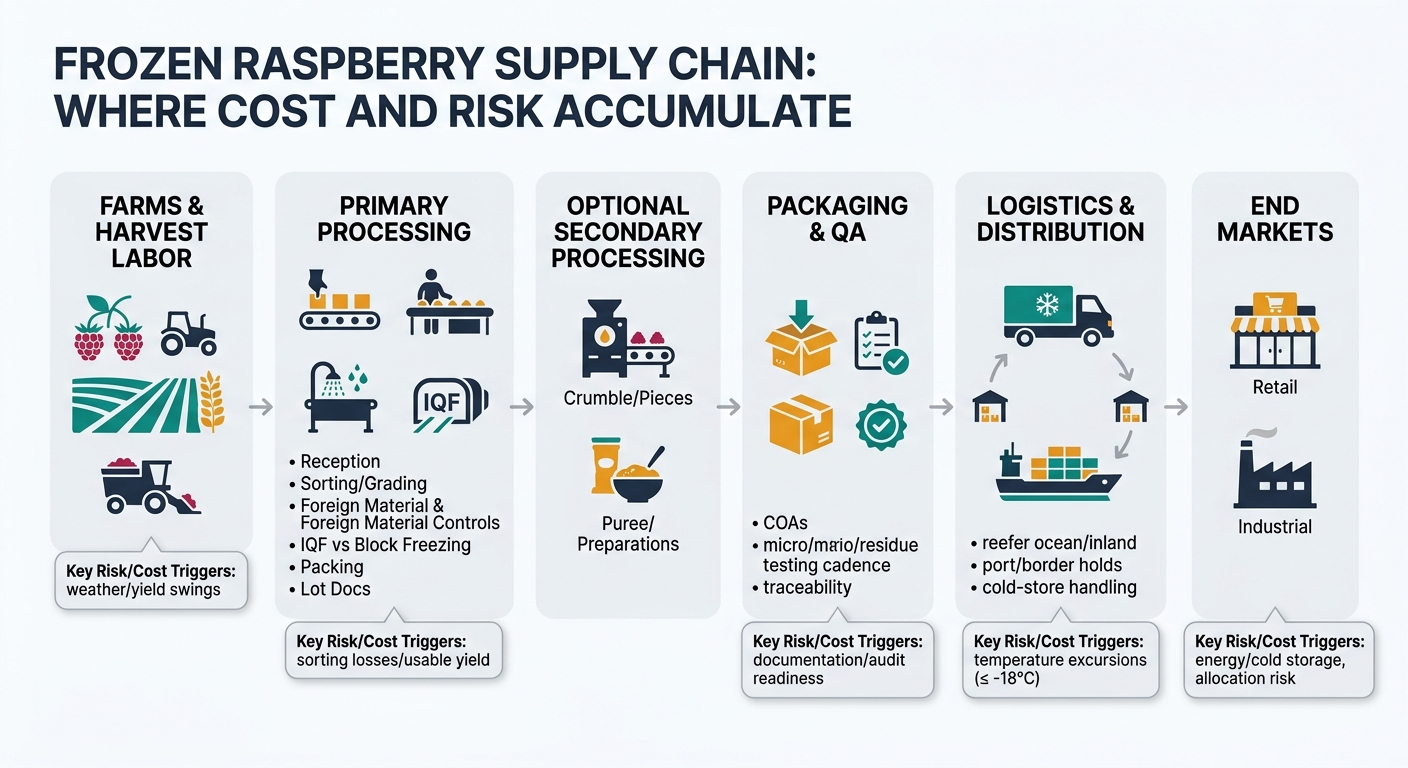
The real supply chain flow (how value and risk move)

  1. Upstream / Raw material (farms + harvest labor)
  2. Raspberries are labor-intensive and time-sensitive: the fruit is delicate and must move quickly from field to cooling/freezing to prevent softness, leakage, and quality downgrade.
  3. Yield and grade mix can swing materially with frost, rain at harvest, heat stress, and hail.
  4. Primary processing (freezing plant)
  5. Key operations: reception, sorting/grading, foreign material controls (screens/metal detection), freezing (IQF or block), packing, and lot documentation.
  6. Sorting losses (defects, crumble, juice leakage) are a hidden cost driver: what you pay per kg is less important than usable yield into your application.
  7. Secondary processing (optional)
  8. Some buyers (or suppliers) convert into crumbles/pieces, puree, or preparations. This changes price dynamics because you’re buying a different yield and defect profile.
  9. Packaging & QA
  10. Bulk industrial packs (commonly 10–25 kg cartons) and retail packs (consumer bags) have different packaging cost and traceability complexity.
  11. Logistics & distribution (continuous cold chain)
  12. Frozen berries require uninterrupted cold chain (commonly ≤ -18°C); delays at ports, border inspections, or cold-store congestion can convert a “cheap” buy into claims, downgrades, and emergency rebuys.
  13. End markets
  14. Retail/private label tends to demand whole IQF + tighter defect limits.
  15. Industrial users (dairy/bakery/beverage) can sometimes flex between whole vs crumble vs puree, but only if the spec and labeling allow.
A left-to-right supply chain flow showing: Farms & Harvest Labor → Primary Processing (Reception, Sorting/Grading, Foreign Material Controls, IQF vs Block Freezing, Packing, Lot Docs) → Optional Secondary Processing (Crumble/Pieces, Puree/Preparations) → Packaging & QA (COAs, micro/residue testing cadence, traceability) → Logistics & Distribution (reefer ocean/inland, port/border holds, cold-store handling) → End Markets (Retail vs Industrial), with callout tags for weather/yield swings, sorting losses/usable yield, energy/cold storage, documentation/audit readiness, temperature excursions (≤ -18°C), and allocation risk.

Key insight: Frozen raspberries are a “spec-driven commodity.” Price and risk are dominated by (a) origin crop reality, (b) format (IQF vs block), and (c) your defect/yield tolerance—not just supplier negotiation skill.
2) Where the Money Goes: Cost & Margin Build-Up by Supply Chain Node

2.1 Upstream / Raw Material (Farms + harvest)

What procurement should remember

  • The largest single driver is the farmgate fruit price, which is highly sensitive to crop size and quality.
  • Hand-picking availability and wage inflation can tighten supply quickly.

Primary cost drivers

  • Harvest labor (availability, wage rate)
  • Yield variability (weather-driven)
  • Field logistics (time-to-cool)

Margin reality

  • Many growers are small; financial fragility can show up as allocation risk (your volumes get cut first if you’re not strategically positioned).

2.2 Primary Processing (IQF or block freezing plant)

What procurement should remember

  • This is where your delivered quality is “made or broken”: sorting, foreign material removal, and freezing discipline.
  • IQF typically carries higher processing cost than block due to equipment/throughput and sorting expectations, but can reduce downstream labor and yield loss for some applications.

Primary cost drivers

  • Energy for freezing and cold storage
  • Labor for line operations and sorting
  • Yield loss from grading (whole vs crumble split)
  • QA/testing, certifications, audit readiness

Margin reality

  • Freezing plants often manage allocation: in tight years, they prioritize customers with better contract structure, payment terms, and predictable call-offs.

2.3 Secondary Processing (crumbles/puree/preparations)

What procurement should remember

  • Secondary processing can be a cost lever (using crumble/puree where feasible), but it changes risk: different defect profile, different micro/testing expectations, and different sensory outcomes.

Primary cost drivers

  • Additional processing steps (milling/pureeing/blending)
  • Additional QA and lot handling
  • Packaging formats (drums, aseptic where used)

2.4 Packaging & Quality Assurance

What procurement should remember

  • Packaging is not just materials: it’s lot integrity, labeling accuracy, and audit trail completeness.
  • Standards exist that shape tolerances and grading language (e.g., USDA grade standards for frozen raspberries; Codex standard for quick frozen raspberries).

Primary cost drivers

  • Cartons/liners/bags, palletization
  • COAs, micro/residue testing cadence
  • Traceability systems and document control

2.5 Logistics & Distribution (reefer + cold store)

What procurement should remember

  • Landed cost volatility often comes from lanes: ocean reefer, inland reefer, demurrage, cold-store handling.
  • The “cheapest” origin can become expensive if it increases lead-time risk or forces higher safety stock.

Primary cost drivers

  • Reefer freight and insurance
  • Cold storage fees and handling
  • Temperature excursion risk → claims/downgrades

2.6 Wholesale / Importer / Retail-Industrial Margin Layer

What procurement should remember

  • Many buyers don’t buy directly from processors; trader/importer margin is the price of liquidity, credit, and documentation.
  • In tight markets, margin expands because approved supply is scarcer than physical supply.
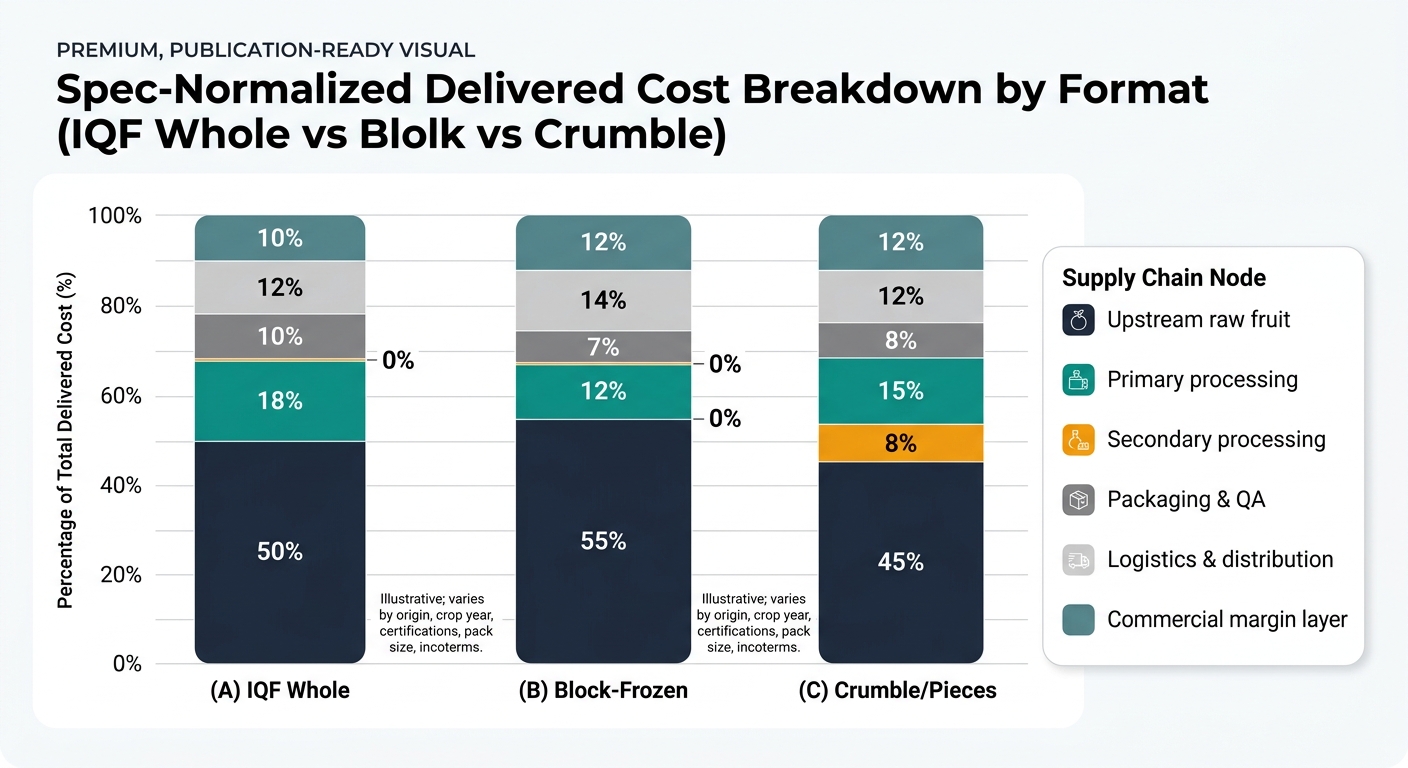
A single 100% stacked bar chart with three bars labeled (A) IQF Whole, (B) Block-Frozen, (C) Crumble/Pieces, segmented by supply chain node using the illustrative ratios: IQF 50/18/0/10/12/10; Block 55/12/0/7/14/12; Crumble 45/15/8/8/12/12, with a legend and note that results are illustrative and vary by origin, crop year, certifications, pack size, and incoterms.

Product-level cost breakdown (illustrative, spec-normalized)

Modeled as % of final delivered cost to your receiving dock. Actual ratios vary by origin, crop year, certifications, pack size, and incoterms.

A) IQF Whole Raspberries (retail-grade / tighter defects)

Supply Chain Node Cost Ratio (% of Final) What moves it most
Upstream raw fruit 50% Crop size/quality, harvest labor
Primary processing (IQF) 18% Sorting intensity, energy, yield loss
Secondary processing 0% N/A
Packaging & QA 10% Testing cadence, traceability, pack spec
Logistics & distribution 12% Reefer + cold-store + port delays
Commercial margin layer 10% Allocation tightness, credit terms

B) Block-Frozen Raspberries (industrial)

Supply Chain Node Cost Ratio (% of Final) What moves it most
Upstream raw fruit 55% Fruit price and grade mix
Primary processing (block) 12% Energy and throughput
Secondary processing 0% N/A
Packaging & QA 7% Bulk pack materials + COA discipline
Logistics & distribution 14% Heavier reliance on cold-store handling
Commercial margin layer 12% Spot buying vs contract coverage

C) Raspberry Crumble / Pieces (industrial flexibility play)

Supply Chain Node Cost Ratio (% of Final) What moves it most
Upstream raw fruit 45% Crop quality (more crumble availability)
Primary processing 15% Sorting strategy, defect removal
Secondary processing 8% Sizing, rework, additional handling
Packaging & QA 8% Spec testing, lot segregation
Logistics & distribution 12% Lane and cold-store costs
Commercial margin layer 12% Demand spikes from substitution

3) One Structural Fact That Explains 80% of Sourcing Pain: “Approved Supply” Is Smaller Than “Global Supply”

Even when global production looks adequate, procurement teams get squeezed because:

  • Your usable pool is constrained by format (IQF vs block), grade, defect tolerances, certifications, and audit approval.
  • Frozen berries have recurring public-health scrutiny around enteric viruses (norovirus, hepatitis A) because viruses can survive freezing; regulators and customers respond by tightening supplier controls and testing expectations.

What this means in practice

  • In disruption years, you don’t compete for berries—you compete for berries you’re allowed to buy.
  • That’s why “we’ll just spot buy if needed” often fails: qualification lead times (documents, samples, audits) don’t match crisis timelines.

4) The Critical Insight: Why IQF vs Block Pricing Can Diverge (Even With the Same Crop)

Procurement teams often expect IQF and block to move together because they start from the same fruit. They don’t—because the grade mix and yield economics differ.

The mechanics behind the disconnect

  • Whole IQF requires better integrity and tighter defect control. In a wet harvest, more fruit downgrades into crumble/puree, tightening whole IQF availability and lifting IQF premiums.
  • Block can absorb more variable berry integrity (depending on spec), so it may not spike as hard—or it may spike later when industrial users substitute away from expensive IQF.
  • Sorting losses amplify price moves: a small deterioration in incoming quality can create a disproportionate reduction in “retail-grade whole IQF output.”

Why this matters for contracting

  • If you contract “frozen raspberries” without format-grade clarity, you create a loophole where suppliers can re-price based on the most favorable interpretation.
  • If you do have clarity, you can create planned substitution rules (e.g., allow crumble for certain SKUs) to stabilize landed cost without breaking quality.

5) Where Procurement Teams Usually Misstep (and Why It Shows Up as Cost + Firefighting)

  1. RFQs that aren’t spec-normalized
  2. Comparing offers across origins without aligning: format, sieve/size expectations, defect tolerances, juice loss expectations, and certification scope.
  3. Treating “origin diversification” as a checkbox
  4. Adding a second origin that can’t meet your spec or lead time still leaves you single-sourced in reality.
  5. Over-indexing on unit price instead of usable yield
  6. A cheaper lot with higher crumble/juice leakage can increase true cost in production (rework, higher usage rate, rejects).
  7. Weak governance triggers
  8. No pre-agreed actions when: rejection rate rises, OTIF slips, or market moves outside a band.
  9. Underestimating food safety event sensitivity
  10. Outbreaks and recalls in frozen berries (including hepatitis A investigations) drive sudden buyer holds, re-testing, and delistings—often faster than procurement can re-source.

6) What an Intelligence-Driven Approach Changes (Decision-by-Decision, Not Feature-by-Feature)

Decision A: “Do we renew the incumbent or add a second source?”

What changes with intelligence

  • Build a defensible longlist by origin + format capability + certification signals + export footprint.
  • Benchmark suppliers on capability fit (whole IQF vs industrial block), documentation maturity, and operational footprint.

Outcome procurement can own

  • Shorter time-to-qualify alternates and lower allocation risk.

Decision B: “Are we being priced fairly for our spec?”

What changes with intelligence

  • Use spec-normalized price intelligence: separate market movement from supplier-specific behavior.
  • Decompose should-cost drivers: raw fruit tightness, yield/grade mix, energy/cold storage, freight lanes, FX.

Outcome procurement can own

  • Better negotiation posture and fewer surprise increases.

Decision C: “What contract structure reduces both price risk and non-performance risk?”

What changes with intelligence

  • Match contract type to market reality:
  • Fixed price can look attractive but increases allocation/non-performance risk in tight crops.
  • Index-linked or banded mechanisms can be easier to defend when tied to transparent drivers and governance triggers.

Outcome procurement can own

  • Better landed-cost stability and fewer emergency spot buys.

Decision D: “How do we govern suppliers so QA and operations aren’t constantly escalating?”

What changes with intelligence

  • Performance monitoring: OTIF, complaint rate, corrective action closure time, spec deviation trends.
  • Decision documentation: why a supplier stays approved, what risks are accepted, and what triggers force re-sourcing.

Outcome procurement can own

  • Auditability plus faster executive reporting.

7) Strategic Use Cases Procurement Leaders Actually Run This Year

Use case 1: Reduce cost volatility without increasing quality risk

  • Move: Spec-normalize RFQs (format + grade + defect tolerances) and negotiate with market context.
  • Trade-off: Tighter specs reduce QA pain but shrink the supplier pool and raise allocation risk.

Use case 2: Pre-qualify alternatives before disruption hits

  • Move: Maintain an always-on bench by origin (e.g., Eastern Europe + Americas) and format (IQF + block).
  • Trade-off: Diversification increases complexity (more audits, more SKUs, more lot management).

Use case 3: Contract for service, not just price

  • Move: Add governance triggers:
  • Price bands tied to defined drivers
  • OTIF thresholds with remedies
  • Rejection-rate thresholds that trigger corrective actions and intensified testing
  • Trade-off: Stronger governance can raise supplier admin cost; offset by fewer disruptions.

Use case 4: Format substitution as a controlled lever

  • Move: Pre-approve where crumble/pieces can replace whole IQF (by SKU/application) with sensory sign-off.
  • Trade-off: Lower cost and better availability vs potential texture/visual impact.

8) Why This Matters Beyond Frozen Raspberries (Examples Your Stakeholders Will Recognize)

The same “spec-driven commodity” logic shows up in categories procurement teams often manage alongside berries:

  • Frozen strawberries / berry blends: Similar IQF dynamics and similar sensitivity to virus-related controls and recalls; approved supply can tighten abruptly after investigations.
  • Tree nuts (e.g., almonds, hazelnuts): Climate-driven yield swings + origin concentration risk → diversification and should-cost decomposition matter.
  • Cocoa: Price volatility is not just “market price”; quality differentials, origin risk, and logistics constraints change realized cost.

Key takeaway: Intelligence is most valuable where (1) supply is seasonal, (2) specs create hidden segmentation, and (3) disruptions convert quickly into real P&L impact.

9) Why Frozen Raspberries Are a High-Power Example for Procurement Intelligence

Frozen raspberries concentrate the hardest procurement problems into one category:

  • Seasonality + concentration: Major supply basins (notably Eastern Europe) can swing sharply by crop year, and exporters like Serbia are structurally important in global frozen raspberry trade.
  • Format-driven economics: IQF vs block is not a minor packaging choice—it changes yield, QA burden, and price behavior.
  • Cold-chain dependency: Landed cost and continuity are as much about logistics resilience as farmgate price.
  • Food safety sensitivity: Virus-related risk management expectations can rapidly shrink “approved supply” and trigger re-testing, holds, and delistings.

What a strong procurement leader does next (practical, low-regret steps)

  1. Rewrite the RFQ template to force spec-normalized comparability (format, grade/defects, pack, testing/cert scope).
  2. Build a two-tier supplier bench (primary + pre-qualified alternates) mapped by origin and format.
  3. Add governance triggers to contracts/QBRs (OTIF, rejection rate, corrective action closure time, price band logic).
Tridge Eye Data Intelligence Solution

Make Faster, Data-Driven Sourcing Decisions

The insights in this report are just the starting point. Tridge Eye is the data intelligence solution that gives procurement and sourcing leaders real-time market signals, price benchmarks, and supply risk alerts — so you can act before the market moves.
Explore Tridge Eye →

Subscribe
By subscribing you agree to with our Privacy Policy and provide consent to receive updates from our company.
Thank you! Your submission has been received!
Oops! Something went wrong while submitting the form.
Subscribe to receive the latest blog posts, updates, promotions, and announcements from Tridge.