INDUSTRY TRENDS

Frozen Raspberries Sourcing Intelligence Playbook (Validated & Updated for Category Managers, Mar 2026)

Author
Team Tridge
DATE
March 9, 2026
9 min read
frozen-raspberries Cover
Tridge — Trusted Global Food Sourcing

This report is powered by Tridge market intelligence.

Every data point, price signal, and supply chain insight in this analysis is drawn from the same engine that procurement teams worldwide rely on daily. As you read, consider what this level of visibility could do for your category.

See how Tridge Eye works →

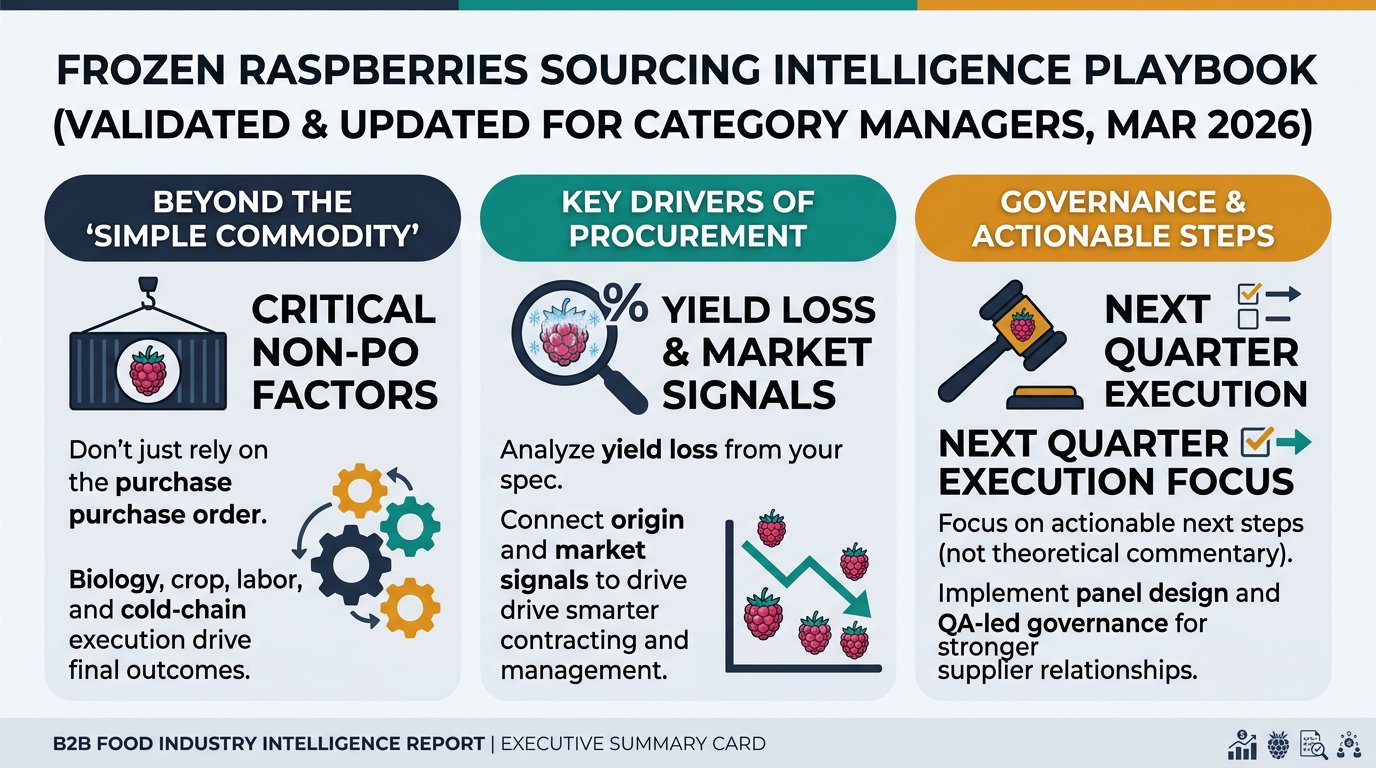
Frozen raspberries behave like a “simple commodity” only on the PO. In reality, outcomes are driven by biology (crop + labor), yield loss created by your spec, and cold-chain execution—so the best procurement decisions come from connecting market/origin signals to contracting, panel design, and QA-led governance. This playbook is written for Purchase – Product & Category Management teams who are strong procurement professionals but newer to frozen raspberries, and it focuses on what to do next quarter (not theoretical market commentary).

Executive Summary

  • Two-layer origin risk is real: The farm origin (weather/labor/compliance) and the processing/export node (capacity/energy/logistics/governance) can differ—especially in Europe where processing/trading hubs are common. [1]
  • Serbia is structurally export-oriented in processed raspberries; U.S. imports from Serbia are largely IQF frozen raspberries. [2]
  • Poland is a major EU frozen-berry exporter and a processing/export hub. [1]
  • Food-safety risk is a procurement design input, not a QA afterthought: frozen berries have a documented history of enteric virus outbreaks; Germany’s 2012 norovirus outbreak linked to frozen strawberries involved ~11,000 cases. [3]
  • Your biggest controllables are often not “€/kg from the processor,” but: (1) usable yield vs spec, (2) cold-chain dwell/storage time, (3) contract structure and spec-flex that prevents forced spot buys.
  • Tables in this playbook are illustrative (not industry “truth data”): use them as a should-cost framework to model your lanes, incoterms, service levels, and QA hold times.

Key Insights

Analyzed at: Mar, 2026

  • Strategy: Hold
  • Reliability: Medium
  • Potential Saving: 6% ~ 12%
  • Insight: Treat 2026 coverage as a “risk-balanced” year rather than a pure price-timing bet: lock a disciplined base volume with Tier-1 suppliers under clear QA/traceability and cold-chain SLAs, and keep a defined flex tranche (format/spec/origin) pre-qualified to avoid late-season spot exposure where quality and compliance risk tends to rise. This approach typically saves 6–12% vs. reactive spot buying through reduced claims, fewer expedites, and better landed-cost stability—especially when QA release holds and cold storage dwell are material.

1) What You’re Actually Buying: The Ground Truth of the Frozen Raspberry Supply Chain

Frozen raspberries look like a simple commodity, but procurement outcomes (cost, continuity, claims, audit exposure) are determined by where value and risk concentrate in the chain.

A realistic end-to-end flow (what happens before your PO lands)

  1. Farm & harvest (fresh raspberries)
  2. Hand-picked, highly time-sensitive, fragile fruit.
  3. The biggest operational constraint is labor availability and picking speed (quality degrades fast).
  4. Collection & rapid delivery to processor
  5. Short time window from field to intake to avoid mold/soft berries.
  6. Primary processing (freezing plant)
  7. Intake checks → (optional) washing → optical/manual sorting → IQF freezing or block freezing → metal detection.
  8. Yield loss is real: tighter defect/whole-berry specs reduce usable output.
  9. Secondary processing (optional)
  10. Re-grading, blending lots for consistency, or converting to purée / concentrate / preparations.
  11. Packaging & QA release
  12. Industrial cartons (commonly 10–25 kg) or retail bags; testing regimes vary by buyer.
  13. Cold-chain logistics (frozen storage + reefer transport)
  14. Dwell time, reefer availability, and temperature excursions drive landed cost and claims.
  15. Importer / distributor / end market
  16. Retail, foodservice, industrial (yogurt inclusions, bakery, beverages).
A left-to-right supply chain flow showing: (1) Farm & harvest (fresh raspberries) → (2) Collection/rapid delivery → (3) Primary processing (intake checks, optional washing, optical/manual sorting, IQF or block freezing, metal detection) → (4) Secondary processing (optional: re-grading/blending; purée/concentrate/preparations) → (5) Packaging & QA release (testing/hold) → (6) Cold-chain logistics (frozen storage, reefer transport, port/inland dwell) → (7) Importer/distributor → (8) End market (retail/foodservice/industrial). Overlay a two-layer callout distinguishing Farm Origin Exposure (weather, labor, compliance) from Processing/Export Node Exposure (capacity, energy, logistics, governance), with iconography and a note that country of shipment does not equal farm origin.

Category reality check (why this matters)

  • Origin concentration is structural (and dynamic). Serbia is an export-oriented supplier of processed raspberry products, and the majority of U.S. imports of frozen raspberries from Serbia are IQF. [2]
  • Processing/export hubs matter. Poland is widely cited as a primary exporter/processor hub for frozen berries into Europe, which can blur “grown in” vs “shipped from.” [1]
  • Food-safety risk is not theoretical. Enteric viruses (norovirus/HAV) have been repeatedly linked to frozen berries globally; Germany’s 2012 outbreak linked to frozen strawberries involved nearly 11,000 cases. [3]

2) Where the Money Actually Goes: Cost & Margin Build-Up by Supply Chain Node

Key insight: In frozen raspberries, procurement leverage is often misapplied to “processor price per kg” while the biggest controllable drivers sit in (a) raw fruit + yield, (b) spec-driven sorting loss, and (c) cold-chain and inventory time.

2.1 Upstream: Farm & Harvest (Fresh Raspberries)

What’s really happening

  • Harvest is labor-intensive and timing-sensitive; slow picking = softer fruit = lower whole-grade yield.
  • Weather during flowering/harvest shifts both volume and usable quality, not just tonnage.

Cost drivers you can influence (indirectly)

  • Labor scarcity and wage inflation during peak harvest.
  • Yield risk (rain at harvest → mold/soft berries → more downgrades).
  • Farm compliance requirements (residue programs, traceability) can narrow the supply base.

Procurement implication

A “cheap origin” can become expensive if it produces more crumble/broken than your spec allows.

2.2 Primary Processing: Sorting + Freezing (IQF / Block)

What’s really happening

This is where your spec becomes a cost function:

  • Whole IQF generally requires stricter sorting and higher yield loss than broken/crumble.
  • Optical sorting, manual trim, and foreign material control are labor/capex heavy.

Cost drivers

  • Yield loss from defect removal (mold, soft berries, foreign material).
  • Energy for freezing and cold storage.
  • QA and holds (micro, residues, and increasingly viral risk management).

Procurement implication

Tightening defect tolerances can raise price and reduce available supplier pool, increasing continuity risk.

2.3 Secondary Processing (Optional): Purée / Concentrate / Preparations

What’s really happening

  • Lower grades can be diverted to purée/concentrate, creating a floor outlet that affects negotiation dynamics.
  • Industrial customers may require heat treatment/pasteurization steps depending on use case.

Cost drivers

  • Milling/purée processing, possible heat treatment, blending for consistency.
  • Additional QA parameters (Brix, seed content, viscosity).

Procurement implication

Purée can be a resilience tool (substitution) but changes functional specs and stakeholder approvals.

2.4 Packaging & QA Release

What’s really happening

  • Packaging looks minor until you scale: liners, cartons, labeling, pallet configuration.
  • QA release timing affects working capital and service levels.

Cost drivers

  • Pack format (10–25 kg industrial vs retail bags).
  • Testing frequency and hold time.

2.5 Cold-Chain Logistics & Distribution

What’s really happening

  • Frozen fruit is a time + temperature business.
  • Reefer capacity, port dwell, and inland cold storage can swing landed cost materially.

Cost drivers

  • Reefer ocean/land freight, terminal handling, cold storage, insurance.
  • Inventory carrying cost (seasonality forces long frozen holds).

Product-Level Cost Breakdown (Illustrative, % of Delivered Cost)

Modeled ranges to show where cost concentrates. Actual ratios vary by origin, spec tightness, lane, incoterms, and seasonality.

A) IQF Raspberries (Whole, industrial pack)

Supply Chain Node Cost Ratio (% of delivered cost) What moves it most
Farm & harvest (raw fruit) 40–55% labor + weather-driven yield
Primary processing (sort + IQF freezing) 15–25% spec tightness, sorting loss, energy
Secondary processing 0% N/A
Packaging & QA 5–10% testing holds, carton/liner
Cold-chain logistics 10–18% reefer + cold storage + dwell
Importer/distributor margin 5–15% service level, financing

B) IQF Raspberries (Broken/Crumble, industrial pack)

Supply Chain Node Cost Ratio (% of delivered cost) What moves it most
Farm & harvest (raw fruit) 35–50% raw fruit pricing
Primary processing 12–20% lower sorting loss than whole
Secondary processing 0% N/A
Packaging & QA 4–9% similar pack, sometimes lighter QA
Cold-chain logistics 10–18% lane + storage
Importer/distributor margin 8–20% more spot trading / blending

C) Raspberry Purée (frozen)

Supply Chain Node Cost Ratio (% of delivered cost) What moves it most
Farm & harvest 25–40% grade flexibility
Primary processing 8–16% intake + base freezing
Secondary processing (milling/standardization) 12–25% blending, possible heat treatment
Packaging & QA 7–14% specs: Brix/seed/viscosity
Cold-chain logistics 8–16% density helps freight efficiency
Importer/distributor margin 5–15% application support + inventory

3) One Structural Fact That Explains Most Supplier Surprises

Structural fact:Processing and trading hubs can decouple “where it’s grown” from “where it’s exported.” Poland is widely referenced as a primary exporter of frozen berries into Europe, and Serbia is heavily export-oriented in frozen raspberries/processed raspberry products. [1]

Why procurement teams feel this as “surprises”

  • Documentation can be compliant yet still obscure upstream farm concentration.
  • A supplier’s “country of shipment” may not equal upstream farm risk exposure.

Category action

Treat origin as a two-layer concept:

  1. Farm origin exposure (weather, labor, compliance)
  2. Processing/export node exposure (capacity, energy, logistics, governance)

4) The Critical Insight: Why Price and Risk Don’t Move Together in Frozen Raspberries

In many categories, higher price implies lower risk (better suppliers, better controls). In frozen raspberries, price spikes often coincide with higher risk.

Mechanism (what’s really happening)

  • When harvest is tight or quality is poor, whole IQF becomes scarce.
  • Processors protect contracted customers first; spot market tightens.
  • Buyers who chase volume late often accept:
  • looser lots,
  • higher foreign material/defect exposure,
  • longer lead times,
  • and more cold-chain complexity.

Food-safety overlay (non-negotiable)

Enteric virus outbreaks have been linked to frozen berries; Germany’s 2012 norovirus outbreak (frozen strawberries) shows how frozen product can still carry viral risk if controls fail upstream and product is consumed without adequate heat treatment. [3]

Procurement takeaway

Your “best price” event timing can be the same window where continuity + quality + compliance are most fragile.

5) Where Procurement Teams Typically Get This Wrong (and Why)

  1. They negotiate on €/kg or $/lb, not on delivered usable yield
  2. A cheaper whole IQF lot that creates higher downstream losses (crumble, defects, claims) can cost more than a higher-priced but stable supplier.
  3. They over-standardize specs too early
  4. Overly tight specs shrink the supplier pool and increase single-origin dependence.
  5. They treat QA as a gate at the end, not a design input
  6. Viral risk management, traceability depth, and hold/release dynamics change lead time and safety stock needs. FDA has explicitly focused on preventing norovirus/HAV outbreaks associated with fresh and frozen berries, emphasizing hygiene and controls across field and processing. [4]
  7. They build “backup suppliers” only after a disruption
  8. In frozen raspberries, qualification lead times (audits, trials, micro/residue baselines) make reactive switching expensive.

6) What Changes When You Run the Category on Intelligence (Not Just Quotes)

This is not about predicting the exact price. It’s about translating signals into category actions that reduce volatility exposure and prevent forced spot buys.

Decision 1: Supplier panel design (who belongs in primary/secondary/contingency)

Intelligence inputs

  • Supplier discovery by format (whole IQF vs crumble vs purée), certifications, and cold-chain capabilities.
  • Benchmarking: service reliability proxies, claims signals, compliance posture.

Category actions

  • Build a tiered panel:
  • Tier 1: high compliance + stable whole IQF capability
  • Tier 2: cost-competitive alternates with pre-agreed spec flex
  • Tier 3: contingency (often different format/origin) with defined trigger conditions

Decision 2: Contracting structure (fixed vs indexed vs reopeners)

Intelligence inputs

  • Cost-driver decomposition: raw fruit, energy, freight, FX.
  • Harvest calendar and crop condition signals.

Category actions

  • Use coverage bands (e.g., 60–80% fixed coverage + 20–40% flex) rather than a single “annual lock.”
  • Put spec-flex clauses in place (e.g., allow broken/crumble substitution within defined applications) to avoid emergency buys.

Decision 3: Risk monitoring with operational triggers

Intelligence inputs

  • Origin risk dashboards (weather anomalies, logistics constraints, policy changes).
  • Supplier capacity indicators and lead-time drift.

Category actions

  • Trigger playbooks:
  • If harvest shortfall signals rise → increase safety stock, pull forward secondary supplier volumes
  • If logistics disruption rises → switch lanes/incoterms, book reefer earlier, adjust delivery windows

Governance guardrail (what intelligence can and cannot do)

  • Intelligence supports decisions; it does not guarantee supply or the lowest price.
  • It complements—does not replace—QA testing, audits, and legal contract review.

7) Strategic Use Cases Category Managers Can Run This Quarter

  1. Reduce cost volatility without increasing stockout risk
  2. Output: should-cost bands by origin/format + recommended coverage structure.
  3. KPI: variance between contracted vs landed cost; emergency buy frequency.
  4. Build a resilient multi-origin panel (without blowing up QA workload)
  5. Output: shortlist of alternates matched to your spec and pack; staged qualification plan.
  6. KPI: supplier concentration (top-1/top-3 share), qualified backup capacity.
  7. Spec governance to widen the supplier pool safely
  8. Output: “spec elasticity map” (what can flex without breaking product performance).
  9. KPI: bid depth (# of qualified offers), claims rate, line yield.
  10. Audit-ready sourcing dossiers for frozen fruit
  11. Output: supplier profiles with certifications, traceability depth, risk notes, and exception rationale.
  12. KPI: audit cycle time, number of documentation gaps.

8) Why This Matters Beyond Raspberries (Examples Your Team Likely Also Buys)

Frozen raspberries are a clean example of a broader procurement truth: when upstream biology + processing yield + logistics constraints interact, quotes alone are a weak decision tool.

Parallel categories with similar dynamics

  • Cocoa / chocolate inputs: weather and origin concentration create volatility; quality differentials affect yield and rework.
  • Coffee: origin risk and quality grading drive price dispersion; contracting timing matters.
  • Olive oil: harvest variability and fraud/compliance risk require stronger provenance and testing governance.
  • Frozen strawberries / mixed berries: similar viral risk profile; FDA has published a strategy focused on preventing norovirus and hepatitis A outbreaks associated with fresh and frozen berries. [4]

The transferable lesson: intelligence-led procurement is how you connect risk signals → contract choices → operational readiness.

9) Why This Is a Powerful Example for Procurement Leaders

Frozen raspberries force clarity on the questions that separate average category management from excellent category management:

  • Are we buying “kg” or are we buying “usable yield delivered on time”?
  • Do we have a documented, auditable rationale for origin and supplier choices?
  • Can we flex specs and formats without breaking downstream performance?
  • Do we have triggers and pre-qualified alternates before the market tightens?

When you can answer those with evidence, you get measurable outcomes:

  • Lower total landed cost variance
  • Fewer emergency buys and expedites
  • Lower supplier concentration risk
  • Better audit readiness and compliance governance

Minimum inputs to tailor this to your exact category situation

  • Format(s): whole IQF, crumble, block, purée? Pack size?
  • Destination + incoterm (EXW/FOB/CIF/DDP) + lanes?
  • Spec priorities (defects/foreign material, organic vs conventional, certifications)?
  • Coverage horizon (spot vs 3–6 months vs 12 months) and demand peaks?
  • Current supplier/origin concentration (top 1–3)?
  • Primary outcome focus right now: cost, continuity, compliance, diversification?

Take Your Sourcing Intelligence to the Next Level

The insights in this report are just the starting point. Tridge Eye gives you real-time market signals, origin risk alerts, and price benchmarks — so you can act before the market moves.


Explore Tridge Eye →

References

  1. cbi.eu
  2. usitc.gov
  3. pubmed.ncbi.nlm.nih.gov
  4. fda.gov
Subscribe
By subscribing you agree to with our Privacy Policy and provide consent to receive updates from our company.
Thank you! Your submission has been received!
Oops! Something went wrong while submitting the form.
Subscribe to receive the latest blog posts, updates, promotions, and announcements from Tridge.