INDUSTRY TRENDS

Frozen Persimmon Sourcing (IQF & Puree): A Procurement Guide to Cost Drivers, Spec Levers, and Cold-Chain Risk

Author
Team Tridge
DATE
March 10, 2026
9 min read
frozen-persimmon Cover
Tridge — Trusted Global Food Sourcing

This report is powered by Tridge market intelligence.

Every data point, price signal, and supply chain insight in this analysis is drawn from the same engine that procurement teams worldwide rely on daily. As you read, consider what this level of visibility could do for your category.

See how Tridge Eye works →

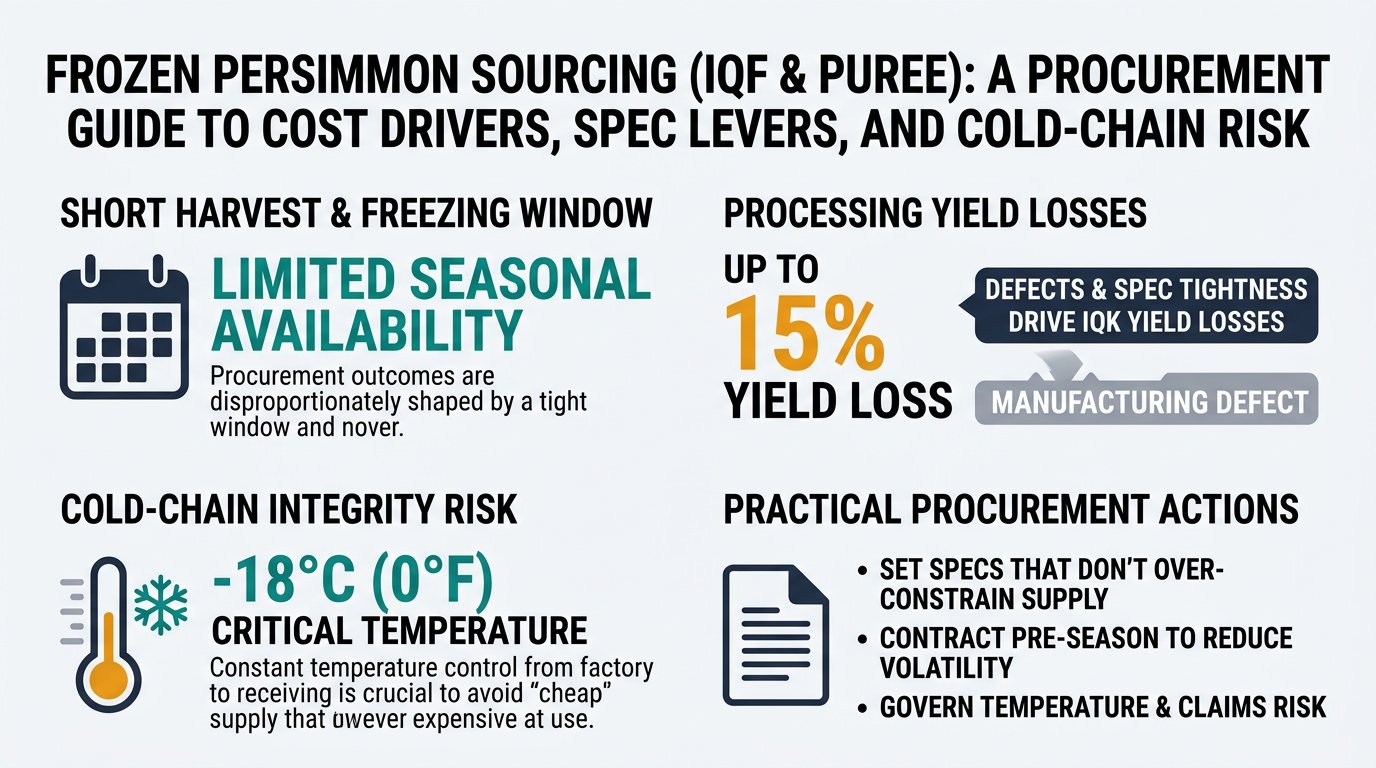
Frozen persimmon is a small, niche frozen-fruit category where procurement outcomes are disproportionately shaped by (1) a short harvest/freezing window, (2) processing yield losses driven by defects and spec tightness, and (3) cold-chain integrity from factory to receiving. This guide translates those realities into practical procurement actions—how to set specs that don’t over-constrain supply, how to contract pre-season to reduce volatility, and how to govern temperature and claims risk so “cheap” supply doesn’t become expensive at use.

Executive Summary

  • Category structure: Frozen persimmon behaves like a seasonal inventory category (freeze during harvest, sell from stock), not a smooth monthly replenishment item.
  • Seasonality signal (Spain): Spanish persimmon availability is commonly cited as early/mid-October through January, which tends to compress processing runs and inventory build into a narrow window.
  • Cold-chain baseline: A widely used benchmark for frozen foods is 0°F / −18°C or colder for storage/transport; deviations often show up later as texture and drip-loss complaints.
  • Reefer reality: Reefers are designed to maintain set temperature and airflow, not rapidly cool warm product; pre-cooling/loading discipline is a real cost and claims driver.
  • Most controllable cost levers: (1) spec governance (defect tolerance, cut size distribution, Brix/texture targets, glaze %, anti-browning allowance), (2) pre-season commitment vs. spot, (3) lane-level total cost-to-serve (storage/dwell/claims reserve).
  • Biggest recurring KPI traps: negotiating on $/kg instead of landed cost + claims; using one spec across all applications; and waiting to qualify alternates until disruption hits.

Key Insights

(Analyzed at: Mar, 2026)

  • Strategy: Hold
  • Reliability: Medium
  • Potential Saving: 6% ~ 12%
  • Insight: Treat frozen persimmon as a seasonal “inventory build” buy. For Mar 2026, the highest-confidence savings typically come less from trying to time spot price and more from (a) tightening your spec-to-application governance (so you stop paying IQF/appearance premiums where you don’t need them), and (b) renegotiating lane-level cold-chain controls (data loggers, excursion handling, claims workflow) to reduce credits/rework. Use the next pre-season window to place a committed tranche on core SKUs while keeping a smaller flexible tranche tied to validated energy/freight indices.

1) What you’re actually buying: the ground truth of frozen-persimmon flow

Frozen persimmon looks like “just another frozen fruit,” but procurement outcomes are disproportionately driven by raw-fruit seasonality + processing yield + cold-chain integrity.

Typical supply chain flow (what matters commercially)

  1. Upstream / Raw Material (orchards + harvest + field sorting)
  2. Fruit is highly seasonal; processors often build inventory in a narrow window.
  3. Fresh-market pull competes for the best grades; frozen takes more “processing grade,” but still needs minimum firmness/sugar for IQF.
  4. Primary Processing (wash/sort/peel/trim/cut; sometimes de-astringency)
  5. This is where yield loss and defect removal drive cost.
  6. Persimmon is bruise/softening sensitive; handling quality affects downstream texture.
  7. Secondary Processing (IQF tunnels or block freezing; puree standardization)
  8. Energy-intensive and capacity-constrained.
  9. Anti-browning steps (ascorbic/citric) and standardization (for puree) become spec levers.
  10. Packaging & QA (metal detection, sieving for puree; retail vs industrial packs)
  11. QA spend is not optional: foreign material + microbiological controls + thaw performance.
  12. Logistics & Distribution (frozen warehousing + reefer ocean/truck + claims)
  13. Frozen chain is typically managed at ≤ -18°C (0°F) for most commercially frozen foods; deviations often show up later as drip loss, texture collapse, and browning/oxidation claims.
  14. End markets (retail smoothie, foodservice dessert/beverage, industrial dairy/bakery inclusions)
  15. Different channels tolerate different defect/appearance profiles, which is why “one spec” often causes avoidable cost.
A left-to-right flowchart showing the end-to-end frozen persimmon movement as a seasonal inventory category: Orchards/Harvest & Field Sorting → Primary Processing (wash/sort/peel/trim/cut; de-astringency optional) → Secondary Processing (IQF tunnel vs block freezing; puree standardization) → Packaging & QA (metal detection, micro, sieving for puree) → Frozen Warehousing → Reefer Transport (ocean/truck) → Receiving & Use (retail smoothie/foodservice/industrial). Includes callouts for short harvest/freezing window, yield loss from defects/spec tightness, and cold-chain integrity (≤ −18°C / 0°F).

Seasonality reality check (procurement implication)

  • Spain’s persimmon season is commonly described as early/mid-October to January (with industry efforts to extend it).
  • That seasonality shapes frozen availability: processors either freeze during peak and carry inventory, or you pay for scarcity/spot.

2) Where the money accumulates: cost & margin by node (and why your landed cost swings)

Below are the cost accumulation points procurement can actually influence (via specs, contracting, and logistics terms).

2.1 Upstream / Raw Material (Orchard-run fruit)

Key insight: In frozen persimmon, the “raw fruit price” is only half the story—grade distribution and firmness/sugar suitability for IQF can change effective input cost more than the orchard price itself.

What drives cost here

  • Harvest labor + speed (to avoid bruising/softening)
  • Weather-driven packout volatility (more seconds → better for puree; worse for IQF)
  • Fresh-market competition for premium grades

Procurement levers

  • Contract language that distinguishes IQF-suitable grade vs puree grade
  • Multi-origin strategy to reduce single-harvest-window exposure

2.2 Primary Processing (Sorting, peeling, trimming, cutting)

Key insight: This is the yield-loss engine of the category. Tight defect tolerances, peel removal requirements, and cut geometry (slice vs dice) can swing yield materially.

What drives cost here

  • Trim loss (peel/calyx removal), defect sorting intensity
  • Labor intensity for peeling/cutting
  • Food safety controls (wash systems, sanitation)

Procurement levers

  • Spec governance: defect tolerance, size distribution, and allowable minor cosmetic defects (especially for industrial use)
  • Supplier benchmarking on yield and rework rates (not just quoted price)

2.3 Secondary Processing (IQF vs block; puree standardization)

Key insight: The freezer is a capacity and energy bottleneck; when energy costs spike or IQF capacity is tight, IQF prices often move faster than puree.

What drives cost here

  • Electricity/refrigeration load (IQF tunnels vs plate freezing)
  • Throughput constraints during peak season
  • Anti-browning treatments and standardization inputs (puree)

Procurement levers

  • Decide where you truly need IQF piece integrity vs where puree/block is acceptable
  • Consider indexation clauses (energy) only if you can verify the passthrough logic

2.4 Packaging & QA (compliance + claims prevention)

Key insight: In niche frozen fruits, QA cost is partly “insurance.” Skimping here often reappears as downgrades, credits, and line disruptions.

What drives cost here

  • Pack format (retail film vs industrial cartons/drums)
  • QA testing cadence (micro, foreign material, thaw performance)
  • Traceability and certification overhead

Procurement levers

  • Standardize pack formats across plants/regions where possible
  • Align QA spec to application risk (don’t demand retail-grade appearance for industrial puree)

2.5 Logistics & Distribution (cold chain + working capital)

Key insight: Reefer logistics is not just freight—it’s temperature integrity + dwell time + inventory carrying cost.

What drives cost here

  • Frozen warehousing and peak-season storage
  • Reefer availability and port dwell time
  • Temperature excursions: reefers are designed to maintain temperature and airflow; they are not intended to quickly pull down warm product temperature. Pre-cooling (product) and correct loading/airflow discipline matter.

Procurement levers

  • Lane-level TCO: include storage, demurrage risk, claims reserve
  • Receiving discipline: require data loggers/temperature records on critical lanes

2.6 End markets (importer/distributor/brand)

Key insight: For frozen persimmon, downstream margin often compensates for inventory risk and claims risk more than marketing spend.

What drives cost here

  • Financing seasonal inventory
  • Service-level buffering (safety stock)
  • Customer chargebacks/OTIF penalties

Procurement levers

  • Decide where you want margin to sit (processor vs importer vs your own inventory)
  • Use service-level KPIs tied to contract terms (OTIF, temperature compliance)

Product-level cost breakdown (illustrative, % of delivered cost)

A stacked bar chart with three bars comparing illustrative delivered-cost allocation for (A) IQF slices, (B) IQF dices, and (C) block-frozen puree. Segments include upstream raw fruit, primary processing, secondary processing, packaging & QA, logistics & distribution, and wholesale/importer margin, using the exact table percentages (Slices: 30/20/18/7/15/10; Dices: 28/22/17/7/16/10; Puree: 25/15/16/10/18/16). Includes a note: Illustrative modeled ranges; varies by origin/crop year/pack/freight.

These are modeled ranges to show where cost concentrates. Actual ratios vary by origin, crop year, pack format, and freight market. Use these as a negotiation “where to look,” not as a market benchmark.

A) IQF Persimmon Slices (industrial/foodservice)

Supply Chain Node Cost Ratio (% of Final Cost) Notes
Upstream raw fruit 30% Grade suitability drives effective input cost
Primary processing 20% Peeling/cutting + yield loss + sorting intensity
Secondary processing 18% IQF energy + capacity constraints
Packaging & QA 7% Metal detection, micro, piece integrity checks
Logistics & distribution 15% Reefer + frozen storage + claims reserve
Wholesale/importer margin 10% Inventory risk + service buffering

B) IQF Persimmon Dices (ingredient inclusions)

Supply Chain Node Cost Ratio (% of Final Cost) Notes
Upstream raw fruit 28% Slightly more tolerance on appearance than slices
Primary processing 22% Dicing yield + size distribution sorting
Secondary processing 17% IQF + clump control
Packaging & QA 7% Size distribution + foreign material controls
Logistics & distribution 16% Similar cold-chain cost
Wholesale/importer margin 10% Similar risk premium

C) Block-Frozen Persimmon Puree (industrial)

Supply Chain Node Cost Ratio (% of Final Cost) Notes
Upstream raw fruit 25% Can utilize more seconds if specs allow
Primary processing 15% Less cut labor; still sorting + peel/seed control
Secondary processing 16% Plate freezing + standardization (Brix/viscosity)
Packaging & QA 10% Higher QA for foreign material (sieving/metal detection)
Logistics & distribution 18% Heavy packs/drums; storage and handling add up
Wholesale/importer margin 16% Often higher due to financing and handling complexity

3) The structural fact that governs everything: it’s a seasonal inventory category, not a continuous-production one

If you manage frozen persimmon like a “monthly replenishment” item, you’ll overpay and under-serve.

Structural reality

  • Harvest windows are tight (e.g., Spanish season commonly Oct–Jan).
  • Processors run hard during season, then sell from frozen inventory.

Procurement implication

  • Your best negotiation leverage is often pre-season commitment + spec clarity, not in-season spot buying.

4) The critical insight: why persimmon prices and your delivered costs disconnect

Teams often ask: “Why did the persimmon quote rise when farmgate didn’t?” In frozen persimmon, the disconnect is usually yield + cold chain, not orchard pricing.

Three common disconnect mechanisms

  1. Yield shock without a raw-fruit price shock
  2. More defects, softer fruit, more trimming → same orchard price, higher cost per kg of finished IQF.
  3. IQF capacity/energy constraint
  4. Secondary processing cost spikes (electricity, freezer capacity) transmit quickly into IQF quotes.
  5. Cold-chain friction
  6. Reefer tightness, port dwell, storage costs, and claims risk raise the “risk premium” in offers.

What you can validate (and should ask for)

  • Yield and defect reports (incoming vs finished)
  • Energy surcharge logic (if any)
  • Lane performance: average dwell time + temperature compliance documentation

5) Where procurement teams typically get it wrong (and how it shows up in KPIs)

  • Mistake 1: One spec for all applications
  • Result: smaller supplier pool, higher concentration risk, higher price.
  • Mistake 2: Negotiating on price/kg instead of cost-to-serve
  • Result: “cheap” supply with higher claims, rework, or line stoppages.
  • Mistake 3: Treating IQF and puree as the same risk profile
  • Result: IQF stockouts during tight slicing-grade years.
  • Mistake 4: Waiting to qualify alternates until disruption hits
  • Result: emergency buys, spec waivers, expedited reefer, QA failures.
  • Mistake 5: Under-investing in cold-chain governance
  • Result: latent quality issues (texture collapse, drip loss) discovered at use, not at receipt.

6) How an intelligence-driven approach changes the outcome (without feature-dumping)

The decision you’re trying to make is usually one of these:

  • Who should be in my supplier portfolio (and where are we over-concentrated)?
  • What should I lock in pre-season vs leave flexible?
  • Which spec changes reduce risk/cost without breaking product performance?

What intelligence changes in practice

  1. Supplier discovery + benchmarking
  2. Compare processors by product form (IQF slices/dice vs puree), certifications, and capacity signals.
  3. Price intelligence + driver decomposition
  4. Separate raw fruit vs processing energy vs cold-chain cost drivers so negotiations anchor in evidence.
  5. Alternative supplier identification
  6. Build a staged bench (primary/secondary/tertiary) aligned to your spec and qualification effort.
  7. Supply-chain risk monitoring
  8. Watch for harvest/energy/logistics disruption indicators that precede quote spikes.
  9. Spec & quality governance support
  10. Quantify how each spec constraint narrows the supplier pool and increases concentration risk.

Operational cadence that works (simple and repeatable)

  • Monthly: exposure dashboard (origin/processor/lane), OTIF proxies, claims/credits
  • Pre-season: spec review + contracting scenario (commitment vs flexibility)
  • Quarterly: alternate qualification pipeline review

7) Strategic use cases (what a category manager can do this week vs this quarter)

Use case A: Reduce cost volatility without breaking service levels

This week

  • Split your spend into IQF vs puree and rank SKUs by service criticality.
  • Build a landed-cost template that forces line items: raw fruit, processing, packaging, freight, storage, claims.

This quarter

  • Introduce contract structures: base + indexed components (energy/freight) only where you can audit.
  • Standardize pack formats to reduce handling and MOQ penalties.

Outcomes / trade-offs

  • Outcome: lower variance in landed cost and fewer surprise surcharges.
  • Trade-off: more upfront analytics and tighter governance.

Use case B: Pre-qualify alternatives before disruption hits

This week

  • Map concentration: % volume by origin, processor, and lane.
  • Identify “single points of failure” (one processor for IQF slices, one lane, one cold store).

This quarter

  • Run a staged qualification plan (secondary supply with slightly wider spec bands).

Outcomes / trade-offs

  • Outcome: faster recovery time, fewer emergency buys.
  • Trade-off: qualification cost and QA bandwidth.

Use case C: Expand supplier pool by fixing spec governance

This week

  • Identify 3 specs that most restrict supply (e.g., cut size distribution, defect tolerance, color range, glaze %).

This quarter

  • Align QA/R&D on “must-have vs nice-to-have” specs by application.

Outcomes / trade-offs

  • Outcome: more qualified suppliers, better leverage.
  • Trade-off: controlled variability management at receiving.

Use case D: Cold-chain governance that prevents hidden quality loss

This week

  • Require temperature records/data loggers on high-risk lanes.
  • Tighten receiving checks for temperature compliance around frozen norms (commonly ≤ -18°C).

This quarter

  • Add contractual language for excursion handling, documentation, and claims process.

8) Why this matters beyond persimmon (adjacent categories you likely also buy)

Frozen persimmon is a compact example of a broader procurement truth: in cold-chain agricultural ingredients, the biggest risks are often invisible in the PO price.

Where the same playbook applies

  • Frozen mango (IQF vs puree): similar yield/spec trade-offs; puree can absorb seconds; IQF more sensitive to grade.
  • Frozen peaches: seasonality + texture after thaw; spec tightness affects supplier pool.
  • Frozen berries: higher food-safety testing intensity and foreign material controls; QA governance is a major cost driver.
  • Frozen fruit blends: substitution decisions (swap persimmon % or particle size) can de-risk supply but require spec equivalency mapping.

Transferable procurement muscle

  • Spec-to-supplier-pool analysis
  • Lane-level cost-to-serve modeling
  • Pre-qualified alternates before disruption

9) Why this example is powerful for procurement leaders evaluating intelligence-led sourcing

Frozen persimmon forces clarity on the fundamentals that separate reactive buying from category management:

  • You can’t negotiate away physics: temperature integrity and seasonality create real cost.
  • Specs are commercial strategy: each tightened parameter is a hidden supplier-reduction decision.
  • Risk is measurable: concentration by origin/processor/lane, plus lead-time variance, predicts service failures.
  • The right outcome metrics are procurement-native: landed cost variance, OTIF/service proxies, claims rate, and time-to-recover.

If you can manage frozen persimmon with discipline—balancing spec governance, yield reality, and cold-chain execution—you can usually improve performance across the rest of your frozen fruit portfolio.

© Frozen Persimmon Sourcing Guide

Take Your Sourcing Intelligence to the Next Level

The insights in this report are just the starting point. Tridge Eye gives you real-time market signals, origin risk alerts, and price benchmarks — so you can act before the market moves.
Explore Tridge Eye →

Subscribe
By subscribing you agree to with our Privacy Policy and provide consent to receive updates from our company.
Thank you! Your submission has been received!
Oops! Something went wrong while submitting the form.
Subscribe to receive the latest blog posts, updates, promotions, and announcements from Tridge.