INDUSTRY TRENDS

Frozen Passion Fruit Sourcing (IQF, Puree, Concentrate): How Category Teams Control Cost, Risk, and Supply Resilience

Author
Team Tridge
DATE
March 10, 2026
10 min read
frozen-passion-fruit Cover
Tridge — Trusted Global Food Sourcing

This report is powered by Tridge market intelligence.

Every data point, price signal, and supply chain insight in this analysis is drawn from the same engine that procurement teams worldwide rely on daily. As you read, consider what this level of visibility could do for your category.

See how Tridge Eye works →

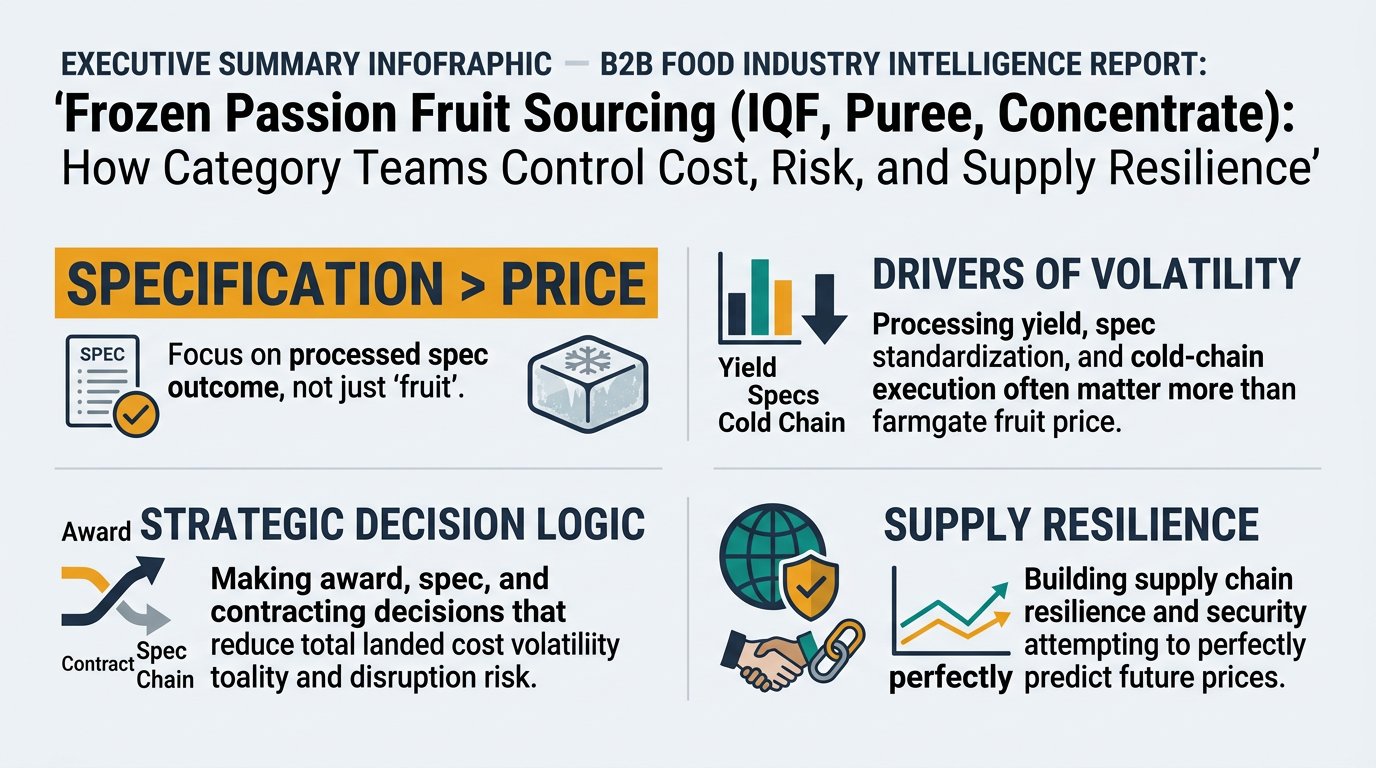
This guide is written for procurement and category leaders who already know sourcing mechanics, but want clearer “decision logic” for frozen passion fruit—where processing yield, spec standardization, and cold-chain execution often matter more than farmgate fruit price. The goal is to help you make award, spec, and contracting decisions that reduce total landed cost volatility and disruption risk—without pretending anyone can perfectly predict future prices.

Executive Summary

  • You’re buying a processed spec outcome, not “fruit”: In frozen passion fruit, most wins/losses happen at processing (yield + standardization) and cold chain execution, not at the farmgate.
  • Format choice changes your cost structure:Puree/pulp vs. 50° Brix concentrate vs. IQF shifts freight intensity, working capital, and quality-claims exposure.
  • 50° Brix concentrate is a common commercial standard: Multiple supplier spec sheets show ~49–51° Brix as typical for passion fruit juice concentrate. [1]
  • Cold-chain temperature expectation is typically -18°C or colder: This aligns with widely used frozen-food handling norms (Codex quick-frozen standards reference maintaining products at -18°C). [2]
  • Production ≠ exportable supply: Brazil is widely cited as the largest producer, but domestic absorption can be high; exportable industrial supply is shaped by processor/exporter capacity and consistency, not acreage alone. [3]
  • EU residue scrutiny can be origin-specific: CBI notes passion fruit from Colombia is on the EU’s increased control attention list (frequency of checks) due to pesticide residues—relevant for risk-based incoming testing and supplier governance. [4]
  • Confidence level: Medium. Structural patterns are strong; your exact landed-cost splits and risk hotspots must be validated by lane, Incoterms, packaging, and your QA history.

Key Insights (Analyzed at: Mar, 2026)

  • Strategy: Hold
  • Reliability: Medium
  • Potential Saving: 4% ~ 10%
  • Insight: If you are buying frozen puree/pulp on annual fixed pricing, the best near-term value is usually not “chasing a new lowest quote,” but re-structuring the buy around usable solids + cold-chain performance: (1) re-price to $/kg of soluble solids (or SSE equivalent) using verified Brix ranges (50° Brix concentrate norms are typically ~49–51°), and (2) contractually tie service to temperature logging, dwell-time accountability, and claims rules. This typically reduces hidden losses (over-dosing, rework, claims, premium freight) more reliably than switching origins purely on unit price. Validate via a 6–8 week data pull: COA Brix variance, yield in your process, claim history, and lane dwell times. [1]

1) What’s actually happening in the frozen passion fruit supply chain (ground truth)

Frozen passion fruit is rarely a “farm-to-factory” ingredient in the way procurement teams expect from grains or dairy inputs. It is a high-perishability fruit that becomes a stable industrial ingredient only after processing close to origin—and that processing step (pulping/standardizing/freezing or aseptic filling) is where most sourcing outcomes are won or lost.

A practical way to think about the flow is:

  1. Farms / aggregators supply fresh fruit (yellow or purple varieties) into local collection.
  2. Primary processing converts fruit into pulp/puree/juice (seeded or deseeded) and standardizes basic parameters.
  3. Secondary processing makes the exportable formats:
  4. Frozen pulp/puree (blocks or bags)
  5. IQF formats (less common than puree/pulp for industrial buyers)
  6. Juice concentrate (commonly ~50° Brix; sometimes higher)
  7. Packaging + QA release (COA, micro, residues, foreign matter controls).
  8. Cold chain logistics from origin cold store → reefer ocean → destination cold store.
  9. Importers / blenders / distributors may re-pack, blend lots to hit specs, and manage service levels.
A left-to-right flowchart showing the end-to-end frozen passion fruit chain from farms/aggregators through primary processing and secondary processing into frozen puree/pulp, IQF, and ~50° Brix concentrate, then packaging and QA release, cold chain logistics at -18°C or colder, and importer/blender/distributor, with callouts highlighting yield and standardization risk in processing and temperature control and dwell time risk in logistics.

Why this matters for category decisions

  • You are not just buying fruit. You are buying a processed spec outcome (Brix/pH, seed/fiber, micro, sensory) delivered through a cold chain.
  • The trade-off you’re managing is spec tightness vs. supplier pool vs. total landed cost and service risk.
  • Brazil is widely cited as the largest producer of passion fruit, but exportable supply for industrial buyers is shaped by processed exporters and their capability (capacity, consistency, documentation), not just production volume. [3]

2) Where the money is made (and lost) at each node of the chain

Key insight

For frozen passion fruit, cost does not accumulate smoothly. It jumps at two points: (1) Yield + standardization in processing (how much usable pulp you get per kg of fruit and how much blending/testing you need to hit Brix/seed specs), and (2) Cold-chain logistics + inventory carrying (reefers, cold storage, demurrage risk, and working capital).

2.1 Upstream (Farms & Aggregation): “Fruit price is only the starting point”

What’s happening

  • Fresh passion fruit quality varies by variety, maturity, weather, and orchard practices; that variability later shows up as Brix/pH swings and pulp yield.
  • Processors often compete with fresh-market channels in some origins; when fresh prices rise, processors pay up or see lower intake.

Cost drivers you feel downstream

  • Farmgate price volatility (seasonality/weather)
  • Reject rates (defects, disease pressure)
  • Collection logistics (time-to-plant matters because fruit quality deteriorates quickly)

Margin reality

Farms/aggregators typically have thin margins but drive big downstream variability.

2.2 Primary Processing (Pulping/Sieving/Standardization): “Yield is the hidden P&L lever”

What’s happening

  • Converting fruit into pulp/puree creates meaningful waste streams (peel/seed) and yield loss.
  • Specs like seed content, fiber/particle size, and Brix range directly affect how much rework/blending is needed.

Cost drivers

  • Yield loss (fruit-to-pulp)
  • Labor and throughput constraints during peak intake
  • Water/effluent treatment
  • Testing burden (basic chem + micro screening)

Margin reality

This is a major value-add node: processors price in yield risk and rework.

2.3 Secondary Processing (Freezing, Concentration, Aseptic): “Format choice changes your cost structure”

What’s happening

  • Frozen puree/pulp: energy-intensive freezing + cold storage; often preferred when buyers want a “closer to fruit” sensory profile.
  • Concentrate: removes water, lowering freight cost per unit of solids, but adds processing complexity and can increase sensitivity to blending/spec management.
  • In beverage supply chains, ~50° Brix concentrate is a common commercial standard; multiple published spec sheets show 49–51° Brix as typical ranges. [1]

Cost drivers

  • Energy (freezing/cold rooms; evaporation energy for concentrate)
  • Capex depreciation (freezers/evaporators)
  • Blending to hit Brix targets
  • Losses from temperature excursions (quality claims risk)

Margin reality

Secondary processing is where suppliers can differentiate (consistency, micro control, documentation).

2.4 Packaging & QA Release: “Compliance is not optional—and it’s not evenly distributed”

What’s happening

  • Industrial formats (bags/cartons, pails, drums) are chosen for handling and MOQs.
  • QA release typically relies on COA + buyer verification (micro, residues, sensory).

Cost drivers

  • Food-grade liners, cartons/drums
  • Micro testing + foreign matter controls
  • Residue compliance and documentation (especially for EU buyers)

Risk signals procurement should care about

For EU-bound trade, CBI notes passion fruit from Colombia is among products subject to increased attention (frequency of checks) due to pesticide residues—this is a practical trigger for risk-based incoming testing and supplier governance. [4]

2.5 Cold Chain Logistics & Distribution: “Reefer reality sets the true landed cost”

What’s happening

  • Frozen passion fruit is typically shipped in reefer containers and stored at -18°C or colder (common frozen-food handling expectation). [2]
  • Delays create demurrage/detention and increase risk of temperature excursions.

Cost drivers

  • Ocean reefer freight
  • Origin + destination cold storage
  • Port congestion and dwell time
  • Inventory carrying cost (frozen stocks tie up cash)

Margin reality

Importers/distributors often price for service level (OTIF), not just product.

A 100% stacked bar chart with three bars (puree/pulp, ~50° Brix concentrate, and IQF) showing illustrative delivered cost ratios by node—farms and aggregation, primary processing, secondary processing, packaging and QA, cold chain logistics, and importer/distributor margin—using consistent colors and labeling each segment with the percentages from the article tables, with a note that ratios are illustrative and should be validated by lane, Incoterms, pack size, and service model.

Product-level cost breakdown (illustrative)

Modeled ratios below show how cost concentration shifts by format. They are directional (not quotes) and should be validated against your own lane, Incoterms, pack size, and service model.

A) Frozen Passion Fruit Puree/Pulp (industrial pack)

Supply Chain Node Cost Ratio (% of delivered cost) What drives it
Farms & aggregation 30% farmgate volatility, rejects
Primary processing 18% yield loss, labor, standardization
Secondary processing (freezing) 14% energy, freezing throughput
Packaging & QA 8% liners/cartons, testing
Cold chain logistics 18% reefer + cold storage + dwell
Importer/distributor margin 12% service level, financing

B) Passion Fruit Juice Concentrate (commonly ~50° Brix)

Supply Chain Node Cost Ratio (% of delivered cost) What drives it
Farms & aggregation 26% fruit availability, quality
Primary processing 16% yield + filtration
Secondary processing (concentration) 20% evaporation energy/capex, blending
Packaging & QA 7% drums/aseptic, testing
Cold chain logistics 12% lower freight per solids than puree
Importer/distributor margin 19% working capital, consistency, service

C) IQF Passion Fruit Formats (where applicable)

Supply Chain Node Cost Ratio (% of delivered cost) What drives it
Farms & aggregation 28% fruit selection tighter for IQF
Primary processing 14% cutting/pulp prep, rejects
Secondary processing (IQF freezing) 18% IQF energy + yield losses
Packaging & QA 10% bags, metal detection, sorting
Cold chain logistics 18% cube integrity depends on cold chain
Importer/distributor margin 12% service level

3) Structural fact procurement teams underestimate: “Production ≠ exportable supply”

A recurring structural feature in passion fruit is:

  • Brazil is widely cited as the world’s largest producer, but a large share can be absorbed domestically. [3]
  • Exportable supply for industrial buyers is therefore disproportionately shaped by processed exporters and their capacity, not just acreage.

Procurement implication

  • If you build strategy purely on “top producing countries,” you can end up with the wrong supplier universe.
  • The better segmentation is: (1) processing/export capability, (2) spec capability, (3) cold-chain execution history.

4) The critical insight: why raw fruit signals and frozen/puree pricing can disconnect

Many category managers expect a tight linkage: bad harvest → immediate price spike in frozen puree. In practice, frozen passion fruit often behaves differently.

What causes the disconnect

  1. Inventory buffering: Processors and importers carry frozen stocks; contract pricing can lag fruit fundamentals by weeks to months.
  2. Spec-driven blending: When Brix/pH varies, suppliers blend lots to hit targets—this can raise costs even in “normal” harvest years.
  3. Cold chain constraints can dominate: Reefer availability, port dwell, and cold storage costs can move landed cost faster than farmgate fruit.
  4. Format substitution: Buyers can switch between puree vs. concentrate depending on formulation flexibility; this changes demand pressure.

A concrete example of spec reality (Brix)

  • Commercial specs commonly reference ~50° Brix concentrate (often 49–51° Brix) and dilution back to ~14° Brix single-strength equivalents in beverage contexts. [1]

So what?

The trade-off you’re managing is unit price vs. usable solids consistency vs. claim risk.

5) Where procurement teams typically get this wrong (patterns that create avoidable cost and risk)

  1. Awarding on price per kg instead of price per kg of usable solids: If Brix range is wide or seed/fiber is high, your “cheap” puree can be expensive in formulation and waste.
  2. Over-tightening specs without quantifying supplier pool shrinkage: Tight micro limits + tight Brix + tight seed spec can collapse your qualified universe to 1–2 suppliers.
  3. Treating cold chain as a logistics problem, not a quality/spec problem: Temperature excursions show up as drip loss, texture breakdown, sensory drift, and disputes.
  4. Dual-sourcing on paper but not in QA reality: Backups aren’t qualified (sensory, micro validation, packaging fit) until disruption hits.
  5. Assuming compliance risk is “covered by certificates”: Certificates help, but residue and food safety risk need ongoing verification and supplier performance monitoring.

What I’d want to confirm before acting

  • Your internal tolerance for Brix/pH drift in formulation
  • Whether your application is kill-step (e.g., pasteurized beverage) or not (risk posture differs)
  • Your actual inventory cover and how quickly you can re-qualify alternates

6) How an intelligence-driven approach changes the outcome (without pretending to predict prices)

This is not about guaranteeing future pricing. It’s about reducing decision error.

Decision 1: Spec governance (what you lock vs. what you flex)

What intelligence can observe/compare

  • Supplier capability signals (formats, certifications, shipment consistency)
  • Comparable specs offered in-market

How it changes the decision

Define a two-tier spec:

  • Non-negotiables: food safety/micro, traceability, allergen/foreign matter controls
  • Flex bands: Brix range, seed/fiber thresholds (within R&D acceptable window)

Outcome metrics

  • Higher qualified supplier count
  • Lower expedite frequency

Decision 2: Award & contracting structure (baseline vs. flex)

What intelligence can observe/compare

  • Shipment patterns as a proxy for reliability
  • Origin concentration risk signals

How it changes the decision

Split volume:

  • Baseline with most reliable cold-chain performer
  • Flex with alternates that meet minimum spec and can ramp

Outcome metrics

  • Improved OTIF
  • Reduced disruption recovery time

Decision 3: Risk monitoring (early warning that is actually relevant)

What intelligence can observe/compare

  • Regulatory and compliance signals (e.g., heightened residue scrutiny by market)
  • Supplier-level incident signals

How it changes the decision

Pre-define triggers:

  • Increase incoming testing frequency
  • Pull forward audit cadence
  • Activate alternate origin trials

Outcome metrics

  • Fewer compliance surprises
  • Lower claim rate

Supporting reality check on food safety posture

FDA has documented virus surveillance and strategy work in frozen fruit categories (not passion fruit-specific, but relevant to frozen fruit risk thinking). [5]

7) Strategic use cases a category team can operationalize (quarterly/weekly/annual)

Use case A: “Resilience dual-sourcing that survives QA” (quarterly)

  • Build an alternate set by format + Brix capability + packaging + certifications
  • Run sensory + application trials on 1–2 alternates before you need them
  • Set a rule: rotate 5–15% of volume annually to keep alternates warm (where feasible)

Use case B: “Contracting that matches volatility” (quarterly)

  • Baseline volume on longer commitments where supplier reliability is proven
  • Flex volume indexed/shorter term where market swings are highest
  • Explicitly price cold-chain service expectations (temperature logging, dwell-time accountability)

Use case C: “Spec flexibility exercise” (twice per year)

  • With R&D/QA, quantify what happens if you widen:
  • Brix band by ±0.5–1.0
  • seed/fiber thresholds
  • Translate that into: how many more suppliers qualify and what is the cost delta

Use case D: “Governance hygiene for the ASL” (annual)

  • Clean the Approved Supplier List:
  • Remove inactive suppliers
  • Tag each supplier by origin exposure, format capability, audit status
  • Set audit cadence based on risk signals and performance

8) Why this matters beyond passion fruit (and where you’ll reuse the same playbook)

If you source frozen passion fruit, you likely also touch categories that behave similarly—where processing yield + spec standardization + logistics constraints dominate outcomes.

Examples procurement teams commonly overlap with

  • Mango puree / IQF mango: similar yield and Brix standardization dynamics; strong seasonality and origin concentration.
  • Pineapple (IQF or juice/concentrate): high sensitivity to cold chain and consistency; residue/compliance scrutiny can be material in some lanes.
  • Strawberry (IQF/puree): high recall/food safety sensitivity; frozen fruit has seen public health attention in virus/outbreak contexts. [6]

The transferable lesson

Intelligence-based sourcing is less about “finding the cheapest supplier” and more about engineering a supply base that can repeatedly hit spec at an acceptable landed cost under disruption.

9) Why this example is powerful for procurement leaders evaluating intelligence-led sourcing

Frozen passion fruit is a clean demonstration category because it combines:

  • High spec sensitivity (Brix/pH/seed/fiber) that impacts formulation cost and consistency
  • Cold chain dependence (quality and claims risk are logistics-linked)
  • Export concentration (processed supply shaped by a limited set of origins and processors)
  • Compliance complexity (residue scrutiny can change the risk profile by origin/market) [4]

In other words: it’s a category where better visibility doesn’t just improve negotiation—it improves award logic, contract design, contingency readiness, and governance discipline.

Confidence level: Medium. The structural patterns (processing-led economics, ~50° Brix concentrate norms, cold-chain cost leverage, compliance scrutiny) are well-supported, but your exact cost ratios and risk hotspots should be validated with lane-specific freight, Incoterms, pack formats, and your QA testing history.

Take Your Sourcing Intelligence to the Next Level

The insights in this report are just the starting point. Tridge Eye gives you real-time market signals, origin risk alerts, and price benchmarks — so you can act before the market moves.
Explore Tridge Eye →

References

  1. fruitsmart.com
  2. sps.gdtbt.org.cn
  3. freshplaza.com
  4. cbi.eu
  5. fda.gov
  6. cdc.gov
Subscribe
By subscribing you agree to with our Privacy Policy and provide consent to receive updates from our company.
Thank you! Your submission has been received!
Oops! Something went wrong while submitting the form.
Subscribe to receive the latest blog posts, updates, promotions, and announcements from Tridge.