INDUSTRY TRENDS

Frozen Orange Sourcing Intelligence (2026): Cost Drivers, Risk Concentration, and Contract Levers for Procurement Leaders

Author
Team Tridge
DATE
April 14, 2026
9 min read
frozen-orange Cover
Tridge Eye Data Intelligence Solution

This report is powered by Tridge Eye Data Intelligence.

Every data point, price signal, and supply risk insight in this analysis comes from the same platform that procurement and sourcing leaders worldwide rely on daily. As you read, consider what this level of market intelligence could do for your sourcing decisions.

Explore Tridge Eye →

Frozen-orange sourcing looks like a “frozen fruit” buy on the surface, but procurement outcomes are typically decided upstream—by fruit availability, processing capacity access, and cold-chain execution. This guide is written for procurement and sourcing managers who are experienced buyers in other ingredients, but want a practical, decision-oriented understanding of frozen-orange realities (formats, specs, seasonality, and supply assurance) and how intelligence changes what you do week-to-week.

Executive Summary

  • Cold-chain setpoint reality: Many regulations/guidelines and industry practice anchor frozen storage/transport around −18°C / 0°F (with some emerging industry discussion about slightly warmer setpoints for energy savings, but not universally adopted) [1].
  • Structural concentration (juice-linked supply): Brazil remains the dominant exporter in orange juice trade; reputable industry and market sources commonly cite ~70–75%+ of global orange juice exports/trade tied to Brazil (definitions vary by year and “trade vs production”) [2].
  • U.S. supply backdrop: Florida orange production has been at historic lows in recent seasons, reinforcing import dependence for juice-linked inputs and tightening the “domestic backstop” [3].
  • Pricing doesn’t move like headlines: Delivered frozen-orange cost is best managed as fruit + yield + processing capacity + cold chain/financing, not a single commodity index.
  • Contracting lesson: If you need peak-season continuity for a spec-sensitive item (IQF segments; tight brix/acid puree), you are effectively buying capacity + compliance + service, not just product.
  • Governance lesson: Intelligence improves timing, guardrails, and triggers—but does not replace QA testing, audits, and supplier confirmation.

Key Insights

Analyzed at: Apr, 2026

  • Strategy: Hold
  • Reliability: Medium
  • Potential Saving: 4% ~ 9%
  • Insight: Current market signals (as of early 2026) point to continued structural concentration in juice-linked supply (Brazil-led) and U.S. import dependence, while Florida production remains depressed. That combination usually keeps suppliers disciplined on allocating capacity and maintaining risk premiums—especially for spec-sensitive frozen formats. The most reliable near-term savings are therefore less about “waiting for a crash” and more about reducing landed-cost leakage: shorten freezer dwell time (inventory turns), renegotiate freight/storage responsibilities, tighten temperature-excursion claim processes, and run a targeted dual-source program for the top 20% of spec-critical SKUs. (This is a “Hold” rather than “Buy” because price direction depends heavily on crop/inventory cycles and contract coverage timing; intelligence can improve timing, but you still need supplier quotes and QA validation before committing.) [2]

1) What you’re actually buying: the frozen-orange supply chain (ground truth)

Frozen orange looks like a simple frozen fruit category, but procurement outcomes are usually determined by three constraints that sit upstream of your RFQ:

  1. Fruit availability and quality are seasonal and shock-prone (weather + disease + competing demand from juice and fresh channels).
  2. Processing is capacity-constrained (peeling/segmenting, IQF tunnels, cold storage) and often concentrated near growing regions.
  3. Cold-chain integrity is non-negotiable from plant to your DC (a common industry/regulatory anchor for frozen handling is −18°C / 0°F, though specific specs and product sensitivity can require tighter control) [1].

The practical flow (what moves, when, and where margin accumulates)

  1. Upstream / Raw fruit: processing-grade oranges (variety, maturity, defects, juice content) sourced near citrus belts.
  2. Primary processing: washing, sorting, peeling/segmenting, de-seeding, trimming; juice extraction for puree/juice-based frozen inputs.
  3. Secondary processing: IQF freezing (segments/pieces), block freezing, blending/standardization for puree (brix/acid), packing into industrial cartons/drums.
  4. Packaging & QA: metal detection, microbiology, brix/acid checks (puree), traceability, label compliance.
  5. Cold-chain logistics: blast freeze → cold store → reefer truck/ocean reefer → destination cold store → your plant/DC.
  6. End markets: retail smoothie/fruit mixes, foodservice desserts/beverages, industrial inclusions (yogurt, bakery fillings, ice cream, sauces).

Why this matters for procurement: frozen formats buffer seasonality, but they also shift your risk from “can I buy fruit?” to “can a processor run my spec and hold inventory without service failures?”

Left-to-right supply chain flow diagram from citrus origin fruit supply through primary processing, secondary processing, packaging & QA, and cold-chain logistics to buyer end use, with callouts for three constraints: seasonal fruit availability/quality, processing capacity bottlenecks, and cold-chain integrity anchored at −18°C / 0°F.

2) Where the money goes: cost and margin by node (and why it differs by format)

Key insight

Frozen-orange cost is dominated by raw fruit economics + processing yield + cold-chain energy/storage, while margins concentrate at nodes that can reliably deliver spec consistency and service level (fill rate, lead time, claim performance).

Below is a procurement-oriented view of cost build-up by node.

2.1 Upstream / Raw material (oranges)

What drives cost

  • Farmgate fruit price (largest swing factor): weather events, drought/frost/hurricanes, and disease pressure.
  • Yield and maturity: brix/acid and segment integrity affect usable yield.
  • Competition for fruit: fresh market and juice processors can bid fruit away in tight years.

How margin behaves

  • Grower margins are volatile; in shortage years, fruit price moves faster than downstream contract repricing.

2.2 Primary processing (peel/segment/extract)

What drives cost

  • Labor intensity (peeling/segmenting is hard to fully automate at high quality).
  • Yield loss: peel/membrane removal, trimming, broken segments.
  • Water/waste handling and sanitation.

How margin behaves

  • Processors with better yield control and lower defect/foreign material rates can price a premium—especially for high-integrity IQF segments.

2.3 Secondary processing (IQF / block freezing / puree standardization)

What drives cost

  • Energy and refrigeration: IQF tunnels/spirals and blast freezing are energy-intensive.
  • Throughput constraints: peak-season bottlenecks create allocation risk.
  • Standardization/blending (puree): hitting brix/acid targets can require blending lots and tighter QA.

How margin behaves

  • Margin concentrates where a supplier can deliver consistent spec lots and high service reliability under peak demand.

2.4 Packaging & QA

What drives cost

  • Packaging format (retail vs industrial), film/barrier needs to prevent freezer burn/odor pickup.
  • QA testing cadence and certifications (organic, kosher/halal, non-GMO claims, retailer programs).

How margin behaves

  • Lower “visible” margin, but this node drives claim avoidance (temperature abuse, foreign material, micro failures).

2.5 Logistics & distribution (cold chain)

What drives cost

  • Cold storage (time in freezer = working capital + storage fees).
  • Reefer trucking/ocean reefer, port/terminal fees, insurance.
  • Temperature monitoring and claim management.

Structural reality: a widely used anchor for frozen handling is −18°C / 0°F; excursions increase drip loss, texture damage, and claims even if food safety is not immediately compromised [1].

2.6 Downstream margin (importer/wholesale/retail or industrial distribution)

What drives cost

  • Inventory risk (carrying frozen stock), customer service penalties, and promotions.
  • For industrial buyers: internal handling, thaw management, and line efficiency impacts.

Product-level cost breakdown (illustrative, modeled % of final delivered cost)

Assumptions: industrial pack (10–25kg cartons or drums), stable cold chain, typical import program. Actuals vary by origin, certifications, pack size, season, and service terms.

100% stacked bar chart comparing delivered cost build-up by format for (A) FCOJ industrial, (B) IQF orange segments, and (C) frozen orange puree, segmented into raw fruit, primary processing, secondary processing, packaging & QA, cold-chain logistics, and wholesale/import margin, with a note that the model is illustrative and actuals vary by origin, certifications, pack size, season, and service terms.

A) Frozen orange juice concentrate (FCOJ / industrial)

Supply chain node Cost ratio (% of final delivered cost) Procurement meaning
Raw fruit 45% Fruit price and yield dominate; watch crop/disease signals.
Primary processing 12% Extraction efficiency and byproduct economics matter.
Secondary processing 10% Concentration + freezing energy and plant utilization.
Packaging & QA 6% Drums/totes, traceability, lab controls.
Cold-chain logistics 12% Reefer + cold storage time; biggest lever is dwell time.
Wholesale/import margin 15% Risk premium for inventory + financing + service.

B) IQF orange segments (spec-sensitive)

Supply chain node Cost ratio (% of final delivered cost) Procurement meaning
Raw fruit 35% Fruit quality affects segment integrity and yield.
Primary processing 22% Labor + breakage/yield are the cost battleground.
Secondary processing 12% IQF capacity and energy; peak-season allocation risk.
Packaging & QA 8% Foreign material controls and defect sorting reduce claims.
Cold-chain logistics 10% Texture damage risk in excursions; monitor lanes.
Wholesale/import margin 13% Premium tied to service reliability and spec compliance.

C) Frozen orange puree (standardized brix/acid)

Supply chain node Cost ratio (% of final delivered cost) Procurement meaning
Raw fruit 40% Fruit economics plus blending flexibility.
Primary processing 14% Pulp management, filtration, sanitation.
Secondary processing 14% Standardization/blending + freezing; spec consistency premium.
Packaging & QA 7% Drums/cartons + brix/acid and micro testing.
Cold-chain logistics 10% Drums are heavy; landed cost sensitive to freight.
Wholesale/import margin 15% Inventory/financing and customer service terms.

3) The structural fact most sourcing teams miss: frozen-orange is concentrated where oranges and processing capacity are

If you source anything tied to orange juice (including concentrate inputs), the market is structurally shaped by Brazil’s dominance in global orange juice exports/trade.

  • Credible industry and market sources commonly cite Brazil accounting for roughly ~70–75%+ of globally traded/exported orange juice (shares vary by definition and year) [2].

For U.S.-linked supply assurance, Florida’s long-run production decline is a major background risk driver.

  • USDA reporting has described Florida orange production at historic lows in recent seasons (forecasts vary by month and storm impacts) [3].

Procurement implication: you are not negotiating in a “many interchangeable suppliers” category. You are managing capacity access + spec capability + cold-chain execution.

4) The critical insight: why your frozen-orange price can move differently from “orange market headlines”

Procurement teams often expect a clean line from “orange crop news” → “my frozen price.” In practice, frozen-orange pricing disconnects for four reasons:

  1. Inventory buffering creates a time lag
  2. Frozen inventory delays price transmission. A tight crop may not hit your delivered price until inventories draw down.
  3. Spec-driven yield is the hidden multiplier
  4. A small shift in defect rates or segment breakage can change usable yield materially for IQF segments, amplifying cost beyond fruit price.
  5. Processing capacity is a separate market
  6. When IQF tunnels, peeling lines, or cold storage are tight, suppliers price capacity scarcity even if fruit prices are stable.
  7. Cold-chain and financing costs can dominate in “normal fruit” years
  8. If energy, storage, or reefer costs rise, your landed cost can increase without any dramatic farmgate move.

Decision takeaway: treat price as a combination of fruit + yield + capacity + cold chain, not a single commodity index.

5) Where procurement teams typically get frozen-orange wrong (and what it costs)

  1. Over-indexing on unit price and under-buying service reliability
  2. Outcome: short shipments, substitutions, expediting, production changeovers.
  3. Assuming alternates are “one audit away”
  4. Reality: qualification cycles are slow because specs are sensory/functional (brix/acid, pulp, segment integrity) and claims risk is high.
  5. Writing contracts that don’t match how suppliers manage capacity
  6. If you want continuity in peak season, suppliers often need volume visibility, run plans, and sometimes reservation-like commitments.
  7. Not separating “proof” from “signals”
  8. Teams rely on supplier narratives without triangulating crop, capacity, and logistics signals.

6) How intelligence-driven sourcing changes the outcome (without pretending to replace QA)

This is not about “having more data.” It’s about changing the decision cadence: when you shortlist, when you lock, when you trigger contingency, and how you govern suppliers.

Capability 1: Price intelligence & trend drivers (category-level)

What changes in practice

  • You stop negotiating off anecdotes and start negotiating off driver-based ranges:
  • fruit availability signals
  • processing utilization constraints
  • energy/cold storage pressure
  • freight/reefer constraints

What it does not do

  • It does not guarantee a price; it improves your timing and guardrails.

Capability 2: Supplier discovery & segmentation (format + export readiness)

What changes in practice

  • Build a longlist by format capability (IQF segments vs puree vs concentrate-linked inputs), certifications, and lanes.
  • Segment suppliers into:
  • Strategic (capacity + proven service)
  • Qualified alternates (spec-feasible, limited allocation)
  • Spot/overflow (use only with tight controls)

Capability 3: Risk monitoring & alerts (disruption triggers)

What changes in practice

  • You define triggers that move you from “monitor” to “act,” such as:
  • repeated OTIF deterioration
  • port/reefer disruption on critical lanes
  • storm events impacting harvest/processing regions

Governance boundary (important): intelligence flags risk; QA testing, audits, and supplier confirmations remain mandatory for food safety and spec compliance.

7) Strategic use cases procurement leadership can operationalize

Use case A: Reduce cost volatility without increasing stockout risk

  • Decision: fixed vs indexed vs hybrid pricing; when to lock.
  • How to run it:
  • Set a driver-based negotiation range.
  • Align finance on risk appetite (budget certainty vs upside participation).
  • Use contract structures that match supply reality (e.g., volume bands, scheduled call-offs, defined surcharge logic).

Use case B: Pre-qualify alternates before disruption hits

  • Decision: where to dual-source (by SKU/spec), not “dual-source everything.”
  • How to run it:
  • Identify 2–3 alternates that are spec-feasible (brix/acid, pulp, cut size, additive rules).
  • Start qualification early (sensory + application trials).
  • Put alternates into a playbook with activation triggers.

Use case C: Build a governance-ready supplier portfolio

  • Decision: preferred allocation, corrective action, exit.
  • How to run it:
  • Standardize a scorecard that blends:
  • service signals (lead time stability, fill-rate proxies)
  • incident signals (claims, temperature excursions)
  • concentration exposure (origin/plant dependency)

8) Why this matters beyond frozen orange (categories you likely also buy)

The same “spec + capacity + cold chain + concentration” logic shows up in other procurement portfolios that often sit adjacent to frozen-orange spend:

  • Frozen berries (IQF): weather shocks + labor-intensive harvest + cold-chain claims.
  • Mango/pineapple IQF: processing throughput constraints and yield variability drive price more than farmgate alone.
  • Tomato paste / fruit purees: crop headlines matter, but processing capacity and inventory cycles often set near-term pricing.
  • Cocoa and coffee ingredients: origin concentration + disease/weather risk; price indices exist, but basis and quality differentials drive realized cost.

Management takeaway: intelligence is most valuable where procurement is exposed to (1) concentrated supply, (2) slow qualification, (3) high service penalties.

9) Why this frozen-orange example is a strong model for prospective customers

Frozen-orange is a “stress test” category for procurement maturity because it forces disciplined governance:

  • It rewards early action (alternate qualification and capacity planning) more than heroic spot buying.
  • It makes trade-offs explicit: a slightly higher unit price can be rational if it reduces expediting, shortages, and customer penalties.
  • It separates signals from proof: the best teams use intelligence to decide where to look and when to act, then validate via QA and supplier confirmation.

If you can run frozen-orange with clear driver-based pricing logic, a resilient supplier portfolio, and trigger-based risk governance, you can replicate that operating model across your broader food ingredient spend.
Tridge Eye Data Intelligence Solution

Make Faster, Data-Driven Sourcing Decisions

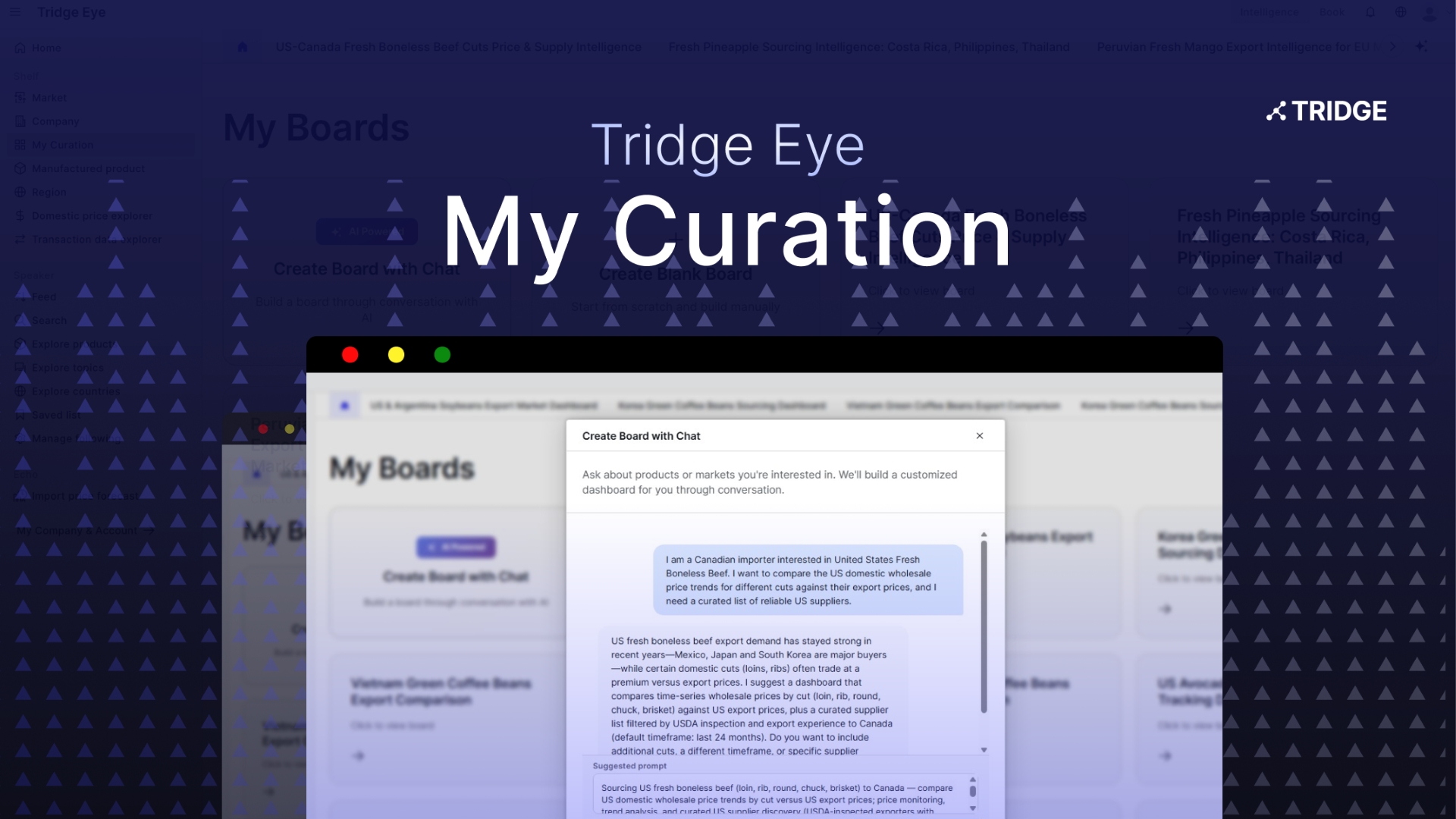
The insights in this report are just the starting point. Tridge Eye is the data intelligence solution that gives procurement and sourcing leaders real-time market signals, price benchmarks, and supply risk alerts — so you can act before the market moves.
Explore Tridge Eye →

References

  1. gcca.org
  2. foodnavigator.com
  3. ers.usda.gov
Subscribe
By subscribing you agree to with our Privacy Policy and provide consent to receive updates from our company.
Thank you! Your submission has been received!
Oops! Something went wrong while submitting the form.
Subscribe to receive the latest blog posts, updates, promotions, and announcements from Tridge.