
This report is powered by Tridge market intelligence.
Every data point, price signal, and supply chain insight in this analysis is drawn from the same engine that procurement teams worldwide rely on daily. As you read, consider what this level of visibility could do for your category.
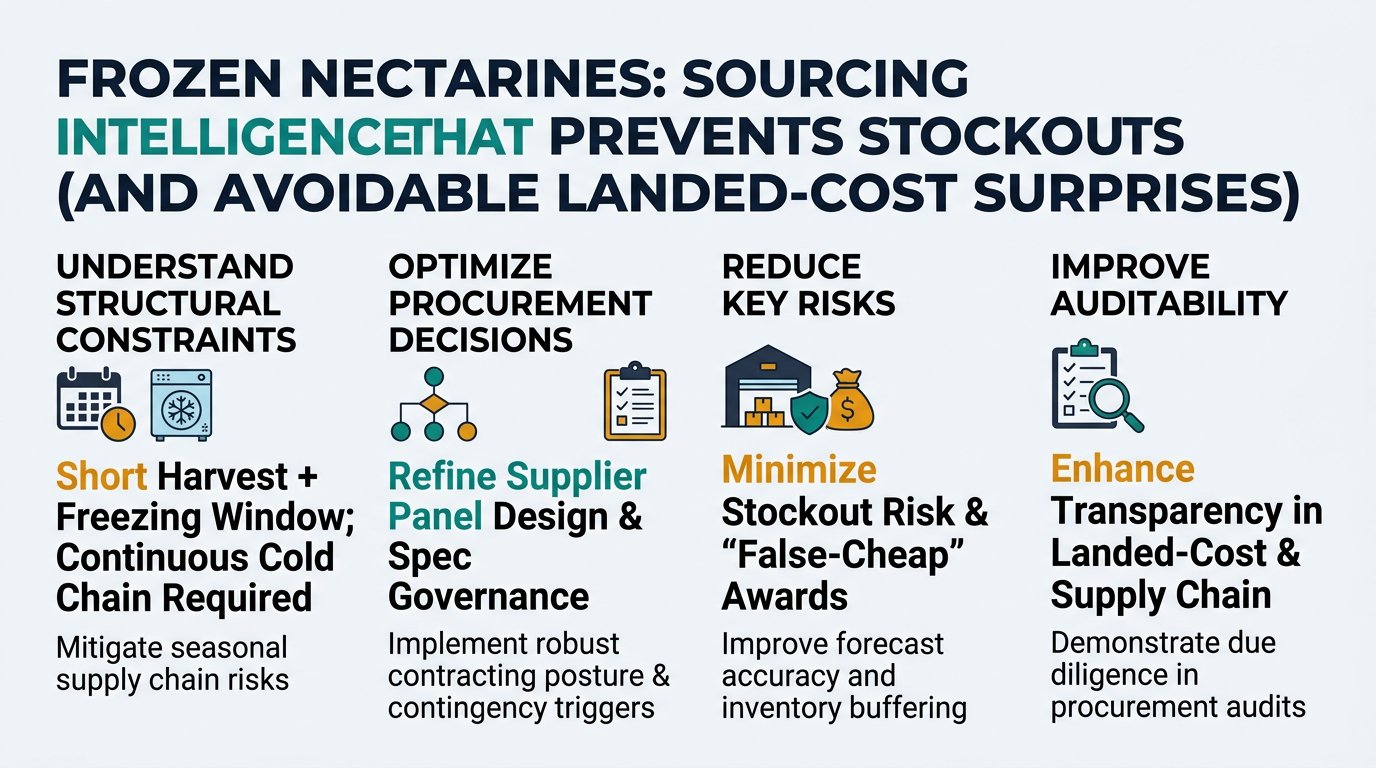
Frozen nectarines look like a simple frozen-fruit line item, but they behave like a seasonal, capacity-constrained supply chain that must fund year-round inventory and a continuous cold chain. This guide translates those realities into procurement decisions—supplier panel design, spec governance, contracting posture, and contingency triggers—so Purchase / Product & Category Managers can reduce stockout risk, avoid “false-cheap” awards, and improve auditability.
(Analyzed at: Mar, 2026)
Frozen nectarines are not a “continuous production” category. They’re a short-harvest, short-processing-window commodity that gets turned into year-round inventory. That single structural reality explains most of the pain procurement teams experience: price swings, allocation, quality drift, and surprise logistics costs.

Key insight: Frozen nectarines behave like a hybrid of agriculture + manufacturing + cold-chain logistics. Even if farmgate fruit is stable, energy, labor, packaging, and reefer logistics can move your delivered cost meaningfully—especially for IQF.
Below is a practical, procurement-oriented breakdown by node. Percent ranges are illustrative modeling for delivered cost to your DC (not retail shelf price), and will vary by origin, season tightness, and contract coverage.

| Supply chain node | Cost ratio (% of delivered cost) | What typically moves it |
|---|---|---|
| Raw material (fruit) | 35–50% | Crop size/quality, fresh-market pull |
| Primary processing | 10–18% | Yield loss, labor, throughput |
| Freezing / secondary processing | 8–15% | IQF capacity, energy |
| Packaging & QA | 6–10% | Film/carton, testing, labeling |
| Cold-chain logistics & storage | 12–22% | Reefer rates, cold storage, dwell |
| Trade / duties / brokerage | 0–12% | Origin, HS classification, duty rate |
| Supply chain node | Cost ratio (% of delivered cost) | What typically moves it |
|---|---|---|
| Raw material (fruit) | 35–48% | Same as IQF |
| Primary processing | 12–20% | More cutting; yield and labor |
| Freezing / secondary processing | 7–13% | Energy, line efficiency |
| Packaging & QA | 5–9% | Case pack, foreign material controls |
| Cold-chain logistics & storage | 12–22% | Same as IQF |
| Trade / duties / brokerage | 0–12% | Same as above |
| Supply chain node | Cost ratio (% of delivered cost) | What typically moves it |
|---|---|---|
| Raw material (fruit/trim streams) | 30–45% | Input availability, competing uses |
| Primary processing | 8–15% | Receiving/sorting, basic prep |
| Secondary processing (puree) | 10–18% | Milling/finishing, QA |
| Packaging & QA | 6–12% | Aseptic vs frozen packs, labeling |
| Cold-chain logistics & storage | 10–20% | Storage and transport weight/format |
| Trade / duties / brokerage | 0–12% | Same as above |
Important structural fact: Frozen nectarines are built around harvest + processing allocation. If you miss coverage during the freezing window, you don’t just pay more later—you may be forced into:
This is why “spot buying” in frozen stone fruit is often a false economy.
Frozen-nectarine RFQs often fail because they compare offers that are not economically equivalent.
This is where sourcing intelligence earns its keep: not by “finding cheap suppliers,” but by changing the timing and quality of decisions.
Break the spec into:
Measured outcome: lower claim rate, fewer line stoppages, fewer spec waivers.
Pre-agree:
Measured outcome: improved service level during tight seasons.
Build a simple exposure view:
Measured outcome: reduced single-origin exposure and faster recovery time.
The same “short window → year-round inventory” and “spec realism vs supplier pool” dynamics show up in:
If you build your organization’s muscle on frozen nectarines—panel depth, spec governance, cost-driver negotiation—you can reuse it across these categories.
Frozen nectarines are a compact case study where intelligence clearly connects to outcomes because:
Run a 45-day “category reset” sprint:
Take Your Sourcing Intelligence to the Next Level
The insights in this report are just the starting point. Tridge Eye gives you real-time market signals, origin risk alerts, and price benchmarks — so you can act before the market moves.