

Frozen mango puree looks like a simple farm-to-freezer flow, but most cost and service outcomes “lock in” at a few irreversible points: fruit-to-puree yield, freezer throughput/capacity, and lane-level cold-chain execution. This guide maps the physical chain, highlights the cost drivers procurement and ops can actually influence, and flags the structural constraints you can’t negotiate away.
Frozen mango puree is a harvest-built, inventory-sold ingredient: processors convert highly perishable fruit into a stable (-18°C) industrial input, then carry cold storage and working capital to supply buyers year-round. The physical chain is short on paper (farm → plant → freezer → reefer → buyer), but cost accumulates at every handoff because each step has a non-negotiable constraint: fruit quality/yield upstream, hygienic thermal control in processing, and uninterrupted cold-chain power/handling in logistics.
Insight: The biggest fixed cost-drivers are (1) yield loss (peel/seed/defects), (2) energy intensity (pasteurization + freezing + frozen storage), and (3) cold-chain execution (reefer availability, setpoint discipline, and temperature-excursion risk).
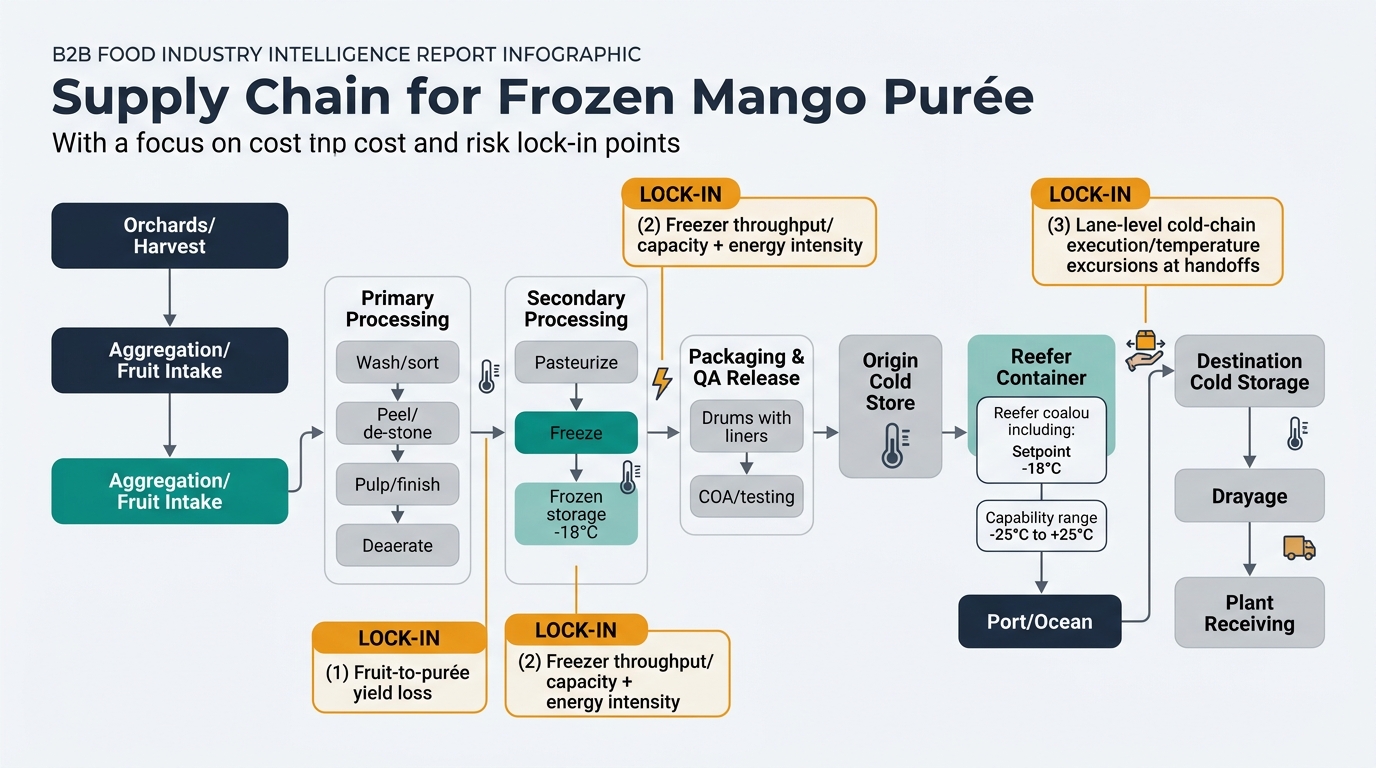
Data: Frozen foods are commonly stored/transported at -18°C (0°F) as a global set point. [1] Reefer containers commonly operate around -25°C to +25°C (model-dependent), with some fleets specifying ranges like -30°C to +30°C. [5]
Procurement Impact: Even before any “market” dynamics, your landed cost and service outcomes are structurally shaped by fruit-to-puree conversion efficiency, freezer capacity, and lane reliability—not just the supplier’s ex-works price.
Insight: Frozen mango puree economics are dominated by irreversible conversion steps: once fruit is peeled, de-stoned, finished, pasteurized, and frozen, most cost is “baked in,” and downstream players mainly manage cold-chain integrity and handling efficiency.
Data: “Single-strength” mango purée is commonly referenced in the ~14–18 °Brix band in market guidance and supplier technical sheets, though definitions vary and some standards set different minimums (e.g., one US specification lists mango at 13.5 °Brix minimum for single-strength in a broader fruit purée standard). [2]
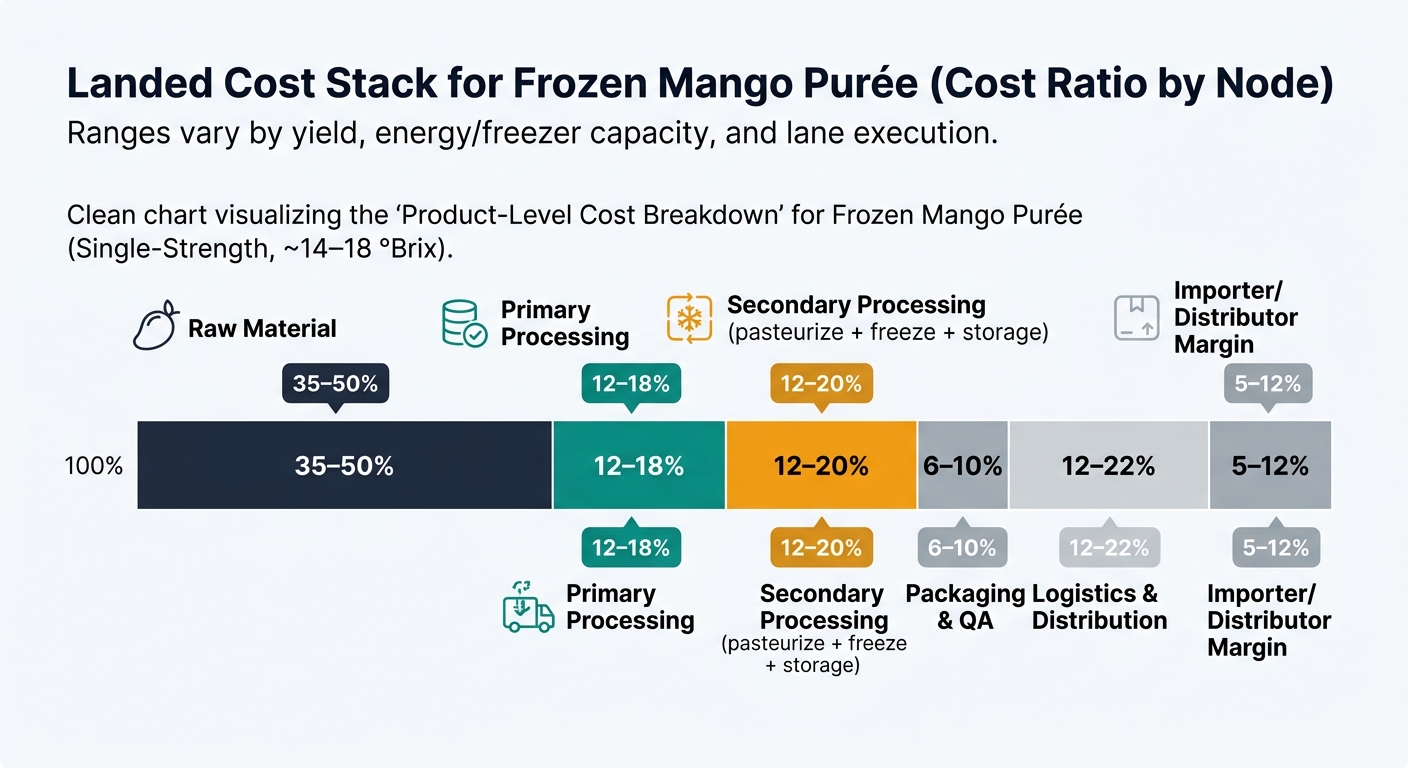
Procurement Impact: The cost stack is best understood as a yield + energy + cold-chain model. If you see unexplained cost deltas between suppliers, they often trace back to (a) fruit grade/yield, (b) freezing/storage energy and throughput, or (c) pack format and lane execution.
| Supply Chain Node | Cost Ratio (% of Final Cost) | Notes |
|---|---|---|
| Raw Material Cost (fresh mangoes) | 35–50% | Dominated by effective yield (defects + peel/seed loss) and variety-driven solids. |
| Primary Processing | 12–18% | Sorting/trim, pulping/finishing, sanitation, labor; tighter fiber control can raise cost. |
| Secondary Processing (pasteurize + freeze + storage) | 12–20% | Energy + freezer throughput + frozen storage rent/overhead; capacity is a constraint. |
| Packaging & QA | 6–10% | Liners, drums/cartons, pallets, labeling/traceability, micro/analytical testing. |
| Logistics & Distribution | 12–22% | Inland cold moves + reefer ocean + destination cold storage/drayage; high variance. |
| Importer/Distributor Margin | 5–12% | Inventory financing, cold storage management, shrink/claims handling. |
| Supply Chain Node | Cost Ratio (% of Final Cost) | Notes |
|---|---|---|
| Raw Material Cost | 30–45% | Higher solids target can increase fruit requirement per finished kg. |
| Primary Processing | 10–16% | Similar steps, but tighter control needed to hit concentration targets. |
| Secondary Processing (incl. concentration step) | 15–25% | Additional thermal/evaporation energy and equipment; different quality risks (cooked notes). |
| Packaging & QA | 6–10% | COA rigor increases due to concentration and application sensitivity. |
| Logistics & Distribution | 10–18% | Lower water content can reduce shipped mass per solids delivered, but still cold-chain if frozen. |
| Importer/Distributor Margin | 5–12% | Similar financing and handling costs; depends on format and channel. |
| Supply Chain Node | Cost Ratio (% of Final Cost) | Notes |
|---|---|---|
| Raw Material Cost | 30–45% | Similar fruit economics; variety drives flavor and solids. |
| Primary Processing | 10–16% | Pulping/finishing/standardization before sterilization. |
| Secondary Processing (aseptic sterilization + filling) | 12–22% | Commercial sterility targets and aseptic line overhead. |
| Packaging & QA | 8–14% | Aseptic bags/drums, sterility assurance, documentation. |
| Logistics & Distribution | 6–14% | Ambient ocean freight reduces cold-chain costs; different storage constraints. |
| Importer/Distributor Margin | 5–12% | Often lower cold storage burden, but higher QA documentation burden. |
Insight: Frozen mango puree behaves like a manufactured ingredient, but it is still anchored to agricultural biology and cold-chain physics—two constraints that create predictable failure modes.
Data: Industry and market guidance commonly reference (a) mid-teens °Brix for single-strength mango purée, and (b) frozen storage/transport anchored around -18°C. [2]
Procurement Impact: If you plan inventory and lanes as if this were a shelf-stable commodity, you will under-estimate both lead-time variance and quality-hold risk.
Key Takeaways: Treat frozen mango puree as a cold-chain manufacturing system, not a simple agricultural import. Your biggest predictable losses come from yield variance, energy/capacity constraints, and temperature excursions at handoffs.
(Analyzed at: Aug, 2026)
Build your next frozen mango purée award around a lane-qualified cold-chain clause: require -18°C setpoint, a consistent receiving-temperature window, and downloadable time/temperature records tied to each lot, then pre-approve one alternate port/routing with your forwarder. This works because 2025–2026 industry initiatives are pushing more standardized frozen temperature monitoring, while effective reefer capacity and trade-route disruption risk remain uneven—so the avoidable losses are at handoffs, not in the purée itself. [8] If you don’t formalize it, you’ll keep paying for “invisible” costs—quality holds, claims, and emergency cold storage—that can easily eat a few points of landed cost during a single disrupted quarter.


