This report is powered by Tridge Eye Data Intelligence.
Every data point, price signal, and supply risk insight in this analysis comes from the same platform that procurement and sourcing leaders worldwide rely on daily. As you read, consider what this level of market intelligence could do for your sourcing decisions.
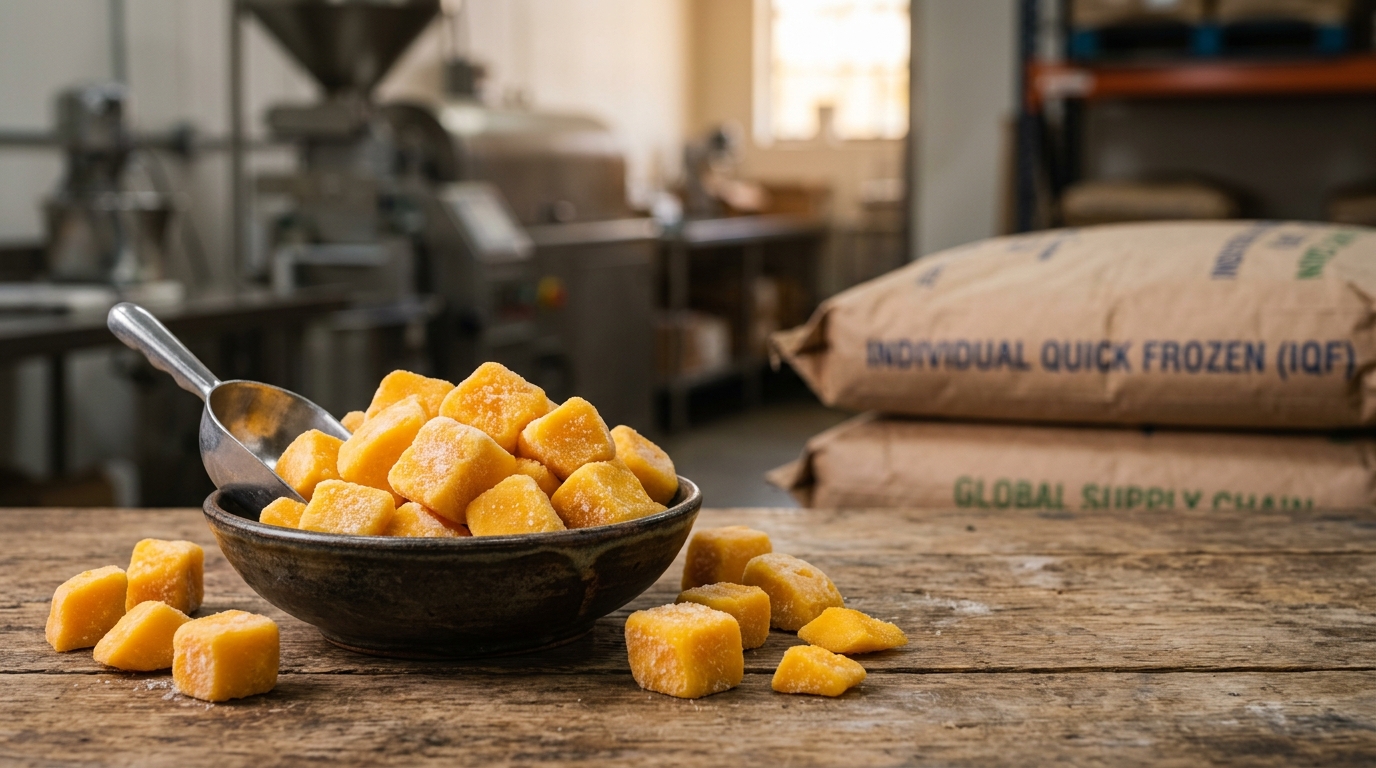
Frozen mango is deceptively simple: a “bag of fruit” that behaves like an engineered ingredient with agricultural volatility, processing yield economics, and cold-chain fragility baked into the delivered outcome. This guide is written for procurement and sourcing leaders who are strong buyers in other categories but want a decision-ready model for frozen mango—how to structure RFQs, compare suppliers like-for-like, negotiate with cost-driver context, and build contingency readiness without over-claiming what data (or any intelligence service) can guarantee.
(Analyzed at: Mar, 2026)
Frozen mango looks like a simple ingredient, but procurement outcomes (cost variance, service failures, claims, recalls) are mostly determined before you ever see a quote—by origin seasonality, processing yield economics, and cold-chain execution.
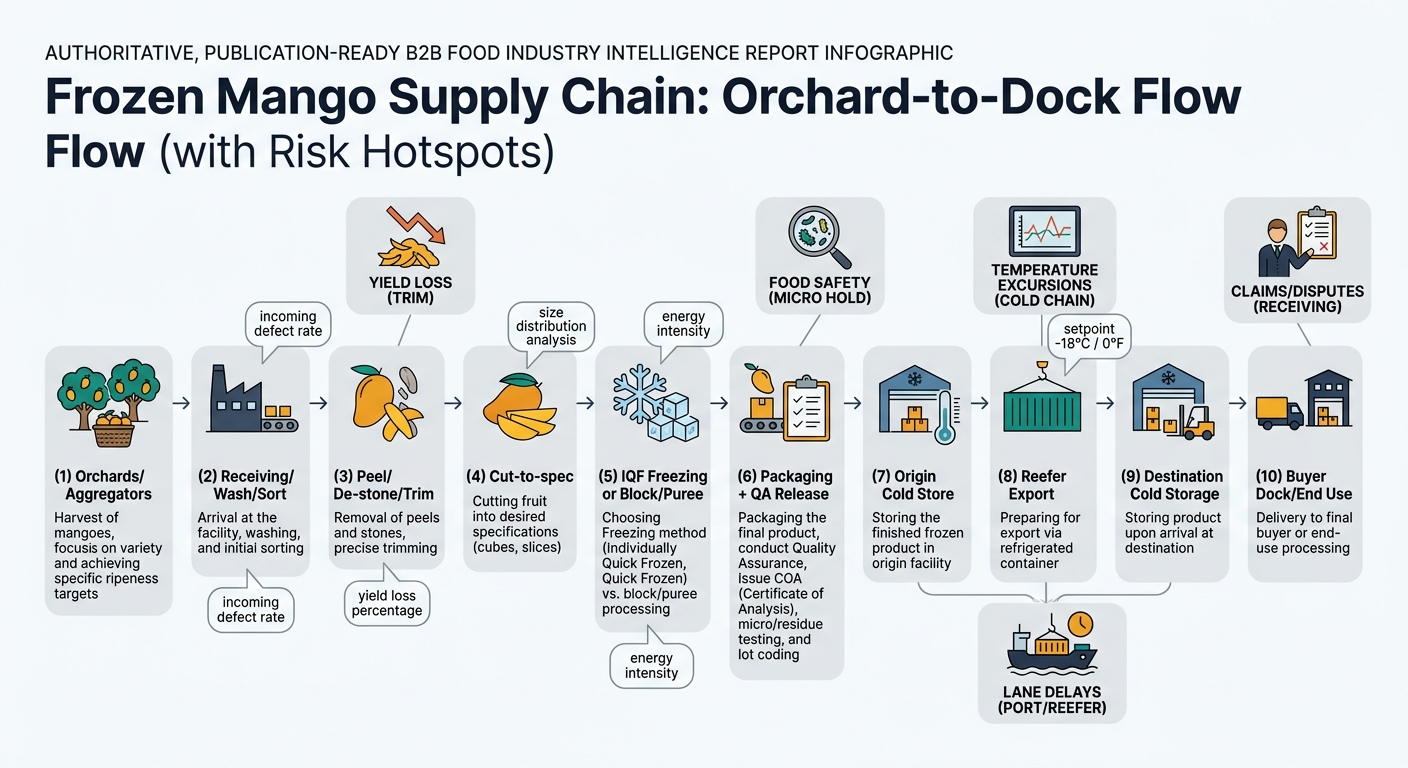
Key insight: In frozen mango, unit price is a lagging indicator. The leading indicators are raw fruit availability vs fresh-market pull, processing yield, energy + packaging, and reefer lane reliability.
Below is a practical cost-stack view you can use to sanity-check supplier narratives during RFQs and negotiations.
Modeled cost ratios as % of final delivered cost to a U.S. buyer dock. Actuals vary by origin, season, spec tightness, Incoterms, and freight market.
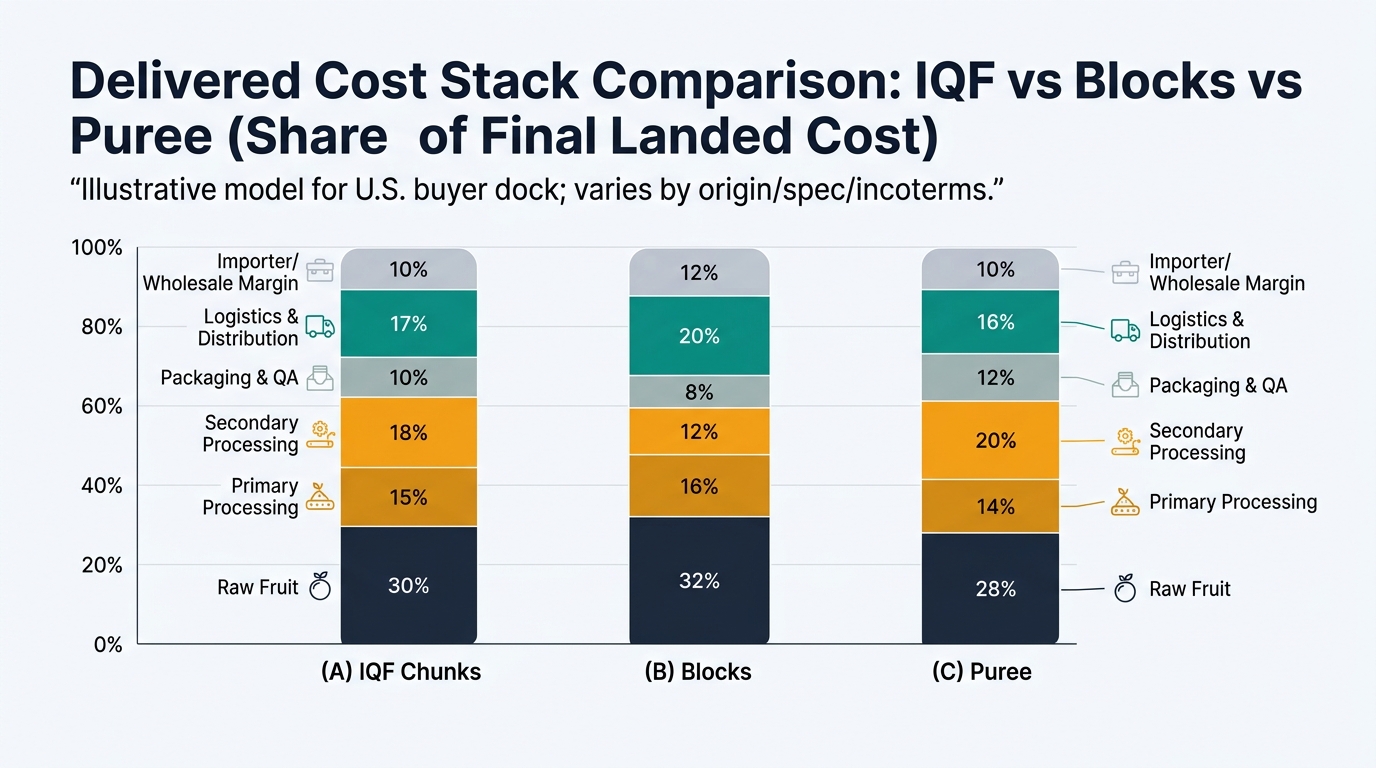
| Supply Chain Node | Cost Ratio (% of Final) | What moves it most |
|---|---|---|
| Raw fruit | 30% | Crop size/quality, fresh-market pull |
| Primary processing | 15% | Labor + trim/yield loss |
| Secondary processing (IQF) | 18% | Energy + throughput + rework |
| Packaging & QA | 10% | Film/cartons + testing/traceability |
| Logistics & distribution | 17% | Reefer freight + cold storage + claims |
| Importer/wholesale margin | 10% | Inventory buffering + service scope |
| Supply Chain Node | Cost Ratio (% of Final) | What moves it most |
|---|---|---|
| Raw fruit | 32% | Fruit cost and variety |
| Primary processing | 16% | Yield and labor |
| Secondary processing (block) | 12% | Lower piece-spec cost than IQF |
| Packaging & QA | 8% | Liners/cartons + release testing |
| Logistics & distribution | 20% | Weight efficiency helps; delays still costly |
| Importer/wholesale margin | 12% | Often higher service + financing |
| Supply Chain Node | Cost Ratio (% of Final) | What moves it most |
|---|---|---|
| Raw fruit | 28% | Fruit price; puree can use more offcuts |
| Primary processing | 14% | Sanitation + yield |
| Secondary processing (puree finishing) | 20% | Finishing/filtration + energy |
| Packaging & QA | 12% | Drum/BIB cost + micro program |
| Logistics & distribution | 16% | Cold storage + handling |
| Importer/wholesale margin | 10% | Service scope |
Frozen mango is a category where two suppliers can quote the same $/lb and deliver very different economics:
Procurement implication: treat “price” as price × probability-adjusted service (OTIF + claim risk), not as a standalone KPI.
In many food commodities, buyers expect farm-gate changes to explain downstream prices. Frozen mango breaks that intuition because pricing often “disconnects” due to:
Practical takeaway: build negotiation narratives around driver decomposition (fruit, yield, energy, packaging, freight, FX) rather than debating a single all-in number.
This is not about replacing audits, lab testing, or legal review. It’s about improving decision speed and decision quality.
The frozen mango lesson generalizes: true cost = unit price + risk-adjusted service + governance readiness.
Examples procurement teams commonly recognize:
In each, intelligence improves outcomes by separating structural drivers from supplier-specific behavior, and by keeping alternates pre-qualified.
Frozen mango is a procurement “stress test” category because it combines:
If your organization can build a repeatable, intelligence-driven operating model here—spec discipline, cost-driver negotiation, contingency readiness, and traceable governance—you can replicate it across other frozen fruit and high-volatility food ingredients.

Make Faster, Data-Driven Sourcing Decisions
The insights in this report are just the starting point. Tridge Eye is the data intelligence solution that gives procurement and sourcing leaders real-time market signals, price benchmarks, and supply risk alerts — so you can act before the market moves.