INDUSTRY TRENDS

Frozen Lychee Sourcing (Mar 2026): How to Control Landed Cost, Supply Risk, and Spec Drift in a Season-Built Category

Author
Team Tridge
DATE
March 8, 2026
9 min read
frozen-lychee Cover
Tridge — Trusted Global Food Sourcing

This report is powered by Tridge market intelligence.

Every data point, price signal, and supply chain insight in this analysis is drawn from the same engine that procurement teams worldwide rely on daily. As you read, consider what this level of visibility could do for your category.

See how Tridge Eye works →

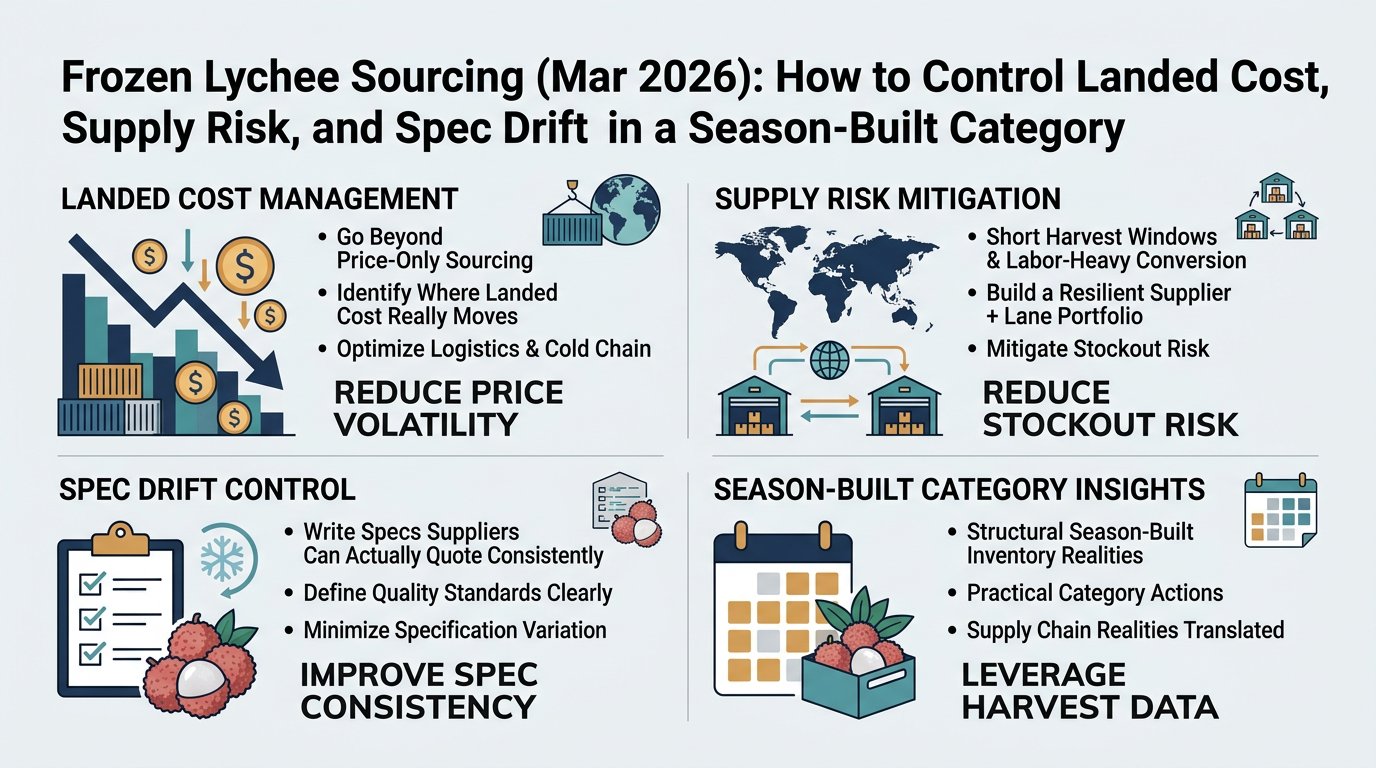
Frozen lychee is a deceptively small category that behaves like a “stress test” for procurement: short harvest windows, labor-heavy conversion, and cold-chain-dependent quality make price-only sourcing fragile. This guide translates frozen-lychee supply chain realities into practical category actions—how to write specs that suppliers can actually quote consistently, where landed cost really moves, and how to build a supplier + lane portfolio that reduces volatility and stockout risk.

Executive Summary

  • Season-built inventory is structural: In China, lychee harvesting is concentrated within ~1.5 months (late May–early July), which forces processors to build most annual frozen inventory right after harvest [1].
  • “Supplier + lane” is the true unit of approval: Reefer dwell time and temperature control can drive texture/drip-loss claims even when FOB is unchanged.
  • IQF vs block is a cost-to-serve decision, not a spec detail: IQF is designed to preserve piece integrity and reduce clumping; it typically costs more to produce but can reduce downstream handling loss and dosing variability.
  • Certifications help qualification—but don’t replace evidence: BRCGS Food Safety is GFSI-benchmarked and commonly used by brands/retailers as a qualification shorthand, but you still need lot consistency and lane performance data [2].
  • Negotiation leverage comes from driver-level conversations: The biggest controllables are (a) conversion yield and rework (peel/de-seed + foreign matter), (b) packaging/QA regimes, and (c) cold-chain service terms—not just raw fruit.

Key Insights

(Analyzed at: Mar, 2026)

  • Strategy: Hold
  • Reliability: Medium
  • Potential Saving: 6% ~ 12%
  • Insight: Treat frozen lychee as a season-built inventory category and contract around the post-harvest build: lock core volume with clear spec governance and lane requirements right after the main origin harvest window (for China, late May–early July), while keeping a smaller flexible tranche for late-season coverage with pre-qualified alternates. The savings typically come from fewer quality claims and lower “late-season premium” exposure rather than headline FOB reductions [1].

1) What You’re Really Buying: The Frozen-Lychee Supply Chain (Ground Truth)

Frozen lychee is not “fresh lychee, just colder.” It is a time-compressed supply chain designed to beat lychee’s rapid post-harvest deterioration (browning, texture loss, flavor fade). The commercial reality is:

  • The harvest window is short in key origins; in China it is concentrated within about one and a half months (late May–early July), so processors build inventory quickly and sell from frozen stock for months [1].
  • Processing is labor- and yield-sensitive: peeling/de-seeding creates unavoidable loss and introduces defect risk (broken arils, seed fragments, oxidation).
  • Cold-chain integrity is the product: temperature control is not just logistics—it’s texture, drip loss, and claims exposure.

End-to-end flow (what procurement should map to decisions)

  1. Grower/orchard aggregation → fruit maturity, variety mix, pesticide program, field sorting
  2. Harvest + rapid pre-cool → critical to slow browning and preserve aril integrity
  3. Primary processing (wash/sanitize, grading) → reject rate management
  4. Secondary processing (peel/de-seed, trim, foreign-matter control) → labor + yield + defect risk
  5. Freezing (IQF or block) → ice crystal formation drives texture outcomes
  6. Packing formats (retail bags, industrial 1–10 kg, drums for puree) → cost-to-serve + handling loss
  7. Cold storage + export (reefer ocean/air) → lane variability, excursions, dwell time
  8. Import handling + distribution → holds, testing, storage capacity, customer OTIF

Procurement implication: The “right” supplier is the one whose capability matches your spec + lane + governance model—not the one with the lowest FOB on a single quote.

A left-to-right flowchart showing the frozen-lychee journey as a time-compressed system from grower aggregation through harvest/pre-cool, primary and secondary processing, a freezing split (IQF vs block), packing formats, cold storage/export, and import distribution, with a bold callout that the approved unit is 'Supplier + Lane' and a side panel listing lane variables such as reefer setpoint, temperature logger requirement, excursion threshold, max dwell time, and claims/credit rules.

2) Where the Money Actually Goes: Cost & Margin Build-Up by Node (and by Product Form)

Below is an illustrative cost-and-margin decomposition. Use it as a negotiation and governance map (where to ask questions, where to audit, where to index), not as a universal truth.

2.1 Upstream / Raw Fruit (Orchard + aggregation)

Key insight: Frozen lychee cost starts with a seasonal raw fruit price spike concentrated into a short harvest window; in heavy crop years more fruit diverts to lower-value channels, but in tight years processors compete aggressively for suitable grades.

  • Main cost drivers
  • manual harvest labor
  • orchard inputs + compliance (pesticide programs, residue risk)
  • field sorting losses (cracked, overripe, browned)
  • Margin behavior
  • aggregators capture margin when supply is fragmented and buyers need speed during peak weeks

Seasonality anchor (planning reality): China’s harvesting season is concentrated within late May–early July (about 1.5 months) [1].

2.2 Primary processing (pre-cool, wash/sanitize, grading)

Key insight: This node determines the reject rate that later becomes your hidden cost (yield loss + more labor downstream).

  • Main cost drivers
  • energy for pre-cooling
  • water + sanitizers + wastewater control
  • sorting/grading labor
  • Margin behavior
  • plants that can document traceability and consistent grading earn “preferred” status and more stable allocations

2.3 Secondary processing (peeling/de-seeding, trimming, foreign-matter control)

Key insight: This is typically the highest conversion-cost step for IQF arils because it is labor-intensive and yield-sensitive.

  • Main cost drivers
  • peeling/de-seeding labor (throughput constraints)
  • yield loss (peel/seed + damaged arils)
  • foreign matter control (metal detection/X-ray) and rework
  • Margin behavior
  • processors with stable labor availability and strong QA systems can price a premium—especially for tight defect tolerances

2.4 Freezing method (IQF vs block) and what it does to cost-to-serve

Key insight: IQF isn’t just a format; it’s a performance promise (piece integrity, less clumping, better dosing in manufacturing). It usually costs more to produce but can reduce downstream handling loss.

  • IQF basics: IQF is a freezing method used in food processing; one of its key advantages is that the freezing process typically takes only a few minutes [3].
  • Why it matters: Faster freezing tends to produce smaller ice crystals, which generally helps preserve texture versus slower/block freezing (your QA will see this as lower mushiness/drip loss risk).
  • Cost drivers
  • energy intensity (freezing + cold storage)
  • freezer type/capacity utilization
  • higher QA expectations (piece integrity, defect counts)

2.5 Packaging & QA (where “cheap packaging” becomes expensive)

Key insight: Packaging is where suppliers either protect you from claims—or create them.

  • Main cost drivers
  • freezer-grade film + cartons + palletization
  • lot coding + traceability documentation
  • micro and residue testing regimes (market/customer dependent)
  • Margin behavior
  • certified systems (e.g., BRCGS Global Standard Food Safety) are often used as a shorthand qualification signal by retailers/brands; BRCGS Food Safety Issue 9 is GFSI-recognized [2].

2.6 Logistics & distribution (cold chain as a negotiated service)

Key insight: Reefer variability can erase a “good FOB” through temperature excursions, dwell time, and claim disputes.

  • Main cost drivers
  • reefer ocean freight, inland refrigerated trucking
  • cold storage at origin and destination
  • insurance/claims handling, demurrage/detention
  • Margin behavior
  • importers/distributors charge for risk absorption (inventory, compliance, service levels)

Product-level cost breakdown tables (illustrative % of final delivered cost)

Assumptions: Delivered cost to a North America/EU buyer; percentages vary by origin, season tightness, pack size, freight rates, and defect tolerance.

Three 100% stacked bars comparing delivered cost breakdown by product form (IQF arils, block frozen, puree/pulp), segmented by raw fruit and aggregation, primary processing, secondary processing, freezing, packaging and QA, logistics and cold storage, and importer/wholesale margin, with annotations for key differentiators and a footnote noting shares are illustrative and vary by origin, season tightness, pack size, freight rates, and defect tolerance.

A) IQF Lychee Arils (peeled & de-seeded)

Supply chain node Cost ratio (% of final delivered cost) What to watch in procurement
Raw fruit + aggregation 30–40% harvest window exposure; residue program; variety mix
Primary processing 6–10% reject rate transparency; pre-cool discipline
Secondary processing 18–28% labor throughput; seed fragment control; rework rate
Freezing (IQF) 6–10% freezer capacity utilization; piece integrity
Packaging & QA 6–10% lot coding; micro specs; packaging integrity
Logistics & cold storage 12–18% lane stability; reefer monitoring; dwell time
Importer/wholesale margin 8–14% service level, financing, compliance coverage

B) Block Frozen Lychee (industrial blocks)

Supply chain node Cost ratio (% of final delivered cost) What to watch in procurement
Raw fruit + aggregation 32–45% same as above; grade flexibility can reduce cost
Primary processing 6–10% sorting standards (less strict than IQF in some cases)
Secondary processing 12–20% lower piece-integrity requirement but still FM risk
Freezing (block) 4–8% core freezing time; block size consistency
Packaging & QA 5–9% block liners; thaw/leak risk
Logistics & cold storage 12–18% pallet stability; temperature controls
Importer/wholesale margin 8–14% similar service economics

C) Frozen Lychee Puree/Pulp (drums or pails)

Supply chain node Cost ratio (% of final delivered cost) What to watch in procurement
Raw fruit + aggregation 25–38% ability to use lower-grade fruit can buffer shortages
Primary processing 6–10% sanitation and wash controls
Secondary processing (pulping/finishing) 15–25% particle size, brix/acid targets, oxidation control
Freezing 5–9% freeze curve for drums; uniformity
Packaging & QA 7–12% drum liners, seals, sampling plans
Logistics & cold storage 12–20% drum handling damage; warehouse capability
Importer/wholesale margin 8–14% documentation + service levels

3) The Structural Fact That Drives Most Outcomes: Frozen Lychee Is a “Season-Built Inventory” Category

Because major origins have tight harvest windows (for China, concentrated late May–early July), the market is structurally forced into:

  • Inventory build right after harvest (processors run hard, buy raw fruit aggressively) [1]
  • Inventory drawdown for the rest of the year (availability depends on how much was frozen and the quality achieved)

Procurement consequence: Spot buying in the “wrong month” often means you’re buying from:

  • older lots (higher drift risk), or
  • constrained inventory (premium pricing), or
  • non-ideal specs (more defects, more breakage, more drip loss).

4) The Critical Insight: Why Your Spec and Your Landed Cost Decouple (Even When the Market Is “Flat”)

In frozen lychee, price doesn’t move as a single line item. It moves as three interacting systems:

  1. Raw fruit availability (season shock)
  2. A short harvest window concentrates risk; tight crop years re-rate raw fruit quickly.
  3. Conversion economics (labor + yield)
  4. Small changes in breakage, trimming standards, or seed-fragment limits can materially change throughput and rework.
  5. Cold-chain service cost (lane volatility)
  6. Reefer availability, port dwell time, and destination cold storage constraints can shift landed cost even if FOB is unchanged.

Practical takeaway: Two suppliers quoting the same FOB can produce very different true landed cost once you include:

  • defect-related yield loss in your plant,
  • claims/credits handling,
  • rework labor,
  • and service failures (late delivery, partial thaw, clumping).

5) The Common Procurement Mistakes (and Why They Keep Repeating)

  1. Treating IQF and block as interchangeable
  2. IQF often wins on dosing accuracy and less clumping; block can win on $/kg but may increase handling loss and variability.
  3. RFQing without “spec governance”
  4. If QA tolerances are vague (seed fragments, broken arils, browning), suppliers will quote to different internal interpretations.
  5. Over-indexing on certifications as a substitute for performance evidence
  6. Certifications matter, but they don’t replace lane data, lot consistency, and defect trend evidence.
  7. Using last PO price as the only benchmark
  8. In a season-built inventory category, last PO may reflect a different inventory position (post-harvest vs late-season).
  9. Not contracting the cold chain
  10. If temperature monitoring, excursion thresholds, and claims rules aren’t explicit, you’ll pay in disputes, not price.

6) What Changes When You Run This Category with Intelligence (Not Gut Feel)

Below is how an intelligence-driven service changes decisions—mapped to a category manager’s real workflows.

Capability 1: Price intelligence & landed-cost decomposition

Decision shift: From “negotiate FOB” → to “negotiate the right cost drivers.”

  • Break price into: raw fruit, conversion (peel/de-seed), freezing energy, packaging, cold storage, freight, FX.
  • Establish should-cost ranges by product form (IQF vs block vs puree) and by pack format.
  • Decide when to use fixed price vs indexed components (e.g., freight or energy pass-through with caps).

Outcome you can measure: Reduced landed-cost volatility (variance) and fewer surprise surcharges.

Capability 2: Supplier benchmarking & qualification intelligence

Decision shift: From “lowest quote shortlist” → to “risk-adjusted shortlist.”

Benchmark suppliers on:

  • operational footprint (freezer capacity signals, cold storage access)
  • compliance readiness (audit cadence, documentation discipline)
  • customer/market presence signals (who trusts them for tight specs)

Outcome you can measure: Higher first-pass qualification rate (fewer failed samples / fewer re-audits).

Capability 3: Supply chain risk monitoring

Decision shift: From “react after shortage” → to “trigger early qualification and buffers.”

  • Monitor origin/season signals and logistics disruption signals.
  • Use triggers to start contingency actions (sample pulls, alternate lane booking, safety stock adjustments).

Outcome you can measure: Fewer stockouts and fewer emergency buys/premium freight events.

7) Strategic Use Cases a Category Manager Can Put on a Quarterly Plan

  1. Reduce landed-cost volatility without breaking the spec
  2. Build a cost driver model by form (IQF/block/puree)
  3. Define negotiation guardrails: what is indexable, what is fixed, what requires QA sign-off
  4. Pre-qualify backup suppliers before disruption hits
  5. Maintain a standing longlist filtered by: form capability, certifications, export history signals
  6. Rank by “time-to-qualify” (documentation completeness + sample readiness)
  7. Spec governance that prevents hidden cost
  8. Align procurement + QA on 5–7 measurable parameters (e.g., seed fragments, broken arils %, browning index proxy, brix range where relevant)
  9. Set escalation thresholds (block, rework, credit, corrective action)
  10. Lane qualification as part of supplier qualification
  11. Treat “supplier + lane” as the unit of approval
  12. Require temperature monitoring evidence and define excursion rules
  13. Portfolio design to reduce concentration risk
  14. Balance: one large-scale supplier (volume) + one flexible MOQ supplier (agility)
  15. Consider counter-seasonal options (where commercially viable) to reduce single-window dependence

8) Why This Matters Beyond Lychee (Examples Your Team Likely Also Buys)

Frozen lychee is a clean example of a broader procurement pattern: when quality and logistics are inseparable, price-only sourcing fails.

Similar dynamics show up in:

  • Frozen berries (strawberry/raspberry/blackberry): food safety surveillance and contamination events can trigger holds/alerts; risk monitoring and supplier verification are essential [4].
  • Avocado pulp/puree (frozen): oxidation control, spec on particle size, and cold chain drive downstream performance in sauces and beverages.
  • Mango IQF/puree: harvest seasonality + conversion yield + pack format strongly affect landed cost and line performance.
  • Pineapple chunks (IQF): sugar/acid balance and piece integrity affect consistent taste and dosing; lane excursions show up as texture/drip loss claims.

Meta-lesson: Intelligence is most valuable where your category has:

  • short harvest windows,
  • labor-intensive conversion,
  • and cold-chain-dependent quality.

9) Why Frozen Lychee Is a Powerful Demonstration Category (for Prospective Customers)

Frozen lychee forces good procurement behavior because it makes trade-offs visible:

  • Cost vs. quality is measurable (defect rates, breakage, drip loss, claims)
  • Supply risk is structural (short harvest windows and inventory build cycles; for China, late May–early July concentration is a concrete example) [1]
  • Governance is non-negotiable (spec clarity, documentation, lane rules)

If a team can run frozen lychee with disciplined intelligence—supplier benchmarking, landed-cost decomposition, and trigger-based risk monitoring—the same operating model typically transfers well to other frozen fruits and cold-chain ingredients.

Take Your Sourcing Intelligence to the Next Level

The insights in this report are just the starting point. Tridge Eye gives you real-time market signals, origin risk alerts, and price benchmarks — so you can act before the market moves.
Explore Tridge Eye →

References

  1. fao.org
  2. brcgs.com
  3. en.wikipedia.org
  4. fda.gov
Subscribe
By subscribing you agree to with our Privacy Policy and provide consent to receive updates from our company.
Thank you! Your submission has been received!
Oops! Something went wrong while submitting the form.
Subscribe to receive the latest blog posts, updates, promotions, and announcements from Tridge.