INDUSTRY TRENDS

Frozen Lemon Sourcing (2026): How to Control Landed-Cost Volatility, Quality Risk, and Cold-Chain Failures with Smarter Supplier Panels

Author
Team Tridge
DATE
March 8, 2026
9 min read
frozen-lemon Cover
Tridge — Trusted Global Food Sourcing

This report is powered by Tridge market intelligence.

Every data point, price signal, and supply chain insight in this analysis is drawn from the same engine that procurement teams worldwide rely on daily. As you read, consider what this level of visibility could do for your category.

See how Tridge Eye works →

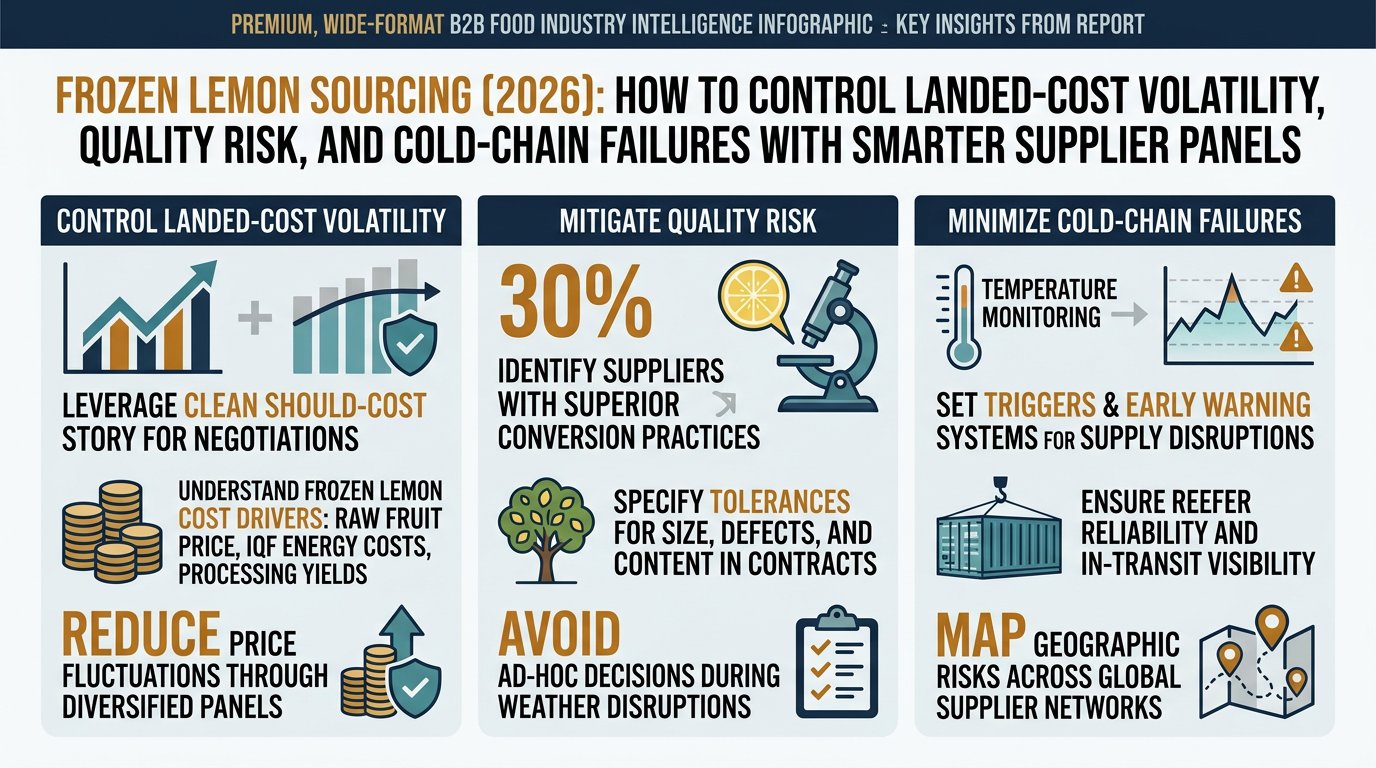
Frozen lemon is a deceptively complex category: it behaves like a fresh commodity (seasonal, weather-sensitive), but it’s priced and operationalized like a conversion + cold-chain product (cut/yield, IQF energy, reefer reliability). This guide is written for experienced procurement/category managers who know sourcing—but want a practical, frozen-lemon-specific playbook for building a resilient supplier panel, negotiating with a clean should-cost story, and setting triggers before disruptions force bad decisions.

Executive Summary

  • Category reality: Frozen lemon is a fresh-commodity base + conversion (cut/yield/IQF) + cold-chain category; “lowest case price” frequently loses once you include usable yield, claims, and expedites.
  • Cold-chain standard: Frozen products are typically expected to be held at -18°C (0°F) or colder through storage and distribution; temperature excursions create clumping/dehydration and downstream claims risk. [1]
  • Origin concentration (macro): Major lemon/lime producing origins that regularly matter in global supply discussions include Mexico, Turkey, and Argentina (among others). USDA/FAS reporting highlights material production changes in these origins (e.g., Mexico up, Turkey down in the Jan 2025 update). [2]
  • Freight volatility is still “real” in 2026: Container rates remain volatile; Drewry’s WCI in early March 2026 showed week-to-week movement and lane-level divergence—meaning delivered-cost swings can happen even when ex-works pricing is stable. [3]
  • Best-practice sourcing move: Build a format-specific supplier panel (primary/secondary/contingency) and manage the category using three negotiation lanes: fruit economics, conversion economics, and cold-chain economics.

Key Insights

(Analyzed at: Mar, 2026)

  • Strategy: Buy
  • Reliability: Medium
  • Potential Saving: 6% ~ 14%
  • Insight: In early 2026, the most reliable savings lever in frozen lemon is not “calling the bottom” on fruit—it’s locking operational resilience:
  • Re-balance awards toward suppliers with proven cold-chain performance and stable lead times.
  • Convert more spend to dual-sourcing by origin/format.
  • Add a freight/cold-chain adjustment lane (index-linked or trigger-based) so you stop renegotiating conversion margin every time reefer markets move.
  • Drewry’s March 2026 WCI update supports the case that container rates can still move week-to-week, so governance around freight pass-through and switch triggers is a practical 2026 advantage. [3]

1) What You’re Really Buying: The Frozen-Lemon Supply Chain in Plain English

Frozen lemon (slices, wedges, diced, IQF pieces, zest/peel, puree/pulp, and sometimes juice/concentrate inputs) is not just “lemons, frozen.” It’s a chain where fresh-market dynamics, yield loss during cutting, energy-intensive freezing, and cold-chain reliability decide your true landed cost and service performance.

Ground-truth flow (industrial + foodservice reality):

  1. Upstream / Raw material: fresh lemons (export grade + processing grade + culls/off-grade)
  2. Primary processing: wash/sanitize → grade/size → cut (rings/wedges/dice) → de-seed → anti-browning/oxidation controls (spec-dependent)
  3. Secondary processing:IQF freezing (or block freeze for some formats) → foreign matter controls (metal detect/X-ray) → rework
  4. Packaging & QA: bulk cartons (10–20 kg), foodservice bags, retail packs; COAs; micro + residues; traceability
  5. Logistics & distribution: origin cold store → export terminal → ocean reefer → destination cold store → last mile (all at frozen setpoints, typically ≤ -18°C)
  6. End markets: foodservice (bars, beverage programs, kitchens), retail, and industrial manufacturing
A left-to-right flowchart showing the end-to-end frozen lemon chain with labeled stages and risk callouts: upstream raw lemons (seasonality/weather, fresh-market diversion) to primary processing (wash/grade/cut/de-seed; yield loss; spec tightness) to secondary processing (IQF or block freezing; energy intensity; foreign matter controls like metal detect/X-ray) to packaging & QA (barrier film/liners; COA; micro + residues; traceability) to cold-chain logistics (origin cold store to export terminal to ocean reefer to destination cold store to last-mile frozen distribution) with a temperature integrity note of ≤ -18°C / 0°F target across nodes, ending in end markets (foodservice/retail/industrial), plus icons and three highlighted negotiation lanes (fruit economics, conversion economics, cold-chain economics).

Why this matters to a category manager:

  • Frozen lemon demand is year-round, but supply is seasonal at origin; suppliers “smooth” this by freezing during peak and holding inventory—so working capital + cold storage are embedded in the price.
  • A low unit price can be erased by:
  • temperature excursions (clumping, dehydration/freezer burn, browning)
  • higher defect/seed counts (yield loss in your operation)
  • missed OTIF leading to expedites and substitutions

Origin concentration is real. Large lemon-producing countries include Mexico, Turkey, Argentina, and others; global citrus statistics and USDA/FAS reporting show these origins are consistently material in supply availability and trade context. [2]

2) Where the Money Actually Goes: Cost & Margin Build-Up by Supply-Chain Node

Below is a practical “cost stack” view. The point isn’t precision to the decimal—it’s to show which levers move your landed cost and which ones mainly create risk.

2.1 Upstream / Raw Material (Fresh Lemons for Processing)

Key insight: Your frozen price often starts with a fresh-market competition problem. When fresh lemon prices rise, processors must pay more to secure fruit (or get smaller/less suitable fruit), which tightens frozen availability and pushes offers up.

What drives cost here:

  • Farmgate price linked to fresh-market pull (diversion effect)
  • Weather-driven yield and size distribution (more trimming loss later)
  • Harvest labor availability and wage inflation

Procurement “tell” that upstream is driving the move:

  • Suppliers cite fruit scarcity, smaller calibers, higher seed incidence, or shorter pack-out windows.

2.2 Primary Processing (Wash/Grade/Cut/De-seed)

Key insight: This is where specs become money. Tight cut-size tolerances, low seed counts, and low defect tolerances increase labor, rework, and yield loss.

Cost drivers:

  • Cutting labor or automation level (throughput)
  • Yield loss from end-trimming, seed removal, and defect sorting
  • Sanitation + water treatment and QA labor

Hidden margin dynamic:

  • Processors can offset economics via byproducts (peel/zest/oil streams), but that benefit varies widely by facility and market.

2.3 Secondary Processing (IQF Freezing + Foreign Matter Control)

Key insight: IQF is an energy + equipment utilization business. When energy costs rise or lines run below capacity, unit costs jump.

Cost drivers:

  • Electricity/gas for freezing tunnels/spirals
  • Line efficiency, downtime, and rework rates
  • Metal detection/X-ray performance and foreign matter incidents

Quality risk linkage:

  • Poor freezing performance shows up later as clumping, broken pieces, or dehydration.

2.4 Packaging & Quality Assurance

Key insight: Packaging is not “just packaging” in frozen lemon. It’s protection against dehydration and a compliance layer for audits and claims.

Cost drivers:

  • Film/liner quality (moisture barrier), carton strength, pallet stability
  • COA/testing frequency (micro + pesticide residues)
  • Traceability documentation and certification overhead

Compliance reality:

  • For EU-bound flows, pesticide residue compliance is governed by EU Maximum Residue Levels (MRLs), which creates testing/documentation cost and rejection risk when suppliers are not disciplined. [4]

2.5 Logistics & Distribution (Cold Chain)

Key insight: Cold-chain logistics can dominate delivered cost volatility even when ex-works pricing is stable.

Cost drivers:

  • Reefer ocean freight cycles, equipment availability, port dwell time
  • Demurrage/detention risk at congested nodes
  • Destination cold storage and last-mile frozen distribution

Why you should treat this as a separate negotiation lane:

  • Freight indices and market reporting show container rates can move materially over time, creating sudden delivered-cost swings that are not “supplier margin grabs.” [3]

2.6 End-Market Margin (Importer/Distributor/Your Internal Handling)

Key insight: The last margin layer is where volatility becomes visible to stakeholders (“why did our case cost jump?”). If you don’t separate commodity vs. conversion vs. cold-chain drivers, approvals get political.

Cost drivers:

  • Distributor margin + financing of inventory
  • Shrink/write-offs from temperature abuse
  • Internal handling and storage costs
A stacked bar chart (or three side-by-side stacked bars) visualizing modeled percent ranges of final delivered cost by supply-chain node for (A) IQF slices/wedges (foodservice bulk), (B) IQF dice/pieces (industrial), and (C) zest/peel (specialty), segmented into upstream raw lemons, primary processing, secondary processing (IQF), packaging & QA, cold-chain logistics & distribution, and trade/importer/distributor margin; includes min–max range styling and a callout emphasizing cold-chain logistics can be 10–25%+ and a major volatility driver.

Node-by-Node Cost Ratio Tables (Illustrative)

Modeled ranges as % of final delivered cost to your dock. Real ratios vary by origin, contract structure (FOB/CIF/DDP), pack size, and service model.

A) IQF Frozen Lemon Slices/Wedges (Foodservice bulk)

Supply Chain Node Cost Ratio (% of Final Delivered Cost) What Usually Moves It
Upstream raw lemons 25–40% Fresh-market pull, weather/yield
Primary processing (cut/de-seed/sort) 15–25% Spec tightness, labor, yield loss
Secondary processing (IQF + FM control) 10–20% Energy, utilization, rework
Packaging & QA 6–12% Barrier materials, testing regime
Cold-chain logistics & distribution 12–25% Reefer rates, dwell, cold storage
Trade + importer/distributor margin 8–18% Financing, service model

B) IQF Frozen Lemon Dice/Pieces (Industrial)

Supply Chain Node Cost Ratio (% of Final Delivered Cost) What Usually Moves It
Upstream raw lemons 25–45% Fruit price and availability
Primary processing 12–22% Cut size tolerance, defect sorting
Secondary processing 10–18% Energy and throughput
Packaging & QA 5–10% Bulk liners/cartons, COA
Cold-chain logistics & distribution 10–22% Reefer + cold store
Trade + margin 8–15% Channel structure

C) Frozen Lemon Zest/Peel (Specialty ingredient)

Supply Chain Node Cost Ratio (% of Final Delivered Cost) What Usually Moves It
Upstream raw lemons 20–35% Peel oil content, fruit availability
Primary processing 18–30% Zesting method, contamination control
Secondary processing 8–15% Freezing + sieving
Packaging & QA 6–12% Specialty packaging, testing
Cold-chain logistics & distribution 10–20% Cold chain
Trade + margin 10–20% Specialty ingredient markups

3) The Structural Fact That Explains Most Supplier “Surprises”

Frozen lemon is a “conversion + cold-chain” category built on a fresh commodity base.

That means your price and availability are a composite of:

  • Fruit economics (fresh vs. processing diversion)
  • Conversion economics (yield loss + labor + IQF energy)
  • Cold-chain economics (reefer + dwell + cold storage)

So two suppliers can quote the same CFR price but deliver radically different outcomes because:

  • one runs higher yields (better trimming/seed removal tech)
  • one has stronger cold-chain discipline and lower claims
  • one is effectively subsidizing price via byproduct monetization (not always stable)

4) The Critical Insight: Why “Lemon Prices” and Your Frozen Quotes Disconnect

Category teams often expect frozen lemon to track “lemon prices.” In practice, the linkage is lagged and filtered.

Three common disconnect mechanisms:

  1. Inventory smoothing: processors freeze during peak and sell from inventory later—so offers may reflect fruit bought months ago.
  2. Freight/energy can reprice faster than fruit: a reefer surge or port disruption can change delivered cost next booking cycle even if fruit is stable. [3]
  3. Spec-driven yield loss: tighter specs (seed count, defect tolerance, ring thickness) can raise conversion cost even when fruit is cheap.

What this changes in negotiation:

  • You need a should-cost narrative with three lanes (fruit, conversion, cold chain), not one headline index.

5) Where Procurement Teams Typically Misstep (Even Good Ones)

These are the repeatable failure modes I see when a team is strong in other categories but new to frozen lemon.

  1. Awarding on unit price instead of “delivered usable yield.”
  2. A cheaper wedge with higher seed/defect rate can cost more after line losses and complaints.
  3. Over-tight specs that shrink the supplier pool.
  4. You accidentally create single-origin/single-supplier dependency.
  5. Treating cold chain as a logistics afterthought.
  6. Reefer performance, dwell time, and temperature monitoring should be part of supplier qualification, not a post-award firefight.
  7. No pre-qualified backup bench.
  8. When disruption hits, you accept spec deviations under time pressure, increasing quality and brand risk.
  9. Weak audit trail for “why this supplier, why now.”
  10. Approvals slow down because the decision looks subjective.

6) What Changes When You Run This Category with Intelligence (Not More Spreadsheets)

This is not about “more data.” It’s about changing Monday-morning decisions: who is on panel, what you negotiate, and when you switch volume.

Decision 1: “Who should be on our approved panel by format?”

Capability used: Supplier discovery + supplier benchmarking

  • Build a longlist filtered by:
  • format capability (rings/wedges/dice/zest)
  • compliance readiness (GFSI/HACCP evidence, traceability depth)
  • cold-chain discipline signals (temp monitoring, claims handling)
  • Benchmark into a panel:
  • Primary: best reliability + acceptable cost
  • Secondary: cost-competitive + pre-qualified
  • Tertiary/spot: only for defined scenarios

Decision 2: “How do we negotiate without getting gaslit?”

Capability used: Price intelligence + cost driver tracking

  • Split the ask into lanes:
  • fruit component (seasonal + origin-driven)
  • conversion component (labor/yield/energy)
  • cold-chain component (reefer + cold storage + dwell)
  • Outcome: fewer circular negotiations, faster approvals.

Decision 3: “When do we trigger contingency suppliers?”

Capability used: Supply chain risk monitoring + alternative supplier identification

  • Set triggers tied to your exposure:
  • origin-level weather/production warnings
  • reefer congestion/dwell thresholds
  • supplier OTIF/claims deterioration
  • Pre-qualify backups with a lightweight plan:
  • samples against spec hierarchy
  • COA + residue testing alignment (especially for EU-bound)
  • packaging validation (dehydration risk)

Decision 4: “Can we prove governance and reduce key-person risk?”

Capability used: Procurement performance & governance analytics

  • Track:
  • supplier concentration by origin/format
  • realized vs. contracted pricing
  • exceptions (spot buys) with documented rationale

7) Strategic Use Cases You Can Apply Immediately (Frozen Lemon)

Use Case A: Reduce landed-cost volatility without service failures

  • What you do: separate cost lanes; award to a primary/secondary panel; add freight/energy adjustment logic where appropriate.
  • KPIs: landed-cost variance, expedites, OTIF, claims rate.

Use Case B: Build a contingency bench before disruption hits

  • What you do: map dependency by origin and format; pre-qualify 2–3 backups; define switch triggers.
  • KPIs: time-to-switch supplier, continuity during peak season, % volume covered by qualified alternates.

Use Case C: Spec rationalization to expand the supplier pool (without breaking the product)

  • What you do: define spec hierarchy:
  • Must-have: food safety, residue compliance, temperature integrity, critical sensory
  • Negotiable: ring thickness bands, minor cosmetic tolerances
  • KPIs: number of qualified suppliers, concentration risk, complaint rate.

Use Case D: Claims and quality cost-out through “delivered usable yield” scoring

  • What you do: score suppliers on defect/seed counts, breakage, dehydration, and temperature excursion evidence.
  • KPIs: write-offs, customer complaints, rework labor.

8) Why This Intelligence Approach Transfers to Other Categories You Likely Manage

Frozen lemon is a clean example of a broader procurement pattern: commodity base + conversion step + logistics constraint + compliance risk.

Similar logic shows up in:

  • Frozen berries (IQF): defect control, foreign matter risk, cold-chain claims, and panel design across origins (very similar operating model).
  • Juice concentrates (citrus or apple): spec-driven buying (Brix/acidity), commodity-linked volatility, and the need to separate raw material vs. processing vs. freight.
  • Nuts (e.g., almonds/pistachios): origin concentration + aflatoxin/quality compliance + price cycles; contingency benches matter.
  • Fresh vegetables with cold chain (e.g., ready-to-eat salads): logistics reliability and compliance are often bigger cost drivers than farmgate.

The transferable procurement habit is: don’t source the product—source the risk-adjusted outcome.

9) Why Frozen Lemon Is a High-Impact Proof Point for Prospective Customers

Frozen lemon is “small enough” to pilot quickly but “complex enough” to prove value.

It forces the right behaviors:

  • building a supplier panel by format capability (not vendor familiarity)
  • quantifying delivered usable yield (not just case price)
  • integrating cold-chain reliability into sourcing decisions
  • documenting triggers and fallbacks for governance

And it produces measurable outcomes within one or two buying cycles:

  • fewer expedites and substitutions
  • lower landed-cost variance
  • faster approvals due to clearer cost-driver narratives
  • reduced single-origin/single-supplier exposure

Take Your Sourcing Intelligence to the Next Level

The insights in this report are just the starting point. Tridge Eye gives you real-time market signals, origin risk alerts, and price benchmarks — so you can act before the market moves.
Explore Tridge Eye →

References

  1. ams.usda.gov
  2. fas.usda.gov
  3. drewry.co.uk
  4. food.ec.europa.eu
Subscribe
By subscribing you agree to with our Privacy Policy and provide consent to receive updates from our company.
Thank you! Your submission has been received!
Oops! Something went wrong while submitting the form.
Subscribe to receive the latest blog posts, updates, promotions, and announcements from Tridge.