
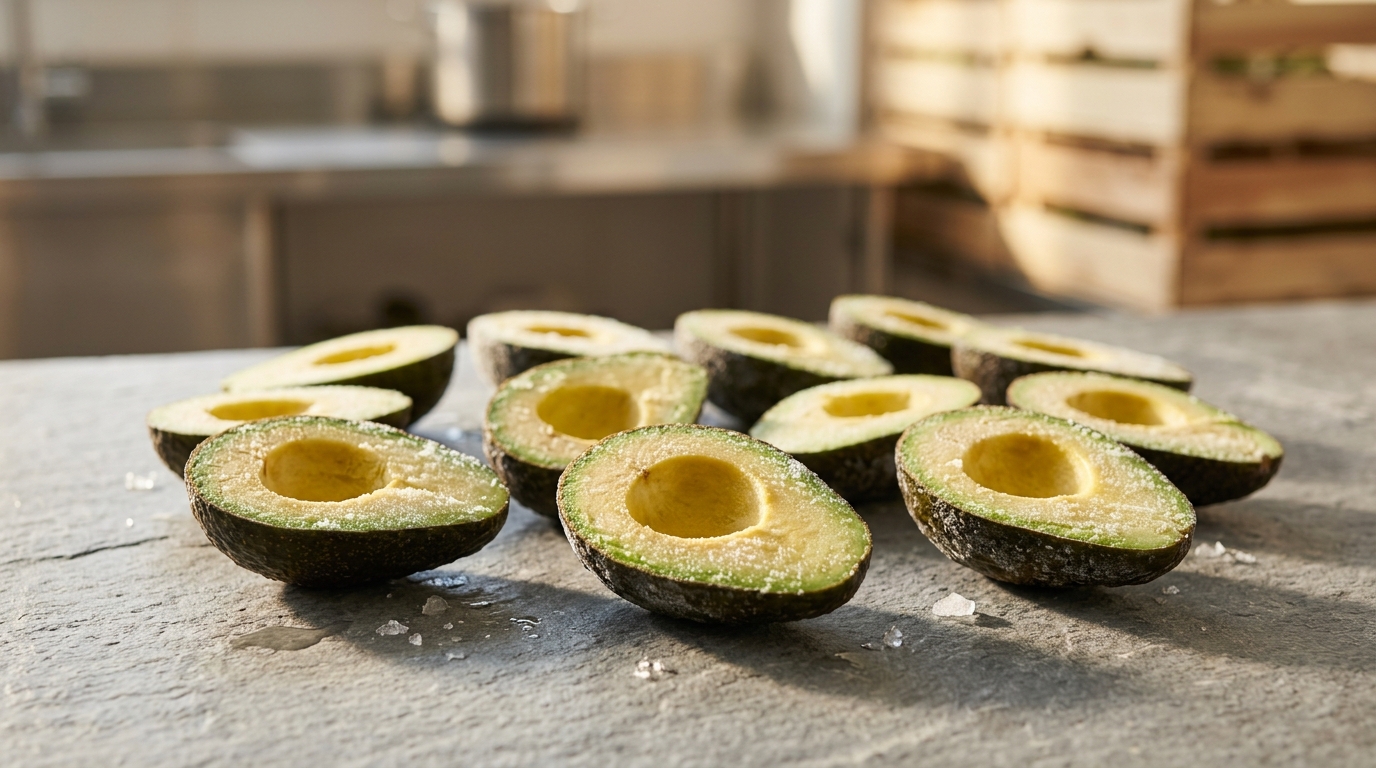
Frozen avocado halves sit in a narrow “conversion window” where fresh-fruit biology, labor-heavy processing, and cold-chain discipline determine whether you get commercially acceptable thaw performance months later. This guide maps the physical flow and highlights where cost and quality risk become irreversible—so QSC-focused purchasing teams can write tighter specs, change-control clauses, and verification plans without over-buying assurance.
Frozen avocado halves are built on a tight conversion window: mature Hass fruit must be handled gently, processed fast, and frozen hard enough to protect color/texture through months of storage. Unlike many frozen vegetables, the product’s value is set less by cooking performance and more by thaw appearance, drip loss, and oxidative browning—which means the chain’s fixed cost-drivers concentrate around raw fruit quality, labor-heavy halving/peeling, and cold-chain integrity.
The supply chain is a conversion pipeline from fresh-grade fruit into a frozen, appearance-sensitive finished good; the chain’s biggest “irreversible” losses happen before and during freezing (bruise/defect sorting, oxidation control, and IQF execution).
Typical physical flow: orchard harvest (maturity) → packhouse sorting → controlled ripening (often) → wash/sanitize → halving/pitting/peeling → anti-browning dip → IQF freezing → metal detection/packout → frozen storage → reefer export → destination cold storage → retail/foodservice distribution.
Your downstream nonconformance risk is often predetermined upstream: maturity, bruising, and process hygiene drive whether halves hold green color and clean texture after thaw, and cold-chain excursions amplify defects that look like “supplier quality” but are actually logistics-induced.

Frozen halves are a yield-and-labor business: processors must outbid the fresh market for suitable fruit, then manage conversion yield (whole halves vs trim/pulp) while running energy-intensive freezing and a zero-compromise cold chain.
The most common structural cost stack is (1) fruit input, (2) labor for peeling/halving and line throughput losses, (3) freezing energy + cold storage, (4) packaging/QA, and (5) reefer logistics.
The “expensive” part of the chain is not one line item—it is the compounding effect of fruit price + yield loss + labor + cold chain, which makes defect tolerances and pack style (retail vs foodservice) meaningful cost levers.

| Supply Chain Node | Cost Ratio (% of Final Cost) | Notes |
|---|---|---|
| Raw Material Cost (fresh fruit) | 45% | Dominant driver; must compete with fresh market pricing for suitable Hass fruit. |
| Packhouse / Export Prep | 6% | Sorting, grading, pre-cooling, and traceability setup. |
| Ripening + Primary Processing | 18% | Labor-heavy halving/peeling; yield loss from defects is embedded here. |
| Anti-browning + IQF Freezing | 10% | Dip ingredients + freezer energy/capex + throughput losses. |
| Packaging & QA + Frozen Storage (origin) | 8% | Bulk bags/cartons, testing, metal detection, storage holding cost. |
| Reefer Logistics + Destination Cold Storage/Distribution | 13% | Ocean/truck reefer, port handling, cold warehouse, domestic frozen transport. |
| Supply Chain Node | Cost Ratio (% of Final Cost) | Notes |
|---|---|---|
| Raw Material Cost (fresh fruit) | 40% | Similar fruit requirement; some suppliers tighten visual standards for retail-facing product. |
| Packhouse / Export Prep | 6% | Same physical function; higher spec discipline increases sorting losses. |
| Ripening + Primary Processing | 17% | Labor and yield remain central; retail often demands tighter size/appearance. |
| Anti-browning + IQF Freezing | 10% | Same technical requirement; more attention to clump control and appearance. |
| Packaging & QA + Frozen Storage (origin) | 14% | Higher packaging material cost (printed film, zippers), higher packout labor, more checkweigh/label controls. |
| Reefer Logistics + Destination Cold Storage/Distribution | 13% | Similar cold-chain dependence; retail adds more handling nodes downstream. |
| Supply Chain Node | Cost Ratio (% of Final Cost) | Notes |
|---|---|---|
| Raw Material Cost (fresh fruit + trim stream) | 35% | Often uses trim/off-grade from halves; input can be structurally cheaper per usable kg. |
| Packhouse / Export Prep | 5% | Lower visual standard reduces some sorting losses, but traceability still matters. |
| Primary Processing (pulping/dicing) | 20% | Mechanical processing, sanitation, and yield control dominate. |
| Anti-browning + Freezing | 12% | Oxidation control still required; freezing may be block or IQF depending on format. |
| Packaging & QA + Frozen Storage | 10% | Different packaging (tubs/liners), similar QA and storage needs. |
| Reefer Logistics + Destination Cold Distribution | 18% | Often shipped in larger, heavier formats; logistics share can rise. |
Frozen halves behave more like a “fresh-quality product preserved by freezing” than a typical frozen commodity; the chain is structurally constrained by biology (maturity), labor (conversion), and physics (cold chain).
Three non-obvious constants shape availability, cost, and defect patterns regardless of supplier:
If you only monitor COA pass/fail, you can miss the structural drivers of claims. The most predictive controls are often physical: maturity verification, time-to-freeze discipline, packaging barrier integrity, and end-to-end temperature evidence.
(Analyzed at: Aug, 2026)
Write your next frozen-avocado-halves agreement as a conversion-control contract, not just a spec-and-price deal: require documented maturity controls (e.g., DM-based maturity verification), a defined max time-from-cut to freeze, and explicit notification/approval for any change to dip chemistry, freezer throughput, or packaging barrier. This works because the biggest commercial failures (browning, drip loss, mushiness) are typically “baked in” at the conversion step and then amplified by cold-chain variability, and 2026 logistics volatility makes temperature evidence non-negotiable. Teams that formalize these controls usually avoid the quiet margin leak of thaw-related credits and downgrades—often a mid-single to low-double-digit share of annual spend when claims and rework are fully costed—while still keeping optionality to shift volume across origins when fresh-market competition tightens.


