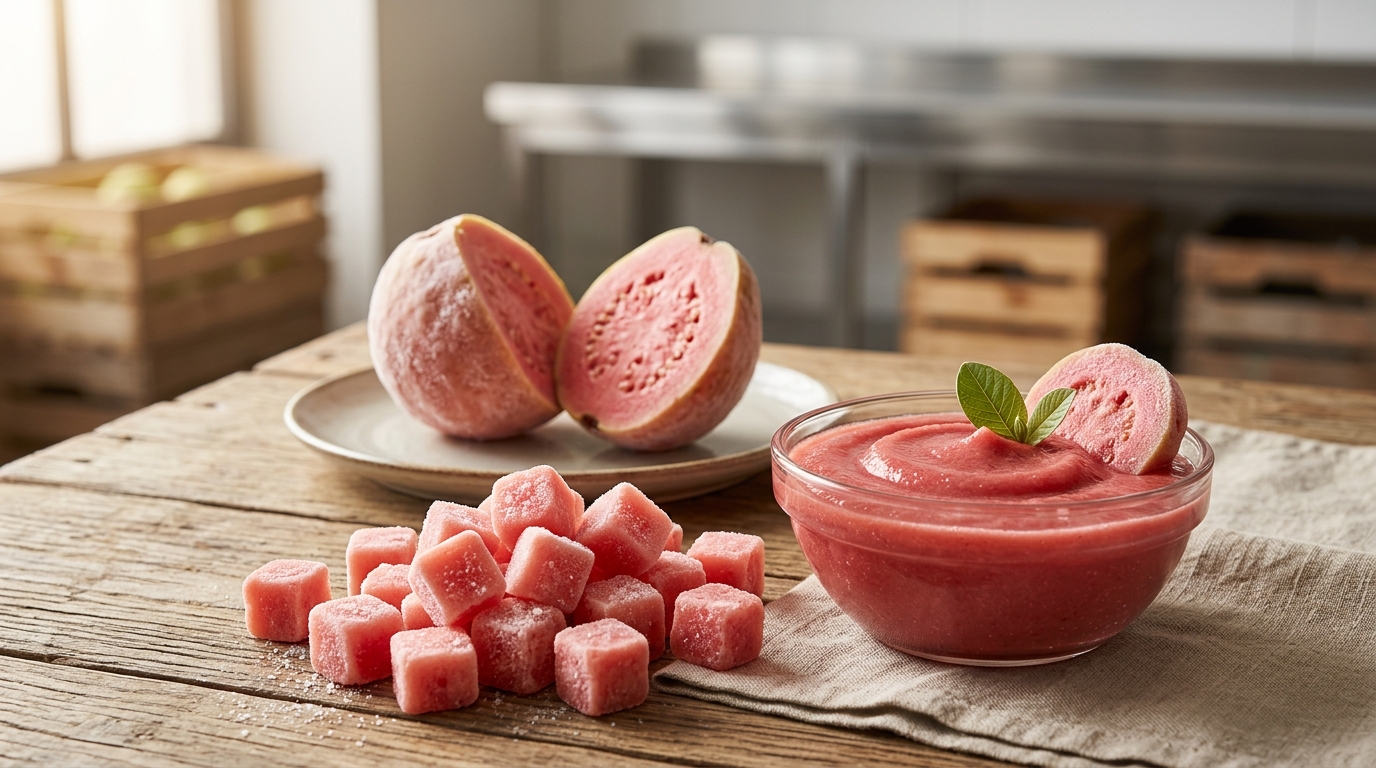
Frozen guava is best managed like a processed ingredient with a cold-chain dependency—not like a freely traded fresh fruit. This guide maps the physical flow, where cost and risk “lock in,” and how specs (°Brix, seed/particle limits, microbiology, packaging) translate into real capacity, lead time, and claims exposure for procurement teams.
Frozen guava is structurally a processed-ingredient supply chain, not a whole-fruit trade. Most exportable volume moves as guava pulp/puree (frozen blocks, pails, drums; and in some lanes aseptic drums) because guava bruises easily and loses value fast unless it is pulped and stabilized near farms.
Insight: The chain’s economics are set by three physical constraints: fast time-to-processing after harvest, pulping/finishing yield (seed/peel removal), and uninterrupted cold chain from freezer to destination.
Data: Single-strength guava puree is commonly standardized around ~8–11/12 °Brix, with specs controlling seed/black speck limits, particle size/mesh, pH/acidity, and microbiological targets; these specs drive rework, rejects, and usable yield.
Procurement Impact: Your landed cost and service risk are often determined earlier than you think—at raw fruit sorting/yield and at freezing + cold storage capacity, not only at ocean freight.

Insight: Frozen guava cost is a layered build-up: fruit yield loss + processing throughput + energy/cold storage + packaging + cold-chain logistics. Margins concentrate at nodes that control spec compliance (seed/mesh/color/micro) and availability of cold capacity.
Data: Guava processing creates meaningful byproduct streams (seed/peel fractions); effective separation and low rework are major unit-cost swing factors, while frozen formats add working-capital duration via cold storage.
Procurement Impact: When specs tighten (seed/mesh/micro), cost often rises non-linearly because plants shift from “run-rate production” to slower throughput + more sieving/rework + higher hold risk.

| Supply Chain Node | Cost Ratio (% of Final Cost) | Notes |
|---|---|---|
| Raw Material Cost (fresh guava) | 35–50% | Driven by farmgate price, field sorting, and conversion yield into spec puree. |
| Primary Processing | 12–18% | Pulping/finishing yield, rework/sieving for seed/mesh, labor, water/effluent. |
| Secondary Processing (freeze + cold storage) | 10–16% | Energy and cold-room capacity; longer dwell increases working capital. |
| Packaging & QA | 6–10% | Drums/pails/liners, labeling/traceability, lab testing, hold/release. |
| Logistics & Distribution (cold chain) | 12–20% | Reefer ocean + inland refrigerated trucking + cold storage + accessorials. |
| Distributor/Importer Margin | 6–12% | Consolidation, inventory risk, financing, and service levels. |
| Supply Chain Node | Cost Ratio (% of Final Cost) | Notes |
|---|---|---|
| Raw Material Cost (fresh guava) | 30–45% | Still yield-driven; concentrate economics depend on solids recovery. |
| Primary Processing | 12–18% | Includes puree making before concentration; tighter filtration often required. |
| Concentration Step (evaporation) | 8–14% | Energy + equipment utilization; may be limited-capacity vs puree lines. |
| Packaging & QA | 6–10% | Often drums; specs emphasize °Brix, acidity, and micro stability. |
| Logistics & Distribution | 10–18% | Lower freight per unit solids can offset extra processing energy. |
| Distributor/Importer Margin | 6–12% | Similar risk/financing profile; sometimes higher if niche. |
| Supply Chain Node | Cost Ratio (% of Final Cost) | Notes |
|---|---|---|
| Raw Material Cost (fresh guava) | 40–55% | Higher raw fruit quality requirement; more trimming loss. |
| Cutting/Preparation (pre-freeze) | 12–20% | Labor-intensive peeling/seed management; defect sorting is critical. |
| Freezing + Cold Storage | 10–18% | IQF/freezing throughput and freezer time; high energy intensity. |
| Packaging & QA | 6–10% | Bag integrity, metal detection, foreign matter controls, micro testing. |
| Logistics & Distribution | 12–20% | Same cold-chain exposure; more sensitive to thaw/refreeze texture damage. |
| Distributor/Importer Margin | 6–12% | Higher handling complexity for piece integrity and customer complaints. |
Insight: Frozen guava behaves like a capacity- and spec-constrained ingredient, not a freely fungible fruit commodity.
Data: Export supply is concentrated in a limited set of processing regions (notably parts of South/Southeast Asia and Latin America/Caribbean), and most trade is in processed formats (puree/pulp) requiring freezing (or aseptic packing), cold storage, and documentation.
Procurement Impact: Your continuity risk is structurally tied to processor throughput + freezer/cold-store access + quality-release discipline, so supplier changes are rarely “plug-and-play.”
Insight: Frozen guava’s physical cost structure is dominated by conversion yield, freeze/cold capacity, and spec-driven rework, with logistics acting as a multiplier when cold-chain dwell time increases.
Data: Most export trade is guava pulp/puree standardized around ~8–11/12 °Brix, packed in blocks/pails/drums, with tight controls on seed/particle size and microbiological release.
Procurement Impact: If you only compare price per kg, you miss the structural drivers of total cost: kg fruit per kg puree, hold/release time, cold storage exposure, and pack format fit (drums vs blocks) for your plant.
(Analyzed at: Apr, 2026)
Write your guava contract so spec compliance and cold-chain evidence are priced and governed like capacity, not treated as “included.” Concretely: lock a single release gate (°Brix/pH, mesh/seed/black speck, micro limits, pack format) and require shipment-level proof (COA detail plus temperature/handling records), then split award so at least 20–30% of volume sits with a qualified alternate that can hit the same gate. This works because, in 2026, reefer markets are more stable than crisis peaks but still exposed to schedule reliability and accessorial shocks—so the cheapest quote without execution proof is where claims and downtime usually originate. What’s at stake is rarely pennies on freight; it’s the avoidable cost of QA quarantine, write-offs, and emergency cover buys that can quietly add a high-single-digit percentage to landed cost when one weak node fails.