
This report is powered by Tridge Eye Data Intelligence.
Every data point, price signal, and supply risk insight in this analysis comes from the same platform that procurement and sourcing leaders worldwide rely on daily. As you read, consider what this level of market intelligence could do for your sourcing decisions.
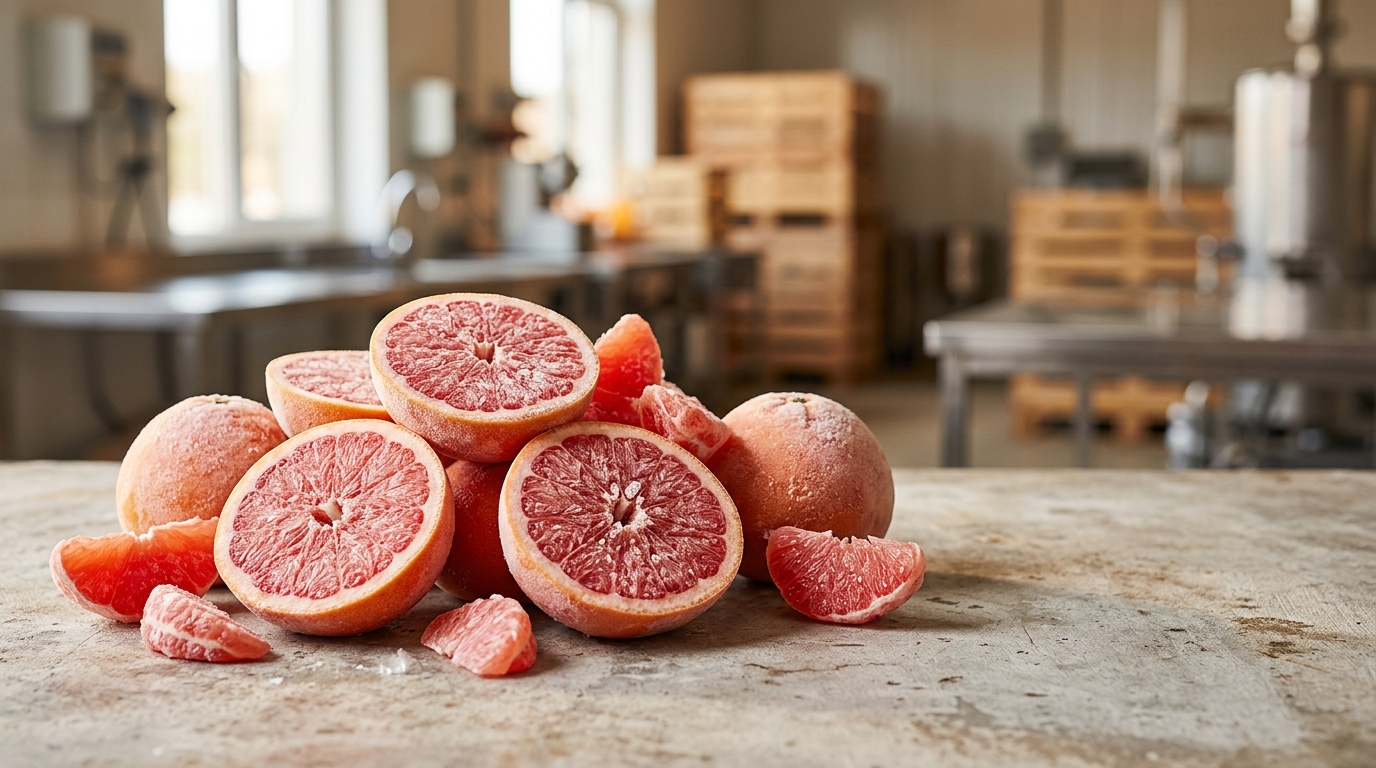
Frozen grapefruit is a “stored-season” category: you’re buying a short harvest/processing window, converted into year-round availability through freezing, inventory carry, and cold-chain execution. For procurement leaders, the practical challenge isn’t just unit price—it’s balancing conversion yield, processing slot access, and logistics reliability while staying inside QA/spec guardrails.
This guide maps the real supply chain behind frozen grapefruit and translates it into decisions procurement management owns: portfolio design (primary/secondary), contracting posture (coverage vs. spot), and governance (spec discipline + cold-chain controls).
(Analyzed at: Apr, 2026)
Frozen grapefruit is not one product—it’s a set of highly yield‑sensitive, cold‑chain‑dependent product forms that sit on top of a shrinking and increasingly volatile citrus base.

Cold chain is non-negotiable: Codex quick frozen guidance anchors industry practice around maintaining product temperature at -18°C or lower through the cold chain (subject to permitted tolerances).
In frozen grapefruit, yield loss + labor intensity + energy/cold storage are the compounding engines of cost. A small deterioration in fruit quality (maturity, segment firmness, membrane integrity) can cascade into:
Below is a procurement-oriented view of cost build by node, then a product-level modeled cost split.
Fruit is grown and harvested; then diverted to fresh market or processing depending on grade-out and economics.
Grower margins swing widely; processors often lock fruit earlier, then manage the risk via finished-goods pricing and allocation clauses.
Primary processors monetize optionality: they can swing fruit between fresh, juice, segments, and byproducts—so your frozen segment price is partly an opportunity-cost price.
Product is quick-frozen; fragile citrus segments are prone to breakage and clumping if process control is weak.
This node is where “cheap” suppliers often become expensive: higher defect rates drive more downgrades and claims.
Pack formats (10–20kg industrial, 2.5–5kg foodservice, retail) plus labeling and release documentation.
Packaging is a smaller % of total cost than fruit + processing, but it’s a high leverage node for compliance risk.
Frozen inventory carries for months; shipped via reefer containers; port dwell times matter.
Logistics providers and importers price risk (seasonal reefer tightness, longer transit routes).
Import clearance, warehousing, order fulfillment; receiving checks (core temp, COA match, lot traceability).

Assumptions (so you can calibrate):
| Supply Chain Node | Cost Ratio (% of final delivered cost) | Procurement meaning |
|---|---|---|
| Raw fruit procurement | 30% | Tight crop years move this fast |
| Primary processing (peel/segment/sanitation) | 28% | Labor + yield loss dominate |
| Secondary processing (IQF, rework, FM controls) | 12% | Throughput + defects drive hidden cost |
| Packaging & QA | 8% | COA discipline reduces disputes |
| Cold storage & logistics | 14% | Reefer + dwell time + inventory carry |
| Importer/distributor margin | 8% | Service level + risk premium |
| Supply Chain Node | Cost Ratio (% of final delivered cost) | Procurement meaning |
|---|---|---|
| Raw fruit procurement | 32% | Similar fruit exposure |
| Primary processing | 22% | Less integrity requirement reduces loss |
| Secondary processing | 12% | Still energy + sorting |
| Packaging & QA | 7% | Similar compliance overhead |
| Cold storage & logistics | 16% | Same cold chain burden |
| Importer/distributor margin | 11% | Often more spot trading |
| Supply Chain Node | Cost Ratio (% of final delivered cost) | Procurement meaning |
|---|---|---|
| Raw fruit procurement | 38% | Fruit is the index-like driver |
| Primary processing (juicing/evaporation) | 15% | Energy + plant efficiency |
| Secondary processing (standardization/blending) | 10% | Specing brix/acid and sensory |
| Packaging & QA | 6% | Drums/totes + documentation |
| Cold storage & logistics | 14% | Heavy freight + cold storage |
| Importer/distributor margin | 17% | Trading margin can widen in tight markets |
Even if you don’t buy U.S.-origin frozen grapefruit, U.S. grapefruit economics influence global flows through demand substitution and pricing psychology.
If your team expects a clean pass-through from raw fruit to frozen finished goods, frozen grapefruit will keep surprising you.
The disconnect is driven by four wedges:
This is how procurement intelligence changes outcomes in frozen grapefruit without pretending to replace QA audits or lab testing.
Build a segmented supplier universe by:
Outcome: higher continuity and faster switching when allocation hits.
Decompose landed cost into:
Outcome: fewer “surprise” increases mid-cycle and better timing for coverage.
Identify must-have vs. tradable specs:
Outcome: larger qualified pool and better leverage without uncontrolled spec drift.
Frozen grapefruit is a clean teaching example because it combines ag risk + processing capacity + cold chain. The same intelligence discipline transfers to:
Common pattern: when a category is stored-season + spec-constrained + logistics-sensitive, procurement wins come from managing optionality and risk—not just negotiating unit price.
Frozen grapefruit forces clarity on what “good procurement” means:

Make Faster, Data-Driven Sourcing Decisions
The insights in this report are just the starting point. Tridge Eye is the data intelligence solution that gives procurement and sourcing leaders real-time market signals, price benchmarks, and supply risk alerts — so you can act before the market moves.