
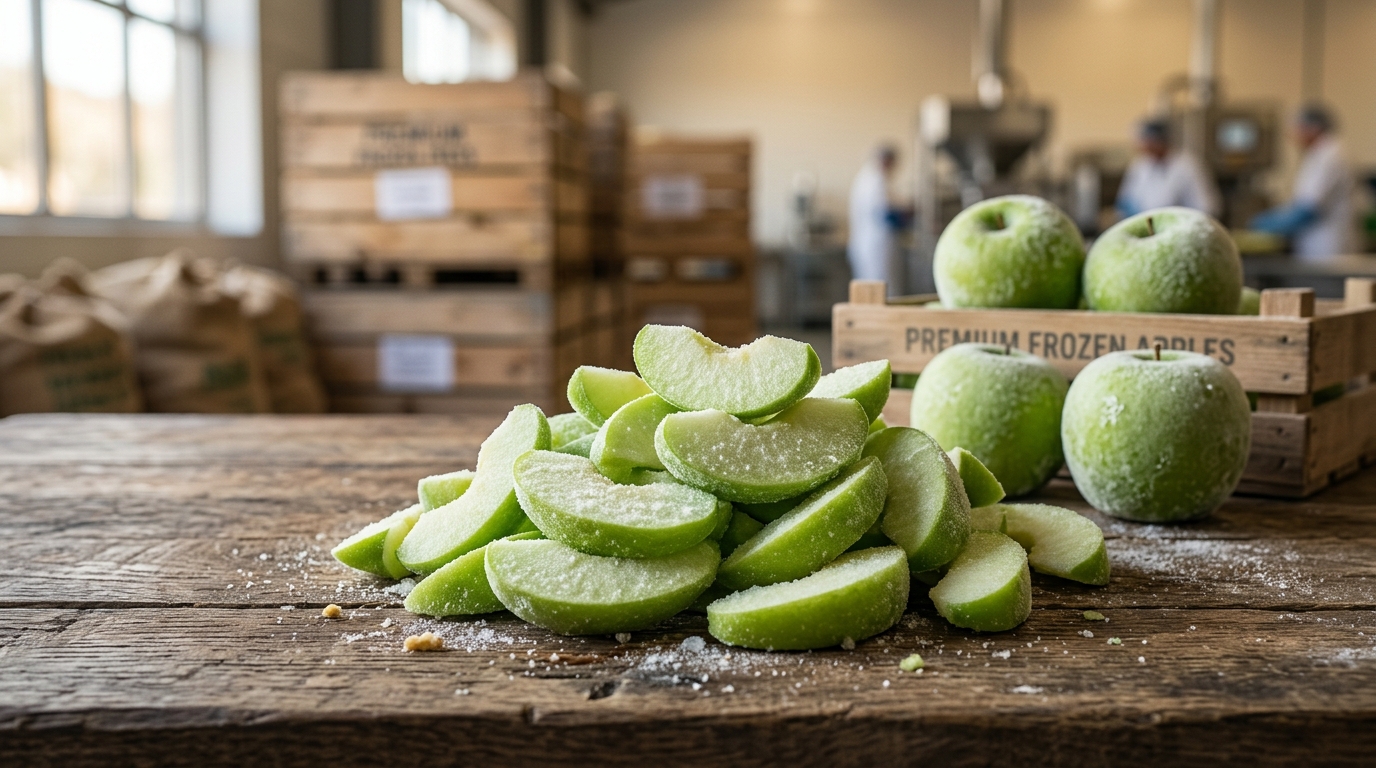
Frozen Granny Smith apples are not a single commodity—they’re a cold-chain engineered ingredient whose cost and quality are largely determined before the product ever freezes: orchard grade-out, trimming/yield loss, and the plant’s cut/treat/freeze capability. The chain is structurally seasonal upstream (harvest and raw apple availability) but structurally fixed downstream (freezing energy, cold storage, and reefer logistics).
Most “surprises” (browning, mushy thaw, excessive fines, off-size pieces) trace back to three physical steps: fruit selection (processing-grade vs better packout), pre-treatment (anti-browning/firming), and freezing rate (IQF vs block).
Typical commercial forms include IQF slices/dices, block-frozen slices/dices, and puree—each with different equipment, yield loss, packaging, and temperature-excursion sensitivity.
Your spec is effectively a process spec (cut geometry, anti-browning system, freeze method, storage temperature discipline). If you don’t map requirements to the physical nodes, you’ll see variability that looks like “supplier inconsistency” but is actually structural.

Frozen apples behave like a “yield + energy + cold-chain” business. Yield losses (trim + breakage + fines) and energy/cold storage are structurally unavoidable; what varies is how efficiently a supplier converts raw apples into spec-compliant pieces.
The same raw apple lot can produce materially different finished-cost outcomes depending on: peel/core efficiency, defect sorting intensity, slice thickness targets, and whether IQF is required.
When two suppliers quote different levels, the gap often reflects different physical realities (raw grade access, yield loss assumptions, freezer technology, storage duration), not just margin.
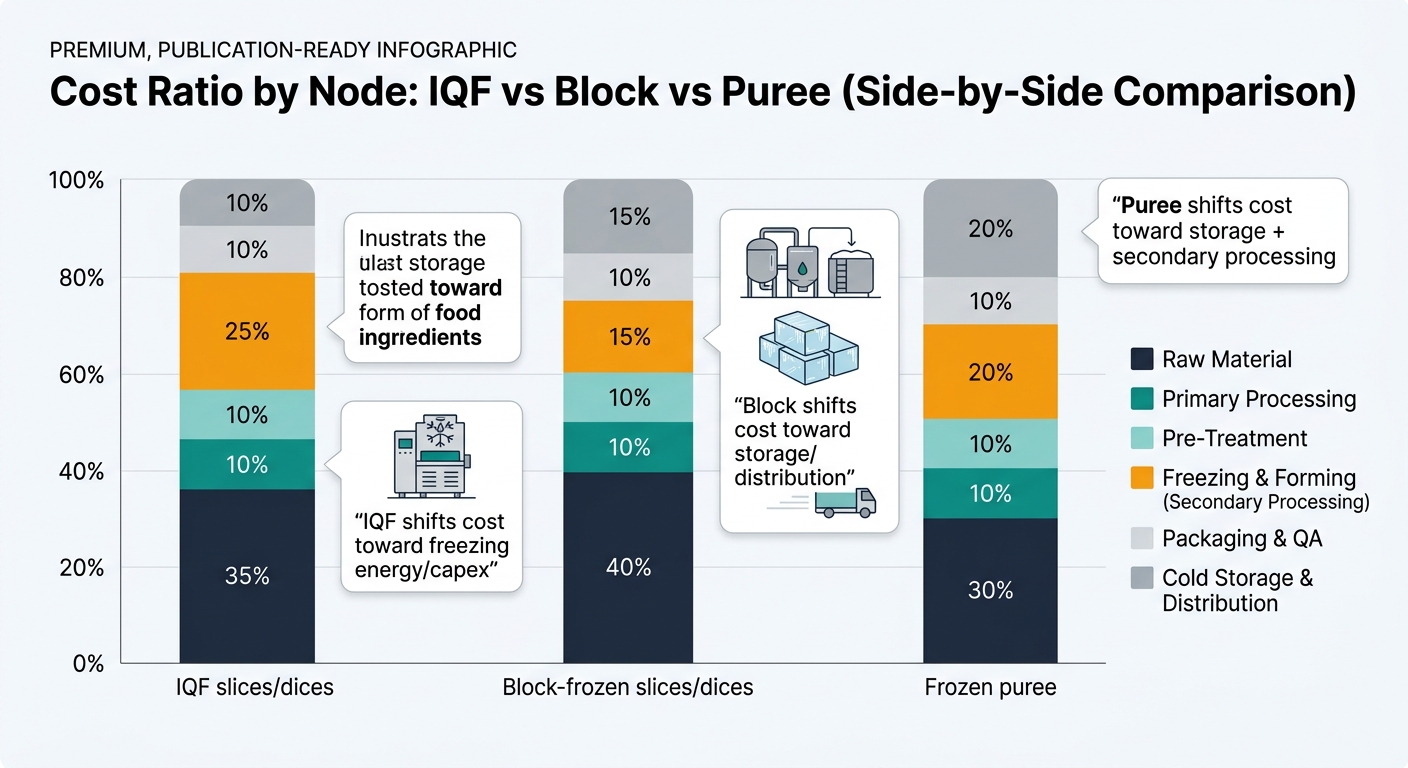
| Supply Chain Node | Cost Ratio (% of Final Cost) | Notes |
|---|---|---|
| Raw Material (apples) | 30% | Driven by fresh-market diversion and fruit firmness/defect mix. |
| Primary Processing | 18% | Peel/core/cut labor + yield loss are central. |
| Pre-Treatment | 4% | Anti-browning/firming chemicals + water handling. |
| Freezing & Forming | 20% | Energy + freezer utilization; IQF premium vs block. |
| Packaging & QA | 10% | Barrier film/cartons + foreign material controls + COA. |
| Cold Storage & Distribution | 18% | Cold warehouse + reefer transport + inventory carry. |
| Supply Chain Node | Cost Ratio (% of Final Cost) | Notes |
|---|---|---|
| Raw Material (apples) | 32% | Similar raw driver; may accept broader size distribution. |
| Primary Processing | 19% | Yield loss still central; defect removal drives economics. |
| Pre-Treatment | 4% | Similar chemistry needs; oxygen control becomes more critical. |
| Freezing & Forming | 14% | Lower IQF energy/capex intensity but higher clump sensitivity. |
| Packaging & QA | 9% | Carton + liner; QA similar but physical defects can differ. |
| Cold Storage & Distribution | 22% | Often longer storage; block handling adds temperature risk. |
| Supply Chain Node | Cost Ratio (% of Final Cost) | Notes |
|---|---|---|
| Raw Material (apples) | 28% | Can utilize smaller fruit and some trim streams (spec-dependent). |
| Primary Processing | 14% | Milling/cooking (if applicable) shifts labor profile. |
| Pre-Treatment | 3% | Oxidation control remains important; chemistry differs by spec. |
| Secondary Processing (Pureeing/Deaeration) | 18% | Equipment, heat/energy, and viscosity control. |
| Packaging & QA | 11% | Drums/totes; hygiene and foreign-material control remain key. |
| Cold Storage & Distribution | 26% | Heavy units + long storage; reefer and handling dominate. |
Frozen Granny Smith supply is shaped by a small set of physical constraints that stay true across years and suppliers.
The constraints below are “industry constants” rooted in biology (seasonality), physics (freezing and oxidation), and infrastructure (cold chain).
When your internal stakeholders ask for “same quality, faster lead time, lower cost,” these realities explain which requests are physically compatible—and which require spec or process trade-offs.
Your spec should describe the product and the physical conditions required to keep it stable from cut to consumption.
The most complaint-linked failure modes in frozen Granny Smith apples are browning/color shift, mushy thaw, excessive fines, clumping, and off-flavor from storage/oxidation.
Quick wins that reduce downstream turbulence:
(Analyzed at: Sep, 2026)
Write your next frozen Granny Smith apple contract as a format- and process-linked spec: explicitly lock IQF vs block, the permitted anti-browning/firming system (including sulfite disclosure expectations), and a simple thaw-performance test tied to your end use. This works because most downstream complaints trace to the cut/treat/freeze node, while the biggest avoidable costs show up later as holds, rework, and yield loss when lots don’t behave consistently. Given continued pressure on U.S. apple economics and region-by-region variability, teams that add a qualified alternate (even 15–25% of volume) and tighten lot-level documentation typically avoid the “emergency switch” premium and can realistically protect a low-single-digit percent of ingredient spend that otherwise leaks into waste, downtime, and complaint handling.


