
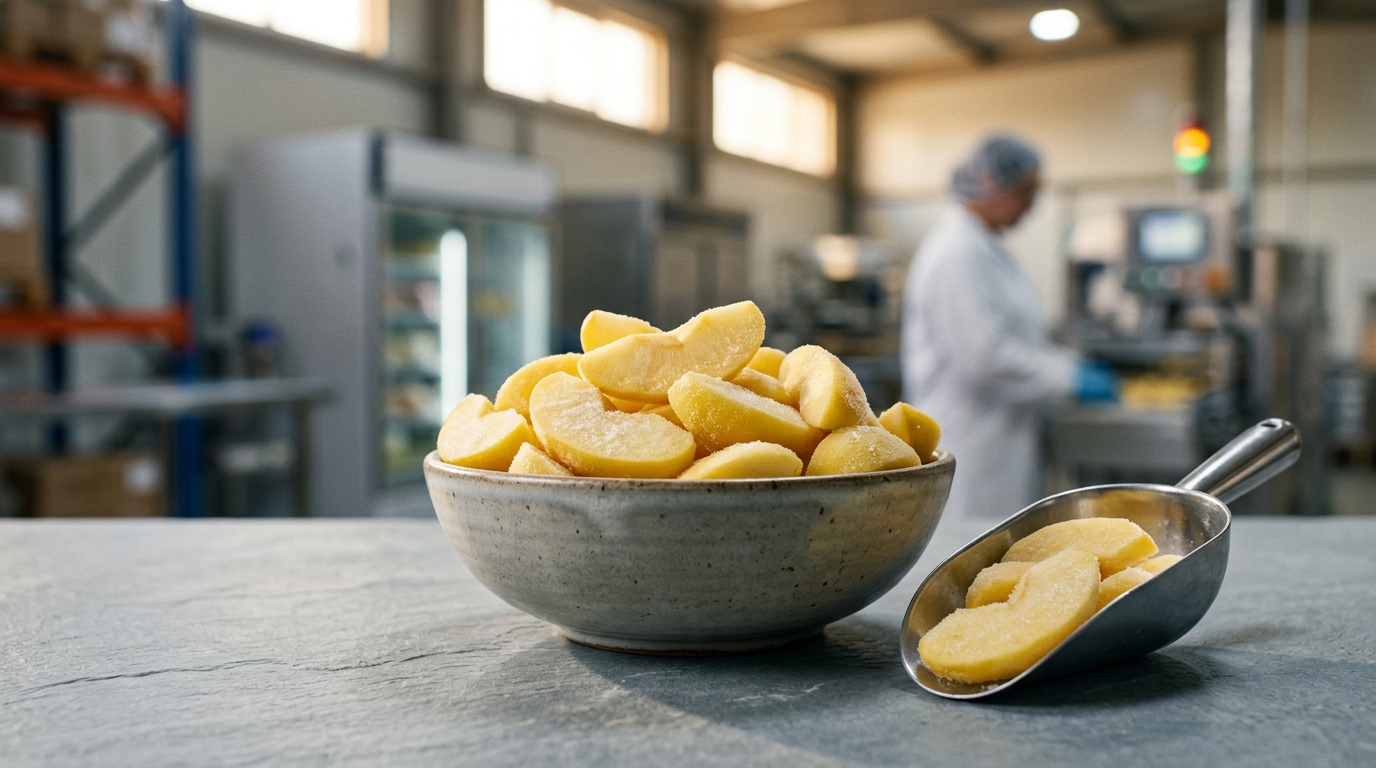
Frozen Golden Delicious apples look simple on a spec sheet, but most cost and quality outcomes are “locked in” before product ever hits a reefer. This guide maps the physical flow and highlights where procurement teams with Quality/Safety/Compliance accountability should focus—because yield, browning control, freezing discipline, and cold-chain time drive the majority of delivered cost and complaint risk.
Frozen Golden Delicious apples are built on a seasonal raw fruit base, then “stabilized” through trimming, anti-browning control, rapid freezing, and uninterrupted cold storage. The chain’s economics are structurally yield-sensitive: every defect removed (bruise, rot, internal browning) and every millimeter of cut spec tightness converts directly into trim loss, labor minutes, and downgraded output. Once the product is frozen, cost becomes dominated by energy, storage time, and cold-chain handling rather than farm inputs.

Supply chain flow (ground truth): Orchard harvest (industrial-grade fruit) → short-term storage or CA storage → wash/sort/trim → peel/core/cut → anti-browning treatment (ascorbic/citric and/or blanch) → IQF tunnel/spiral (or block freeze) → metal detection/foreign-body controls → bulk pack (lined cartons/bags) → frozen warehousing (target 0°F / -18°C or colder) → reefer transport/distribution. [1]
Insight: Frozen apple cost is not a single “raw material + conversion” number; it is an accumulation of yield loss, labor minutes, energy intensity, and time-in-cold-storage. The same orchard fruit can produce very different unit economics depending on cut style (slices vs dices), defect tolerance, and color/texture targets.
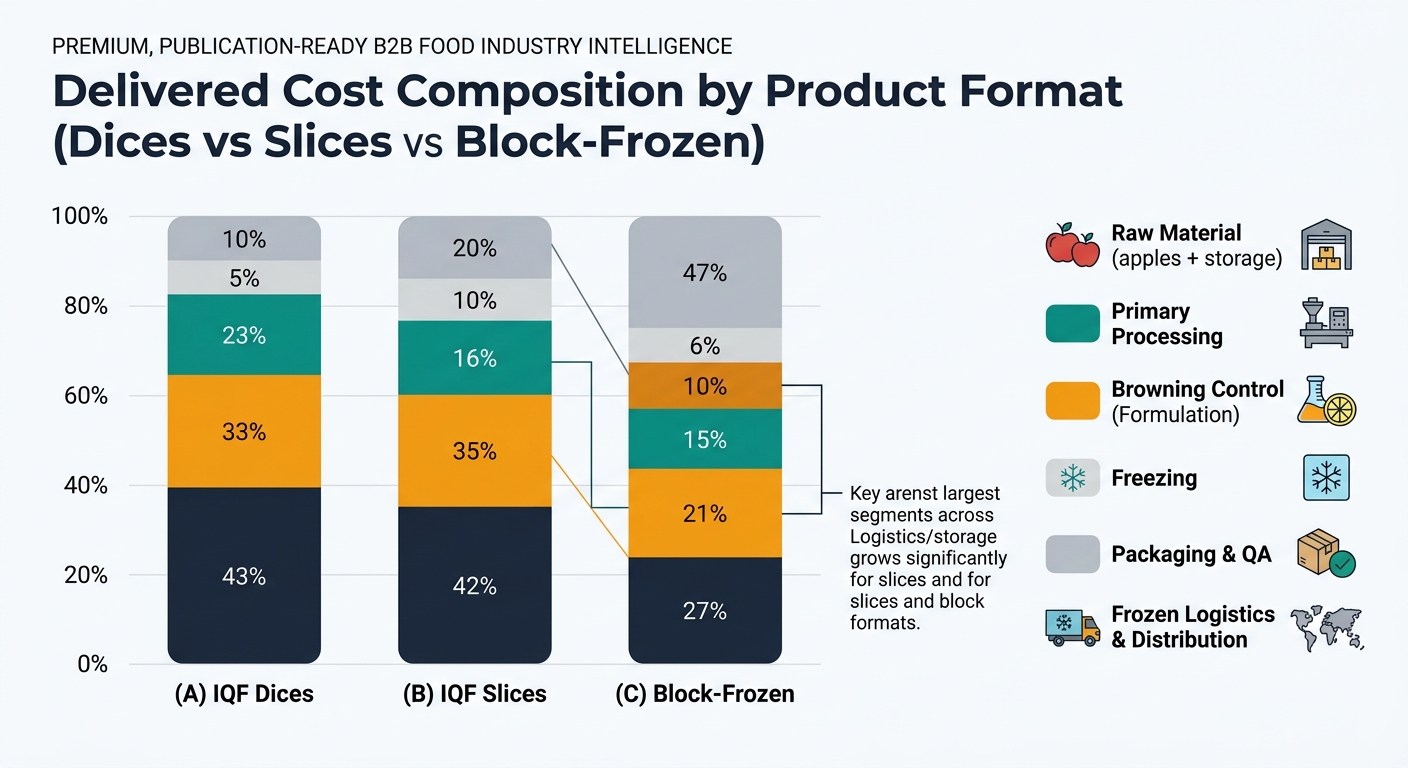
| Supply Chain Node | Cost Ratio (% of Final Cost) | Notes |
|---|---|---|
| Raw Material (apples + storage) | 30% | Industrial-grade fruit + CA storage/shrink risk. |
| Primary Processing | 22% | Peel/core/cut labor + yield loss + sanitation/wastewater. |
| Browning Control Step | 6% | Ascorbic/citric inputs + control/verification. |
| Freezing | 16% | High energy intensity + capacity constraint premium. |
| Packaging & QA | 10% | Liners/cartons + metal detection + inspection/lab. |
| Frozen Logistics & Distribution | 16% | Cold storage time + reefer transport + handling dwell. |
| Supply Chain Node | Cost Ratio (% of Final Cost) | Notes |
|---|---|---|
| Raw Material (apples + storage) | 32% | Slice programs often target more uniform fruit. |
| Primary Processing | 18% | Lower surface-area trimming vs dices; still yield-sensitive. |
| Browning Control Step | 5% | Lower surface area can reduce browning load. |
| Freezing | 15% | Similar energy; slice loading affects uniform freeze. |
| Packaging & QA | 10% | Similar CCP/QA; breakage/fines monitoring differs. |
| Frozen Logistics & Distribution | 20% | Slices can be more prone to clumping/dehydration if storage is long. |
| Supply Chain Node | Cost Ratio (% of Final Cost) | Notes |
|---|---|---|
| Raw Material (apples + storage) | 24% | Can tolerate broader fruit variability depending on end use. |
| Primary Processing | 16% | Cut + fill; yield still matters but spec may be looser. |
| Formulation (sugar/syrup) | 14% | Sugar, water, heating/mixing controls (if applicable). |
| Freezing | 14% | Block freezing shifts throughput constraints to molds/cartons. |
| Packaging & QA | 12% | Heavier packaging; seal integrity critical. |
| Frozen Logistics & Distribution | 20% | Higher weight/volume; cold chain still dominant. |
(Analyzed at: Sep, 2026)
Write the contract so the supplier is accountable for post-thaw outcomes (color stability window and drip/texture) and for the evidence trail that explains them—anti-browning treatment controls, freezer setpoints/loading discipline, and time–temperature records through warehouse release. This works because browning control and freezing are the two points where defects become irreversible, while today’s cold-chain economics and volatility mean longer dwell time is a realistic scenario, not an exception. U.S. cold storage remains expensive versus dry warehousing and has seen large rent growth since 2020, so weak temperature discipline and extended holds can quietly add several cents per pound in total delivered cost through rework, yield loss, and claims. [4]


