INDUSTRY TRENDS

Frozen Goat Meat Sourcing Intelligence: A Practical Procurement Guide to Landed Cost, Compliance Risk, and Supply Continuity (Mar 2026)

Author
Team Tridge
DATE
March 31, 2026
9 min read
frozen-goat-meat Cover
Tridge Eye Data Intelligence Solution

This report is powered by Tridge Eye Data Intelligence.

Every data point, price signal, and supply risk insight in this analysis comes from the same platform that procurement and sourcing leaders worldwide rely on daily. As you read, consider what this level of market intelligence could do for your sourcing decisions.

Explore Tridge Eye →

Frozen goat meat looks like a straightforward frozen-protein buy. In practice, it’s a capacity- and compliance-constrained category where supplier eligibility, paperwork discipline, and cold-chain evidence often decide your true landed cost more than the headline quote. This guide is written for procurement and sourcing leaders who are strong buyers in other proteins, but newer to goat—so it focuses on what to standardize, what to validate, and how to use intelligence to make award/contract/risk decisions with fewer surprises.

Executive Summary

  • Goat is not a “pure commodity” buy: award decisions should be made on spec + documents + temperature history, not FOB alone.
  • U.S. import gating factor: for the U.S., you must source from countries with FSIS-equivalent inspection systems and from FSIS-eligible foreign establishments for the relevant product category; this is not fixable after shipment. [1]
  • Cold-chain target is widely anchored at −18°C (0°F): many industry references use core temperature ~−18°C as the frozen benchmark; temperature abuse often becomes a delayed quality/cost problem. [2]
  • Origin concentration is structurally real: Australia is the leading goatmeat exporter and the U.S. has recently been its largest market by volume—so concentration, capacity, and route risk must be designed out (dual-source + pre-qualification). [3]
  • Cost variance is usually “non-linear”: yield/spec variance + border friction (holds/rework/demurrage) can dominate variance even when farmgate prices look stable.

Key Insights (Analyzed at: Mar, 2026)

  • Strategy: Buy
  • Reliability: Medium
  • Potential Saving: 6% ~ 14%
  • Insight: If your U.S. program is still effectively single-origin/single-route, prioritize a 90-day dual-source qualification (Plan B) rather than chasing incremental FOB concessions. Use intelligence to: (1) filter only FSIS-eligible establishments for goat by country/product category, (2) benchmark documentation/hold risk proxies, and (3) run a trial shipment with temperature recorder + document pack audit. The savings comes less from lower base price and more from avoiding port holds, claim leakage, and emergency spot buys during disruptions. [4]

1) What You’re Actually Buying: The Ground Truth of Frozen Goat Meat Flow

Frozen goat meat looks like a simple commodity (a frozen carton is a frozen carton). In practice, it behaves more like a capacity- and compliance-constrained protein with unusually high sensitivity to:

  • Origin concentration (a few export systems dominate trade-grade volumes)
  • Plant eligibility and documentation (import clearance risk is often “paperwork + inspection readiness,” not just price)
  • Cold-chain integrity over long transit (quality claims and rejections are frequently temperature-history problems)
  • Spec variability (carcass size range, bone-in style, trim level, packaging) that changes your true yield and downstream labor

The real supply chain flow (frozen goat meat)

Flowchart showing the end-to-end frozen goat meat movement from live goat supply through processing, packaging, reefer ocean freight/port inspection/cold storage, and domestic distribution, with risk gates for FSIS eligibility, documentation pack completeness, cold-chain evidence, and spec/yield.
  1. Upstream / Raw material (live goats)
  2. Smallholder/pastoral supply (esp. East Africa) and rangeland/feral harvest (notably Australia)
  3. Seasonal turnoff + drought/rain cycles influence availability and price
  4. Primary processing (slaughter + inspection + export certification)
  5. Export-licensed abattoirs convert live animals to carcasses; inspection and export certification happen here
  6. Halal supervision may be embedded or arranged depending on market
  7. Secondary processing (cutting/deboning + freezing)
  8. Whole carcass programs are operationally simpler; boneless/cut programs are labor- and yield-sensitive
  9. Blast freezing and stable storage conditions set the quality baseline
  10. Packaging & QA (labels, establishment IDs, claims, test plans)
  11. Carton strength, inner liners, labeling accuracy, halal claims, and traceability documentation
  12. Logistics & distribution (reefer ocean freight + cold storage + domestic distribution)
  13. Long transit times, port holds, reefer set-point discipline, and destination cold-store capacity drive claims and cost
  14. End markets (ethnic retail, foodservice, processors)
  15. Demand is resilient but niche; substitution with lamb/mutton/beef can swing buying behavior quickly

Procurement decision lens: The “best” supplier is usually the one that can reliably deliver your spec + documents + temperature history at a predictable landed-cost range—not the one with the lowest FOB quote.

2) Where the Money Accumulates: Cost & Margin by Node (and Why It’s Not Linear)

Key insight

In frozen goat meat, the biggest procurement mistakes come from assuming cost is mainly “farmgate + freight.” In reality, processing capacity, cut/yield loss, and border/cold-chain friction can dominate your variance.

Below is how cost and margin typically stack up—first by node, then by product form.

2.1 Upstream / Raw Material (Live goat procurement)

What matters operationally

  • Goats are often a secondary enterprise (cull animals, opportunistic harvest), so supply is structurally variable.
  • Weather cycles (drought liquidation vs. rebuild) can change availability quickly.

Primary cost drivers

  • Live animal price (largest variable input)
  • Collection/mustering and inland transport to abattoir
  • Condemnation/residue risk (especially where controls are weaker)

Procurement implication

When upstream supply tightens, abattoirs may ration kill slots or re-price quickly. Your contract structure needs a plan for this (indexation, volume flexibility, dual-source).

2.2 Primary Processing (Slaughter, inspection, export certification)

What matters operationally

Export eligibility is plant/system dependent. For the U.S., foreign plants must be certified by their competent authority under a system FSIS deems equivalent; FSIS continuously evaluates equivalence and conducts point-of-entry reinspection. FSIS also maintains eligible foreign establishment lists by country and product category; this is a gating check for U.S. imports. [1]

Primary cost drivers

  • Slaughter fees, labor, inspection/veterinary controls
  • Halal supervision costs (where required)
  • Yield loss from trimming/condemnations

Procurement implication

A “cheap” supplier that is weak on documentation discipline can create expensive port holds, relabeling, or rejection scenarios.

2.3 Secondary Processing (Cutting/deboning, freezing, value recovery)

What matters operationally

  • Whole carcass: lower labor, simpler spec control; more variability in carcass size and downstream cutting burden.
  • Bone-in cuts: moderate labor; spec disputes often about cut style and bone fragments.
  • Boneless: highest labor + yield sensitivity; trimming standards change your effective cost/kg.

Primary cost drivers

  • Labor for cutting/deboning
  • Freezing energy and throughput constraints
  • Byproduct value recovery (offal, skins/hides) that can subsidize primal economics when demand is strong

Procurement implication

Your “price” is only meaningful after you normalize for yield and trim spec. Intelligence should help quantify this, not just compare quotes.

2.4 Packaging & QA (compliance packaging, labeling, testing)

What matters operationally

  • Label accuracy and claim governance (origin, establishment number, halal claim) are frequent failure points.
  • QA programs differ sharply by origin and plant maturity.

Primary cost drivers

  • Cartons/liners/labels, palletization
  • QA testing, foreign matter controls, traceability systems

Procurement implication

Tight packaging specs reduce damage and freezer burn claims but narrow the supplier pool.

2.5 Logistics & Distribution (reefer ocean freight, cold storage, port/inspection friction)

What matters operationally

  • Frozen meat quality depends on stable temperature history. Multiple cold-chain references anchor frozen meat handling around −18°C (0°F) as a benchmark for frozen storage/transport, with colder temperatures used for longer quality retention. [2]
  • Transit risk is not just “late container”—it’s late + warm + held at port.

Primary cost drivers

  • Reefer ocean freight, terminal fees, demurrage/detention
  • Cold storage at origin/destination
  • Insurance and claims handling

Procurement implication

A supplier with consistent documentation and shipment discipline can be lower total cost even at a higher FOB.

2.6 End-market margins (importer, distributor, foodservice/retail)

What matters operationally

Goat is niche in many markets; demand is strong in diaspora channels and tends to be less price-elastic around cultural/holiday peaks than mainstream proteins.

Primary cost drivers

  • Working capital tied up in frozen inventory
  • Distributor handling and last-mile cold chain
  • Retail markup / foodservice margin

Procurement implication

If you serve ethnic retail/foodservice, service failures (out-of-stock near peak periods) can destroy customer trust faster than modest price increases.
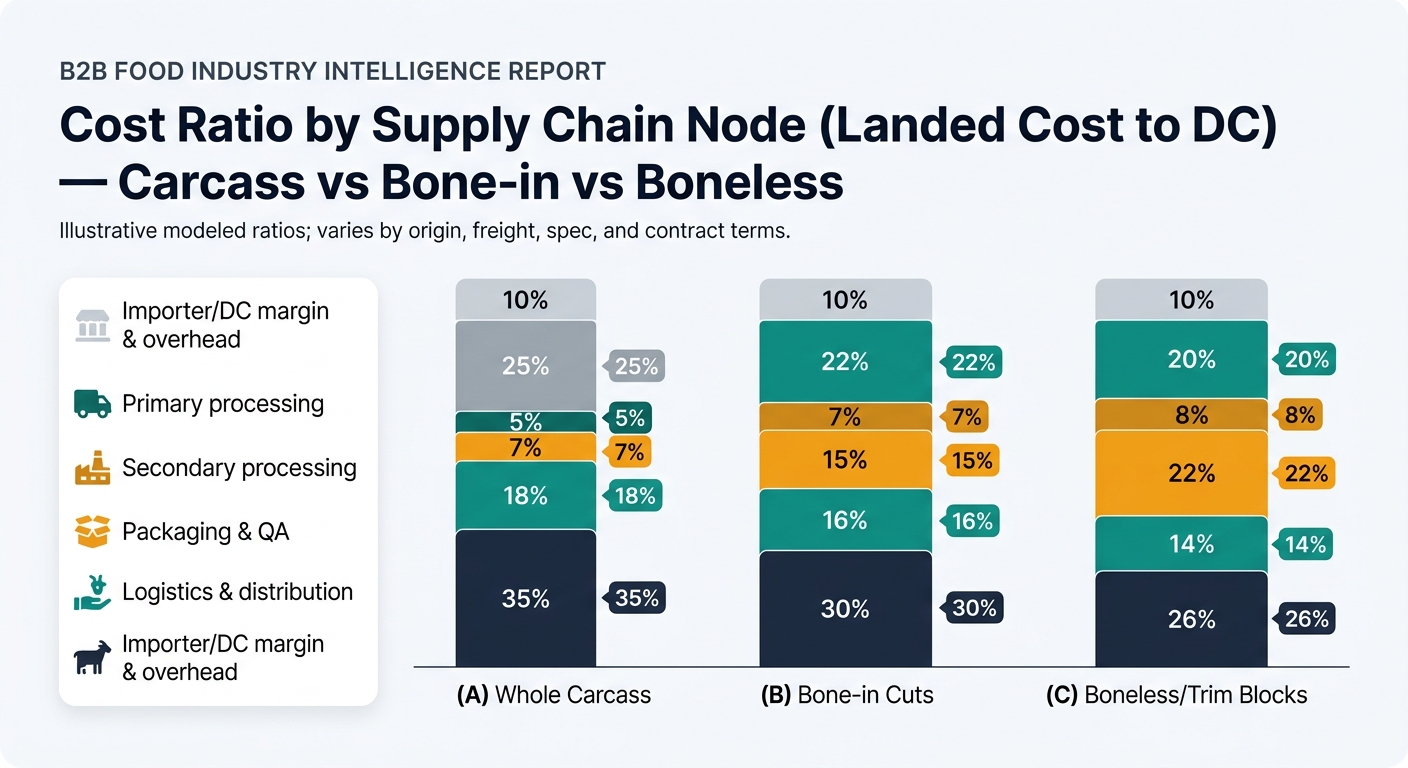
Product-level cost breakdown (illustrative)

Grouped stacked bar chart comparing illustrative landed cost ratios to DC across Whole Carcass, Bone-in Cuts, and Boneless/Trim Blocks, stacked by six supply chain nodes (Upstream/Live goat, Primary processing, Secondary processing, Packaging & QA, Logistics & distribution, Importer/DC margin & overhead) using the exact ratios from the tables, with a note that ratios vary by origin, freight, spec, and contract terms.

Modeled ratios show where cost typically concentrates as a share of final delivered cost to your DC (not retail shelf price). Actual ratios vary by origin, freight market, spec tightness, and contract terms.

A) Frozen Whole Goat Carcass

Supply Chain Node Cost Ratio (% of Final Landed Cost) Notes
Upstream / Live goat 35% Live availability + seasonality drives volatility
Primary processing 18% Slaughter + export certification
Secondary processing 7% Minimal cutting; freezing throughput matters
Packaging & QA 5% Lower complexity than portion cuts
Logistics & distribution 25% Reefer + cold storage + port friction
Importer/DC margin & overhead 10% Inventory carrying + handling

B) Frozen Bone-in Cuts (e.g., shoulder/leg portions)

Supply Chain Node Cost Ratio (% of Final Landed Cost) Notes
Upstream / Live goat 30%
Primary processing 16%
Secondary processing 15% Cutting labor + spec disputes increase hidden cost
Packaging & QA 7% More SKUs, labeling complexity
Logistics & distribution 22%
Importer/DC margin & overhead 10%

C) Frozen Boneless / Trim Blocks

Supply Chain Node Cost Ratio (% of Final Landed Cost) Notes
Upstream / Live goat 26%
Primary processing 14%
Secondary processing 22% Deboning + trim spec drives yield and labor
Packaging & QA 8% Testing + traceability expectations often higher
Logistics & distribution 20%
Importer/DC margin & overhead 10%

3) One Structural Fact That Should Shape Your Supplier Strategy

“Export-grade goat meat is not evenly distributed globally.”

Australia is structurally dominant in export goat meat and the U.S. has been a major destination for Australian product in recent years. [3]

  • MLA reports Australia as the world’s leading goatmeat exporter and notes the U.S. as Australia’s largest market by volume in 2024. [3]

Why this matters for procurement:

  • If your program is heavily tied to one export system, your risk is not only price—it’s capacity, labor, regulatory events, and logistics concentration.

4) The Critical Insight: Why “FOB Price” and “True Landed Cost” Diverge in Goat

Frozen goat meat has a bigger-than-usual gap between quoted price and realized cost because of three compounding effects:

  1. Yield/spec variability is financially loud
  2. Small differences in carcass size range, trim level, and cut style change downstream labor and usable yield.
  3. Compliance friction is binary and expensive
  4. Eligibility, labeling, halal claim governance, and document readiness determine whether product clears smoothly.
  5. For the U.S., system equivalence and establishment eligibility are gating items (you can’t “fix” that after the fact). [1]
  6. Cold-chain excursions create delayed losses
  7. Even when product is “accepted,” temperature abuse shows up later as drip loss, discoloration, freezer burn, or customer complaints.
  8. Frozen meat references commonly anchor around maintaining a sufficiently low core temperature (often ~−18°C / 0°F) to protect quality. [2]

Procurement decision lens: If you don’t quantify these three, you’re negotiating the wrong number.

5) The Common Procurement Failure Modes (Especially for Teams New to Goat)

  1. Awarding on quote price without a yield-normalized comparator
  2. Result: “cheaper” supplier costs more after trimming, rework, and claims.
  3. Treating halal as a checkbox instead of a governance system
  4. Result: disputes over certifier acceptance, labeling, or audit trail.
  5. No pre-qualified alternates before disruption
  6. Result: emergency spot buys, spec concessions, and higher compliance risk.
  7. Weak contract language on documentation + temperature evidence
  8. Result: arguments at the worst time (port delay, quality claim).
  9. Over-tight specs that shrink the supplier pool unintentionally
  10. Result: single-source dependency and premiums.

6) What an Intelligence-Driven Approach Changes (Mapped to Real Decisions)

This is not about “more data.” It’s about changing the decision quality on four procurement moves.

Decision A: Award / re-award suppliers

Use intelligence to:

  • Build a longlist by origin, product form (carcass/bone-in/boneless), and compliance profile
  • For U.S. programs, hard-filter candidates to FSIS-eligible countries/establishments for the relevant goat product category before commercial evaluation. [4]
  • Benchmark suppliers on shipment consistency proxies, documentation readiness, and spec adherence patterns

Outcome you can measure:

  • Reduced award-to-first-shipment failure rate
  • Lower exception handling cost (relabeling, holds, claims)

Decision B: Contract structure (spot vs. coverage; indexation vs. fixed)

Use intelligence to:

  • Separate commodity movement from logistics/FX and spec-driven cost
  • Set contract coverage targets by quarter (e.g., 60–80% covered + controlled spot window)

Outcome you can measure:

  • Narrower landed-cost variance band
  • Fewer emergency buys at peak freight/peak demand

Decision C: Dual-source / origin diversification

Use intelligence to:

  • Identify alternates that meet must-haves (spec, halal governance, cold-chain capability)
  • Run a structured gap analysis vs. incumbent and create a staged validation plan (samples → audit → trial shipment)

Outcome you can measure:

  • Shorter switch time during disruption
  • Lower supplier concentration exposure

Decision D: Governance and escalation

Use intelligence to:

  • Maintain origin/route watchlists and define trigger thresholds (e.g., repeated delays, document defects, inspection holds)
  • Track concentration, contract coverage, and exception logs for leadership review

Outcome you can measure:

  • Earlier interventions (inventory, rerouting, alternate activation)
  • Cleaner corrective action closure rates

7) Strategic Use Cases Procurement Leaders Actually Fund

  1. “Plan B in 30–90 days” alternate supplier bench
  2. Deliverable: shortlist + validation plan + trial shipment calendar
  3. Yield-normalized negotiation pack
  4. Deliverable: cost comparator that adjusts for trim/spec, pack size, defect rates
  5. Cold-chain and documentation control tower (lightweight)
  6. Deliverable: exception taxonomy + supplier scorecards + escalation triggers
  7. Spec rationalization to expand the supplier pool without losing quality
  8. Deliverable: which spec dimensions shrink the pool most (and what to relax safely)

8) Why This Intelligence Discipline Transfers to Other Categories You Also Buy

If you buy frozen goat meat, you likely also buy items with similar “hidden cost” mechanics:

  • Frozen lamb/mutton: similar halal governance + cold-chain + cut/yield sensitivity; typically more liquid markets, so benchmarking is easier.
  • Frozen beef trim / manufacturing blocks: yield and spec disputes (fat/lean) drive realized cost more than headline price.
  • Frozen seafood: cold-chain excursions and documentation failures (catch method, origin, health certs) create binary clearance risk.
  • Spices and dried ingredients (e.g., cumin, chili): not cold-chain, but compliance/documentation and adulteration risk create the same “paperwork + assurance” cost layer.

The common pattern: quote price is not the procurement truth unless you instrument yield, compliance, and logistics risk.

9) Why Frozen Goat Meat Is a High-Signal Example for Prospective Customers

Frozen goat meat forces procurement teams to operate at a higher maturity level because:

  • Supplier pool is narrower under strict spec/cert constraints (so governance matters more)
  • Export eligibility and documentation discipline are gating items for regulated import markets like the U.S. [1]
  • Cold-chain failures are expensive and often discovered late (claims, discounting, reputational damage) [2]
  • Origin concentration is real in global trade (so resilience must be designed, not hoped for) [3]

For procurement leadership, this category becomes a practical proving ground for intelligence-led sourcing: you can directly link better signals and governance to landed-cost stability, continuity of supply, and fewer compliance/quality exceptions.
Tridge Eye Data Intelligence Solution

Make Faster, Data-Driven Sourcing Decisions

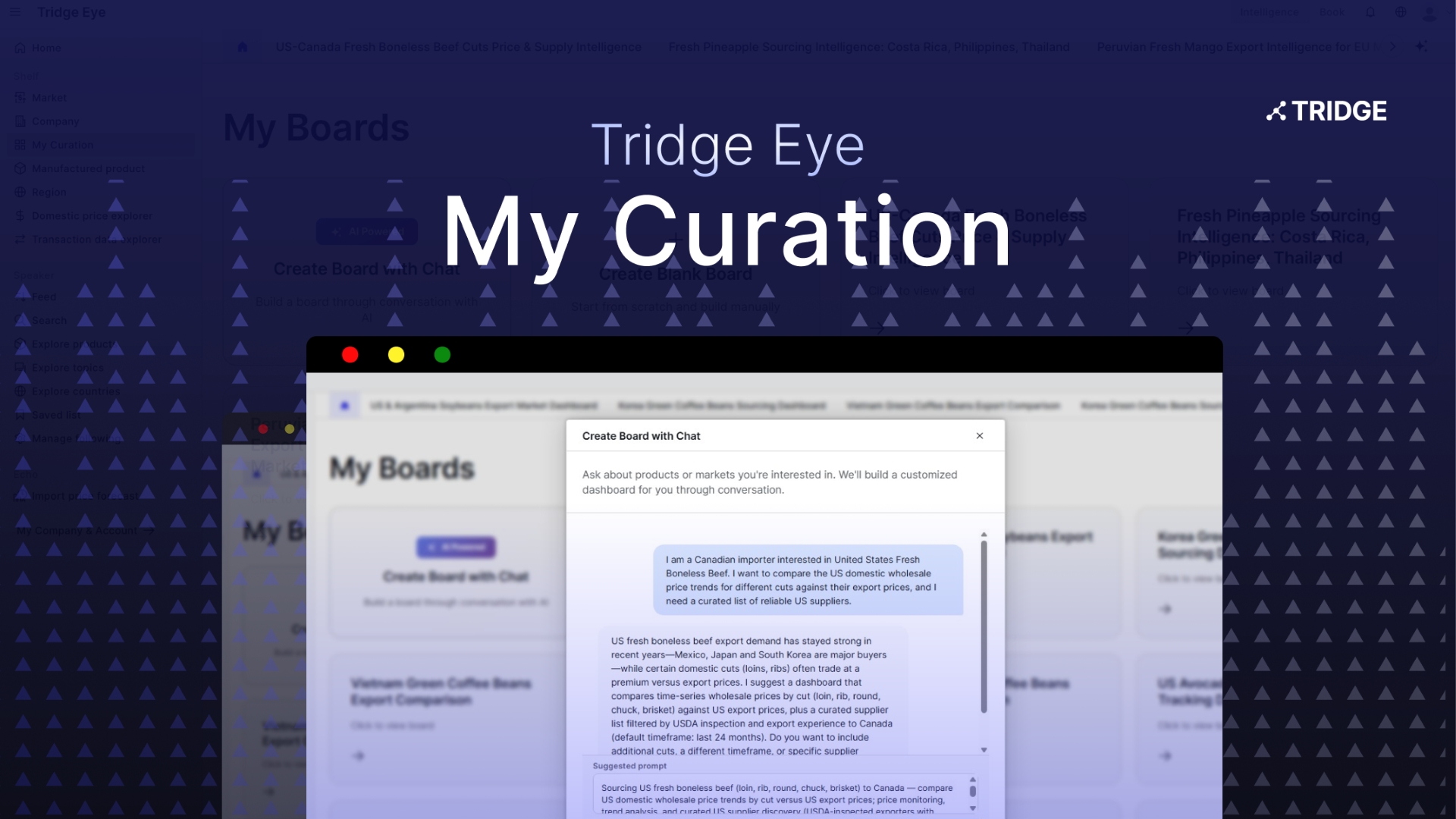
The insights in this report are just the starting point. Tridge Eye is the data intelligence solution that gives procurement and sourcing leaders real-time market signals, price benchmarks, and supply risk alerts — so you can act before the market moves.

Explore Tridge Eye →

References

  1. fsis.usda.gov
  2. tis-gdv.de
  3. mla.com.au
  4. fsis.usda.gov
Subscribe
By subscribing you agree to with our Privacy Policy and provide consent to receive updates from our company.
Thank you! Your submission has been received!
Oops! Something went wrong while submitting the form.
Subscribe to receive the latest blog posts, updates, promotions, and announcements from Tridge.