INDUSTRY TRENDS

Frozen Elderberry Sourcing (2026): How Category Managers Control Landed Cost, Allocation Risk, and QA Failures in a Niche Berry

Author
Team Tridge
DATE
March 6, 2026
10 min read
frozen-elderberry Cover
Tridge — Trusted Global Food Sourcing

This report is powered by Tridge market intelligence.

Every data point, price signal, and supply chain insight in this analysis is drawn from the same engine that procurement teams worldwide rely on daily. As you read, consider what this level of visibility could do for your category.

See how Tridge Eye works →

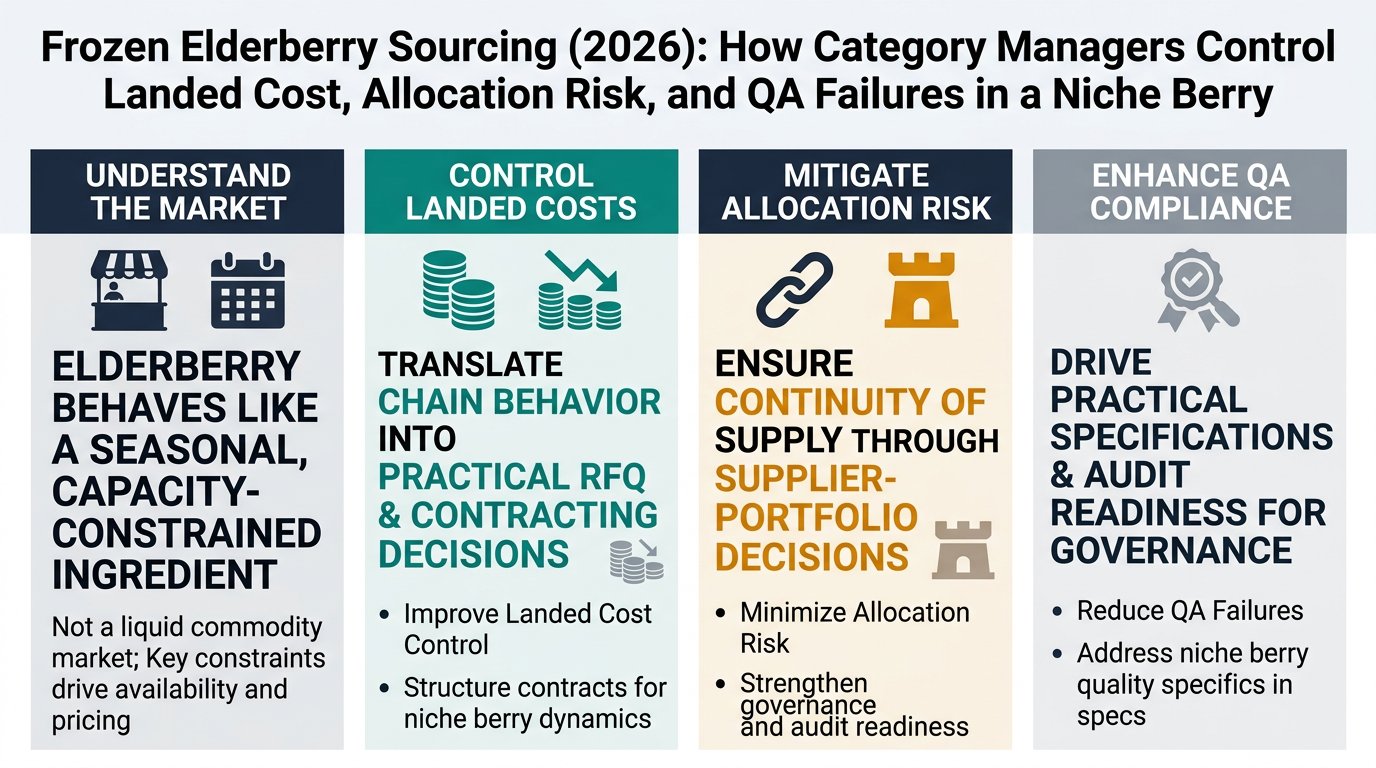
This guide is written for Purchase – Product & Category Management professionals who already know procurement, but are newer to the specifics of frozen elderberry. The goal is to translate how this niche berry supply chain behaves into practical RFQ, contracting, spec, and supplier-portfolio decisions that improve: (1) landed cost control, (2) continuity of supply, and (3) governance/audit readiness.

Executive Summary

  • Elderberry behaves like a seasonal, capacity-constrained ingredient—not a liquid commodity market. The binding constraints are often harvest timing + destemming/cleaning throughput + freezing/cold storage capacity, which drives allocation risk.
  • Europe harvest timing is commonly August–September (variety/latitude dependent), which compresses intake and increases allocation sensitivity [1].
  • The -18°C “set point” is widely used across frozen food cold chains, referenced by Codex and discussed by GCCA; some industry initiatives evaluate -15°C for energy savings, but contracts still commonly anchor around -18°C unless all parties align [2].
  • Food safety governance must be procurement-visible. FDA’s FY2019–FY2023 microbiological surveillance of frozen berries detected HAV and norovirus in a subset of samples (strawberries/raspberries/blackberries), supporting the need for preventive controls and importer verification discipline even when elderberry is not specifically named [3].
  • Best near-term procurement value (Mar 2026): reduce “surprise” conversion/logistics adders by forcing quote transparency (conversion, storage days, temperature evidence) and pre-qualifying at least one backup supplier before the next harvest window.

Key Insights (Analyzed at: Mar 2026)

  • Strategy: Buy
  • Reliability: Medium
  • Potential Saving: 6% ~ 14%
  • Insight: Lock in conversion capacity and cold-chain evidence now (before the next August–September intake window) by splitting RFQ pricing into raw fruit + conversion/freezing + packaging + cold-storage days + logistics assumptions, and by pre-qualifying at least one backup supplier/origin. The savings is primarily from reducing conversion “risk padding,” avoiding expedite/demurrage, and lowering internal QA hold/rework costs—rather than from chasing the lowest spot price. This is supported by (a) the structural reliance on the -18°C set point in contracts/cold chain norms, (b) active industry work to standardize temperature monitoring, and (c) ongoing regulator attention to viral hazards in frozen berries, which increases the cost of poor documentation and weak verification [2].

1) What you’re really buying: the ground truth of the frozen-elderberry flow

Frozen elderberry (often Sambucus nigra in European trade) is not a “commodity berry” market like strawberry. It behaves more like a seasonal, batch-processed ingredient where supply tightness, lot variability, and cold-chain execution determine whether you get usable yield at your plant.

End-to-end flow (what matters to a category manager)

  1. Growers / collectors (short harvest window)
  2. Fruit is highly perishable; delays between harvest and processing can increase soft fruit/leakage and raise the probability of micro and defect issues.
  3. In Europe, fruiting/harvest commonly clusters around August–September (variety and latitude dependent) [1].
  4. Primary processing (sorting, destemming, washing, foreign-matter removal)
  5. Elderberry is typically harvested in clusters; destemming and removal of leaves/stems is a defining step for industrial usability.
  6. Practical nuance: stems/leaves/unripe berries are also where undesirable plant material concentrates; post-harvest guidance emphasizes thorough inspection after destemming [4].
  7. Freezing & packing (IQF or block)
  8. IQF is preferred when downstream users need portioning and consistent inclusions; block is common for bulk users converting to puree/juice.
  9. Cold-chain set points commonly anchor around -18°C in global practice and contracts; Codex references “frozen” as -18°C or below and GCCA discusses the industry “set point” [2].
  10. Cold storage + export logistics (reefer container, port handling, domestic cold distribution)
  11. The hidden cost is not just freight; it’s time-at-risk (dwell time, demurrage, delays, temperature excursions).
  12. Importer / repacker / ingredient distributor (often the documentation hub)
  13. Many buyers experience compliance friction here: COAs, traceability, audit packs, and lot linking.
  14. Manufacturer use (supplements, functional beverages, dairy, bakery, blends)
  15. The actual “cost” is usable yield + performance (color, flavor, solids) not just price/kg.

Buyer implication: In frozen elderberry, the procurement decision is less “who’s cheapest?” and more “who can repeatedly deliver lots that pass QA and perform in formulation without emergency expediting?”

A left-to-right (or top-to-bottom) process flow showing the actual nodes described in Section 1: (1) Growers/collectors (short harvest window) → (2) Primary processing (sorting, destemming, washing, foreign-matter removal) → (3) Freezing & packing (IQF vs block) → (4) Cold storage + export logistics (reefer, port handling) → (5) Importer/repacker/documentation hub → (6) Manufacturer use. Add callout badges at the three binding constraints: Harvest timing, Destemming/cleaning throughput, Freezing/cold-storage capacity. Add a secondary layer of procurement controls icons under each node (e.g., spec, COA, temp logs, lead time, claims rules) without referencing any dashboard UI.

2) Where your money really goes: cost & margin build-up by node (and why it surprises teams)

Below is an illustrative cost build-up to help you pressure-test quotes. Ratios will vary by origin, pack format, certification, season tightness, and your QA acceptance criteria.

2.1 Upstream raw fruit (farmgate + harvest handling)

Key insight: Elderberry economics are dominated by yield risk and harvest handling. Weather during flowering/fruit set, rain at harvest, and harvest execution can reduce usable volume and push processors into allocation.

What usually moves your price:

  • Harvest labor availability and cost (manual steps still matter in many regions)
  • Field sorting losses (unripe/overripe/defects)
  • Compliance overhead (spray programs aligned to buyer MRL expectations; documentation discipline)

Procurement action lever: Build RFQ fields that force transparency on harvest period, cultivar/species, and field-to-freezer time (even as ranges). These are practical proxies for leakage/defect risk and lot-to-lot variability.

2.2 Primary processing (cleaning + destemming + sorting + QA gate)

Key insight: This is where elderberry differs from “easy” berries. Foreign matter removal and destemming are cost and yield drivers; tight foreign-matter tolerances can shrink the eligible supplier pool.

Cost drivers you can test in negotiation:

  • Line efficiency (destemming throughput can be a bottleneck)
  • Reject rates (foreign matter, soft fruit, mold/defects)
  • QA testing scope (micro, residues; sometimes heavy metals depending on end use)

Trade-off: Tightening foreign matter tolerance improves downstream safety and reduces plant rejects—but can increase price and allocation risk (fewer suppliers can consistently hit it).

2.3 Freezing & packing (IQF vs block) + cold storage

Key insight: Freezing is an energy and capacity game. When freezer capacity is tight or energy costs rise, processors protect margin through conversion charges or by prioritizing larger/easier-to-serve customers.

Operational realities:

  • The global frozen-food “set point” is commonly -18°C; Codex references “frozen” as -18°C or below, and GCCA documents the industry norm and the ongoing discussion about moving to -15°C under controlled conditions [2].
  • IQF tends to carry higher conversion cost than block due to equipment, handling, and packaging complexity.

Procurement action lever: Separate pricing into: raw fruit assumption + conversion (processing/freezing) + packaging + cold storage days included. This surfaces where a supplier is pricing uncertainty.

2.4 Logistics & distribution (reefer + border + domestic cold chain)

Key insight: In a niche category, logistics volatility often decides whether you achieved a “good price” or a “bad landed cost.” Delays increase exposure to temperature abuse and claims.

Cost drivers:

  • Reefer availability and peak season congestion
  • Dwell time at port/cold store
  • Insurance + temperature monitoring requirements

Procurement action lever: Put temperature logging requirements and claims rules in the contract (what constitutes excursion, evidence, and remedies). Also align with current industry moves to standardize temperature monitoring protocols [5].

2.5 Importer/packer margin + compliance handling

Key insight: Many teams underestimate the “paperwork labor” (traceability, COAs, audit packs). Suppliers with strong documentation discipline reduce your internal workload and import friction.

2.6 Your internal cost-to-serve (QA, segregation, rework, claims)

Key insight: The biggest avoidable cost is often internal: extra QA holds, re-testing, line downtime due to foreign matter, and rework.

Procurement action lever: Track cost per nonconformance by supplier/lot and feed it into supplier segmentation (strategic/core/backup).

Product-level cost breakdown (illustrative % of delivered cost)

Assumptions: industrial bulk purchase, delivered to buyer cold store; excludes buyer-specific duties/tariffs; ratios vary widely.

A) IQF Frozen Elderberries (10–25 kg cartons)

Supply chain node Cost ratio (% of delivered cost) What typically drives variance
Raw fruit (farmgate + harvest handling) 35% crop size, labor, compliance
Primary processing (clean/destem/sort/QA gate) 18% foreign matter removal intensity, reject rate
Freezing & packing (IQF) + cold storage 20% energy, freezer capacity, pack materials
Logistics & distribution (reefer + cold chain) 12% freight volatility, dwell time
Importer/packer + compliance handling margin 7% documentation workload, financing
Buyer internal cost-to-serve (QA holds, rework, claims) 8% spec tightness, incoming variability

B) Block-Frozen Elderberries (bulk blocks for further processing)

Supply chain node Cost ratio (% of delivered cost) What typically drives variance
Raw fruit 38% crop size, labor
Primary processing 16% cleaning/destemming scope
Freezing & packing (block) + cold storage 16% energy + simpler packing
Logistics & distribution 12% reefer + cold store
Importer/packer margin 6% commercial structure
Buyer internal cost-to-serve 12% higher variability, more downstream conversion work

C) Frozen Elderberry Puree (drums/totes)

Supply chain node Cost ratio (% of delivered cost) What typically drives variance
Raw fruit 30% fruit solids and yield
Primary processing 14% sorting losses
Secondary processing (milling/finishing/standardization) 18% yield loss, specs (Brix/pH/color)
Freezing/packing + cold storage 16% drum/tote cost, energy
Logistics & distribution 12% reefer + handling
Importer/packer margin + compliance 10% documentation + financing
Three stacked bars labeled: (A) IQF cartons, (B) Block-frozen, (C) Puree drums/totes. Each bar segmented by the same cost nodes used in Section 2 tables: Raw fruit; Primary processing; Freezing/packing + cold storage; Logistics & distribution; Importer/packer + compliance; Buyer internal cost-to-serve (note: for puree, replace buyer internal cost-to-serve with Secondary processing as shown in the puree table). Use the illustrative percentages from the article tables and include a small footnote: “Illustrative ratios for procurement structuring; not industry benchmarks.”

Validation note on the tables: These ratios are not presented as industry statistics (and should not be treated as such). They are a reasonable procurement teaching tool if you label them “illustrative” (as done) and use them to structure RFQs and negotiations—not to benchmark suppliers.

3) The structural fact you can’t negotiate away: elderberry is a capacity-and-quality constrained market

In frozen elderberry, the limiting factor is often not acreage alone—it’s the combination of:

  • Short harvest window (compressed intake period)
  • Destemming/foreign-matter removal capacity (a throughput bottleneck)
  • Freezing + cold storage capacity (energy and space)

This is why you can see “stable demand” but sudden allocation: processors protect their lines for customers who are easiest to serve (clear specs, predictable call-offs, fewer disputes).

4) The critical insight: why your elderberry price can rise even when “fruit is cheap”

Category teams often expect raw fruit cost to dictate finished frozen price. In reality, elderberry price can disconnect because:

  1. Usable yield swings more than farmgate price
  2. If foreign matter/soft fruit/micro risk increases, processors experience higher rejects and slower line speeds—raising conversion cost per usable kg.
  3. Freezer and cold storage are economic choke points
  4. When electricity and capacity are tight, processors price in risk and opportunity cost.
  5. Cold-chain friction amplifies landed cost volatility
  6. Delays create both direct cost (demurrage/storage) and indirect cost (claims, quality degradation).

Practical takeaway: A “good” negotiation is not only price/kg—it’s locking in conversion capacity + service levels + documentation discipline during the harvest-to-freeze cycle.

5) Where procurement teams typically get it wrong (in frozen elderberry)

  1. RFQs that don’t specify what drives usability
  2. Asking for “frozen elderberry IQF, best price” without measurable tolerances (foreign matter, defect definitions, lot COA scope).
  3. Over-tight specs without mapping supplier pool impact
  4. Specs copied from a legacy document can unintentionally eliminate backups.
  5. Treating food safety as a QA-only topic
  6. FDA’s FY2019–FY2023 frozen berry surveillance (strawberries/raspberries/blackberries) detected HAV and norovirus in some samples—reinforcing why buyers need preventive controls and importer verification discipline for frozen berries broadly [3].
  7. Assuming cold chain is “the forwarder’s job”
  8. Without temperature evidence standards and claims rules, you absorb ambiguity and cost.

6) What changes when you source with intelligence (and what it does not do)

Decision focus: Purchase – Product & Category Management in frozen elderberry, aiming for cost control + continuity + governance-ready supplier decisions.

Selected capabilities (only the ones that change the buying decision here)

Capability 1: Price intelligence & cost-driver decomposition

What you use it for in elderberry:

  • Build a negotiation fact base that separates:
  • raw fruit availability signals
  • conversion/freezing capacity constraints
  • cold-chain logistics volatility
  • FX exposure (where relevant)

Procurement actions it enables:

  • Shift from “last price + %” to a should-cost conversation with defined levers (conversion, packaging, storage days, logistics assumptions).
  • Choose contract structure: fixed price vs indexed components vs volume bands.

Limits to acknowledge: Not a live exchange; some pricing is inferred and contract/private.

Capability 2: Supply chain risk monitoring (event + structural)

What you use it for in elderberry:

  • Trigger earlier decisions when risk signals rise (weather anomalies, border delays, cold storage constraints).

Procurement actions it enables:

  • Pre-approved playbooks: when to pull forward buys, when to activate backup origin, when to increase safety stock.

Limits to acknowledge: Alerts are risk signals; they don’t confirm lot-level impact without supplier follow-up.

Capability 3: Supplier benchmarking & segmentation

What you use it for in elderberry:

  • Segment suppliers into strategic/core/backup based on capability to meet your spec + documentation + service reliability.

Procurement actions it enables:

  • Dual-source design that is governance-ready (documented criteria, not ad hoc).

Limits to acknowledge: Benchmarking depends on available signals; you may need to add your own scorecard data (claims, OTIF, rejects).

7) Strategic use cases you can run immediately (frozen elderberry)

Use case A: Continuity under seasonal allocation

Goal: avoid line stoppage and emergency spot buys.

  • Immediate (next 2 weeks):
  • Build a backup longlist by origin + certifications + pack format.
  • Create a fast-track qualification checklist (COA set, traceability, allergen controls, cold-chain evidence).
  • This quarter:
  • Pre-negotiate a contingent volume with at least one backup supplier (even small) with defined lead times.
  • Governance (ongoing):
  • Define triggers: e.g., if lead time extends by +2–4 weeks vs contracted, or if rejection/claims exceed an agreed threshold over 3 consecutive lots, activate backup.

Trade-off: More suppliers increases QA workload; mitigate by standardizing incoming testing and documentation templates.

Use case B: Cost volatility control without relaxing specs

Goal: reduce PPV and budget shocks.

  • Immediate: Rebuild RFQ pricing into components: raw fruit assumption, conversion, packaging, cold storage days included, logistics assumptions.
  • This quarter: Contract design: volume bands + agreed review points around harvest outcome.
  • Governance: Monitor variance drivers and document changes (audit trail).

Use case C: Spec strategy to expand supplier pool safely

Goal: increase competitive bids while protecting product performance.

  • Immediate: Identify 2–3 spec parameters that most restrict supply (often foreign matter tolerance, defect definitions, pack format).
  • This quarter: Propose controlled flex bands (e.g., “standard” and “tight” grades) with validation tests.
  • Governance: Maintain a spec decision log: what changed, why, and which stakeholders approved.

8) Why this matters beyond elderberry (and where you’ll feel it next)

If you manage frozen elderberry, you likely also touch categories with similar dynamics:

  • Frozen raspberry / blackberry / strawberry: similar cold-chain sensitivity and documented viral hazard concerns (HAV/norovirus) in the broader frozen-berry supply chain; this raises the value of preventive controls, supplier verification, and documentation discipline [3].
  • Frozen mango / tropical fruit: higher traceability expectations; documentation quality becomes a supplier differentiator.
  • Vanilla / cocoa / specialty botanicals: price is not just “crop”; it’s processing capacity, quality grading, and compliance overhead.

The transferable lesson: procurement outcomes improve when you translate market signals into specific contracting, specification, and supplier-portfolio actions—and document them for governance.

9) Why this example is powerful for prospective customers (from a buyer’s perspective)

Frozen elderberry is a clean test of whether your sourcing approach is modern:

  • It forces risk-adjusted supplier decisions (not just lowest quote).
  • It exposes the real drivers of volatility: usable yield, conversion capacity, and cold chain.
  • It rewards governance maturity: clear specs, documented thresholds, and pre-approved contingency plans.

If you can run elderberry well, you can replicate the same playbook across dozens of “quietly high-risk” ingredient categories—without adding headcount, just better decision infrastructure.

Take Your Sourcing Intelligence to the Next Level

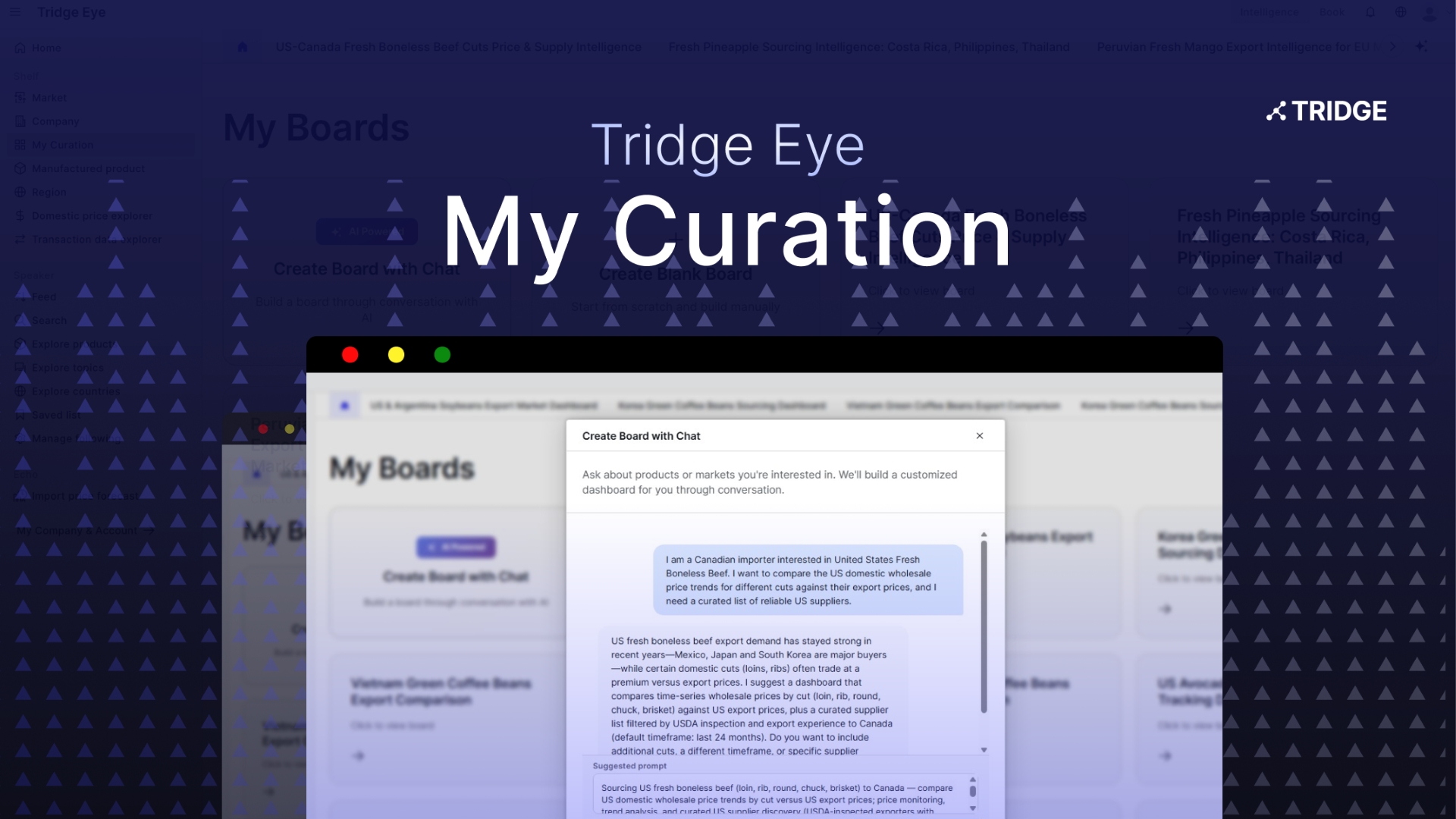
The insights in this report are just the starting point. Tridge Eye gives you real-time market signals, origin risk alerts, and price benchmarks — so you can act before the market moves.
Explore Tridge Eye →

References

  1. forest.jrc.ec.europa.eu
  2. gcca.org
  3. fda.gov
  4. ucanr.edu
  5. gcca.org
Subscribe
By subscribing you agree to with our Privacy Policy and provide consent to receive updates from our company.
Thank you! Your submission has been received!
Oops! Something went wrong while submitting the form.
Subscribe to receive the latest blog posts, updates, promotions, and announcements from Tridge.