INDUSTRY TRENDS

Frozen Dragon Fruit Sourcing (IQF & Puree): The Cost, Risk, and Spec Levers Procurement Can Actually Control

Author
Team Tridge
DATE
April 7, 2026
9 min read
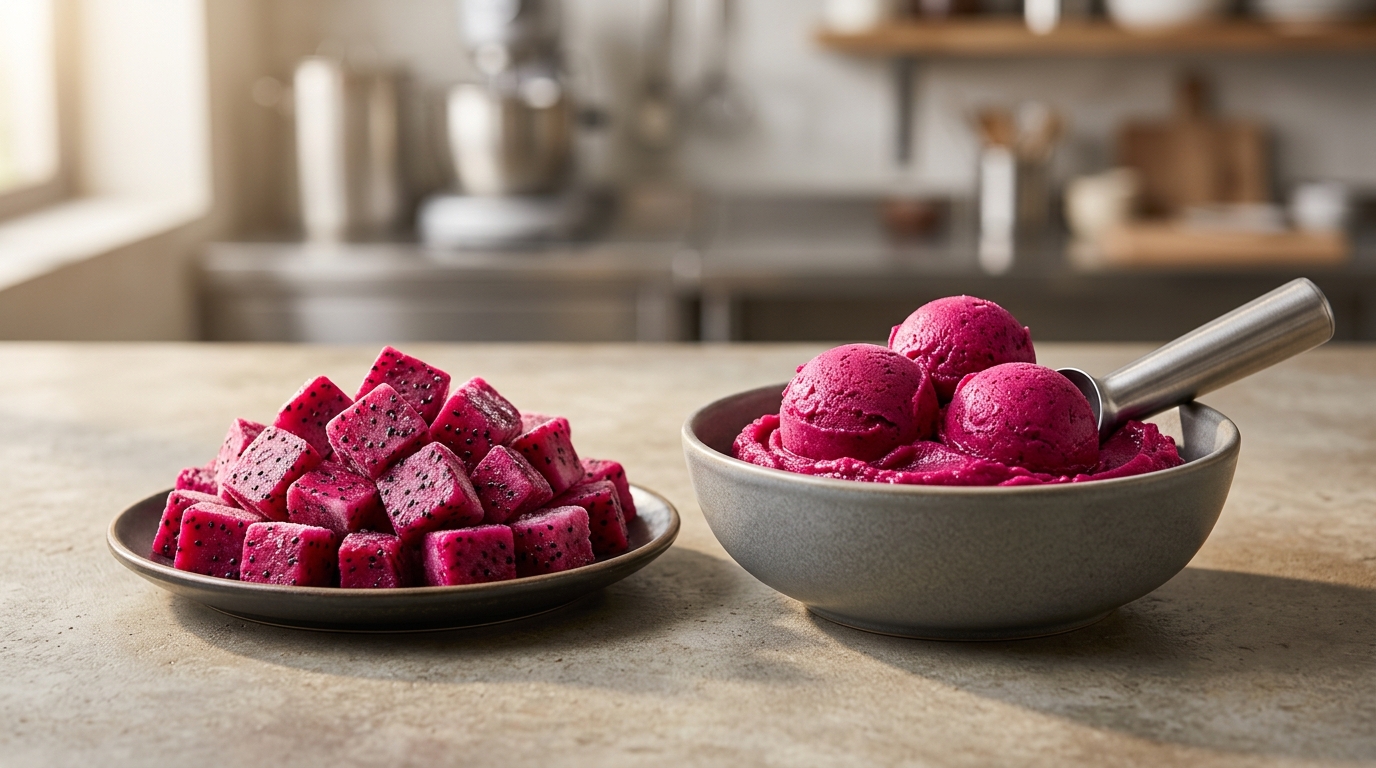
frozen-dragon-fruit Cover
Tridge Eye Data Intelligence Solution

This report is powered by Tridge Eye Data Intelligence.

Every data point, price signal, and supply risk insight in this analysis comes from the same platform that procurement and sourcing leaders worldwide rely on daily. As you read, consider what this level of market intelligence could do for your sourcing decisions.

Explore Tridge Eye →

Frozen dragon fruit looks like a simple ingredient, but procurement outcomes (true landed cost, continuity of supply, and quality rejects) are mostly determined by three things you can manage: (1) how your spec is written and tested, (2) how cold-chain governance is contracted and evidenced, and (3) how diversified your supplier/origin portfolio is before the market tightens. This guide translates those mechanics into practical levers for sourcing leaders who are experienced buyers—but newer to pitaya.

Executive Summary

  • The category behaves like “capacity + cold chain,” not just agriculture. IQF/freezing throughput, cold storage space, and reefer execution become binding constraints in tight periods.
  • Vietnam supply is widely described as available year-round, with a natural peak around May–October. Off-season production is commonly supported by flowering induction (e.g., supplemental lighting), which tends to raise costs vs peak season. [1]
  • Cold-chain standards and claims reality matter:
  • -18°C is a widely referenced reference temperature for quick-frozen storage/distribution, and industry loss-prevention guidance notes frozen goods should generally not deviate more than ~3°C from set point in transit. [2]
  • Biggest value leak: the gap between quoted $/kg and usable $/kg after thaw loss, defect sorting, clumping, and claims friction.
  • Best procurement playbook: write measurable specs + enforce logger/data retention + dual-source by origin/processor + normalize Incoterms to a comparable “risk-adjusted landed cost.”

Key Insights

(Analyzed at: Apr, 2026)

  • Strategy: Buy
  • Reliability: Medium
  • Potential Saving: 6% ~ 14%
  • Insight: If your current program is single-origin/single-processor, prioritize a dual-source qualification now (even at a small initial split) while Vietnam is in/approaching its natural peak window (commonly cited May–Oct). Use this timing to negotiate (a) capacity reservation / MOQ flexibility, and (b) cold-chain evidence clauses (logger + set-point + handoff records). The savings typically come less from a headline $/kg drop and more from reducing “hidden” costs: fewer rejects, fewer emergency spot buys, and fewer unresolved temperature claims.

1) What You’re Really Buying: The Ground Truth of the Frozen Dragon Fruit Flow

Frozen dragon fruit (pitaya) looks simple—“pink cubes in a bag”—but procurement outcomes are driven by where the raw fruit is grown, how it’s processed, and how well the cold chain is controlled.

Typical supply chain flow (what matters for sourcing):

  1. Upstream / Raw material: fresh pitaya (white- or red-flesh) harvested multiple times per year.
  2. Primary processing: wash/sanitize → peel/trim → cut (IQF formats) or pulp/screen (puree) → foreign material control.
  3. Secondary processing:IQF freezing (tunnel/fluidized bed) or puree finishing (sometimes heat treatment depending on spec) → standardization.
  4. Packaging & QA: bulk cartons/bags, metal detection/X-ray, microbiology + residue testing, traceability.
  5. Logistics & distribution: origin cold store → inland to port → reefer ocean → destination cold store → DC/plant.
  6. End markets: smoothie/QSR, retail frozen fruit, industrial blends, dairy/bakery inclusions.

Reality check on seasonality (why timing matters):

  • Vietnam-origin pitaya is commonly described as available year-round with a natural peak May–October, with off-season volumes possible via cultivation practices that induce flowering (e.g., supplemental lighting). [1]

Reality check on cold chain (why “same price” isn’t same cost):

  • Frozen cargo quality claims often trace to set-point mistakes and temperature excursions; industry loss-prevention guidance notes that frozen goods should not, in general, deviate by more than about 3°C (5°F) from set point. [3]
A left-to-right flow diagram of the frozen dragon fruit (pitaya) journey with 6–7 labeled nodes from farm/harvest through processing, packaging & QA, cold storage, reefer transport, and destination use, with callouts for yield loss, clumping/thaw loss, temperature excursions, and documentation/claims friction plus a legend distinguishing cost vs risk drivers.

2) Where the Money Accumulates: Cost & Margin Mechanics by Supply Chain Node

2.1 Upstream (Farmgate fruit): the hidden price setter

Key insight: In frozen pitaya, the “raw fruit” line item is not just a commodity input—it’s a quality and yield determinant that drives downstream rejects and conversion cost.

What procurement should know (in plain terms):

  • Fresh-export vs. processing pull: when fresh market demand spikes, processors must pay more to secure fruit, or accept lower grades that can increase trimming loss.
  • Off-season fruit is often structurally more expensive: induced flowering (e.g., lighting) and lower natural volumes typically raise farmgate cost, which later shows up in IQF/puree quotes. [4]
  • Variety matters: red-flesh often commands different pricing and has different color outcomes in finished goods.

Cost drivers you can negotiate around (indirectly):

  • Supplier’s farm program (contracted growers vs spot buying)
  • Residue compliance program and traceability depth (reduces hold/reject risk)

2.2 Primary processing (wash/peel/cut or pulp/screen): labor + yield loss dominate

Key insight: This is where “cheap offers” often get expensive—because peeling/trimming yield loss and foreign material control (peel fragments, hard seed clusters, etc.) drive real conversion cost.

What drives cost here:

  • Labor intensity: peeling and trimming are hard to mechanize at the same quality level.
  • Yield loss: more defects or smaller fruit → more trim loss → higher cost/kg finished.
  • Food safety controls: sanitation, water management, and in-process checks.

Procurement lever:

Align spec with application: if you’re blending into smoothies, you may accept wider cut-size distribution than for “visible inclusion” SKUs—widening the supplier pool and lowering conversion cost.

2.3 Secondary processing (IQF freezing or puree finishing): energy + throughput are the swing factors

Key insight: Freezing capacity is not infinite. When IQF lines are full, suppliers protect throughput and margin by pushing up price, raising MOQs, or prioritizing long-term customers.

What drives cost here:

  • Energy intensity: freezing and cold rooms are major operating costs.
  • Throughput constraints: tunnel availability and maintenance downtime.
  • Finished quality outcomes: faster, controlled freezing better preserves texture and reduces clumping/drip loss (which affects your yield after thaw).

Cold storage reference point you’ll see in standards and guidance:

  • -18°C is widely referenced as a reference temperature for storage/distribution of quick-frozen foods in international guidance. [2]

2.4 Packaging & QA: where governance and claims prevention live

Key insight: For frozen fruit, QA and packaging are not overhead—they are claim prevention.

Cost drivers:

  • Freezer-grade films/bags, cartons, labeling
  • Metal detection/X-ray
  • Micro and residue testing; certification programs (GFSI-recognized schemes are common buyer expectations)

Procurement lever:

Specify COA content and frequency and tie it to lot release. This reduces the probability that you discover a problem only after the container lands.

2.5 Logistics & distribution: the “silent” cost center

Key insight: In frozen pitaya, logistics is not just freight—it’s risk-adjusted landed cost.

What drives cost and risk:

  • Reefer container availability and lane volatility
  • Port dwell time (power connection / plug-in time)
  • Temperature logging and dispute readiness

Practical governance point:

Temperature claims often become “he said / she said” without a documented set point, logger data, and handoff records; industry loss-prevention guidance highlights how set-point confusion and execution gaps create losses. [3]

2.6 End markets: where margins are captured—and where your spec decisions get tested

Key insight: Your internal customer (R&D/QA/ops) will experience the product as:

  • Smoothie blend performance (color, seed perception, viscosity)
  • Line efficiency (clumping, breakage, thaw loss)
  • Consumer acceptance (color consistency)

This is why procurement should model total landed cost + performance loss, not only $/kg.

Product-level cost breakdown (illustrative, modeled)

A 100% stacked bar chart comparing cost concentration by node for three products—(A) IQF bulk, (B) Puree bulk, (C) Retail-ready IQF—segmented into upstream raw fruit, primary processing, secondary processing, packaging & QA, logistics & distribution, and margin, using the illustrative ratios from the tables, with an annotation that the model varies by origin, season, pack, and Incoterms.

The table below shows typical cost concentration by node for three common frozen pitaya product forms. Actual ratios vary by origin, season, certification scope, pack format, and Incoterms.

A) IQF Dragon Fruit (cubes/dices, bulk foodservice/industrial)

Supply Chain Node Cost Ratio (% of delivered cost) What moves it most
Upstream raw fruit 35% seasonality, fresh-market pull, variety
Primary processing 22% peel/trim yield, labor, defect rate
Secondary processing 15% energy cost, IQF throughput
Packaging & QA 8% pack format, testing cadence
Logistics & distribution 12% reefer lane + dwell time
Importer/wholesale margin 8% inventory risk, service level

B) Frozen Dragon Fruit Puree (no sugar added, bulk)

Supply Chain Node Cost Ratio (% of delivered cost) What moves it most
Upstream raw fruit 32% fruit solids / Brix variability
Primary processing 18% pulping/screening yield, FM control
Secondary processing 18% finishing, standardization, energy
Packaging & QA 10% packaging format, micro program
Logistics & distribution 12% reefer + cold storage
Importer/wholesale margin 10% working capital, shrink

C) Retail-ready IQF Pitaya (small packs, private label)

Supply Chain Node Cost Ratio (% of delivered cost) What moves it most
Upstream raw fruit 28% seasonality
Primary processing 18% yield + defect sorting
Secondary processing 12% IQF throughput
Packaging & QA 18% film/printing, retail compliance
Logistics & distribution 12% reefer + DC handling
Retail/brand margin 12% promo cadence, shrink

3) One Structural Fact That Explains Most Supplier Behavior

Frozen pitaya is a “capacity-and-cold-chain” category, not just an “ag” category.

That means your supply reliability is constrained by:

  • IQF/freezing throughput (can’t instantly scale)
  • Cold storage space (origin and destination)
  • Reefer execution quality (set point discipline + documentation)

So when the market tightens, suppliers don’t only raise price—they also:

  • tighten MOQs
  • reduce spec flexibility
  • prioritize customers with stable forecasts and longer commitments

4) The Critical Insight: Why Your Quote Price and Your Real Cost Disconnect

In frozen dragon fruit, the biggest disconnect is between:

  • Quoted $/kg (what procurement awards)
  • and effective $/kg usable (what operations actually gets after defects, thaw loss, and claims friction)

Three common “disconnect engines”:

  1. Spec ambiguity: “red pitaya cubes” without measurable color/seed/defect limits → suppliers meet the words, not the outcome.
  2. Cold-chain ambiguity: no explicit set point, no logger requirement, unclear responsibility at port dwell → claims become hard to win or even to file properly. [3]
  3. Brix/color variability in puree: puree programs commonly manage Brix as a control variable, and meaningful variation changes your downstream formulation economics.

5) Where Procurement Teams Typically Get This Wrong (and Pay for It Later)

  1. They run an RFP on “certifications + price” and skip performance economics
  2. No model for thaw loss, defect sorting labor, or line downtime.
  3. They over-tighten specs without quantifying supplier pool impact
  4. Tighter color/cut tolerances can unintentionally force single-sourcing.
  5. They treat brokers and processors as interchangeable
  6. Broker can be fine, but traceability depth and corrective-action speed often differ.
  7. They don’t lock cold-chain governance into the contract
  8. No set-point clause, no logger, no handoff records → disputes are slow and outcomes are inconsistent.

6) What an Intelligence-Driven Approach Changes (Practically, Not Theoretically)

This is what “procurement intelligence” looks like when you apply it to frozen pitaya decisions.

A) Supplier discovery that matches your application

Instead of “find me 10 suppliers,” you build two longlists:

  • IQF inclusion-grade (tight cut size, low peel fragments, strong color consistency)
  • IQF smoothie-grade / puree-grade (more tolerant specs, better economics)

Outcome metric: supplier pool size increases without increasing reject risk.

B) Benchmarking that predicts onboarding success

Benchmark suppliers on:

  • Certifications scope (food safety scheme + frozen fruit scope)
  • Cold-chain infrastructure (blast freezer capacity, cold rooms, loading discipline)
  • Traceability (farm program, lot coding)

Outcome metric: fewer “paper-qualified” suppliers that fail in QA trials.

C) Price intelligence that separates structural vs temporary drivers

You track and label movements as:

  • raw fruit availability/season
  • energy/freezing cost pressure
  • reefer lane volatility

Outcome metric: better timing for rebids and contract length decisions.

D) Risk monitoring with triggers (so you move before shortages)

Example triggers procurement can operationalize:

  • peak season transition (Vietnam commonly cited May–Oct peak) → pre-book reefer space earlier and confirm cold-store capacity [1]
  • port dwell time increases → raise safety stock for frozen SKUs
  • residue/compliance signals → tighten COA cadence or shift volume

Outcome metric: shorter time-to-switch and fewer emergency spot buys.

E) Governance analytics leaders actually accept

You produce an auditable view of:

  • origin concentration (e.g., % Vietnam vs Thailand vs LatAm)
  • single-supplier exposure
  • spec exceptions and why they were approved

Outcome metric: faster approvals, clearer risk reporting, stronger audit trail.

7) Strategic Use Cases (How Teams Use This in Real Sourcing Cycles)

1) Dual-source design without doubling your QA workload

  • Award 70/30 or 80/20 across two origins/processors
  • Pre-approve spec bands so the secondary supplier is truly “switch-ready”
  • Define ramp-up terms (lead time, MOQ, packaging changeovers)

Measures: reduced single-point-of-failure exposure; improved OTIF.

2) “Spec banding” to unlock competition while controlling rejects

Run a bid with:

  • must-have: food safety certification scope, micro limits, FM controls
  • banded: cut size distribution, seed tolerance, color range

Measures: lower average awarded price; stable reject rate.

3) Landed-cost normalization across Incoterms

Normalize quotes to the same basis:

  • reefer ocean + destination cold store assumptions
  • demurrage/detention risk ownership
  • logger requirement and claims process

Measures: fewer surprises between award and invoice.

4) Claims-prevention contracting (cheap insurance)

Contract clauses that pay back quickly:

  • explicit reefer set point (commonly -18°C as a reference) and acceptable deviation (often operationalized as a tolerance band)
  • mandatory temperature logging + record retention
  • handoff documentation requirements

Measures: fewer disputes, faster resolution when excursions occur. [3]

8) Why This Matters Beyond Frozen Pitaya (Examples from Adjacent Categories You Likely Buy)

The same “quote vs real cost” and “capacity + cold-chain” mechanics show up in:

  • Frozen mango / pineapple / avocado: thaw loss and cut-size variance drive yield and consumer perception.
  • Frozen berries: microbiological risk and lot traceability can dominate supplier eligibility and total cost.
  • Aseptic fruit purees (passion fruit, guava): Brix standardization affects formulation cost and consistency.

If your organization already sources any of these, frozen dragon fruit is a high-leverage place to apply the same intelligence discipline—because the supplier pool is fragmented and specs are often under-defined.

9) Why This Example Is Powerful (What It Proves to Leadership)

Frozen dragon fruit is a clean demonstration that procurement value is not only “beat last price.” It’s measurable control over:

  • Total landed cost (including yield loss and claims friction)
  • Supply stability (dual-source readiness, trigger-based contingencies)
  • Quality rejects (spec clarity + supplier capability fit)
  • Governance (traceable rationale for awards, concentration limits)

When you can show that a $0.10/kg cheaper quote created a $0.25/kg effective cost through defects, downtime, or claims, leadership alignment becomes straightforward—and your sourcing decisions become easier to defend and repeat.

Tridge Eye Data Intelligence Solution

Make Faster, Data-Driven Sourcing Decisions

The insights in this report are just the starting point. Tridge Eye is the data intelligence solution that gives procurement and sourcing leaders real-time market signals, price benchmarks, and supply risk alerts — so you can act before the market moves.

Explore Tridge Eye →

References

  1. vncommex.com
  2. who.int
  3. westpandi.com
  4. maxapress.com
Subscribe
By subscribing you agree to with our Privacy Policy and provide consent to receive updates from our company.
Thank you! Your submission has been received!
Oops! Something went wrong while submitting the form.
Subscribe to receive the latest blog posts, updates, promotions, and announcements from Tridge.