INDUSTRY TRENDS

Frozen Dragon Fruit Sourcing (IQF, Puree, Pulp): A Procurement Guide to Landed Cost, Risk, and Supply Continuity

Author
Team Tridge
DATE
April 14, 2026
10 min read
frozen-dragon-fruit Cover
Tridge Eye Data Intelligence Solution

This report is powered by Tridge Eye Data Intelligence.

Every data point, price signal, and supply risk insight in this analysis comes from the same platform that procurement and sourcing leaders worldwide rely on daily. As you read, consider what this level of market intelligence could do for your sourcing decisions.

Explore Tridge Eye →

Procurement teams often inherit frozen dragon fruit (pitaya) as “just another IQF fruit SKU,” then discover the category behaves differently: supply is constrained by processing and cold chain (not just farms), quality drift is seasonal and variety-driven, and the biggest cost outcomes come from claims/holds/expedites rather than the quoted $/kg. This guide translates those realities into decision-ready actions for Procurement & Sourcing Management—so you can reduce landed-cost volatility, build qualified alternates, and tighten governance without pretending risk disappears.

Executive Summary

  • Choke point reality: Even when fruit is available, peeling/cutting labor and freezer throughput typically govern what can be exported as compliant frozen product.
  • Food safety reality:Freezing preserves—does not sterilize. Viruses such as hepatitis A and norovirus can persist in frozen conditions, which is why frozen fruit/berries have faced repeated public-health investigations and FDA prevention strategies.
  • Cold chain = quality spec: Industry codes and practice commonly target -18°C (0°F) or colder through the cold chain for quick-frozen foods; temperature abuse shows up as clumping, drip loss, texture breakdown, and color degradation.
  • “Year-round” ≠ “stable”: Vietnam’s off-season flowering via artificial lighting supports extended production windows, but economics, grade availability, and plant capacity still create volatility.
  • Cost model caution: The illustrative cost ratios in this guide are directional; use them to structure negotiations and validation (yield, pack-out, claims history), not as a universal benchmark.
  • Leadership KPI focus: Best near-term wins typically come from (1) dual-source readiness, (2) spec governance that reduces claims, and (3) contract terms that reduce emergency spot buys and premium freight.

Key Insights

(Analyzed at: Apr, 2026)

  • Strategy: Hold
  • Reliability: Medium
  • Potential Saving: 6% ~ 12%
  • Insight: In Apr 2026, the highest-confidence savings in frozen dragon fruit is typically not “timing the market,” but reducing avoidable landed-cost leakage: tighten spec + claims governance (clump tolerance, temperature evidence, COA standardization) and run a non-peak pilot PO with at least one alternate origin/processor. Teams that do this well often reduce credits/holds/expedites enough to drive mid-single to low-double-digit TLC improvement even if the base $/kg is flat. Validate with: (1) 12–18 months of claims/NCs by defect type, (2) temperature records by lane, (3) supplier yield/pack-out assumptions vs actual.

1) What You’re Actually Buying: The Real Frozen Dragon Fruit Supply Chain (Ground Truth)

Frozen dragon fruit (often sold as pitaya) looks like a simple IQF fruit line item, but procurement outcomes are determined by a handful of structural realities:

  • Supply is farm-driven but processing-constrained. Harvest may be available much of the year in some origins, yet peeling/cutting labor + freezer throughput become the real bottlenecks during peak windows.
  • “Frozen” does not eliminate food-safety risk. Freezing preserves quality, but it does not “kill everything.” In practice, freezing can inactivate or stop growth of many microbes, but it does not reliably eliminate viruses (and some pathogens can survive). Frozen fruit/berries have been repeatedly investigated in public-health events, which matters because dragon fruit is often used ready-to-eat in smoothies/bowls. (FDA’s berry strategy; FDA/CDC hepatitis A investigations)
  • Cold chain integrity is a quality spec, not just logistics. Temperature abuse (partial thaw/refreeze) translates into clumping, drip loss, texture breakdown, and color degradation—and then into claims, credits, and emergency rebuys.

Typical end-to-end flow (what matters to procurement)

  1. Farm & harvest (fresh fruit)
  2. Collection + first-mile to processor
  3. Primary processing (wash/sanitize, peel, trim, cut or pulp)
  4. Freezing (IQF tunnels for cubes/slices; plate/block freezing for pulp)
  5. Packing + QA release (metal detection/X-ray, micro testing, COA)
  6. Origin cold storage
  7. Export + ocean reefer
  8. Destination cold storage + distribution
  9. Your plant/packer (or direct to retail/foodservice)
Flowchart showing the end-to-end frozen dragon fruit supply chain from farm and harvest through processing, freezing, QA release, origin cold storage, ocean reefer export, destination cold storage, and distribution/your plant, with callouts for procurement choke points like peeling/cutting labor, freezer throughput, QA holds, port dwell/reefer integrity, and temperature evidence.

Category nuance that trips up non-specialists: Vietnam can extend production via off-season flowering induced by artificial lighting (photoperiod manipulation). That supports availability, but it does not guarantee stable frozen export supply because farm economics, grade availability, and plant capacity still fluctuate. (Vietnam lighting/photoperiod references in technical and government/agriculture sources)

2) Where the Money Really Goes: Cost & Margin Build-Up by Supply Chain Node

Below is a procurement-oriented view of where cost accumulates and which levers actually move total landed cost (TLC) for frozen dragon fruit.
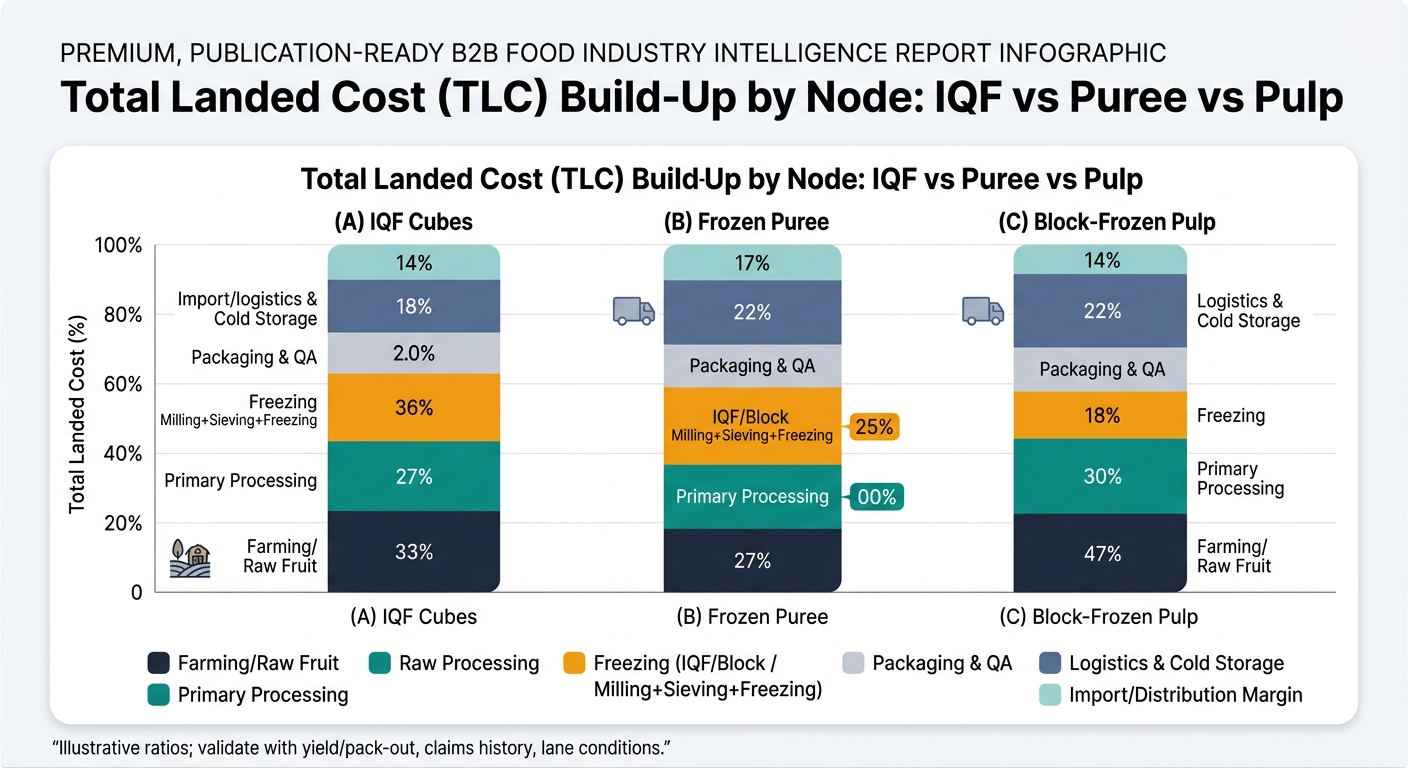
Stacked bar chart comparing illustrative total landed cost build-up by node for IQF dragon fruit cubes, frozen puree, and block-frozen pulp, with segments for farming/raw fruit, primary processing, freezing or milling+sieving+freezing, packaging and QA, logistics and cold storage, and import/distribution margin, plus a footnote noting ratios are illustrative and should be validated with yield/pack-out, claims history, and lane conditions.

2.1 Upstream: Farming & Fresh Fruit Procurement (Raw Material)

Key insight: In frozen dragon fruit, farmgate price volatility often originates from yield swings and competition with the fresh market; processors may switch intake standards (maturity/variety) that later show up as brix/color/texture variability in your frozen spec.

Cost drivers

  • Farm labor (harvest + field sorting)
  • Inputs (fertilizer, irrigation, pest control)
  • Yield/size distribution (affects peel-to-pulp ratio)
  • Variety mix (white vs red flesh impacts color expectations)

Procurement levers

  • Tighten incoming fruit requirements that correlate with finished spec (maturity window, variety declaration)
  • Contract language: define acceptable variety substitution and color tolerance bands

2.2 Primary Processing: Wash, Peel/Trim, Cut or Pulp

Key insight: This is where hidden yield loss lives. Dragon fruit is labor-intensive to peel/trim; small fruit and cosmetic defects increase trim loss, raising cost per kg of finished frozen product.

Cost drivers

  • Labor availability and wage pressure
  • Water/sanitation controls (wash water management)
  • Yield loss (peel + trim + defect removal)
  • Foreign material controls (seed is normal; hard foreign material is not)

Procurement levers

  • Audit/verify yield assumptions in cost models during negotiations
  • Require process controls documentation (sanitation SSOPs, foreign material program)

2.3 Secondary Processing: Freezing (IQF vs Block) + Throughput

Key insight: Freezing method is a commercial choice with operational consequences.

IQF cubes/slices

  • Higher capex/energy and tighter process control
  • Better “free-flow” performance for retail and smoothie applications
  • More sensitive to temperature excursions (clumping claims)

Block-frozen pulp/puree

  • Usually lower processing cost per kg
  • Fits industrial users; less “retail-ready”

Cost drivers

  • Energy (freezer + cold storage)
  • Throughput constraints during peak intake
  • Rework/sorting if cut-size distribution drifts

Procurement levers

  • Align format choice to true end-use value (don’t overbuy IQF if block works)
  • Put clump tolerance and temperature abuse responsibilities into specs + claims policy

2.4 Packaging & QA Release

Key insight: For frozen fruit, QA is not a checkbox—QA failures create inventory holds (cash + service risk) and force spot buys.

Cost drivers

  • Packaging film/cartons/liners, palletization
  • Lab testing (micro, sometimes residues)
  • Certification and audit costs (BRCGS/FSSC/ISO 22000 depending on buyer)

Procurement levers

  • Standardize COA fields across suppliers (micro limits, cut size, brix, additives)
  • Pre-agree escalation rules for out-of-spec: rework, downgrade, credit

2.5 Logistics: Reefer Ocean + Cold Storage + Inland Refrigerated

Key insight: For quick-frozen foods, widely used cold-chain practice targets -18°C or colder through storage and transport (with defined tolerances). Any deviation increases quality risk and claims probability. (Codex quick frozen foods code)

Cost drivers

  • Reefer ocean freight and surcharges
  • Port dwell time + demurrage/detention
  • Destination cold storage capacity and handling

Procurement levers

  • Require temperature recorder data (or carrier monitoring) for dispute resolution
  • Build lead-time buffers around peak congestion periods

2.6 End-Market Margin Stack (Importer/Distributor/Your Internal Handling)

Key insight: The “price” procurement sees is often hiding a margin stack across importer handling, cold storage, and financing (inventory carrying cost).

Cost drivers

  • Importer/distributor margin
  • Inventory holding and shrink
  • Internal handling (repacking, blending, QA sampling)

Procurement levers

  • Decide where you want margin to sit: buy direct ex-works vs through an importer who absorbs complexity

Product-level cost breakdown (illustrative ratios)

Modeled percentages of final delivered cost to your US cold warehouse (TLC). Actual ratios vary by origin, season, pack format, freight conditions, and quality requirements. Use these as a negotiation checklist (what to validate) rather than a fixed benchmark.

A) IQF Dragon Fruit Cubes (retail/foodservice grade)

Supply Chain Node Cost Ratio (% of TLC) What usually drives variance
Farming / raw fruit 28% Yield swings, fresh-market competition
Primary processing 18% Labor + trim/yield loss
Freezing (IQF) 14% Energy + throughput constraints
Packaging & QA 10% Film/cartons + micro testing
Logistics & cold storage 18% Reefer rates + port dwell
Import/distribution margin 12% Handling + financing

B) Frozen Dragon Fruit Puree (industrial)

Supply Chain Node Cost Ratio (% of TLC) What usually drives variance
Farming / raw fruit 30% Fruit price and size distribution
Primary processing 16% Peel/trim labor
Puree milling/sieving + freezing 12% Rework + consistency control
Packaging & QA 8% Drums/cartons + COA requirements
Logistics & cold storage 20% Weight/space efficiency, lane volatility
Import/distribution margin 14% Cold storage + working capital

C) Block-Frozen Pulp (seed-in, industrial)

Supply Chain Node Cost Ratio (% of TLC) What usually drives variance
Farming / raw fruit 32% Farmgate volatility
Primary processing 14% Intake quality and yield
Block freezing 10% Lower than IQF but still energy-driven
Packaging & QA 7% Liners/cartons + sampling
Logistics & cold storage 22% Heavy, cold storage intensive
Import/distribution margin 15% Handling + financing

3) The Structural Fact That Governs the Category: “Year-Round” Supply Is Not “Stable” Supply

Procurement teams often hear that dragon fruit can fruit almost all year, including through lighting-induced off-season flowering. That’s directionally true in Vietnam, but it’s not the same as stable exportable frozen supply.

What makes supply structurally unstable:

  • Origin concentration + regional clustering. In Vietnam, production is heavily concentrated in a few provinces (commonly cited: Binh Thuan, Long An, and Tien Giang), which amplifies weather and infrastructure shocks into global availability.
  • Processing is the choke point. When harvest surges, plants face labor and freezer throughput limits; when harvest is weak, plants protect margins by repricing or rationing.
  • Spec drift is seasonal. Brix/texture and color consistency tend to move with maturity and variety mix—especially when processors widen intake standards to fill capacity.

4) The Critical Insight Procurement Can Use: Why Your Quote Doesn’t Track Farm Reality (and Then Suddenly Does)

Frozen dragon fruit pricing often behaves like this:

  • Phase 1: Farm prices move, finished prices don’t (yet). Processors sell from inventory and contracted commitments; IQF/puree pricing may lag farmgate moves.
  • Phase 2: A constraint hits and prices “gap up.” The moment you get a combination of (a) low compliant inventory, (b) constrained reefer/cold storage, or (c) QA holds, processors reprice quickly—especially for IQF.

What triggers the “gap up” most often:

  • Capacity saturation at peeling/cutting lines and IQF tunnels
  • Cold-chain disruption (port dwell, reefer availability)
  • Food-safety events causing holds/recalls in broader frozen fruit categories—raising scrutiny, testing frequency, and risk premiums. (FDA outbreak investigations and prevention strategy)

Procurement implication: If you only benchmark “price per kg,” you miss the real driver: probability of supply failure + probability of claims during volatility.

5) Common Procurement Mistakes in Frozen Dragon Fruit (and the Hidden Cost of Each)

  1. Single-origin dependence disguised as “multiple suppliers.”
  2. Many “different suppliers” source from the same region and sometimes the same upstream networks.
  3. Hidden cost: correlated disruption → simultaneous shortages.
  4. Spec written like a fresh fruit spec—or too vague to enforce.
  5. Missing: cut-size distribution, clump tolerance, drip loss guidance, variety declaration.
  6. Hidden cost: higher rejection/credit cycles and internal rework.
  7. Treating cold chain as the forwarder’s problem.
  8. Without temperature data and pre-agreed claims rules, disputes become slow and political.
  9. Hidden cost: delayed credits + emergency spot buys.
  10. Qualification done only when disruption hits.
  11. Frozen fruit qualification (docs → sample → pilot PO → performance) takes time.
  12. Hidden cost: switching during crisis forces spec concessions or premium freight.
  13. Overbuying IQF when puree/pulp would meet the application.
  14. IQF carries higher processing and handling costs.
  15. Hidden cost: paying for “format prestige” rather than functional value.

6) How an Intelligence-Driven Approach Changes the Outcome (Without Pretending It Eliminates Risk)

This is where procurement intelligence is practical: it changes timing, options, and governance.

Capability 1: Alternative supplier identification (contingency)

How it changes your decision:

Instead of “incumbent renewal vs spot scramble,” you build a pre-qualified bench by:

  • Format fit (IQF cubes vs puree vs pulp)
  • Cold-chain/export capability signals
  • Quality system maturity signals (certifications, audit readiness proxies)

Practical actions:

  • Build a two-lane sourcing map:
  • Lane A: primary origin (best TLC)
  • Lane B: alternate origin (insurance policy; may cost more but reduces stockout risk)
  • Stage qualification:
  • documentation pack (HACCP/food safety plan summary, allergen statement, COA template)
  • samples against your spec
  • pilot PO in non-peak period

Capability 2: Supply chain risk monitoring (weather/logistics/food-safety signals)

How it changes your decision:

You stop reacting to shortages and start using triggers:

  • If port dwell times rise or reefer availability tightens → pull forward POs / increase safety stock
  • If origin weather anomalies hit key producing clusters → activate alternate supplier sampling

Why this matters in frozen fruit specifically:

Frozen fruit categories have seen significant public-health investigations and recalls (e.g., hepatitis A linked to frozen strawberries in 2023), so early detection of risk signals helps you tighten verification before product is on the water. (FDA/CDC outbreak pages)

What intelligence can’t do (and how to validate):

  • It can surface signals and comparisons, but it can’t guarantee supply or compliance.
  • Validate with QA via: COAs, third-party audit reports, micro trend data, and temperature records.

7) Strategic Use Cases Procurement Leadership Can Operationalize This Quarter

  1. Renewal decision: renew incumbent vs diversify
  2. Output you want: portfolio concentration view + shortlist of alternates by format
  3. KPI: reduce single-origin exposure (e.g., top origin share) and improve time-to-switch
  4. Contract structure redesign: reduce landed-cost volatility
  5. Add: volume bands, lead-time SLAs, and pre-agreed claims/credit policy for temperature abuse
  6. KPI: landed-cost variance; expedited freight incidence
  7. Spec governance upgrade (the “claims prevention” program)
  8. Standardize: cut size distribution, clump tolerance, additives/added sugar declaration, micro limits
  9. KPI: nonconformance rate, credit cycle time, internal rework hours
  10. Peak demand readiness (promotions/new SKU launches)
  11. Align promo calendar with freezer capacity windows; book capacity early
  12. KPI: service level during promo windows; stockout days avoided

8) Why This Intelligence Mindset Matters Beyond Dragon Fruit (Examples You Likely Also Buy)

Frozen dragon fruit is a clean example of a broader procurement truth: the constraint is rarely where your ERP cost bucket says it is. The same pattern appears in other categories procurement leaders commonly manage:

  • Frozen strawberries/berries: food-safety event risk and traceability complexity can dominate cost outcomes (holds, recalls, retailer chargebacks). (FDA berry strategy; FDA/CDC outbreak investigations)
  • Frozen mango: peeling/cutting labor and yield loss drive true cost; IQF vs puree decisions mirror dragon fruit.
  • Avocado products (frozen pulp/puree): origin concentration + cold chain + oxidation/spec control create the same “price lag then gap” dynamic.
  • Shrimp or seafood (frozen): cold-chain integrity and documentation governance often matter as much as raw price.

If your organization builds repeatable intelligence workflows here—alternate qualification benches, trigger-based risk monitoring, and spec governance—you can reuse them across multiple frozen and chilled categories.

9) Why Frozen Dragon Fruit Is a High-Signal Example for Prospective Procurement Programs

Frozen dragon fruit is a strong category to prove procurement intelligence value because:

  • It’s small enough to fix quickly (formats are limited; spec can be standardized), yet
  • Complex enough to expose real enterprise risks (origin concentration, processing bottlenecks, cold chain, and food-safety governance), and
  • Outcomes are measurable within 1–2 sourcing cycles:
  • Reduction in emergency spot buys
  • Lower claim rate tied to clumping/temperature abuse
  • Improved supplier on-time performance
  • Lower landed-cost variance (even if average price doesn’t drop)

The procurement win is not “finding the cheapest pitaya.” It’s building a supply system where price, quality, and continuity trade-offs are explicit, pre-negotiated, and managed before the disruption hits.

Tridge Eye Data Intelligence Solution

Make Faster, Data-Driven Sourcing Decisions

The insights in this report are just the starting point. Tridge Eye is the data intelligence solution that gives procurement and sourcing leaders real-time market signals, price benchmarks, and supply risk alerts — so you can act before the market moves.

Explore Tridge Eye →

Subscribe
By subscribing you agree to with our Privacy Policy and provide consent to receive updates from our company.
Thank you! Your submission has been received!
Oops! Something went wrong while submitting the form.
Subscribe to receive the latest blog posts, updates, promotions, and announcements from Tridge.