INDUSTRY TRENDS

Frozen Bilberry Supply Chain Map (IQF/Block): Physical Flow, Cost Lock-In Points, and Spec Levers for Procurement

Author
Team Tridge
DATE
April 28, 2026
7 min read
frozen-bilberry Cover
Frozen BilberryHS 081190Conventional · Frozen Diced Bilberry · Frozen Whole Bilberry
Powered by Tridge Eye
🇫🇷 France↑ 8.6%
$15.57/kg
🇵🇱 Poland
$6.70/kg
Wholesale reference prices across 131 markets

Frozen bilberry is a seasonal, wild-harvest ingredient where most commercial outcomes are “decided” upstream—during a short intake window, under constrained freezing/sorting capacity, and then either preserved or destroyed by cold-chain execution. This guide maps the real physical flow, shows where cost structurally accumulates, and translates those nodes into the spec and contracting levers procurement teams can actually use.

Executive Summary

  • Seasonality is the constraint: Nordic wild bilberries are typically picked late July to early September, compressing intake and freezing capacity into a few peak weeks.
  • Two failure modes dominate TCO:foreign matter / defect yield loss at sorting, and temperature abuse (−18°C standard) in storage/transport.
  • “Cheap” offers often hide yield haircuts: tighter EVM/defect specs can raise rejects and true cost even if the invoice price is lower.
  • Codex anchors the temperature rule: quick-freezing is not “complete” until the thermal center reaches −18°C, which is why cold-chain is a process capability, not a freight detail.
  • 2026 logistics risk is real: reefer capacity and rate volatility remains elevated vs. 2025 in many lanes—plan dwell time, monitoring, and contingency capacity into awards.

1) How the Physical Supply Chain Is Built (and Where Costs “Lock In”)

Insight: Frozen bilberry (Vaccinium myrtillus) is physically constructed around a short wild-harvest window feeding a capacity-constrained freezing system; most cost and quality outcomes are determined before the product ever reaches export cold storage.

Data: In key Nordic origins, bilberry picking commonly concentrates from late July through early September (later at higher latitudes), creating a compressed intake period where plants must clean, sort, and freeze quickly to protect quality and minimize foreign matter.

Procurement Impact: Your “true” supply chain is not farm → factory; it’s forest collectors → aggregation/buying stations → freezer intake → cleaning/sorting → IQF/block freeze → cold storage → reefer export. Fixed cost drivers concentrate at intake (labor + yield loss), sorting (technology + rejects), freezing/cold storage (energy + capacity), and cold-chain integrity (claims risk).

Physical flow (ground truth)

  • Wild collection: dispersed pickers harvest into field containers.
  • Aggregation: buying stations consolidate, do basic visual screening, and move berries to plants.
  • Primary processing: intake QC, cleaning/de-stemming, (optional) washing, draining.
  • Freezing: IQF tunnel/spiral (premium) or block freezing (ingredient/puree feedstock).
  • Post-freeze controls: optical sorting/foreign body control, metal detection/X-ray as specified.
  • Pack-out & storage: bulk cartons/liners or retail packs; stored at ≤ -18°C.
  • Export logistics: reefer truck/container, port handling, ocean/land reefer, destination cold warehouse.
A left-to-right supply chain flow diagram showing the real physical movement and transformations of frozen bilberries, from wild collection through aggregation, intake QC, cleaning/de-stemming with optional wash/drain, IQF vs block freezing, post-freeze controls, pack-out, origin cold storage at ≤ −18°C, reefer transport to port, port handling/dwell risk, ocean/land reefer, and destination cold warehouse, with callouts noting upstream cost/quality lock-in during the short intake window and end-to-end cold-chain continuity to −18°C.

2) Where Money Accumulates: Cost & Margin Structure by Node

Insight: Bilberry cost is a stack of (1) raw fruit acquisition under yield uncertainty, (2) pack-out loss during cleaning/sorting, (3) energy-intensive freezing + long inventory holding, and (4) cold-chain logistics where temperature excursions can destroy value.

Data: Codex for quick-frozen bilberries ties completion of freezing to reaching −18°C at the thermal center, and industry cold-chain practice typically targets 0°F/−18°C or colder for frozen fruit quality preservation.

Procurement Impact: The “unit cost” you pay is heavily shaped by conversion yield (what gets rejected as stems/leaves/soft fruit), the freezing format (IQF vs block), and how much cold storage + reefer time sits inside your lead time.

1. Upstream / Raw Material (Wild Harvest + Aggregation)

  • Insight: This node is labor- and logistics-dominated, with quality variability baked in because collection is dispersed and time-to-freeze is the first quality gate.
  • Data: Wild bilberries in Nordic countries typically ripen and are harvested in July–September, with practical picking often peaking in August depending on latitude and season.
  • Procurement Impact: The biggest “hidden cost” here is not the picker payment alone; it’s the downstream yield loss caused by field contamination (leaves/stems), mixed ripeness, and delayed delivery that increases softness and sorting rejects.

2. Primary Processing (Intake QC, Cleaning, De-stemming, Optional Washing)

  • Insight: Primary processing converts a variable, contaminated wild input into a manageable frozen-food safety baseline; it also determines the first major yield haircut.
  • Data: Quick-frozen fruit specifications commonly require control of extraneous vegetable material (EVM), practical cleanliness, and temperature targets aligned to frozen storage expectations—meaning defects removed here directly change both compliance and usable yield.
  • Procurement Impact: Plants with better cleaning lines (air separation, de-stemming, wash/drain control) can hit tighter foreign matter tolerances with less over-sorting (less good fruit thrown away), which is a structural advantage in premium-grade supply.

3. Freezing + Secondary Sorting (IQF/Block Freezing, Optical Sorting, Foreign-Body Control)

  • Insight: Freezing is the energy and capacity choke point; secondary sorting is the technology choke point. Together they define grade separation (premium IQF vs ingredient-grade vs downgrade to puree).
  • Data: IQF is designed to freeze pieces individually rather than in a block; quick-frozen standards and common buyer specs typically anchor around −18°C for product temperature and require practical freedom from extraneous matter.
  • Procurement Impact: This node is where “spec compliance” becomes a cost curve: tighter foreign matter/defect targets require more sorting passes, slower line speeds, higher labor/energy per kg, and higher reject rates—raising cost but reducing claims and downstream line stoppages.

4. Packaging & QA Release (Bulk Cartons/Liners, Retail Packs, COA)

  • Insight: Packaging is not just materials—it is cold-environment handling, lot integrity, and QA evidence (COA + traceability) that supports downstream acceptance.
  • Data: Typical frozen fruit/bakery ingredient specs reference packaging integrity (cartons + food-grade liners) and defect expectations (practically free from extraneous vegetable material; sound, clean fruit).
  • Procurement Impact: Packaging choices change physical risk: weak liners increase dehydration/freezer burn risk; poor carton strength increases pallet damage and temperature exposure during handling, which later shows up as clumping, ice crystals, and claim disputes.

5. Cold Storage + Reefer Logistics (Origin Storage → Port → Destination)

  • Insight: Frozen bilberry value can be created perfectly upstream and still be destroyed by a single weak link in cold chain continuity.
  • Data: Frozen fruit storage guidance commonly targets 0°F/−18°C or colder; 2026 reefer markets in many regions continue to show elevated volatility and tighter usable capacity versus 2025, increasing the risk of dwell time and temperature excursions if not managed.
  • Procurement Impact: Logistics cost is not just freight; it includes temperature monitoring, dwell time, demurrage risk, and the probability-weighted cost of claims/rework when product arrives with clumping/drip loss that disrupts your production or retail presentation.

Product-Level Cost Breakdown (Illustrative Ratios)

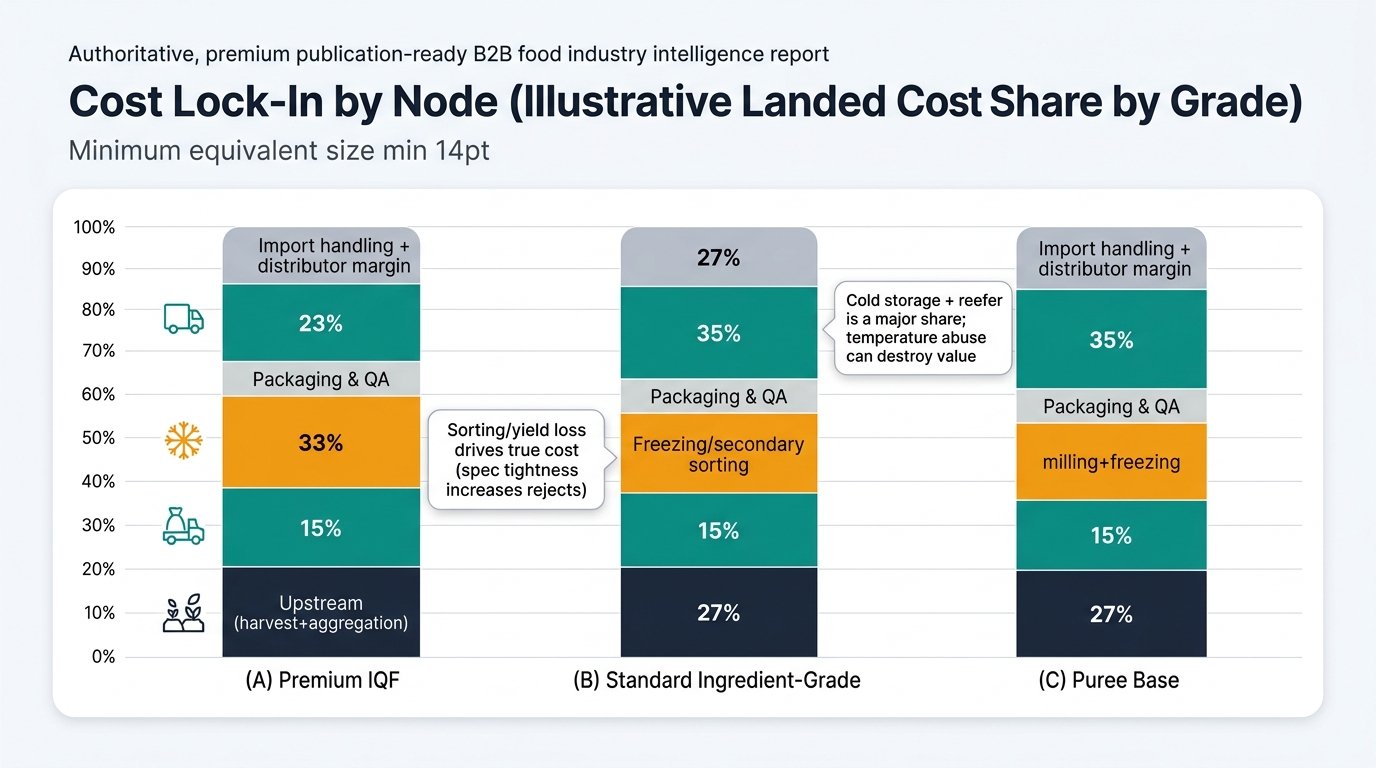
Note: Ratios vary by origin, grade stringency, packaging format, and route. These are structural “shape of cost” estimates to help you locate where cost accumulates, not a price forecast.
A) Premium IQF Bilberries (tight foreign matter/defect spec)

A stacked bar chart with three vertical bars for (A) Premium IQF, (B) Standard Ingredient-Grade, and (C) Puree Base, segmented by supply chain nodes (Upstream, Primary processing, Freezing/secondary sorting or milling+freezing, Packaging & QA, Cold storage + reefer logistics, Import handling + distributor margin) using the illustrative table percentages, with callouts noting that sorting/yield loss drives true cost and that cold storage plus reefer is a major share where temperature abuse can destroy value.
Supply Chain Node Cost Ratio (% of Final Landed Cost) Notes
Upstream (harvest + aggregation) 35% Labor-driven; quality variability creates yield loss downstream.
Primary processing (clean/wash/de-stem) 12% Yield haircut + labor/water/wastewater (if washed).
Freezing + secondary sorting 18% Energy + capacity + optical sorting passes to meet tight spec.
Packaging & QA release 8% Higher QA intensity; stronger packaging to protect IQF integrity.
Cold storage + reefer logistics 17% Long frozen holding + reefer route + port dwell sensitivity.
Import handling + distributor margin 10% Customs, cold warehouse handling, channel margin.

B) Standard Ingredient-Grade Frozen Bilberries (looser defect tolerance)

Supply Chain Node Cost Ratio (% of Final Landed Cost) Notes
Upstream (harvest + aggregation) 38% Raw fruit dominates; still seasonal and labor-driven.
Primary processing 10% Fewer sorting passes; higher tolerance reduces reject loss.
Freezing (IQF or block) + basic sorting 14% More block freezing possible; less optical sorting intensity.
Packaging & QA release 6% Bulk packs; standard COA set.
Cold storage + reefer logistics 20% Logistics share rises when product value/grade is lower.
Import handling + distributor margin 12% Similar channel structure; margin/share often higher vs value.

C) Frozen Bilberry Puree Base (from downgrades/soft fruit)

Supply Chain Node Cost Ratio (% of Final Landed Cost) Notes
Upstream (harvest + aggregation) 30% Often uses lower-grade inputs; still seasonal procurement.
Primary processing 8% Cleaning before milling; foreign matter control still required.
Milling/pureeing + freezing 22% Additional processing step + energy; viscosity/seed management.
Packaging & QA release 10% Drums/aseptic liners (if used) + QA for consistency.
Cold storage + reefer logistics 18% Heavy, dense shipments; temperature integrity still critical.
Import handling + distributor margin 12% Channel and cold handling similar.
Sourcing Window Radar
Frozen Bilberry — Global Harvest Calendar
UKRAINE SEASON ACTIVE
🇺🇦 Ukraine
APR — OCT
🇺🇸 United St.
APR — SEP
🇨🇳 China
MAY — MAY
🇵🇱 Poland
JUN — OCT
🇳🇱 Netherlan.
JUN — OCT
JanFebMarAprMayJunJulAugSepOctNovDec

3) Structural Facts You Can’t Negotiate Away (Industry Constants)

Insight: Frozen bilberry behaves like a constrained wild-ingredient system, not a scalable orchard crop—so physical bottlenecks and documentation complexity are structural.

Data: Bilberry (Vaccinium myrtillus) is widely wild-collected across Northern Europe; ripening/fruiting is typically July to September, and commercial supply commonly moves through aggregation before industrial cleaning and freezing.

Procurement Impact: Three realities shape availability, quality, and claims risk regardless of supplier:

  • Reality 1 — Short intake window + fixed freezing capacity: Peak-week throughput limits mean plants prioritize lots that run clean and freeze well; anything slow to clean/sort competes for scarce line time.
  • Reality 2 — Grade separation is mostly “yield economics”: Premium IQF is created by removing defects/foreign matter; the tighter the spec, the more good fruit can be rejected to protect compliance.
  • Reality 3 — Cold chain is a quality spec, not a logistics detail: A −18°C requirement is effectively a process capability requirement across multiple companies (plant, trucker, port, carrier, warehouse). Breaks show up as clumping/drip loss and can trigger rejections even if the COA was perfect at ship.

Key Insights (What to Remember When You Look at Any Supplier or Origin)

Insight: The supply chain’s “hard points” are aggregation discipline, sorting technology, freezing energy/capacity, and cold-chain continuity.

Data: Bilberry harvest in Nordic supply is typically concentrated in late summer (July–September), and quick-frozen standards/specs commonly anchor around −18°C as the critical temperature threshold.

Procurement Impact: When comparing offers, you are implicitly comparing (1) expected yield loss to hit your foreign matter/defect limits, (2) the plant’s ability to freeze and hold inventory without temperature excursions, and (3) how packaging + handling protect IQF integrity through ports and warehouses.

The Bottom Line for Your Next Contract

The Bottom Line for Your Next Contract:
(Analyzed at: Apr, 2026)
Write your next bilberry contract so it forces evidence on the two value-destroyers you can’t fix later: (1) foreign matter performance at pack-out (define EVM/defect limits and require lot-level inspection records) and (2) cold-chain integrity to −18°C (require calibrated recorder data through handoffs, not just a COA at ship). This works because bilberry economics are fundamentally yield-and-temperature economics: sorting determines how much usable fruit you actually buy, and logistics determines whether that value survives transit. With 2026 reefer capacity/rate volatility still elevated in many markets, teams that contract monitoring and contingency capacity up front typically avoid the quiet 2–6% landed-cost bleed that shows up later as clumping claims, rejections, rework, and emergency resupply—right when the seasonal window is already closed.
Frozen BilberrySupply Chain Intelligence
131 countries tracked
10
Exporters
10
Importers
$468M
Top Export Value
Top Exporters (2024)
🇨🇦
Canada
$468M
🇵🇱
Poland
$310M
🇨🇱
Chile
$263M
🇲🇾
Malaysia
$220M
🇺🇸
United States
$218M
+126 more
Top Buyers
🇺🇸 United States $893M🇩🇪 Germany $317M🇹🇭 Thailand $222M🇨🇦 Canada $194M🇳🇱 Netherlands $191M
Subscribe
By subscribing you agree to with our Privacy Policy and provide consent to receive updates from our company.
Thank you! Your submission has been received!
Oops! Something went wrong while submitting the form.
Subscribe to receive the latest blog posts, updates, promotions, and announcements from Tridge.