INDUSTRY TRENDS

Frozen Avocado Sourcing (2026): Where Landed Cost Really Comes From—Yield, Spec, and Cold-Chain Risk

Author
Team Tridge
DATE
March 9, 2026
9 min read
frozen-avocado Cover
Tridge — Trusted Global Food Sourcing

This report is powered by Tridge market intelligence.

Every data point, price signal, and supply chain insight in this analysis is drawn from the same engine that procurement teams worldwide rely on daily. As you read, consider what this level of visibility could do for your category.

See how Tridge Eye works →

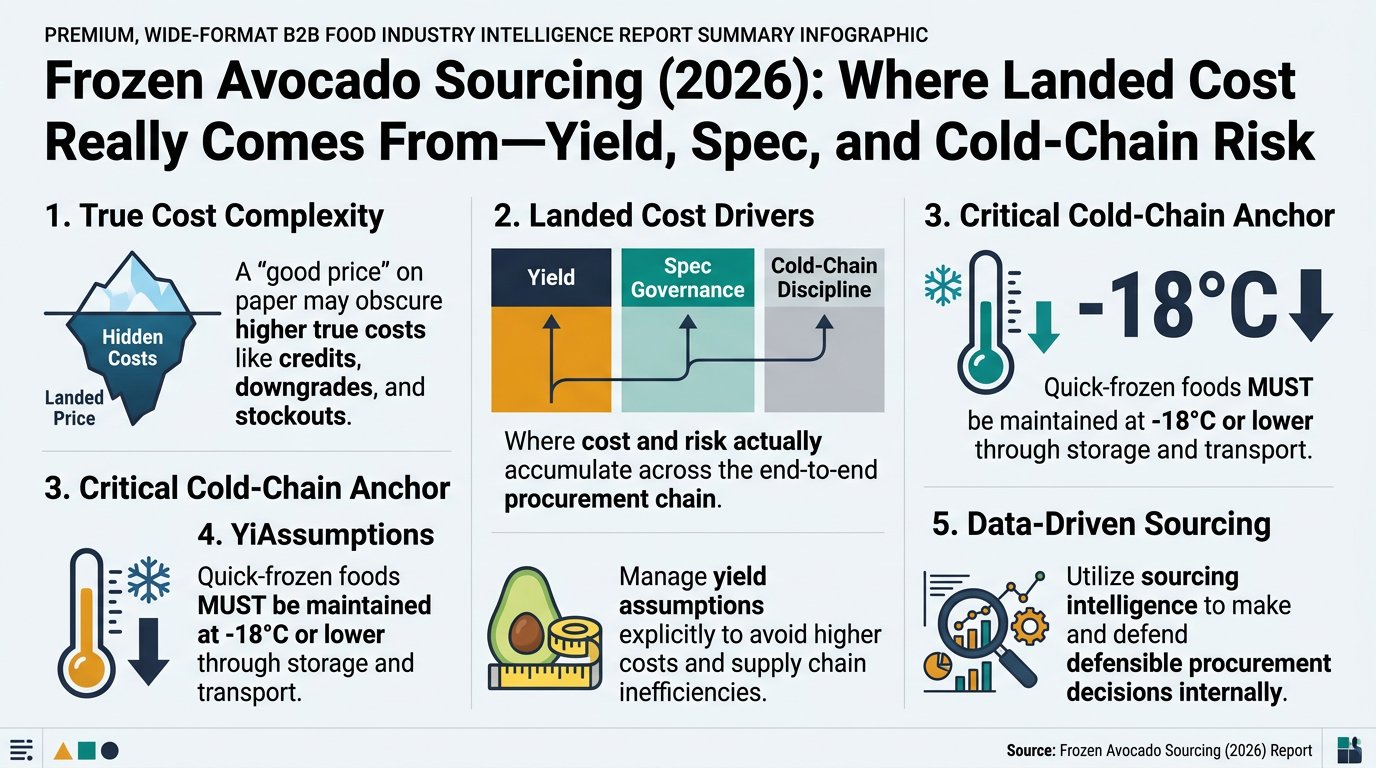
Frozen avocado is one of those categories where a “good price” on paper can still create higher true cost (credits, downgrades, stockouts) if yield assumptions, spec governance, and cold-chain discipline aren’t managed explicitly. This guide maps the end-to-end chain in procurement language, highlights where cost and risk actually accumulate, and shows how sourcing intelligence can be used to make decisions you can defend internally.

Executive Summary

  • Cold-chain anchor: Quick-frozen foods are expected to be maintained at -18°C or lower through storage and transport (subject to permitted tolerances) [1].
  • Yield is structural: A commonly used foodservice yield reference lists avocado at ~67% edible portion (before additional defect trimming) [2].
  • Fresh-market tether: Processing fruit economics are linked to the fresh channel; when fresh demand strengthens, processors often face higher fruit costs or lower plant utilization—both pressure frozen pricing (often with a lag).
  • Mexico matters: USDA FAS reports Mexico’s 2025 avocado production forecast at 2.75 MMT, reinforcing the category’s exposure to Mexico-driven supply and price signals [3].
  • Format drives risk profile: IQF pieces (chunks/slices) are more sensitive to color/texture and cold-chain excursions than pulp/puree, so the “right” supplier and contract structure often differs by format.

Key Insights

(Analyzed at: Mar, 2026)

  • Strategy: Hold
  • Reliability: Medium
  • Potential Saving: 4% ~ 10%
  • Insight: Don’t treat frozen avocado as a single buy. In March 2026, the best near-term value is typically created by (1) locking governance on yield and defect assumptions (so quotes are comparable), and (2) dual-sourcing by format—keep IQF pieces with the most process-controlled, cold-chain-disciplined suppliers, while using pulp/puree to broaden origin/supplier optionality and negotiate more aggressively. This usually reduces “hidden cost” (claims, downgrades, emergency spot buys) more reliably than chasing a headline $/lb.

1) What you’re actually buying: the frozen-avocado supply chain, end-to-end (ground truth)

Frozen avocado looks like a “simple” frozen fruit line item until you map what has to go right between orchard and your freezer.

Typical flow (what procurement is really managing):

  1. Orchard & harvest (fresh Hass, often processing grade) → fruit competes with the fresh-export channel.
  2. Conditioning/ripening + sorting → plants need maturity (dry matter/oil) for yield and texture.
  3. Peel/pit removal + trimming → high labor + high yield loss (you pay for what gets removed).
  4. Cut/pulp + anti-browning controls → oxygen management + acidulants/processing choices drive color and flavor stability.
  5. Freezing (often IQF for pieces) + packing → energy intensive; pieces are more spec-sensitive than pulp.
  6. Cold store → reefer ocean/inland → destination cold store → continuity depends on -18°C discipline and lane reliability.
  7. Distributor / co-man / foodservice / retail → final performance depends on thaw behavior, not just COA pass/fail.

Frozen-category non-negotiable: quick-frozen foods are typically handled and transported to maintain -18°C or lower through the cold chain, with defined tolerances [1].

Flowchart showing the frozen avocado end-to-end supply chain from orchard and harvest through conditioning/sorting, trimming, cutting/pulping with anti-browning controls, freezing and packing, cold-chain logistics, and distribution to the customer freezer, with a cold-chain anchor of -18°C or lower and risk icons for yield loss, browning, and temperature excursions.

2) Where cost and margin build up (and why “fruit price” is not the full story)

Below, each node is written the way a category manager would use it: what cost accumulates here, what can go wrong, and what to measure.

2.1 Orchard & harvest: the cost you can’t see in a frozen quote

Key insight: Frozen avocado is not insulated from the fresh market; it is economically “tethered” to fresh demand windows. When fresh prices rise, processors must either pay up for fruit or run below capacity—both push up your frozen price with a lag.

Cost drivers you should assume matter (even if suppliers don’t itemize):

  • Farmgate price volatility driven by export demand and seasonal peaks.
  • Yield variability (size, defects, maturity) that changes usable flesh per ton.
  • Origin concentration (Mexico plus other key Latin American origins) amplifies systemic shocks.

Procurement KPI to track: % of your cost exposure that is raw fruit-indexed vs. processing/logistics-indexed (even if you don’t formally index contracts).

2.2 Conditioning + sorting: the hidden “yield gate” before processing

Key insight: Plants are buying maturity, not just tonnage. Under-mature fruit increases trimming loss and degrades thaw texture; over-mature fruit raises browning risk and can increase overall quality risk.

Cost drivers:

  • Energy and time for conditioning rooms.
  • Sorting labor + reject handling.
  • Losses from lots that don’t meet processing windows.

What to capture in governance: lot maturity proxies (supplier-side), reject rates, and any “blend to spec” practices for pulp.

2.3 Peeling/pitting/trimming: why yield is the biggest lever you’re not negotiating

Key insight: Avocado has structurally high waste: peel + pit + defects. In foodservice yield references, edible portion is commonly ~67% for avocado (i.e., ~33% is non-edible before additional defect trimming) [2].

Cost drivers:

  • Labor intensity (peel/pit/cut is difficult to mechanize perfectly).
  • Trimming loss (defects, strings, bruising) varies by origin/season.
  • Food safety sanitation downtime (wet processing environment).

Negotiation reality: Two suppliers can quote the same $/lb frozen chunks but have materially different fruit-to-finished yield assumptions. If you don’t pressure-test yield, you’re negotiating blind.

2.4 Cutting/pulping + anti-browning controls: spec is a cost dial

Key insight: Color stability is not “free.” Oxidation control choices (process design, oxygen exposure, acidulants) change:

  • Ingredient declaration and customer acceptance
  • Sensory outcome after thaw
  • Complaint risk and credit notes

Cost drivers:

  • Additives/processing aids (where used)
  • Additional handling steps to limit oxygen exposure
  • Higher QA sampling for pieces vs. pulp

Trade-off to decide:

  • Tighter color/defect spec → smaller supplier pool + higher cost but fewer complaints.
  • Controlled spec-flex (especially for pulp) → wider pool + better resilience but requires stronger internal governance.

2.5 Freezing (IQF) + packing: energy and format sensitivity

Key insight: IQF pieces carry a double premium: (1) energy-intensive freezing and (2) tighter spec sensitivity (uniform cut size, minimal browning, low defects). Pulp/puree can often be standardized via blending, reducing some variability.

Cost drivers:

  • Freezer energy (tunnel/spiral/IQF)
  • Packaging films with oxygen/moisture barrier
  • Metal detection / foreign matter controls

What to benchmark: defect limits, cut-size tolerances, and complaint rates by format (chunks vs. pulp).

2.6 Cold-chain logistics: the “silent” landed-cost swing factor

Key insight: Even when product stays safe, temperature abuse degrades texture and color, turning into commercial loss (downgrades, credits, customer churn). The cold chain expectation for quick-frozen foods is -18°C or lower in storage/transport (subject to permitted tolerances) [1].

Cost drivers:

  • Reefer availability and lane volatility
  • Port dwell time and demurrage risk
  • Destination cold storage capacity and fees

Governance metric: temperature excursion incidents per lane + claim value per incident.

2.7 Import/distribution margin: where “service level” gets priced in

Key insight: Importers/distributors often price not just product but inventory risk (frozen working capital), case-pick complexity, and service expectations.

Cost drivers:

  • Inventory carrying cost (cold storage + capital)
  • Repacking/relabeling compliance
  • Customer chargebacks and service penalties

Procurement lever: align pack formats/MOQs with your demand profile to avoid paying for someone else’s safety stock.

End of Section 2 — Product-level cost breakdown (illustrative ratios)

Stacked bar chart comparing landed cost concentration by format (IQF chunks vs slices/halves vs pulp/puree), segmented into seven supply-chain nodes using illustrative ratios, with callouts that fruit cost dominates (38–45%) and pieces carry higher spec/cold-chain sensitivity, plus a footnote noting ratios vary by origin, season, spec, and freight.

These ratios are modeled to show where cost tends to concentrate by product form. Actual splits vary by origin, season, spec tightness, freight conditions, and whether you buy direct vs. via importer.

A) IQF Frozen Avocado Chunks (foodservice bag-in-case)

Supply Chain Node Cost Ratio (% of landed cost) What typically moves it
Orchard & harvest (fruit) 40% Fresh-market pull; maturity/yield
Conditioning + sorting 6% Reject rates; energy
Peel/pit/trimming 14% Labor + yield loss (~33% non-edible baseline before defects) [2]
Cutting + anti-browning controls 7% Oxidation management; additives
Freezing + packing 13% Energy + barrier films
Cold-chain logistics 12% Reefer rates; port dwell; cold storage
Import/distribution margin 8% Inventory risk + service level

B) Frozen Avocado Slices/Halves (retail-ready quality)

Supply Chain Node Cost Ratio (% of landed cost) What typically moves it
Orchard & harvest (fruit) 38% Fruit size/grade requirements
Conditioning + sorting 7% Stricter grading
Peel/pit/trimming 16% Higher defect rejection
Processing controls (color/texture) 8% Tighter spec and handling
Freezing + packing 14% Higher packaging standards
Cold-chain logistics 10% Similar lanes, higher claim sensitivity
Import/distribution margin 7% Retail compliance, chargebacks

C) Frozen Avocado Pulp/Puree (industrial)

Supply Chain Node Cost Ratio (% of landed cost) What typically moves it
Orchard & harvest (fruit) 45% Fruit price dominates
Conditioning + sorting 5% Can absorb more variability
Peel/pit/trimming 12% Still labor/yield intensive
Pulping + standardization 10% Blending, QA, spec targets
Freezing/packing (blocks/totes) 10% Pack type (tote vs. bag)
Cold-chain logistics 10% Weight/volume efficiency
Import/distribution margin 8% Lower case-pick complexity

3) Structural fact you need in every internal approval deck: frozen avocado is a yield-and-spec business

The important structural fact: A large portion of your “raw material” spend is paying for non-edible mass (peel/pit) plus variable defect trimming. Even before defects, common edible yield references put avocado around ~67% edible portion [2].

So what?

  • When fruit is small, under-mature, or defect-heavy, processors lose yield and must recover it in price.
  • Tight specs on color/defects/cut uniformity amplify yield loss (more trimming + more rejects).

Buyer decision this supports: when to pay for tighter specs vs. when to widen tolerances (especially for pulp) to protect continuity and cost.

4) The critical insight: why frozen-avocado prices can move even when “avocado supply” headlines look stable

Frozen price behavior often confuses non-specialists because it’s not a single commodity price—it’s a stack of linked markets.

Three mechanisms that create price “disconnects”:

  1. Fresh-market pull sets the floor for processing fruit. If fresh exporters pay more, processors must match or lose fruit.
  2. Yield shocks amplify cost faster than volume shocks. A modest drop in usable flesh (more defects, lower maturity) can raise unit cost sharply.
  3. Cold-chain constraints convert into premiums. If lanes tighten (reefer availability, port dwell), landed cost rises even if fruit is unchanged.

Context signal: USDA reports Mexico’s avocado production forecast at 2.75 MMT for 2025 (fresh avocado context that influences processing economics) [3].

5) Where procurement teams typically get frozen avocado wrong (and the avoidable consequences)

  1. They negotiate $/lb without negotiating yield assumptions.
  2. Result: “savings” disappear via higher defects, higher trim loss, or downgraded lots.
  3. They treat IQF pieces and pulp as interchangeable risk profiles.
  4. Result: unexpected complaint spikes when pieces can’t meet color/texture after thaw.
  5. They set specs historically, not application-based.
  6. Result: supplier pool shrinks; dependency rises; you pay a resilience premium.
  7. They qualify suppliers on certificates alone.
  8. Result: documentation passes, but cold-chain discipline and lot consistency fail commercially.
  9. They keep a ‘backup supplier’ that isn’t pre-qualified to your exact format and pack.
  10. Result: disruption forces spot buys, label changes, or emergency QA exceptions.

6) What an intelligence-driven approach changes (signals → decisions, not dashboards)

This is how sourcing intelligence changes category outcomes in frozen avocado—without pretending it replaces audits or QA.

6.1 Intelligence to pull (by capability)

  • Supplier discovery & longlist building
  • Signals: processors/exporters by origin; format capability (IQF pieces vs. pulp); pack formats; cold-store footprint.
  • Supplier benchmarking & qualification support
  • Signals: certification set (GFSI schemes), audit cadence disclosures, facility footprint, lead-time and MOQ patterns.
  • Price intelligence & cost driver tracking
  • Signals: fresh-market tightness indicators, logistics/energy proxies, FX sensitivity by origin.
  • Alternative origin identification
  • Signals: which origins are realistic substitutes for your spec (often pulp first, pieces second).
  • Risk monitoring
  • Signals: weather anomalies, port congestion, security/labor issues, phytosanitary or inspection disruptions.
  • Governance reporting
  • Signals: concentration exposure by supplier/origin/lane; decision logs; compliance milestone tracking.

6.2 How it changes the decision (actions + trade-offs)

  • Action: Split strategy by format.
  • IQF pieces: prioritize process control, cold-chain discipline, complaint history.
  • Pulp/puree: prioritize blending capability, spec standardization, and redundancy.
  • Action: Build a “spec-flex corridor.”
  • Define what can flex (color tolerance, minor defects) vs. what cannot (foreign matter, micro limits, lot traceability).
  • Action: Contract structure that matches volatility.
  • Use volume flex + shorter price review windows in peak volatility; reserve fixed-price for stable lanes/specs.

Business outcomes you can measure:

  • Lower emergency spot buys (service level stability)
  • Fewer credits/claims tied to thaw performance (quality cost)
  • Reduced single-origin dependency (risk exposure)

7) Strategic use cases procurement teams actually run in frozen avocado

  1. Inflation avoidance without supply breaks
  2. Benchmark incumbent offers vs. alternates; time negotiations around harvest/availability windows.
  3. Pre-qualified backup plan per critical SKU
  4. 1–2 alternates per format (chunks vs. pulp), with pack and labeling readiness.
  5. Spec governance as a lever
  6. Identify which lines in the spec are excluding suppliers and quantify cost-of-tightness.
  7. Lane risk playbook
  8. Pre-approve alternate ports/cold stores; define temperature excursion response rules.
  9. Executive-ready risk reporting
  10. Concentration + mitigation progress tracked monthly, not quarterly.

8) Why this matters beyond frozen avocado (examples your category peers will recognize)

Frozen avocado is a clean example of a broader procurement pattern: when yield + processing + cold-chain matter, price alone is a trap.

Comparable categories many procurement teams also buy:

  • Frozen berries (IQF): spec tightness (size, brix, defects) + pesticide compliance + cold-chain claims.
  • Nuts (e.g., cashew/almond): kernel yield and grade spreads create price “disconnects” from raw input headlines.
  • Citrus concentrates: blend-to-spec and inventory carry smooth spot swings—until a crop shock forces step-changes.
  • Frozen mango/pineapple: cut yields and defect trimming drive conversion economics similarly to avocado.

The transferable lesson: intelligence is most valuable where conversion yield and spec governance determine your true landed cost and continuity.

9) Why this frozen-avocado example is powerful for prospective customers

Because it forces the right procurement behavior:

  • It makes yield explicit (edible portion and trimming are structural, not “supplier excuses”) [2].
  • It clarifies the spec-to-supplier-pool trade-off (especially IQF pieces vs. pulp).
  • It highlights cold-chain as a commercial risk, not just a logistics detail, anchored to the -18°C handling norm for quick-frozen foods [1].
  • It produces governance artifacts leadership understands: concentration exposure, backup readiness, and claim cost trends.

Net effect: better decisions you can defend—more stable landed cost, fewer disruptions, and clearer category governance.

Take Your Sourcing Intelligence to the Next Level

The insights in this report are just the starting point. Tridge Eye gives you real-time market signals, origin risk alerts, and price benchmarks — so you can act before the market moves.
Explore Tridge Eye →

References

  1. fao.org
  2. d2jw81rkebrcvk.cloudfront.net
  3. fas.usda.gov
Subscribe
By subscribing you agree to with our Privacy Policy and provide consent to receive updates from our company.
Thank you! Your submission has been received!
Oops! Something went wrong while submitting the form.
Subscribe to receive the latest blog posts, updates, promotions, and announcements from Tridge.