
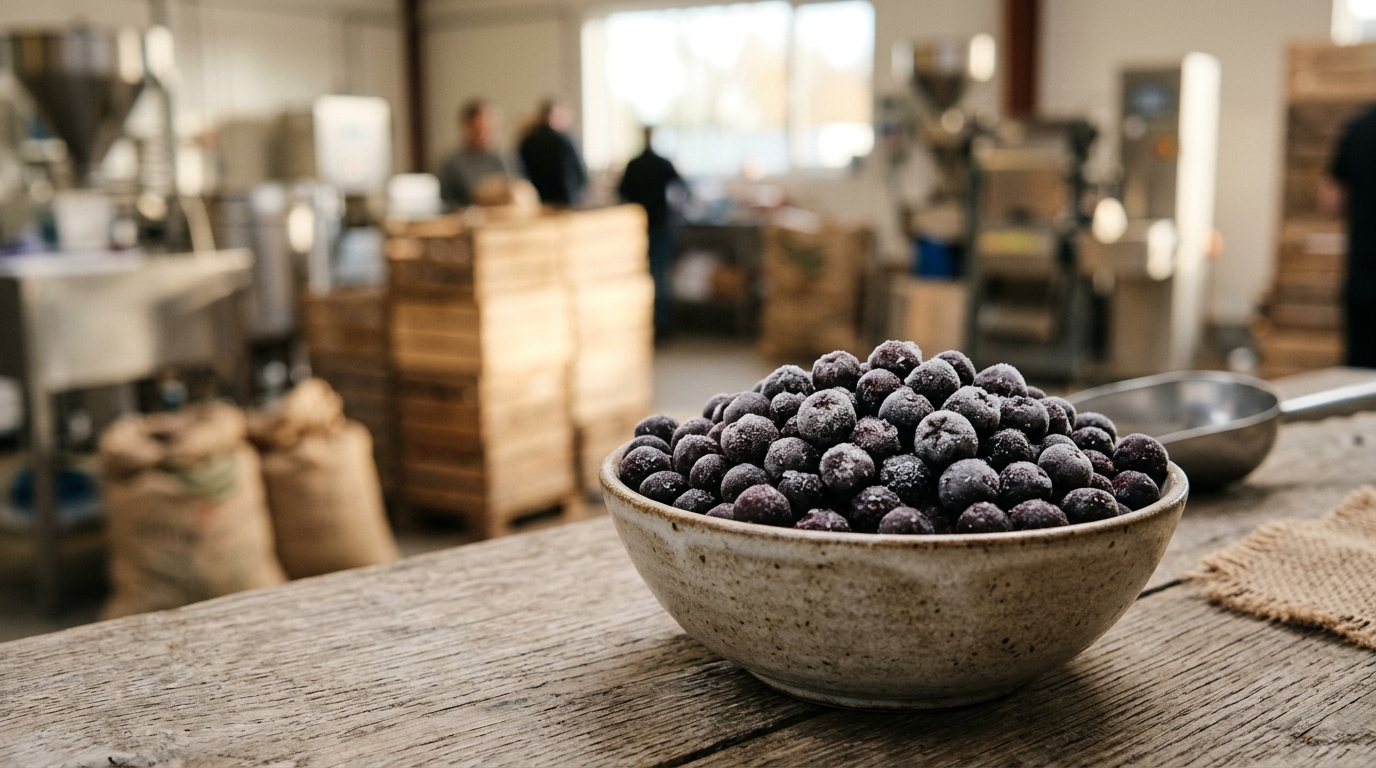
Frozen aronia (black chokeberry) looks like a simple “harvest → freeze → ship” category, but procurement outcomes are decided by a few irreversible execution points: how clean/mature fruit enters the line, how it is frozen, and whether it stays continuously frozen through storage and transport. This guide maps the physical chain, explains where cost and quality lock in, and translates those realities into sourcing actions.

Frozen aronia berry (black chokeberry) is a short, seasonal harvest that gets “converted” into year-round inventory through freezing and cold storage. The supply chain is physically simple—harvest → clean/sort → freeze → store → ship—but economically unforgiving because quality and cost are largely determined by what happens in a few hours post-harvest and then preserved (or degraded) over months in the cold chain.
Insight: The two irreversible moments are (1) harvest/field handling (foreign matter + maturity) and (2) freezing + cold-chain integrity (texture, drip loss, clumping, color stability).
Data: In Poland (a major producing base by acreage), ripening/harvest commonly concentrates in the second half of August into early September, compressing pack activity into a narrow window. [1]
Procurement Impact: Most “variability” you see downstream (claims, inconsistent berry size, lots that clump, color drift) is rooted in upstream handling and whether the product stayed at frozen temperatures (commonly managed at -18°C/0°F or below for long-term frozen storage). [2]
Insight: Frozen aronia’s cost stack is dominated by (a) farmgate raw berry economics, (b) pack-out losses from sorting/defect removal, and (c) energy-intensive freezing plus months of cold storage.
Data: In industrial freezing literature, freezing temperatures are often discussed around -30°C to -40°C (process conditions), with subsequent storage commonly managed around -18°C for quick-frozen products. [4]
Procurement Impact: The chain’s “fixed” cost drivers are physical: harvest throughput, sorting intensity, freezer capacity, energy, storage duration, and reefer handling. These are the levers that determine why two quotes that look similar on paper can reflect very different physical realities.

| Supply Chain Node | Cost Ratio (% of Final Cost) | Notes |
|---|---|---|
| Raw Material Cost (farmgate berries) | 35% | Driven by yield and harvest efficiency; maturity affects usable solids and downstream drip loss. |
| Primary Processing | 18% | Washing/sorting/optical sorting; pack-out losses from culls are a major hidden driver. |
| Freezing & Initial Packing | 15% | IQF tunnel/spiral energy + labor; carton/liner costs. |
| Cold Storage (inventory carry) | 12% | Months of storage to bridge seasonality; energy + handling. |
| Logistics & Distribution | 10% | Reefer trucking/ocean, port cold handling, shrink risk. |
| Processor/Exporter Margin | 10% | Covers overhead, financing, and commercial margin. |
| Supply Chain Node | Cost Ratio (% of Final Cost) | Notes |
|---|---|---|
| Raw Material Cost | 38% | Similar farmgate base; industrial grades may accept wider size/defect ranges. |
| Primary Processing | 14% | Potentially less stringent sizing, but foreign matter control remains critical. |
| Freezing & Packing | 10% | Lower unit processing cost vs IQF; higher downstream handling friction. |
| Cold Storage | 14% | Often longer carry due to industrial buying patterns; clumping risk if temps cycle. |
| Logistics & Distribution | 12% | Heavier units and handling; same reefer requirements. |
| Processor/Exporter Margin | 12% | Financing and overhead; industrial contract administration. |
| Supply Chain Node | Cost Ratio (% of Final Cost) | Notes |
|---|---|---|
| Raw Material Cost | 25% | Retail programs often require tighter visual specs (color, whole berries). |
| Primary Processing | 16% | Higher sorting intensity to protect consumer experience. |
| Freezing & Primary Packing | 12% | IQF strongly preferred to prevent clumping in consumer packs. |
| Repackaging & QA | 18% | Retail film/bags, labeling, traceability, additional QA checks. |
| Cold Storage | 10% | Storage at both origin and destination DCs. |
| Logistics & Distribution | 9% | Reefer to DC + domestic distribution. |
| Brand/Retail Margin | 10% | Channel margin and program overhead. |
Insight: Frozen aronia behaves like a “seasonal crop turned into a 12-month ingredient,” and that physical reality creates three constants: a compressed pack window, high sensitivity to sorting/foreign matter control, and long cold-chain exposure.
Data: Harvest concentration in late August–early September is widely cited for Poland, compressing intake into freezer capacity and labor availability. [1]
Procurement Impact: You are effectively buying a year’s worth of risk in a few weeks of physical execution.
Insight: In frozen aronia, “quality” is less about a single lab number and more about whether the product experienced (a) aggressive foreign matter control and (b) uninterrupted cold-chain discipline.
Data: Long-term frozen storage expectations commonly anchor at 0°F / -18°C or below, and quick-frozen directives emphasize maintaining that temperature through storage/transport with limited deviation allowances. [2]
Procurement Impact: When comparing suppliers, the most decision-relevant technical differentiators are: freezing method (IQF vs block), sorting architecture (optical/metal/aspiration steps), and cold-chain handling capability during storage and transit.
Critical Risk Factors: foreign matter (stems/leaves), clumping from temperature cycling, drip loss after thaw, and lot-to-lot variability driven by harvest maturity and pack-out.
(Analyzed at: Jul, 2026) In 2025–2026, energy volatility in Europe keeps freezing and cold storage economics (and supplier behavior on allocation, storage pass-throughs, and minimum run sizes) more sensitive than in “stable” years. [3] Write contracts that treat temperature history as commercial evidence: require lot-level temperature records (or carrier data), defined maximum excursion windows at handoffs, and a pre-agreed claims protocol tied to custody. This works because most aronia failures you pay for—clumping, drip loss, color drift—are downstream symptoms of temperature cycling, not defects you can reliably inspect out at receipt. The stake is often a quiet 5–12% landed-cost equivalent in scrap, rework, and claim friction when a marginally cheaper lane or weaker cold-store discipline shows up months later in production.


