
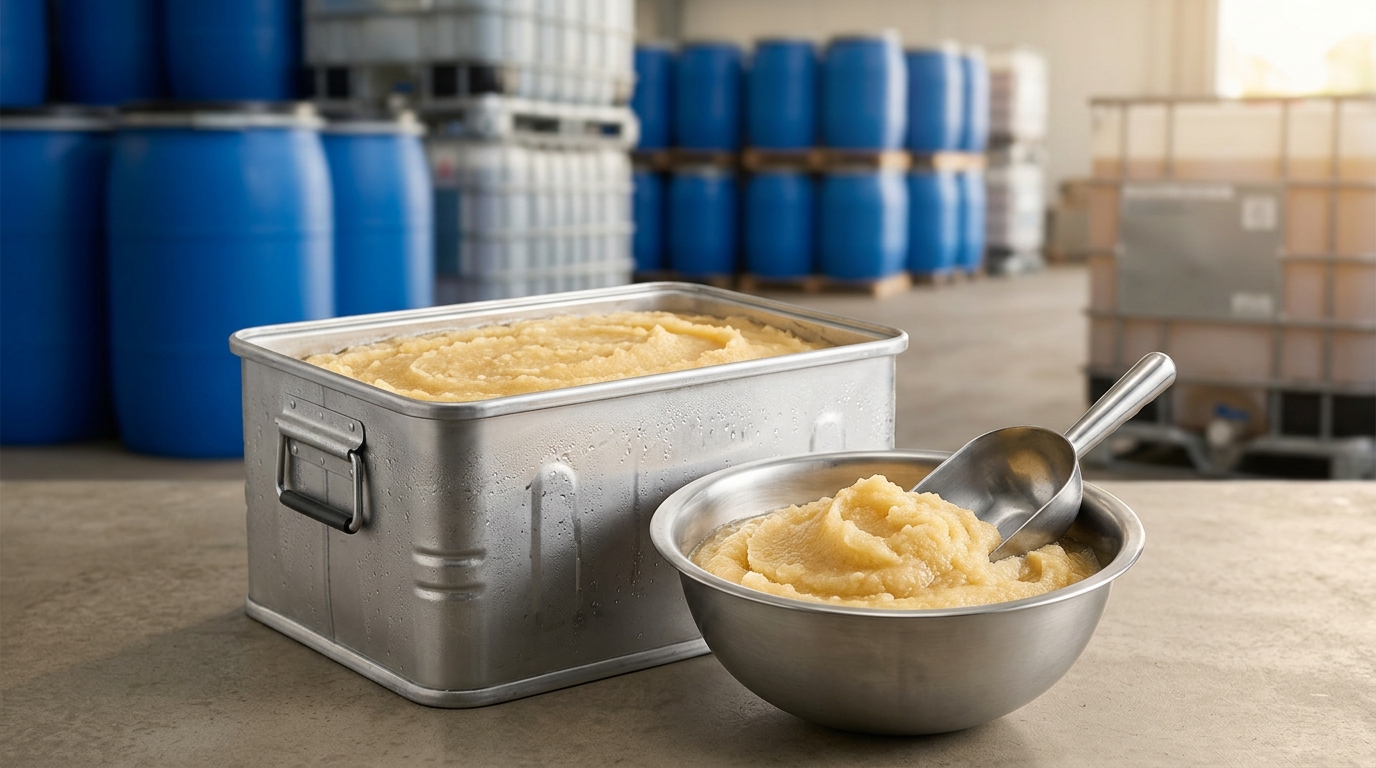
Frozen apple purée looks simple on paper, but procurement outcomes (holds, rework, sensory drift, and compliance exposure) are largely determined upstream—at intake yield, process controls, and uninterrupted frozen handling. This map translates the physical chain into the “where cost locks in / where risk accumulates” view that Purchase teams owning Quality, Safety, and Compliance can actually contract and govern.
Frozen apple purée is structurally a harvest-linked, processing-led, cold-chain-dependent ingredient. The fruit is bulky and perishable, so value creation happens quickly after intake: sorting losses, pulping/standardization, a heat step (commonly pasteurization; “validated” depends on the supplier’s HACCP/Preventive Controls validation), then freezing into industrial packs that must stay continuously frozen to protect texture, color, and practical shelf life.
Insight: Frozen apple purée cost is “locked in” early (raw apples + yield losses) and then compounded by conversion energy, packaging (drums/totes + liners), and cold storage/reefer logistics.
Data: Commercial and institutional specifications commonly show single-strength apple purée around ~11–15 °Brix and pH commonly in the ~3.3–4.0 range (often communicated as “acidic / <~4.2,” depending on the spec owner and grade). [1]
Procurement Impact: The physical map tells you what is structurally hard to change: yield at intake, thermal processing capacity, freezing/cold storage capacity, and frozen transport reliability.

Insight: Each node adds a different kind of “non-negotiable” cost—farmgate apples drive the base, processing drives yield and compliance, and the cold chain drives working capital and quality preservation.
Data: Peer-reviewed work shows apple purée functionality (TSS/°Brix, pulp/particle fraction, and rheology) varies by cultivar and processing conditions—meaning processors spend money on sorting, blending, and thermal control to hit targets. [2]
Procurement Impact: When you see a cost jump, the physical map helps you localize it: raw fruit availability, conversion capacity/energy, packaging inputs, or cold-chain constraints.

| Supply Chain Node | Cost Ratio (% of Final Cost) | Notes |
|---|---|---|
| Upstream Raw Apples | 35% | Farmgate apples + inbound trucking; yield losses begin at sorting. |
| Primary Processing | 15% | Washing/milling/screening; labor + water + waste handling. |
| Secondary Processing | 12% | Standardization + heat step; energy + hygiene controls. |
| Packaging & QA | 10% | Drums/totes, liners, labeling, COA/testing release. |
| Cold Chain (Freeze + Storage) | 13% | Freezing energy + frozen storage carry. |
| Logistics & Distribution | 15% | Reefer ocean/inland + destination cold storage/handling. |
| Supply Chain Node | Cost Ratio (% of Final Cost) | Notes |
|---|---|---|
| Upstream Raw Apples | 32% | Similar base, but higher selection pressure can shift usable yield. |
| Primary Processing | 16% | More sorting/screening discipline to control defects/texture. |
| Secondary Processing | 15% | More blending/standardization effort; tighter process control burden. |
| Packaging & QA | 11% | Higher testing/documentation intensity is common in practice. |
| Cold Chain (Freeze + Storage) | 12% | Similar physics; storage time can rise if lots are held for release. |
| Logistics & Distribution | 14% | Reefer + cold storage remains structurally significant. |
| Supply Chain Node | Cost Ratio (% of Final Cost) | Notes |
|---|---|---|
| Upstream Raw Apples | 28% | More value is created by water removal downstream. |
| Primary Processing | 12% | Similar front-end conversion. |
| Secondary Processing (Concentration) | 25% | Evaporation energy + equipment + yield management dominate. |
| Packaging & QA | 10% | Similar bulk packaging, often different viscosity/handling needs. |
| Cold Chain (Freeze + Storage) | 10% | Less water shipped than single-strength, but still frozen. |
| Logistics & Distribution | 15% | Higher value density can reduce freight per unit solids. |
Insight: Frozen apple purée behaves like a “manufactured agricultural ingredient”: orchard biology sets the starting point, but processing capability and cold-chain integrity decide whether the delivered product matches functional expectations.
Data: Peer-reviewed work shows cultivar and process conditions materially affect purée properties (TSS/°Brix, pulp fraction, rheology), and batch-to-batch differences can be meaningful even within a single cultivar and product type. [2]
Procurement Impact: The constants below explain why two suppliers can both be “in spec” yet behave differently in your plant.
Insight: Frozen apple purée is a short chain with a long shadow: most downstream outcomes are determined by (1) raw fruit selection/yield, (2) process control and hygiene, and (3) uninterrupted frozen handling.
Data: Market-facing specs repeatedly cluster around ~11–15 °Brix and acidic pH (commonly ~3.3–4.0; often stated as <~4.2) for apple purée, while technical studies show rheology and solids can swing with cultivar and thermal regimen. [1]
Procurement Impact: When your team sees variability, the physical map tells you where to look first: intake sorting/yield, screening/particle control, thermal/oxygen management, then cold-chain dwell time.
(Analyzed at: Sep, 2026) Put the cold chain into the commercial spec and acceptance process: require 0°F / -18°C-or-colder handling, temperature recording through transit, and a clear hold/reject protocol when excursions occur. This works because, in 2026, reefer networks are still tight and disruption-prone—elevated rates, constrained specialized capacity, and port/plug constraints make temperature risk a predictable landed-cost and quality driver, not an edge case. [4]
In practice, the dollars at stake are usually not the pennies per pound on conversion—it’s the avoided frozen-warehouse holds, rework, and disposal when a “COA-compliant” lot turns into a functional failure after a compromised trip.


