
FAJC looks like a simple commodity, but most quality escapes and compliance failures trace back to where the physical chain “locks in” risk: orchard sorting (patulin), processing controls (clarity/color), evaporation management (heat/oxygen/aroma), and cold-chain discipline (temperature history + packaging integrity). This guide maps the real physical flow and translates it into practical spec, acceptance, and audit-readiness decisions for Purchase—Quality/Safety/Compliance.
Frozen apple juice concentrate (FAJC) is a bulk, high-solids ingredient built to make apples shippable and storable: water is removed (typically to ~70°Brix), the product is packed into bulk formats (drums/totes), and the cold chain preserves quality over long distances and long inventory holds. The supply chain is structurally shaped by two fixed realities: (1) a short, seasonal apple processing window that “sets” the year’s available juice solids, and (2) energy + cold-chain infrastructure that dominates conversion and logistics costs.
Insight: FAJC’s physical chain is a conversion-and-storage system: apples → clarified juice → vacuum-evaporated concentrate → frozen bulk logistics → industrial reconstitution.
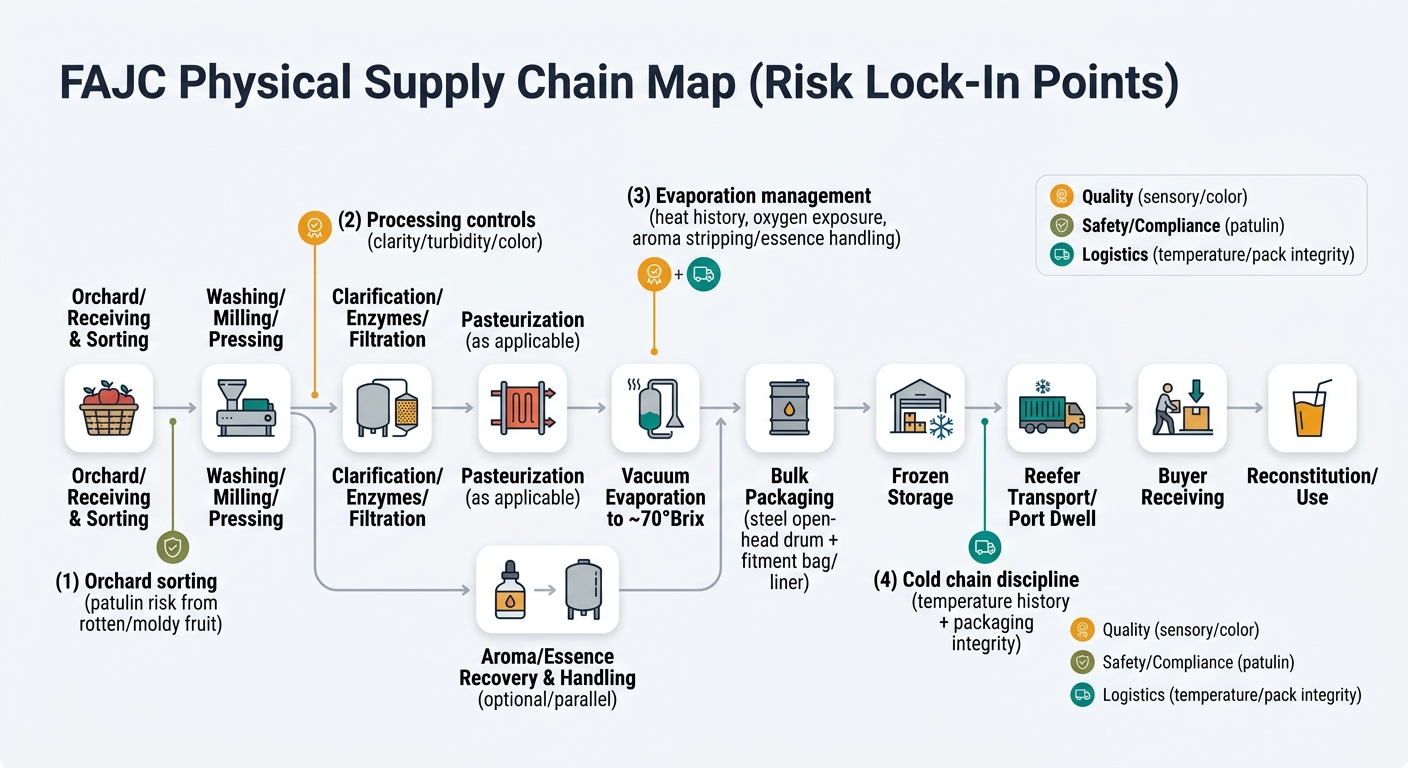
Data (validated): Industrial concentration commonly uses vacuum evaporation (to reduce thermal damage versus atmospheric boiling) and often includes aroma/essence recovery so volatile flavor compounds stripped during evaporation can be managed separately and, where relevant, added back for flavor standardization. [3]
Procurement Impact: The biggest “non-negotiable” cost drivers are upstream fruit yield/quality, evaporation energy load and plant utilization, bulk packaging availability, and frozen logistics capacity—each can constrain supply even when demand is stable.
Insight: FAJC cost accumulates in layers: biological variability (orchard) → yield and quality losses (pressing/clarification) → energy-intensive water removal (evaporation) → packaging + QA controls → cold storage and reefer transport.
Data (validated): FAJC is commonly traded around ~70°Brix; bulk frozen packaging often uses steel open-head drums with bag liners (e.g., ~52-gallon fills) to protect the product and enable handling. [2]
Procurement Impact: For Quality/Safety/Compliance, each node introduces its own “spec risk” (e.g., patulin and residues upstream; thermal/oxidative changes midstream; contamination/temperature abuse downstream). Mapping these to the physical nodes is the foundation for acceptance criteria and audit readiness.

| Supply Chain Node | Cost Ratio (% of Final Cost) | Notes |
|---|---|---|
| Upstream Raw Material (apples) | 35% | Yield + defect load drive usable juice solids; sorting intensity is a real cost. |
| Primary Processing | 12% | Pressing yield, enzymes/filtration media, water/effluent, labor. |
| Secondary Processing (evaporation + aroma handling) | 18% | Energy + plant utilization; aroma/essence handling adds complexity. |
| Packaging & QA | 10% | Drums/liners, labeling/lot identity, routine chemical/micro testing. |
| Frozen Logistics & Storage | 15% | Cold storage + reefer freight + port dwell risk. |
| Processor/Exporter Margin + Overheads | 10% | Working capital for inventory, compliance overhead, shrink. |
| Supply Chain Node | Cost Ratio (% of Final Cost) | Notes |
|---|---|---|
| Upstream Raw Material (apples) | 40% | Raw material dominates when specs allow broader blending. |
| Primary Processing | 10% | Similar unit ops but potentially lower clarification stringency. |
| Secondary Processing (evaporation) | 16% | Energy remains central; aroma handling may be less demanding. |
| Packaging & QA | 8% | Bulk packaging still required; QA scope may differ by end-use. |
| Frozen Logistics & Storage | 16% | Cold chain cost does not scale down with looser specs. |
| Processor/Exporter Margin + Overheads | 10% | Similar overhead structure; depends on lane and service level. |
| Supply Chain Node | Cost Ratio (% of Final Cost) | Notes |
|---|---|---|
| Primary Processing Feed & Handling | 20% | Requires clean juice feed and controlled handling. |
| Aroma/Essence Recovery Operations | 35% | Specialized separation/condensation/concentration steps. |
| Packaging & Cold Storage | 20% | Often stored cold to preserve volatiles; packaging must be tight. |
| QA (sensory/GC-type profiling where used) | 10% | Volatile profile consistency is the “spec.” |
| Logistics & Distribution | 15% | Smaller volumes but high sensitivity to temperature/handling. |
Insight: FAJC availability and compliance performance are constrained by structural bottlenecks more than by day-to-day operational choices.
Data (validated): Patulin controls are enforced at the “reconstituted/single-strength equivalent” level: the U.S. FDA action level is 50 ppb for apple juice (including concentrate, evaluated on reconstituted single-strength juice), and the EU maximum level for fruit juices (including concentrate, assessed as reconstituted) is also 50 μg/kg. [1]
Procurement Impact: Compliance thresholds effectively travel upstream: if the raw material and primary processing don’t prevent patulin formation/carryover, downstream concentration cannot “fix” the problem without creating governance and enforcement risk.
(Analyzed at: Sep, 2026)
Write your FAJC contract so cold-chain evidence is priced and governed like a spec, not treated as a service add-on: require shipment-level temperature records, defined handoff points, and explicit remedies for excursions, because 2026 reefer capacity remains structurally tight and rate pressure has persisted in temperature-controlled freight. [4] Pair that with a hard upstream compliance gate—patulin control language tied to the 50 ppb reconstituted-equivalent standard—so you’re not discovering an upstream defect after the lot is already in frozen inventory. [1] In practice, teams that contract these two “infrastructure risks” upfront avoid the most expensive outcome: holding or replacing a container of drums late in the cycle, where the real cost is often the expedited replacement + production disruption, not the unit price.


