INDUSTRY TRENDS

Frozen Acerola Procurement Intelligence Playbook (Validated & Updated for Category Managers — Mar 2026)

Author
Team Tridge
DATE
March 10, 2026
10 min read
frozen-acerola Cover
Tridge — Trusted Global Food Sourcing

This report is powered by Tridge market intelligence.

Every data point, price signal, and supply chain insight in this analysis is drawn from the same engine that procurement teams worldwide rely on daily. As you read, consider what this level of visibility could do for your category.

See how Tridge Eye works →

Introduction

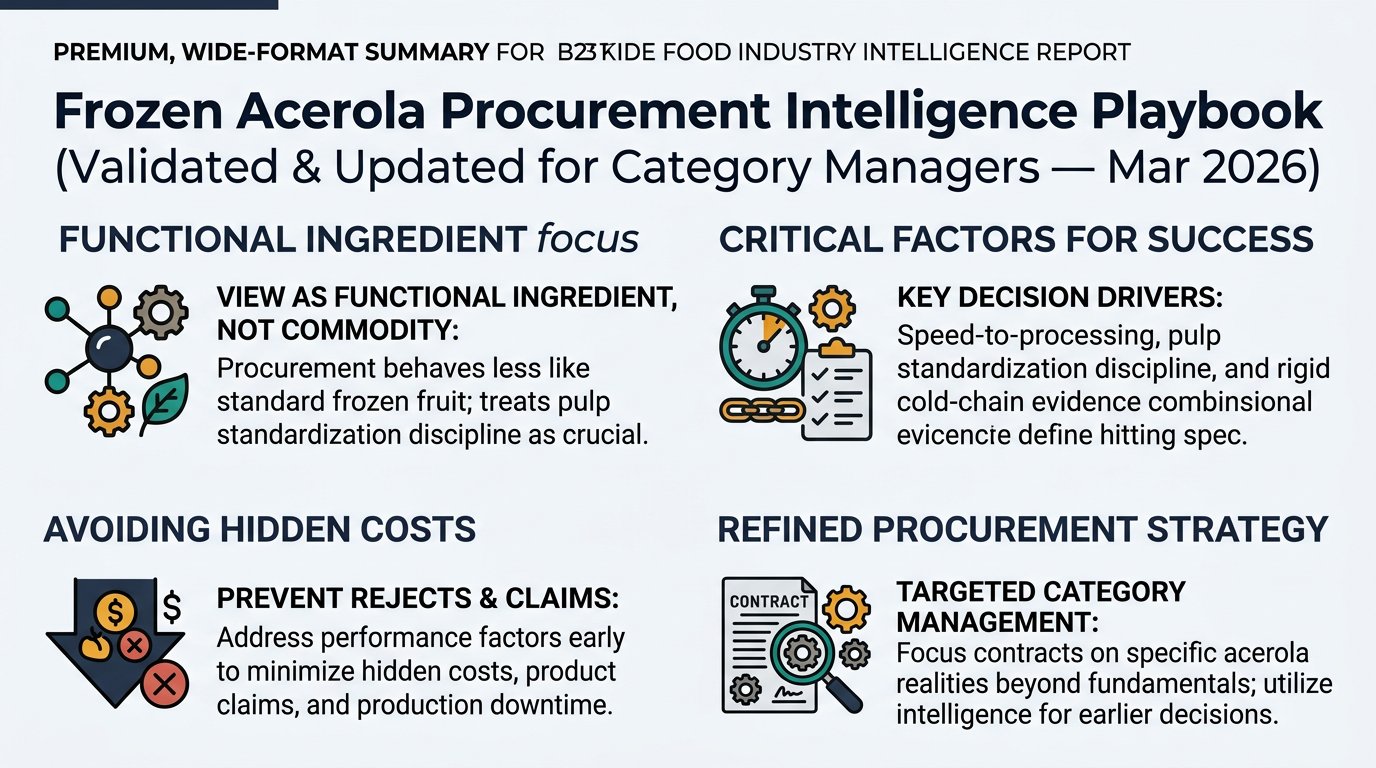
Frozen acerola behaves less like a commodity frozen fruit and more like a processor-controlled functional ingredient: speed-to-processing, pulp standardization discipline, and cold-chain evidence drive whether you hit spec and avoid hidden cost (rejects, claims, downtime). This playbook is written for category managers who already know procurement fundamentals (TCO, Incoterms, qualification, scorecards) but are newer to acerola-specific realities. It focuses on what to measure, what to contract for, and how to use intelligence to make decisions earlier and more defensibly.

Executive Summary

  • Processor-centric reality: Most traded acerola is purchased as frozen pulp/purée; supplier performance is primarily a function of processing discipline + documentation + cold chain, not “origin branding” alone.
  • Vitamin C variability is real: Published vitamin C ranges for fresh acerola commonly span ~1,000–4,500 mg/100 g, and peer-reviewed sources report ranges extending roughly ~695–4,827 mg/100 g depending on maturity/season/climate—so potency governance must be built into specs and COA controls.
  • Cold-chain setpoint is not a nice-to-have: Guidance for quick frozen foods commonly references maintaining product temperature at -18°C or lower during transport/storage; treat temperature evidence as a quality control layer, not just a logistics detail.
  • Spec benchmarking is feasible: Published supplier specs show pH ranges around ~3.4–4.2 and Brix/acidity ratio windows (examples vary by processor); use these as “sanity checks” to flag outlier promises that imply either a real premium (blending/standardization) or paper compliance risk.
  • Governance is the savings lever: The most repeatable savings typically come from reducing rejects/claims, avoiding emergency buys, and reducing inventory days—not from chasing the lowest $/kg.

Key Insights (Analyzed at: Mar, 2026)

  • Strategy: Hold
  • Reliability: Medium
  • Potential Saving: 6% ~ 12%
  • Insight: Use the current window to tighten governance rather than over-rotating on unit price. Specifically: (1) implement lane-level cold-chain evidence requirements aligned to -18°C or lower expectations for quick frozen foods (reefer download/recorder, handoff accountability), and (2) re-baseline your spec/COA governance for potency-driven buys (method alignment + lot frequency + exception rules). These actions typically reduce hidden TCO (rejects, claims, downtime, and expedite) and improve negotiation leverage without assuming a directional market bet.

1) Start Where the Risk Actually Is: The Frozen Acerola Supply Chain (Ground Truth)

Frozen acerola is not a “frozen fruit” category in the same way as strawberries or mango.

Most internationally traded acerola is moved as pulp/purée (often frozen), not whole fruit. This is consistent with how acerola is commonly used in trade for juices/beverages (pulp/puree—often frozen—plus powders/concentrates in some value-added streams).

The practical flow you are buying into

A left-to-right (or top-to-bottom) flow diagram showing the real buying system for frozen acerola: (1) Orchard & harvest (acerola cherries) with callouts for time sensitivity and vitamin C variability; (2) Primary processing near farms (wash/sort → pulp/finish → often pasteurize → fast-freeze) with callouts for finisher screen size, oxygen management, thermal profile; (3) Standardization & industrial packaging (Brix/pH/color/texture targets; block/bag-in-box/pail) with a callout that published examples show pH ~3.4–4.2 (varies by processor); (4) Frozen logistics & cold storage with a prominent temperature setpoint callout “-18°C or lower” and “temperature evidence at handoffs”; (5) End-use manufacturing (beverage/dairy/nutraceutical/blends) with a callout “potency/assay governance critical.” Include a side ribbon labeled “Primary procurement risk” listing: lot-to-lot spec drift, COA reliability, cold-chain execution. Use neutral icons (farm, factory, lab document/COA, reefer container, cold warehouse, manufacturing plant) and avoid any dashboard-like UI frames.
  1. Orchard & harvest (acerola cherries)

  2. Harvest is frequent and time-sensitive; bruising and enzymatic activity quickly degrade quality.
  3. Vitamin C is inherently variable by cultivar, maturity, season, and climate. Commonly cited ranges include ~1,000–4,500 mg vitamin C per 100 g fresh fruit [1], and peer-reviewed summaries report roughly ~695–4,827 mg/100 g.
  4. Primary processing close to farms (wash → sort → pulp/finish → pasteurize often → freeze fast)

  5. Processors cluster near orchards because delays convert into yield loss and spec drift.
  6. Buyer-relevant controls: finisher screen size (seed/skin), thermal treatment profile, oxygen management, and freezing method.
  7. Standardization & packaging (industrial formats)

  8. Product is standardized to a target Brix / pH / color / texture, then packed (commonly industrial cartons/bags/pails).
  9. Published supplier examples show pH ~3.4–4.2 and Brix/acidity ratio windows; treat these as reference points for benchmarking—not universal “market specs” [2].
  10. Frozen logistics (-18°C setpoint expectation) & destination cold storage

  11. For quick frozen foods, guidance commonly references maintaining product temperature at -18°C or lower in transport/storage. Procurement should contract for temperature evidence and accountability at each handoff.
  12. End-use manufacturing (beverage, dairy, nutraceutical, blends)

  13. Many buyers use acerola as a natural vitamin C source (label positioning) as much as a flavor ingredient—which makes potency stability and assay governance procurement-critical.

Procurement implication: your “supplier” is effectively a bundle of (a) orchard network, (b) processing discipline, (c) cold-chain execution, and (d) documentation reliability. The cheapest quote can be the highest TCO if any of those fail.

2) Where Cost Accumulates (and Why Unit Price Misleads): Cost & Margin by Node

Key insight

Frozen acerola economics are processing-and-cold-chain heavy. Once you move from fruit to pulp, your cost base is driven less by the orchard and more by:

  • yield loss at sorting/finishing (seed/skin removal, defect trimming)
  • energy (freezing + cold storage)
  • QA & compliance (micro, residues, heavy metals where required; COA credibility)
  • reefer logistics + inventory holding (working capital tied up in frozen stock)

Below is how procurement should think about cost by node—because this is where negotiation levers and risk controls actually live.

2.1 Upstream / Raw Material (Orchard & Harvest)

What matters operationally

  • Harvest timing and maturity impact acid/Brix balance and vitamin C potential.
  • Weather volatility shows up as fruit availability + quality variability, not always immediately as export pulp price.

Primary cost drivers

  • Labor for frequent harvest
  • Irrigation and orchard inputs (fertilizer/crop protection)
  • Field-to-plant rapid transport (spoilage avoidance)

Procurement levers

  • Multi-origin strategy to reduce single-region weather exposure
  • Contract structures that separate fruit cost movement vs processor service costs

2.2 Primary Processing (Pulping/Finishing + Often Pasteurization + Freezing)

What matters operationally

  • This is where spec consistency is made or lost.
  • Finishing parameters determine seed/skin content and texture.
  • Thermal treatment is a trade-off: micro risk reduction vs sensory/color impact.

Primary cost drivers

  • Yield loss at sorting/finishing
  • Energy for freezing
  • Labor + water/effluent
  • QA testing intensity per lot

Procurement levers

  • Negotiate around yield and rework risk (not just $/kg)
  • Require lot-level documentation discipline (COA + traceability + retention samples)

2.3 Secondary Processing (Standardization / Blending / Concentration where applicable)

What matters operationally

  • Standardizing Brix/pH and (where relevant) vitamin C positioning can add cost but reduces downstream variability.
  • If you buy “vitamin C standardized” acerola inputs, you are paying for assay + blending discipline.

Primary cost drivers

  • Additional processing steps and QC
  • Potential blending losses and hold times

Procurement levers

  • Define which specs are critical-to-quality vs “nice-to-have”
  • Align assay method, frequency, and acceptance windows with QA/R&D

2.4 Packaging & Quality Assurance

What matters operationally

  • Packaging failures become leakers, freezer burn, oxidation, contamination risk.
  • QA is not a checkbox: it’s how you prevent border holds, customer complaints, and rejections.

Primary cost drivers

  • Food-grade liners, cartons/pails
  • Certifications and audit overhead
  • Testing (micro, residues; sometimes vitamin C assay)

Procurement levers

  • Specify packaging performance (liner gauge, sealing, pallet pattern)
  • Tie supplier scorecards to COA accuracy and claims rate

2.5 Logistics & Distribution (Frozen)

What matters operationally

  • Frozen chain is commonly managed around -18°C for quick frozen foods; excursions create latent quality loss that may only appear at thaw/use.

Primary cost drivers

  • Reefer ocean freight, inland drayage
  • Destination cold storage
  • Insurance/claims administration
  • Working capital (inventory days)

Procurement levers

  • Incoterms optimization (who owns temperature risk and where)
  • Require temperature evidence (reefer download/recorder) for higher-risk lanes

Product-level cost breakdown (illustrative, modeled)

These are modeled ratios to show where cost typically concentrates for procurement decisions. Actual ratios vary by origin, spec tightness, contract terms, energy, and freight.

A) Frozen Acerola Pulp/Purée (industrial, block or pail)

A single 100% stacked bar (or donut chart if preferred) visualizing the modeled delivered-cost ratios for “Frozen Acerola Pulp/Purée (industrial)” exactly as shown in the table: Orchard & harvest 25%, Primary processing + freezing 30%, Standardization/secondary processing 8%, Packaging & QA 10%, Frozen logistics + cold storage 17%, Importer/processor margin & distribution 10%. Add short annotations on the largest segments: “Processing + freezing is the cost center” and “Cold chain is both cost + quality control.” Keep the styling data-first (clean labels, percentages on segments) and avoid any product UI/dashboard elements.
Supply Chain Node Cost Ratio (% of delivered cost) What to watch
Orchard & harvest (raw fruit) 25% Weather-driven availability; maturity impacts Brix/acid and potency potential
Primary processing + freezing 30% Yield loss, energy, finishing discipline, lot consistency
Standardization / secondary processing 8% Brix/pH targets; assay governance if potency-relevant
Packaging & QA 10% COA credibility, testing scope, packaging integrity
Frozen logistics + cold storage 17% Reefer reliability, port delays, storage days
Importer/processor margin & distribution 10% Service levels, financing cost, channel markups

B) IQF Acerola (less common than pulp)

Supply Chain Node Cost Ratio (% of delivered cost) What to watch
Orchard & harvest (raw fruit) 30% Higher selectivity for whole fruit quality
Primary processing + IQF freezing 32% Sorting intensity, foreign matter risk, IQF throughput
Secondary processing 2% Minimal
Packaging & QA 12% Foreign material controls, micro, packaging to prevent clumping
Frozen logistics + cold storage 16% Same cold-chain exposure
Importer/processor margin & distribution 8% Service levels

C) Acerola as “Natural Vitamin C” Ingredient (standardized input, often downstream-processed)

Supply Chain Node Cost Ratio (% of delivered cost) What to watch
Orchard & harvest (raw fruit) 18% Potency variability starts here
Primary processing + freezing 22% Oxidation control and hold times
Standardization + assay + blending 20% Method alignment, spec windows, documentation
Packaging & QA 12% COA/traceability robustness
Logistics + cold storage 15% Inventory aging impacts potency stability
Margin & distribution 13% Value-added assurance premium

3) The Structural Fact That Explains Most Supplier Problems

Frozen acerola is a “processor-centric” category, not a “farm-centric” one.

Why that matters:

  • The same origin can produce wildly different outcomes depending on processor discipline (sorting losses, finisher settings, thermal profile, oxygen exposure, freezing speed).
  • Procurement risk concentrates in:
  • lot-to-lot spec drift (Brix/pH/color/texture)
  • documentation reliability (COA accuracy, traceability completeness)
  • cold-chain execution (temperature evidence, claims handling)

This is why “we source from Brazil/Mexico” is not a meaningful risk statement by itself.

4) The Critical Insight: Why Your Price and Your Quality Risk Often Move in Opposite Directions

In frozen acerola, the lowest unit price often correlates with higher hidden costs because suppliers can “save” money in ways that only show up after receipt:

  1. Yield economics are easy to hide in a quote

  2. Less stringent sorting/finishing can reduce processing cost but increases:
  3. foreign matter and defect risk
  4. sensory drift
  5. downstream filtration/handling burden
  6. Cold-chain shortcuts don’t always show at inbound temp check

  7. A load can arrive “at spec temperature” yet have experienced excursions earlier.
  8. The effect is often color/texture drift, drip loss, and potency loss discovered at use.
  9. Spec promises can be unrealistic

  10. Market-facing specs like Brix/pH ranges are achievable, but overly tight windows without evidence usually mean either:
  11. heavy blending/standardization cost (real premium), or
  12. a documentation risk (paper compliance)
  13. Example published supplier ranges for acerola pulp (illustrative): pH ~3.4–4.2 (examples vary by processor) [2].

Procurement takeaway: treat price as one signal inside a TCO model that explicitly prices in rejects, claims, inventory days, and disruption probability.

5) Where Procurement Teams Typically Get Frozen Acerola Wrong

These are repeat failure modes when a team is experienced in other categories but new to acerola.

  1. Over-indexing on origin instead of processor capability
  2. “Brazil = safe” is not a strategy; it can be concentration risk if you don’t segment by processor capacity and performance.
  3. Spec setting without application logic
  4. Teams sometimes lock specs too tight (or too vague) without mapping:
  5. beverage vs dairy vs supplement use
  6. critical-to-quality vs tolerance
  7. Treating COAs as truth rather than a control system
  8. COAs need governance: method, frequency, lab credibility, and exception handling.
  9. Underestimating frozen logistics as a cost and risk driver
  10. -18°C handling expectations are common in quick frozen guidance, but what matters is evidence and accountability across handoffs.
  11. No pre-qualified backup plan
  12. When supply tightens, teams go spot-buying and overload QA—exactly when risk is highest.

6) What an Intelligence-Driven Approach Changes (Without Replacing QA or Procurement)

An intelligence service changes outcomes by making decisions earlier, more comparable, and auditable.

A) Supplier discovery that reflects acerola reality

Instead of “find suppliers,” you build a longlist by:

  • origin + processing cluster proximity (speed-to-plant)
  • product forms (pulp block, pail, IQF)
  • certifications and export readiness
  • capacity signals and lane experience (reefer execution)

B) Benchmarking that normalizes apples-to-apples

You compare suppliers on a scorecard that procurement, QA, and operations can share:

  • spec capability (Brix/pH/color/seed/skin)
  • micro posture and testing scope
  • packaging formats and MOQ constraints
  • lead times, OTIF history, claims responsiveness

C) Price intelligence that separates market movement from supplier behavior

You track drivers that matter in this category:

  • harvest tightness signals (volume and quality)
  • energy and cold storage cost pressure
  • reefer freight and port reliability
  • FX exposure by origin

D) Risk monitoring with pre-defined triggers

You maintain a living risk register:

  • origin concentration
  • supplier dependency
  • logistics chokepoints
  • quality escape indicators (rejects, claims, COA anomalies)

E) Governance: decision trails that survive audits and turnover

  • documented rationale for supplier selection
  • spec exception logs
  • quarterly performance reviews tied to KPIs

Boundary (important): intelligence improves decision quality and speed; it does not replace audits, incoming testing, or legal/compliance review.

7) Strategic Use Cases a Category Manager Can Run in 30–90 Days

  1. Build a 2-tier spec strategy (resilience without overpaying)
  2. Tier 1: tight specs for flagship SKUs
  3. Tier 2: broader tolerance for blends where application allows
  4. Add: define “switch rules” (what can change without reformulation approval: Brix/pH window, pack format, origin, micro limits).
  5. Dual-source design with “real” switching readiness
  6. Pre-qualify backups via staged pathway:
  7. documents
  8. samples
  9. pilot lots
  10. approved status
  11. Add: pre-agree Incoterms, MOQ, lead time, and a “first allocation” clause so the backup is not theoretical.
  12. Negotiation planning anchored in TCO, not $/kg
  13. Model: price + rejects + claims + inventory days + expedite probability
  14. Add: ask for cost drivers you can verify (pack format, freezing method, testing scope, lead time assumptions) and link them to service levels.
  15. Cold-chain accountability program
  16. Lane-by-lane requirements:
  17. reefer setpoint expectations (-18°C or lower)
  18. temperature evidence requirements
  19. claim resolution SLAs
  20. Add: define “evidence at handoff” (seal control, pre-trip inspection (PTI) availability, recorder placement, and who pays for downloads).
  21. Supplier performance system (QBR-ready)
  22. KPIs: OTIF, rejects %, claims rate, COA accuracy, lead time variance, responsiveness
  23. Add: include “COA vs. inbound verification delta” as a KPI (how often COA matches your incoming results).

8) Why This Intelligence Mindset Transfers to Adjacent Categories You Likely Buy

Frozen acerola is an extreme example of a broader procurement truth: in processed agri-ingredients, the “factory + logistics system” often matters more than the farm.

Examples procurement teams typically co-source with acerola programs:

  • Frozen berries (e.g., strawberries/raspberries): regulators have sampled frozen berries for harmful viruses, reinforcing the need for governance beyond price [3].
  • Frozen mango/passion fruit purées: similar standardization economics (Brix/pH) and frozen logistics exposure (reefer and cold storage).
  • Açaí purée: processor controls, adulteration risk, and cold chain are central; origin branding alone doesn’t ensure performance.

The transferable playbook is:

  • normalize specs to application
  • benchmark processors (not just origins)
  • monitor logistics and cold-chain evidence
  • keep backup suppliers qualified before disruption

9) Why Frozen Acerola Makes a Strong “Proof Category” for Procurement Intelligence

Frozen acerola is powerful as an example because it forces procurement to operate at a higher maturity level:

  • High spec sensitivity: small process differences create large downstream variability.
  • Cold-chain dependency: logistics is not a cost line—it’s a quality control layer.
  • Documentation stakes: COA credibility and traceability are operational necessities.
  • Concentration risk: a limited global base makes dual-sourcing and governance a board-level continuity topic.

If your team can make frozen acerola sourcing predictable, auditable, and resilient, you can apply the same intelligence-driven operating model across the rest of your frozen fruit and functional ingredient portfolio.

Take Your Sourcing Intelligence to the Next Level

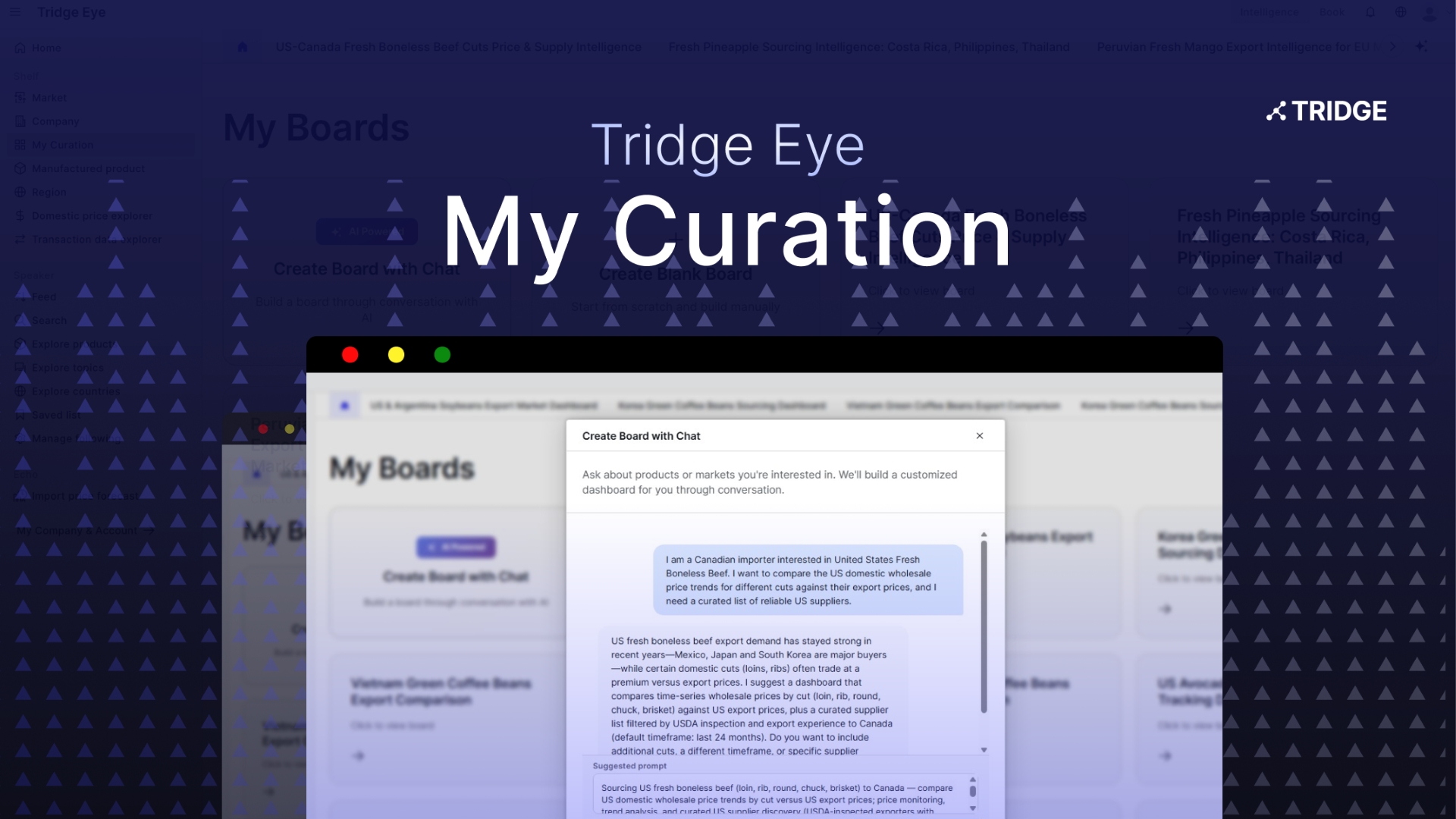
The insights in this report are just the starting point. Tridge Eye gives you real-time market signals, origin risk alerts, and price benchmarks — so you can act before the market moves.
Explore Tridge Eye →

References

  1. drugs.com
  2. tropfruit.com.br
  3. fda.gov
Subscribe
By subscribing you agree to with our Privacy Policy and provide consent to receive updates from our company.
Thank you! Your submission has been received!
Oops! Something went wrong while submitting the form.
Subscribe to receive the latest blog posts, updates, promotions, and announcements from Tridge.