INDUSTRY TRENDS

Frozen Açaí Sourcing Playbook (2026): Pricing the Lag, Protecting Slots, and Governing Cold-Chain Risk

Author
Team Tridge
DATE
April 27, 2026
8 min read
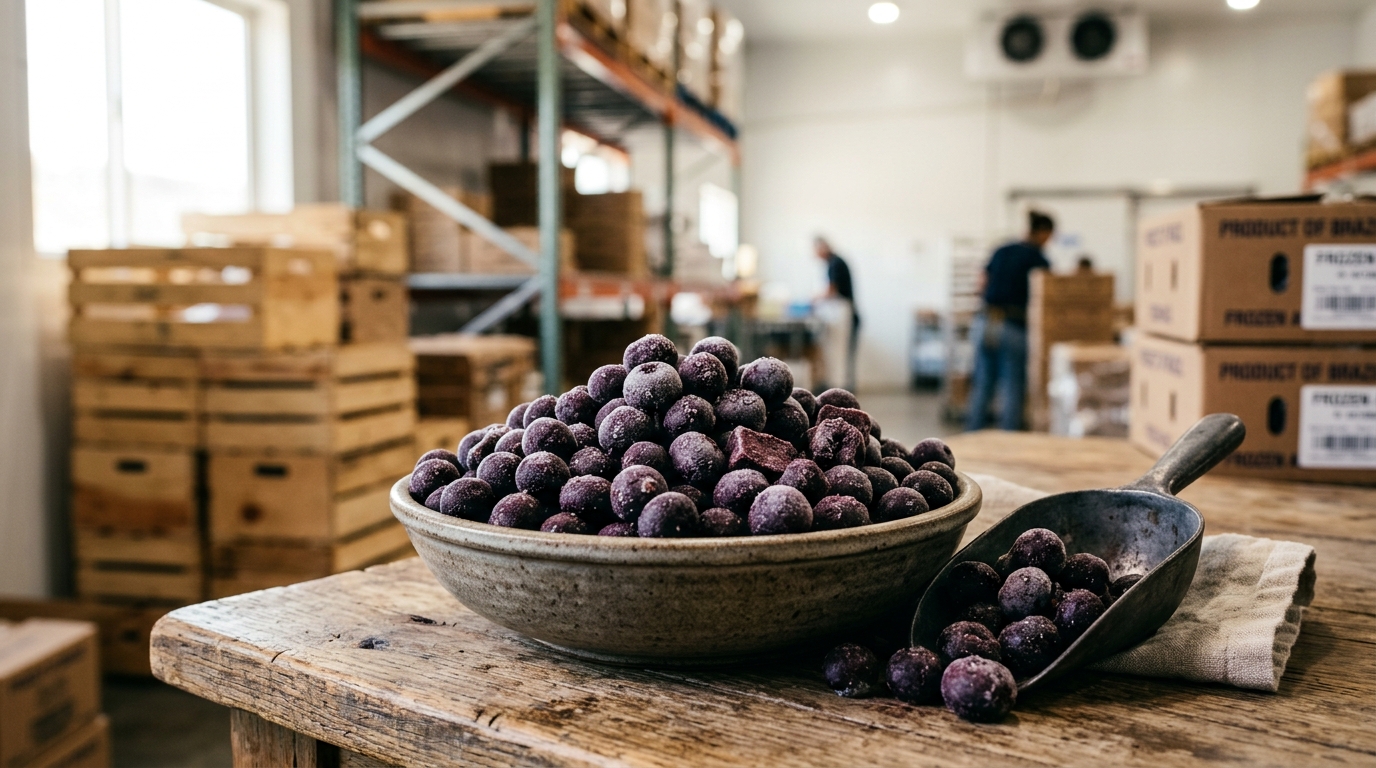
frozen-acai-berry Cover

This playbook is written for procurement leaders who already know how to run competitive bids—but need a practical lens for frozen açaí, where seasonality, processing capacity, and cold-chain volatility can break “lowest $/kg wins.” The goal is to help you separate true cost movement from risk premium, contract the right components, and build executable dual-sourcing.
Executive Summary

  • Origin reality: Brazil—especially Pará—dominates açaí supply, and a large share of harvest is concentrated in a short “~100‑day” peak window, which amplifies availability and pricing risk. [1]
  • Core pricing insight: Exporter quotes often reflect inventory coverage, plant slot scarcity, and logistics risk premium as much as farmgate fruit cost.
  • Governance insight: Most “savings” are lost downstream via spec-to-yield, claims, and lead-time variability—not the PO unit price.
  • Execution move: Contract product price and logistics adders separately, and treat lead time as a distribution (P50/P90) to size safety stock.
  • Resilience move: “Backup supplier” only counts if you reserve capacity/packaging and run real volume through the alternate lane.

Frozen Açaí Sourcing Playbook: Timing, Leverage, and Risk Triggers

1) The Market Signal You’re Probably Missing: Açaí Input Costs and Export Quotes Don’t Move Together

  • Insight: In frozen açaí, the cleanest “alpha” comes from exploiting time-lags: raw fruit tightness (or relief) shows up in exporter quotes late, and sometimes not at all—because processors can buffer with frozen inventory, and because the market often reprices availability risk faster than it reprices fruit cost.
  • Data (validated as directionally realistic): In a typical year, a buyer can see three recurring disconnect patterns:
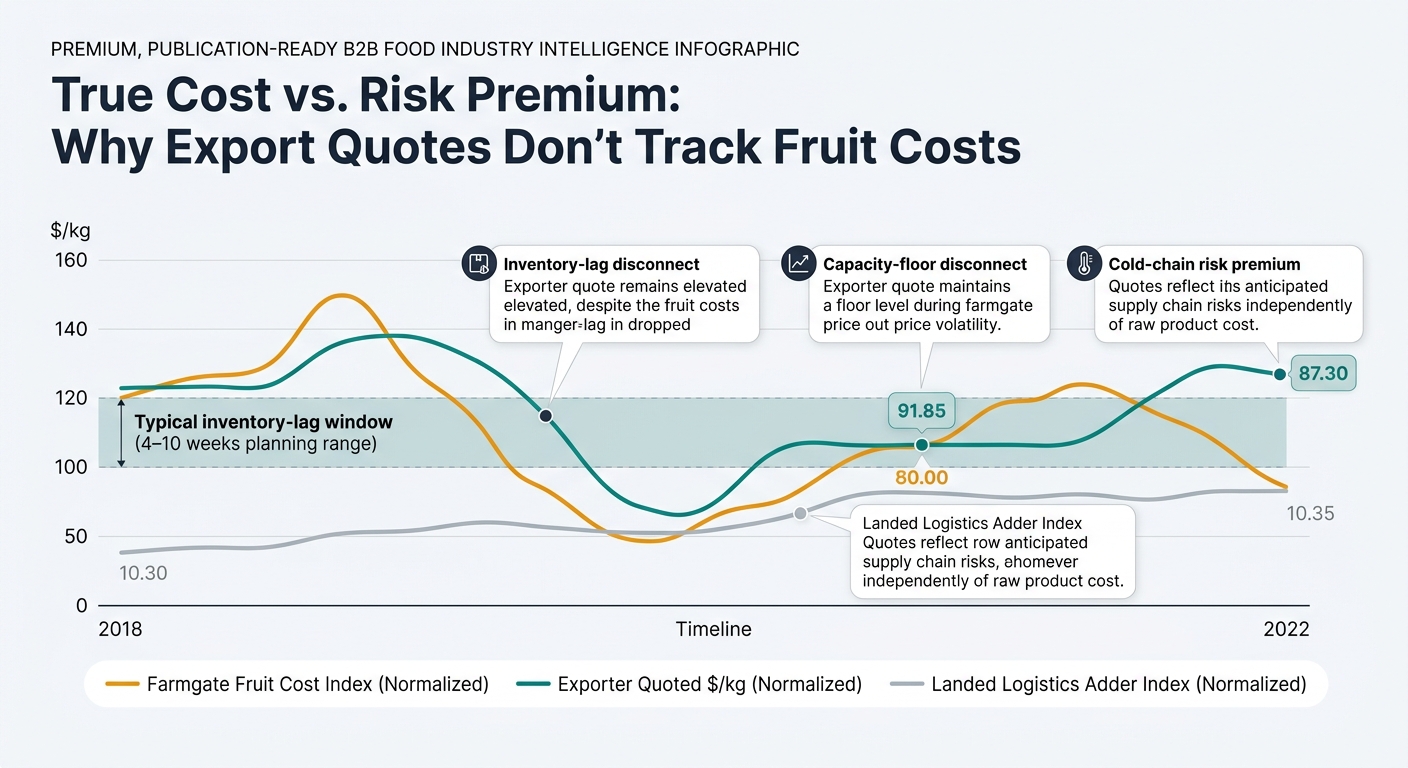
  • Inventory-lag disconnect: When farmgate fruit prices spike during the seasonal squeeze, exporter quotes may hold for ~1–2 shipment cycles if the processor is shipping from frozen stock produced earlier. (The exact lag varies by supplier inventory policy and contracted commitments; treat “4–10 weeks” as a planning range, not a rule.)
  • Capacity-floor disconnect: Even when fruit prices soften, quotes may not follow because depulping + pasteurization + freezing throughput (plus packaging line time) is the binding constraint (not fruit). This is especially visible around peak-season booking, when production slots are rationed.
  • Cold-chain risk premium: During periods of reefer tightness/port congestion, suppliers widen spreads even if fruit is stable. In practice, this shows up as wider CIF spreads, higher “contingency” buffers, and stricter terms around dwell/detention assumptions.
  • Procurement Impact: Treat açaí as a “buffered commodity” with a risk premium. Your negotiation edge is not predicting fruit prices perfectly—it’s identifying when (a) supplier inventory coverage is high, (b) production slots are underbooked, or (c) logistics risk premium is being over-applied. The play is to price the lag: lock short coverage when suppliers are still shipping old-cost inventory, and push for index/adjusters when they’re trying to pass through logistics fear.
A time-series chart with three normalized lines (farmgate fruit cost index, exporter quoted $/kg, and landed logistics adder index), a shaded ‘Typical inventory-lag window (4–10 weeks planning range)’ between fruit-cost movement and quote movement, and callouts for inventory-lag disconnect, capacity-floor disconnect, and cold-chain risk premium.

Quick Win: In your next RFQ, require suppliers to quote with two separate lines—ex-works product and logistics adders (freight, cold storage dwell assumptions, detention). You’re not asking for their margin; you’re forcing transparency on what’s moving.
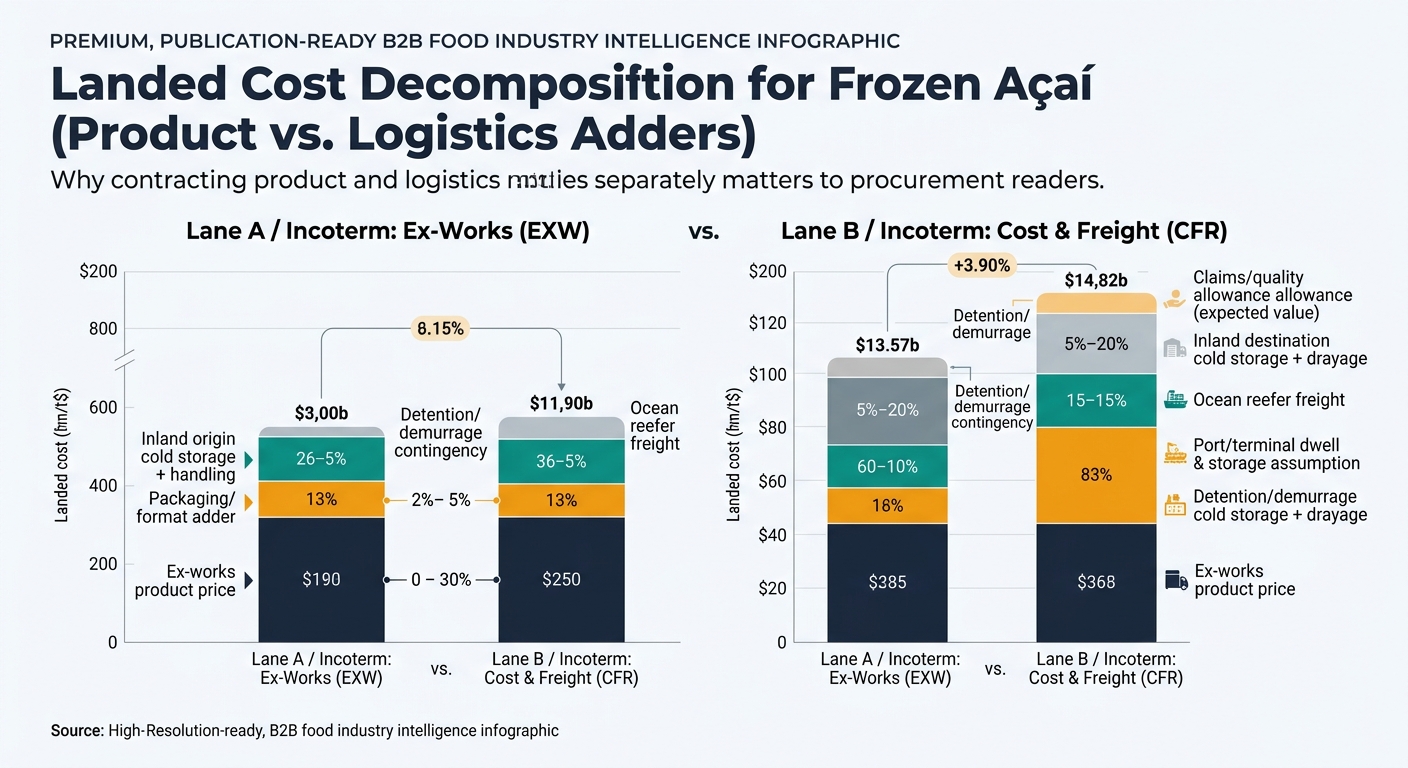
A stacked bar (or waterfall) chart decomposing total landed cost for frozen açaí into labeled components (ex-works product price, packaging/format adder, origin cold storage/handling, ocean reefer freight, port dwell/storage assumption, detention/demurrage contingency, destination cold storage/drayage, and claims/quality allowance), shown side-by-side for two illustrative lanes/terms to highlight why contracting product and logistics adders separately matters.

2) Where Procurement Teams Lose Money (and Don’t See It)

Mistake #1: Negotiating on $/kg While Ignoring “Spec-to-Yield”

  • What happens: Teams award volume to the lowest $/kg quote assuming all pulp is interchangeable, then discover downstream blending adjustments, higher inclusion rates, or sensory defects that force over-dosing.
  • Why it fails: Açaí cost is often “paid twice”—once at purchase, then again via yield loss and reformulation.
  • Reality-check on metrics: The stated 3–5% effective yield penalty is plausible in real operations when pulp %/solids, brix, color intensity, and seed/skin content vary lot-to-lot; but you should validate it with your own formulation and QC data rather than treat it as a universal benchmark.
  • The hidden cost (example, keep as illustrative): A U.S. smoothie base buyer switched to a cheaper lot and needed +0.5–1.0 percentage points higher inclusion to hit color/taste targets. On a 1,000 MT annual program, that kind of inclusion creep can quietly add the equivalent of tens of thousands of dollars—without any PO price change. (Use this as a pattern, not a claim about the broader market.)

Mistake #2: Treating Lead Time as “Static” Instead of a Distribution

  • What happens: Teams plan inventory on a single lead-time assumption (e.g., “6 weeks port-to-port”), then get hit by variability—port dwell, missed connections, cold storage congestion—and end up expediting or stocking out.
  • Why it fails: Frozen açaí is less forgiving than ambient ingredients: delays don’t just create service risk; they raise temperature-excursion probability and claims exposure.
  • The hidden cost: One late container can trigger a chain reaction: production rescheduling, premium freight for substitutes, and a quality hold that ties up working capital. It’s common for the “real” cost of a disruption event to exceed the original container value once you include plant downtime and customer penalties.

Mistake #3: Multi-sourcing on Paper, Single-sourcing in Practice

  • What happens: Procurement qualifies a backup supplier but keeps 95–100% volume with the incumbent. When disruption hits, the backup cannot scale (no reserved production slot, no packaging allocation, no pre-aligned specs).
  • Why it fails: In açaí, capacity is not just fruit—it's plant time, freezing capacity, packaging lines, and export documentation bandwidth. Suppliers prioritize customers who pre-book.
  • The hidden cost: Teams often discover the “backup” lead time is 2–3x longer during peak demand because they’re effectively joining the queue at the worst moment, paying a surcharge for rush slots and accepting higher spec variability.

Quick Win: Define “real dual-source” as at least 70/30 or 80/20 across two operationally independent supply paths (different plants or different logistics lanes), not just two vendor names.

3) What Changes When You Run Açaí Like an Intelligence Category (Not an Annual Bid)

  • Insight: The biggest step-change is moving from quarterly price checks to continuous monitoring of a few leading indicators that predict whether quotes are “cost-driven” or “risk-premium-driven.”
  • Data: A practical before/after looks like this:
Dimension Before (traditional) After (intelligence-driven)
Pricing posture Annual/biannual reset; ad-hoc spot buys 90–180 day coverage decisions tied to inventory + logistics signals
Supplier leverage Incumbent sets the narrative (“fruit is up”) Buyer tests narrative vs. external signals + peer benchmarks
Service level Reactive expediting during delays Safety stock sized to lead-time volatility (P50 vs P90)
Quality cost Claims handled case-by-case Spec drift tracked by supplier/season; corrective actions tied to re-award
  • Procurement Impact: Teams typically see fewer emergency buys, fewer “surprise” surcharges, and tighter governance. The measurable win is not just unit price; it’s reducing volatility in landed cost and avoiding disruption-driven overpayment (often the most expensive açaí you buy all year).

Quick Win: Build a one-page “açaí risk register” that triggers actions (e.g., pre-booking, shifting volume, raising safety stock) based on lane reliability, supplier slot availability, and claims trend—not on anecdotal updates.

4) Three Situations Where Timing and Intelligence Beat the Market

Use Case #1: Contract Renewal in 60 Days—Lock Less, Flex More

  • Insight: The wrong move is locking 12 months when the market is carrying a logistics risk premium; the right move is separating product price from logistics volatility.
  • Data: Use a two-part structure: (1) fixed or indexed product price for 90–180 days; (2) freight/cold storage pass-through with caps and documentation. Add a re-opener if lane costs move beyond a defined band.
  • Procurement Impact: You reduce the chance of paying “insurance margin” for risks that never materialize, while still protecting supply by reserving production slots.

Use Case #2: A Competitor Pre-books Your Supplier’s Peak Slots

  • Insight: In açaí, the scarcest asset is often production slot + packaging availability, not fruit.
  • Data: If your incumbent signals allocation, don’t wait for missed POs. Within 10 business days, test alternates for slot availability, packaging lead times, and spec compatibility; negotiate a small but real volume (10–20%) to secure queue position.
  • Procurement Impact: You convert “backup supplier” from theoretical to executable and avoid paying peak surcharges when everyone scrambles.

Use Case #3: Claims Spike—Is It Supplier-Specific or Seasonal Drift?

  • Insight: A rising claims rate can be a leading indicator of process control issues or cold-chain weakness, and it often precedes bigger failures.
  • Data: Segment claims by lane, season, and pack format. If the same supplier performs well on one lane but poorly on another, the issue is likely logistics/handling, not processing. If drift shows across lanes, it’s likely plant-side.
  • Procurement Impact: You target corrective actions precisely (lane change vs. supplier change) and avoid the costly mistake of switching suppliers when the real culprit is the route.

Quick Win: Require temperature recorder data (or equivalent evidence) on a defined sampling rate for high-risk lanes; tie noncompliance to chargebacks or downgrade rules.

5) How This Thinking Transfers to the Rest of Your Frozen/Tropical Basket

  • Insight: The same “buffered commodity + cold-chain risk premium” dynamic shows up across adjacent categories you likely buy.
  • Data: Three parallels procurement teams can leverage:
  • Mango puree: Crop swings don’t immediately translate to puree quotes because processors manage inventory and capacity; price lags create short buying windows.
  • Avocado pulp: Logistics and quality risk premiums can dominate raw input movement; claims management becomes a core cost lever.
  • Frozen berries (strawberry/blueberry): Spot prices can fall while finished goods stay sticky due to contracted pack schedules and tight freezing capacity.
  • Procurement Impact: Build one repeatable playbook: separate input cost from capacity and logistics premiums, then contract each component with the right mechanism.

6) Why Açaí Is the Best “Stress Test” of Your Procurement Governance

  • Insight: If your organization can govern açaí well—where seasonality, cold-chain fragility, and spec-to-yield effects collide—you can govern almost any high-volatility ingredient category.
  • Data (validated context): Açaí supply is highly seasonal and origin-concentrated, with a large share of harvest concentrated in a peak period often described as a “~100-day” window—conditions that quickly expose weak escalation rules and unclear accountability. [1]
  • Procurement Impact: The payoff is auditability and control: fewer exceptions, faster root-cause closure, and a category story you can defend to finance and operations when costs move.

7) The Bottom Line for Your Next Move

  • Insight: Your next negotiation should target the lag between upstream tightness and downstream quotes—because that’s where suppliers either over-apply a risk premium or under-disclose inventory coverage.
  • Data: Use your next renewal (or mid-term check-in) to split the deal into (1) short coverage on product pricing with a clear re-opener and (2) tightly governed logistics adders with caps, evidence requirements, and lane-level accountability.
  • Procurement Impact: Teams that consistently price the lag tend to avoid the most expensive açaí purchases of the year—emergency spot buys during disruption—while keeping service stable through pre-booked slots and executable secondary supply.

Key Insights (For Fast Scanners)

  • Insight: The açaí market’s biggest opportunity is exploiting timing mismatches between fruit costs, processor inventory, and logistics risk premiums.
    Data: Watch for three disconnects: inventory-lag (often shows up over 1–2 shipment cycles), capacity-floor (quotes stay sticky even when fruit softens), and cold-chain risk premium (landed cost can rise even with flat fruit).
    Procurement Impact: Win by contracting the components differently: product price coverage windows, logistics pass-through with caps, and slot reservations tied to real dual-sourcing.
  • Insight: Most “savings” are lost downstream through yield and claims.
    Data: A 3–5% yield penalty or a single disruption event can wipe out a 4–7% unit-price win.
    Procurement Impact: Treat spec-to-yield and lane reliability as commercial levers—write them into award decisions, not just QA reviews.

The Bottom Line for Your Next Contract

(Analyzed at: Apr, 2026)

Brazil’s açaí supply remains structurally seasonal and concentrated, with a large share of harvest commonly described as occurring in a short “~100‑day” peak window—so the real negotiation is still about who gets plant slots and cold-chain priority when the window tightens, not just whose fruit narrative sounds best. [1] For your next contract, split pricing into (1) a 90–180 day product mechanism and (2) a documented logistics adder with caps, then reserve capacity by running a real 10–20% volume through an alternate lane before peak pressure builds. If you wait until allocation season to “activate” a backup, the premium you pay (plus the downstream cost of claims and rescheduling) can easily dwarf the unit-price delta you fought for in the bid—especially on programs large enough that one or two late reefers can disrupt a full production cycle.
References

  1. apps.fas.usda.gov
Subscribe
By subscribing you agree to with our Privacy Policy and provide consent to receive updates from our company.
Thank you! Your submission has been received!
Oops! Something went wrong while submitting the form.
Subscribe to receive the latest blog posts, updates, promotions, and announcements from Tridge.