
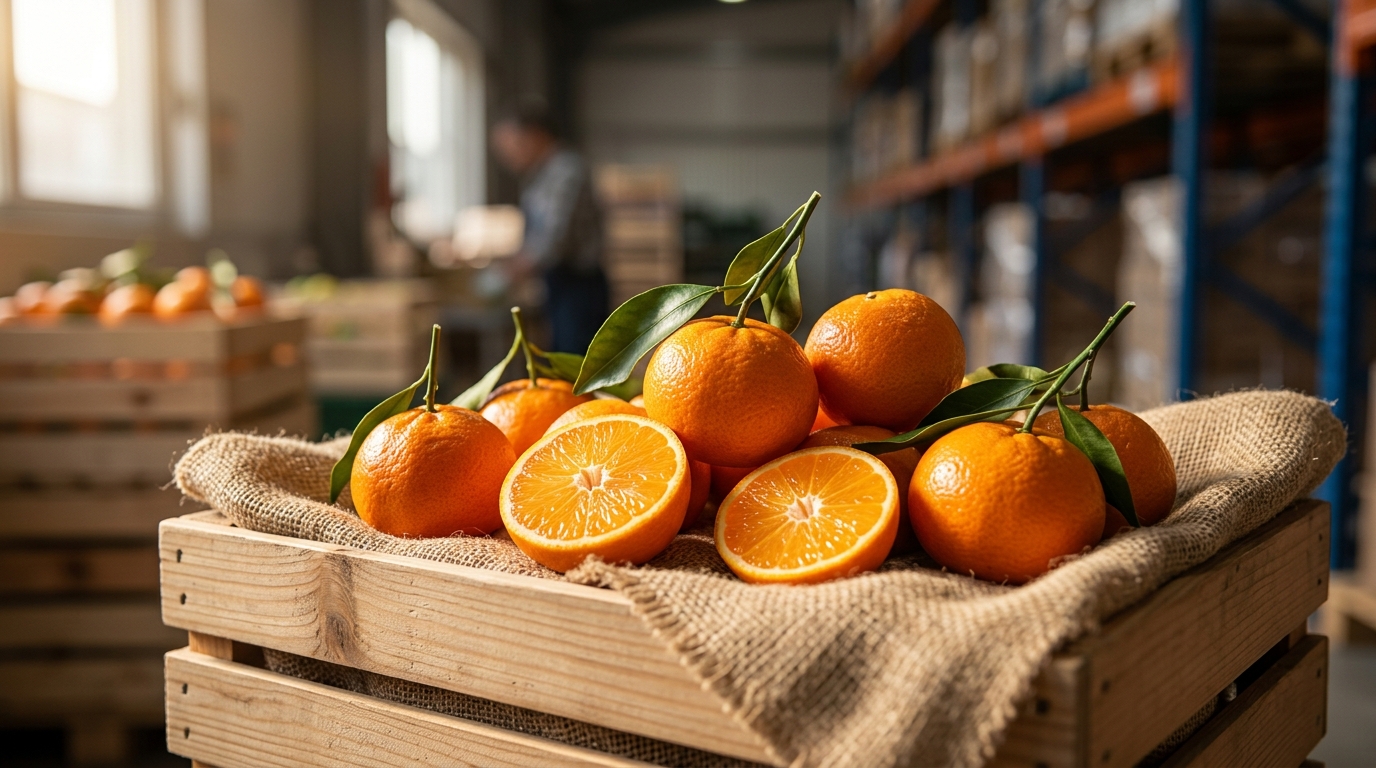
Fresh mandarins are a short, fast-moving supply chain—but it’s also unforgiving: most “cost” is really the price of protecting condition (and compliance) from harvest through arrival. This guide maps the physical flow and highlights the few irreversible points where handling, packhouse decisions, and cold-chain discipline turn into shrink, rework, claims, or import holds.
Fresh mandarins are structurally a handling-and-yield business more than a “manufacturing” business: most value is created (or destroyed) by what happens between harvest and pack-out, then preserved (or lost) through cold-chain discipline. The chain is short, but it has multiple “irreversible” points where bruising, rind injury, decay inoculum, or documentation gaps convert directly into shrink, rework, and claims.
Insight: The supply chain is built around fast conversion from orchard fruit to export-grade cartons, then temperature-controlled movement with limited opportunities to “fix” quality downstream.
Data (validated): Common postharvest guidance for mandarins targets high humidity (90–95% RH) and temperatures around ~5°C (often cited as an optimum reference point), but variety/cultivar sensitivity means the “safe” setpoint is not universal. [1]
Procurement Impact: The fixed cost-drivers sit at (1) packhouse yield loss (packout %) and (2) cold-chain reliability (temperature + dwell time). These two levers largely determine whether landed cost becomes sellable volume or shrink.
Supply chain flow (ground truth):

Insight: For mandarins, cost doesn’t simply “add”—it concentrates where fruit is culled, treated, and standardized (packhouse), then is protected (cold chain). Downstream nodes mostly monetize service (sorting, bagging, distribution) and absorb risk (shrink, claims).
Data (validated): Green and blue molds (Penicillium digitatum / P. italicum) are widely recognized as major postharvest citrus loss drivers; conventional controls include sanitation plus postharvest fungicides such as imazalil and thiabendazole (where permitted and aligned to market MRLs/label). [2]
Procurement Impact: When comparing suppliers or lanes, the meaningful “apples-to-apples” baseline is: packout yield + treatment capability + documented cold-chain setpoints and dwell-time control (because these are the physical constraints that define downstream shrink).
| Supply Chain Node | Cost Ratio (% of Final Cost) | Notes |
|---|---|---|
| Raw Material Cost (orchard fruit) | 30% | Yield and pick discipline set packout ceiling; defects become downstream shrink. |
| Primary Processing (packhouse) | 25% | Sorting/grading labor, sanitation, optional fungicide/wax, cull disposal. |
| Packaging & QA | 12% | Cartons, labels/traceability, inspection labor, basic QC records. |
| Cold Storage + Reefer Logistics | 20% | Pre-cool, cold storage, reefer freight, port/terminal handling risk. |
| Importer/DC Handling + Distribution Margin | 13% | Receiving inspection, possible repack/bagging, distribution service and shrink buffer. |

| Supply Chain Node | Cost Ratio (% of Final Cost) | Notes |
|---|---|---|
| Raw Material Cost | 26% | Often similar fruit base; bag programs may tighten size/appearance uniformity. |
| Primary Processing (packhouse) | 22% | More stringent cosmetic sorting increases culls. |
| Packaging & QA | 18% | Bags/film, label compliance, repack labor and line downtime. |
| Cold Storage + Reefer Logistics | 19% | Similar cold-chain needs; bagging can increase handling touches. |
| Importer/DC Handling + Distribution Margin | 15% | Repack operations + distribution; higher touchpoints raise damage risk. |
| Supply Chain Node | Cost Ratio (% of Final Cost) | Notes |
|---|---|---|
| Raw Material Cost | 55% | Value is constrained; price anchored to local processing economics. |
| Primary Processing | 10% | Minimal grading; basic handling and transport to processor. |
| Packaging & QA | 3% | Limited packaging; basic lot identification. |
| Logistics & Distribution | 12% | Shorter lanes typically; still sensitive to decay speed. |
| Processor/Trader Margin | 20% | Margin compensates for rapid spoilage and variable solids yield. |
Insight: In mandarins, the largest economic swing often comes from how much orchard-run fruit survives grading into export specs.
Data (validated): Packhouse operations explicitly cull for damage and decay risk; decay control relies heavily on sanitation and (where permitted) postharvest fungicide programs targeting key pathogens. [6]
Procurement Impact: Two suppliers can quote the same carton price but deliver different effective cost per sellable kg because packout and arrival condition determine shrink and rework.
Insight: “Colder is safer” is not always true; cultivar sensitivity means overly low temperatures can create chilling injury that expresses later.
Data (validated): Postharvest references commonly cite ~5°C and 90–95% RH for mandarins, while also emphasizing that requirements vary by type and program (including degreening options). [1]
Procurement Impact: The cold chain is a specification: setpoint + humidity + ventilation must match the variety and transit duration, otherwise defects appear at destination when options are limited.
Insight: For U.S.-bound mandarins, residue and documentation compliance is not a “paper exercise”—it is a gatekeeping layer that can stop product flow.
Data (validated): FDA’s pesticide residue monitoring is a compliance program, and FDA enforces EPA tolerances for foods offered for import (with standard category exceptions like meat/poultry/egg products under FSIS). [3]
Procurement Impact: The cost of non-compliance is structurally asymmetric: one detention or failed tolerance event can erase the margin of multiple successful shipments.
Quick Win: When reviewing any mandarin program, ask for a simple physical map: variety → pack date → treatment/wax status (if used) → target setpoint/RH → expected transit time → arrival inspection method. If any link is vague, that vagueness will show up later as shrink or disputes.
(Analyzed at: Sep, 2026)
Write the contract so packhouse controls and cold-chain parameters are auditable deliverables, not “best-effort” language: require a variety-specific temperature/RH target (and evidence of pre-cool, setpoint discipline, and dwell-time management) plus a residue/document pack aligned to U.S. import enforcement realities. This works because the biggest economic swing is still packout + arrival condition, while FDA tolerance enforcement makes compliance failures disproportionately expensive. [1]
With U.S. tangerine/mandarin supply forecast around 1.6 million tons in 2025/26 and imports doing real work to fill gaps, the teams that lock in lane reliability and pre-qualified alternates typically avoid the “good at loading, bad at arrival” spiral that quietly turns a few cents per pound into several points of margin loss. [4]


