INDUSTRY TRENDS

French Saucisson Supply Chain Map & Cost Drivers (What Actually Sets Lead Time, MOQ, and Margin)

Author
Team Tridge
DATE
July 29, 2026
7 min read
french-saucisson Cover
French SaucissonHS 160100
Powered by Tridge Eye
🇺🇦 Ukraine↑ 204.9%
$9.28/kg
Wholesale reference prices across 134 markets

French saucisson is a “time + control” product: procurement outcomes (price stability, service levels, and quality consistency) are set less by the last negotiation and more by what happens at three physical bottlenecks—raw meat variability at intake, validated fermentation/drying capacity, and post-process hygiene + oxygen control in packing.

Executive Summary

  • Cost lock-in happens early: lean/fat ratio, freshness, and microbial load at intake drive defect risk and downstream rework more than most unit-price deltas.
  • The real bottleneck is space/time: fermentation + drying rooms cap throughput; you can’t “expedite” curing without raising defect and hold risk.
  • Shelf-stability is hurdle-based: many industry/food-safety references use aw and pH combinations (e.g., aw ≤0.85 as a common shelf-stability threshold, with some fermented products using higher aw when pH is sufficiently low). [1]
  • Format changes the risk profile: sliced packs typically add disproportionate hygiene, scrap, and barrier-film cost versus whole-stick.
  • July 2026 regulatory reality: EU Listeria monocytogenes expectations tighten around proof of control across shelf-life, not just day-0 testing—raising the value of suppliers with strong validation and environmental monitoring maturity. [2]

1) The Physical Reality: Where Saucisson Costs “Lock In”

French saucisson is not a fast-turn meat SKU. The chain is physically built around (1) pork/fat quality at intake, (2) controlled fermentation + drying room time, and (3) post-process hygiene + packaging protection—each of which fixes cost and service levels long before the product ships.

  • Insight: The supply chain is a time-and-space business (curing rooms, humidity control, inventory tied up during weight loss), not just a meat conversion business.
  • Data (validated framing): Dry/fermented sausage safety and shelf-life are typically managed via “hurdles” (water activity + pH + salt/cure + process control). Many food-safety references use aw ≤0.85 as a common shelf-stability threshold, and for fermented products some frameworks allow higher aw when pH is sufficiently reduced (e.g., pH ≤5.3 with aw ≤0.90–0.91 in certain guidance). [1]
  • Procurement Impact: The fixed cost-drivers are structural: raw material variability, yield shrink (moisture loss), and capacity utilization of fermentation/drying rooms. If you don’t map these nodes, you’ll misread why lead times, MOQs, and quality drift happen.

Supply chain flow (physical)

hog farms → slaughter/deboning (chilled trims + backfat) → casing prep → grinding/mixing (salt, nitrite/nitrate where permitted, spices, sugars, starter cultures) → stuffing → fermentation (pH drop) → drying/aging (aw reduction + weight loss) → optional smoking → QA release (micro + aw/pH as applicable) → whole-stick or slicing/packing (vacuum/MAP) → ambient or chilled distribution.
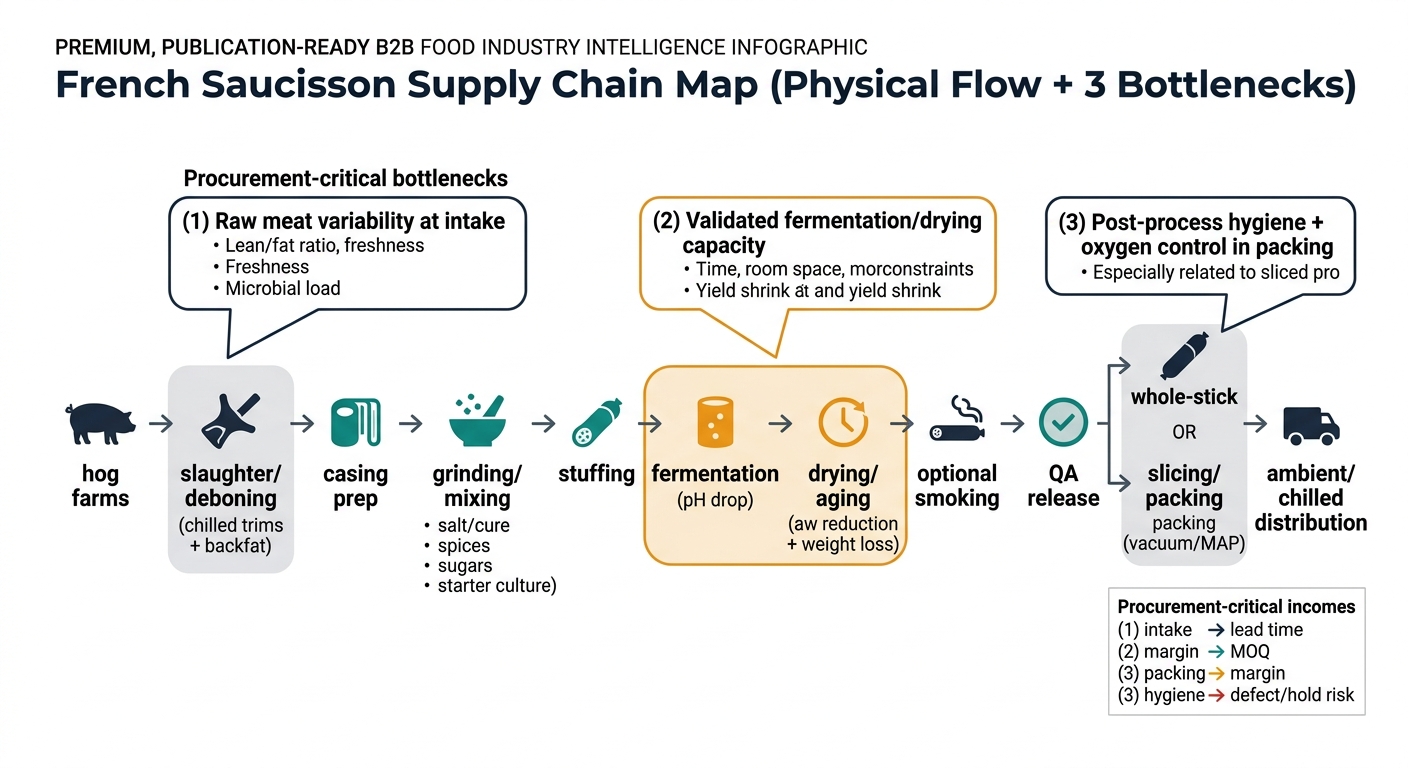
A left-to-right supply chain flow with labeled stages from hog farms through slaughter/deboning, casing prep, grinding/mixing, stuffing, fermentation, drying/aging, optional smoking, QA release, whole-stick or slicing/packing (vacuum/MAP), and ambient/chilled distribution; highlights three bottlenecks: raw meat variability at intake, validated fermentation/drying capacity, and post-process hygiene plus oxygen control in packing, with a legend tying bottlenecks to lead time, MOQ, margin, and defect/hold risk.

2) Cost & Margin Structure by Node: What Each Step Adds (and Why)

Insight: In saucisson, cost accumulates through conversion + time + compliance. The “expensive” steps are often the ones that consume controlled space (drying rooms), create yield loss (shrink), or require high-hygiene packaging environments (especially slicing).
1. Upstream / Raw Material (Hogs → Pork trims + backfat)

  • Insight: The chain’s biggest technical dependency is lean/fat ratio + freshness + microbial load at intake; it determines fermentation performance, texture, and defect rates (smearing, rancidity, inconsistent bind).
  • Data (procurement-relevant, non-controversial): Pork inputs are typically purchased as defined trim ratios and backfat; fat is oxidation-prone, and oxygen exposure later in the chain can accelerate quality loss—driving packaging performance requirements.
  • Procurement Impact: Variability here becomes downstream yield loss, rework, and sensory drift—costs that rarely show up in unit price but hit service levels.

2. Primary Processing (Slaughter, deboning, chilling/freezing)

  • Insight: This node monetizes cold-chain control + cut specification + traceability. It’s where “commodity pork” becomes a charcuterie-grade input.
  • Data: Chilling/freezing decisions change grinding behavior and fat smear risk; frozen blocks can smooth availability but can increase process variability if tempering is inconsistent.
  • Procurement Impact: This node drives lead time reliability (availability of defined trims) and documentation completeness (lot traceability needed for downstream QA release and export).

3. Secondary Processing (Grinding, mixing, stuffing)

  • Insight: This is the formulation-and-controls node: salt, cure system, sugars, spices, starter cultures, and mixing temperature determine whether fermentation is predictable.
  • Data (tightened for accuracy): Many industry and regulator-adjacent references describe fermented sausage control using pH/aw combinations (commonly citing pH targets around ≤5.3 for fermented products, and shelf-stability often associated with aw ≤0.85, or aw ≤0.90–0.91 when pH is sufficiently low in some guidance). Exact targets are process- and product-specific and should be supplier-validated. [3]
  • Procurement Impact: Ingredient specs (salt type, nitrite/nitrate system, culture strain, dextrose) become process-critical parameters: if a substitute changes kinetics, it changes drying time, defect rates, and release timing.

4. Fermentation + Drying/Aging (the capacity bottleneck)

  • Insight: This is where economics are structurally “non-linear”: time in controlled rooms consumes capacity while sellable weight declines (moisture loss).
  • Data (validated framing): Water activity reduction is a core preservation lever in dried/fermented meats; many references treat aw as a primary shelf-stability control, with typical dry/fermented products spanning a range depending on endpoint and style. [4]
  • Procurement Impact: This node drives working capital (inventory tied up), throughput ceilings (room availability), and seasonal sensitivity (ambient humidity/temperature affects energy use and process stability).

5. Packaging & QA Release (whole-stick vs sliced)

  • Insight: Packaging is not cosmetic; it’s the oxygen and hygiene control system that protects fat quality and shelf-life—especially once sliced.
  • Data (validated directionally): High-oxygen atmospheres are widely shown to increase oxidation risk versus vacuum in pork systems, and barrier performance matters because it governs oxygen exposure over time. [5]
  • Procurement Impact: Moving from whole-stick to sliced usually raises cost via higher hygiene controls, tighter barrier specs, more QA testing, and higher scrap risk.

6. Distribution (ambient vs chilled; domestic vs export)

  • Insight: Distribution cost is a function of product endpoint + customer handling requirements, not just distance.
  • Data: Many dry/fermented sausages can be distributed without deep cold-chain if shelf-stability hurdles are met, but retailers/importers may still require chilled handling to reduce quality drift and manage shelf-life consistency.
  • Procurement Impact: This node determines landed cost volatility (freight + temperature control) and write-off risk (clearance delays, shelf-life losses).
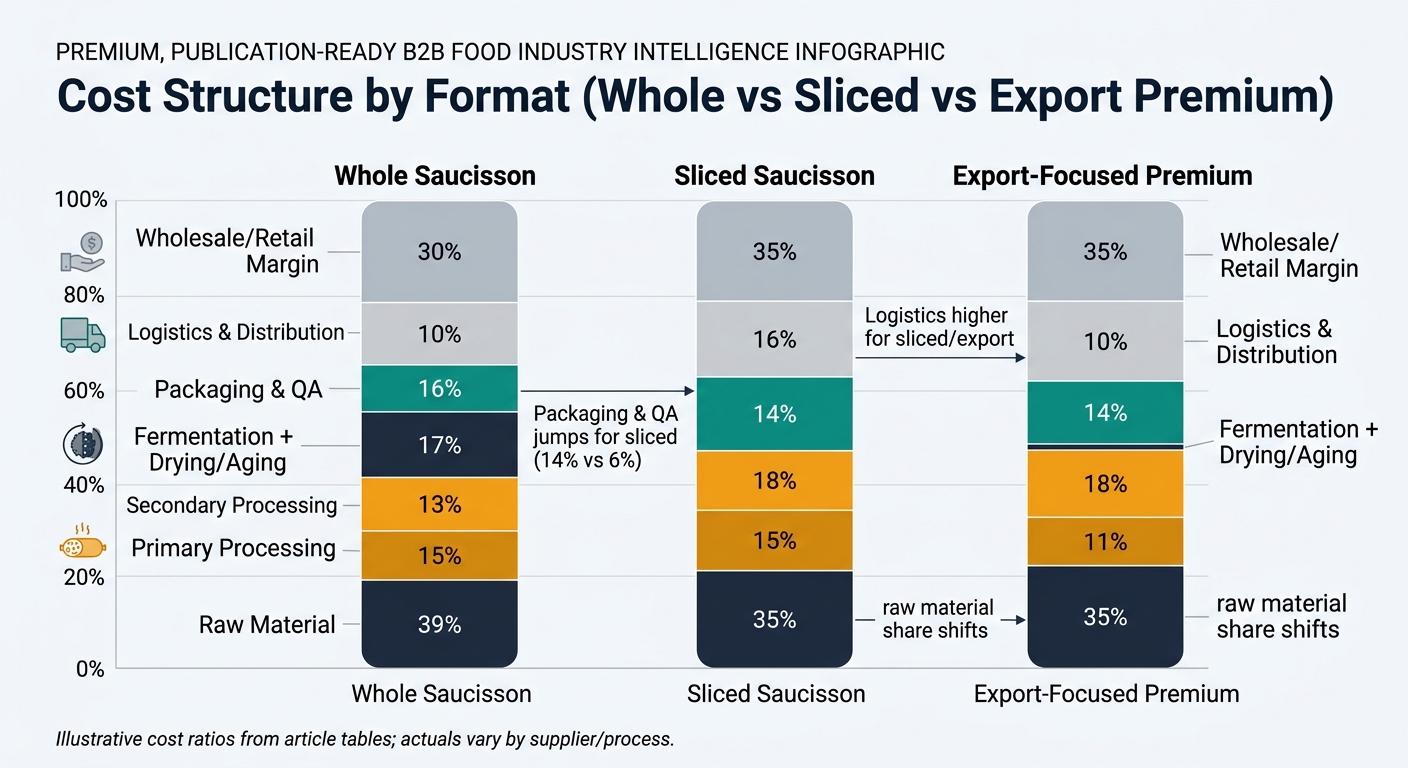
A 100% stacked bar chart comparing cost structure by format across Whole Saucisson, Sliced Saucisson, and Export-Focused Premium, segmented by Raw Material, Primary Processing, Secondary Processing, Fermentation + Drying/Aging, Packaging & QA, Logistics & Distribution, and Wholesale/Retail Margin; annotations highlight key deltas such as Packaging & QA higher for sliced (14% vs 6%) and higher logistics for sliced/export; includes a footnote that ratios are illustrative from the article tables and actuals vary by supplier/process.

Product-Level Cost Breakdown

A) Whole Saucisson (traditional stick, paper wrap or flow-wrap)

Supply Chain Node Cost Ratio (% of Final Cost) Notes
Raw Material Cost (pork + backfat) 45% Lean/fat spec and freshness drive defect rates downstream.
Primary Processing 8% Cut/trim spec, chilling/freezing, traceability documentation.
Secondary Processing 14% Mixing/stuffing labor, spices, cultures, process controls.
Fermentation + Drying/Aging 12% Room time + energy + yield shrink (moisture loss).
Packaging & QA 6% Basic barrier needs; QA release testing.
Logistics & Distribution 7% Often ambient-capable; retailer handling can add cost.
Wholesale/Retail Margin 8% Channel margin on premium charcuterie.

B) Sliced Saucisson (vacuum or MAP retail packs)

Supply Chain Node Cost Ratio (% of Final Cost) Notes
Raw Material Cost (pork + backfat) 38% Same inputs, but slicing magnifies quality sensitivity.
Primary Processing 7% As above.
Secondary Processing 12% As above.
Fermentation + Drying/Aging 10% As above; tighter endpoint control often required.
Packaging & QA 14% Higher barrier films, slicing hygiene, more QA, higher scrap.
Logistics & Distribution 9% More frequently chilled; shelf-life management tighter.
Wholesale/Retail Margin 10% Higher value-add format supports higher margin.

C) Export-Focused Premium Saucisson (defined recipe/claims; stricter QA)

Supply Chain Node Cost Ratio (% of Final Cost) Notes
Raw Material Cost 40% Tighter spec + traceability expectations.
Primary Processing 9% Documentation and segregation requirements increase cost.
Secondary Processing 13% More controlled formulation; often tighter spice/allergen controls.
Fermentation + Drying/Aging 12% Longer/stricter process windows; higher working capital.
Packaging & QA 10% Export labeling, stronger QA release, sometimes chilled expectation.
Logistics & Distribution 10% Certificates, customs clearance time, temperature control risk.
Wholesale/Retail Margin 6% Margin varies by importer/route-to-market.
Sourcing Window Radar
French Saucisson — Global Harvest Calendar
🇫🇷 France
AUG — DEC
🇷🇺 Russia
SEP — OCT
🇳🇱 Netherlan.
JAN — JAN
JanFebMarAprMayJunJulAugSepOctNovDec

3) Structural Facts (Industry Constants You Can’t “Optimize Away”)

Reality 1: Drying-room capacity is the real factory bottleneck

  • Insight: You can add grinders and stuffers faster than you can add validated fermentation/drying capacity.
  • Data (validated framing): Shelf-stability and safety are governed by the pH/aw trajectory and process control; pushing throughput without stable controls increases defects and release holds. [4]
  • Procurement Impact: Supply availability is constrained by validated room capacity and process control, not just pork supply.

Reality 2: Slicing/packing is disproportionately high-risk (and high-cost)

  • Insight: The moment you slice, you create more surface area, more oxygen exposure, and a higher hygiene burden.
  • Data (validated direction): Studies in pork packaging commonly show higher oxidation under high-oxygen MAP than under vacuum, and barrier packaging can materially reduce oxidation versus more permeable formats. [5]
  • Procurement Impact: “Same product, different format” can mean materially different QA intensity, scrap, and shelf-life variability.

Reality 3: Food-safety criteria can force process proof—not just end-product testing

  • Insight: For RTE foods, regulators increasingly expect producers to demonstrate control across shelf-life, not only at day-0.
  • Data (verified): Commission Regulation (EU) 2024/2895 (adopted 20 Nov 2024) amends Regulation (EC) 2073/2005 on Listeria monocytogenes and applies from 1 July 2026; it reinforces that use of the 100 cfu/g criterion is conditional on the operator demonstrating the product will not exceed that limit throughout shelf-life—otherwise stricter criteria apply at placing on the market. [2]
  • Procurement Impact: Plants with stronger validation data and environmental monitoring maturity will have fewer release delays and fewer disruptive holds.

Key Insights You Can Reuse in One Slide

  • Insight: Saucisson cost is structurally built from three physical realities: raw material variability, drying-room time + yield shrink, and post-process hygiene + oxygen control.
  • Data (tightened): Many food-safety references use hurdle logic where aw and pH combinations define shelf-stability expectations (commonly aw ≤0.85, with some fermented categories allowing higher aw when pH is sufficiently low). Packaging oxygen exposure materially affects oxidation behavior in pork systems. [1]
  • Procurement Impact: When supply tightens or quality drifts, the root cause is usually at a physical node (trim spec, room capacity, slicing hygiene, barrier film)—not “generic supplier performance.”

The Bottom Line for Your Next Contract

(Analyzed at: Jul, 2026)

Write your next saucisson contract like a capacity-and-release agreement, not just a price sheet: require suppliers to disclose validated fermentation/drying capacity by format, plus release criteria and shelf-life control evidence (pH/aw endpoints, environmental monitoring maturity, and how they support Listeria compliance under the EU’s rules applying 1 July 2026). [2] This works because the most common “surprise costs” are QA holds, late releases, and rework—problems rooted in process control and packing hygiene, not pork index moves. If you don’t contract for that proof up front, you’ll pay for it later via expedited logistics, missed promotions, and scrap; in most mature plants those failure modes can easily erase a few points of margin faster than any negotiated cents-per-kilo win.

French SaucissonSupply Chain Intelligence
134 countries tracked
10
Exporters
10
Importers
$962M
Top Export Value
Top Exporters (2024)
🇮🇹
Italy
$962M
🇺🇸
United States
$866M
🇪🇸
Spain
$729M
🇵🇱
Poland
$678M
🇩🇪
Germany
$676M
+129 more
Top Buyers
🇬🇧 United Kingdom $1.00B🇩🇪 Germany $619M🇧🇪 Belgium $372M🇨🇦 Canada $322M🇳🇱 Netherlands $315M

References

  1. canada.ca
  2. eur-lex.europa.eu
  3. ontario.ca
  4. meathaccp.wisc.edu
  5. pmc.ncbi.nlm.nih.gov

Related Contents

Subscribe
→
By subscribing you agree to with our Privacy Policy and provide consent to receive updates from our company.
Thank you! Your submission has been received!
Oops! Something went wrong while submitting the form.
Subscribe to receive the latest blog posts, updates, promotions, and announcements from Tridge.
