
Freeze-dried pomegranate looks like a simple fruit ingredient, but procurement outcomes (price, lead time, rejects, and continuity) are mostly determined by a few physical conversion bottlenecks. This guide maps how the product moves, where cost becomes structurally “fixed,” and which specification and contract levers actually change total cost of ownership for sourcing teams.
Freeze-dried pomegranate is not a simple “fruit in, fruit out” chain. It is a seasonal agricultural input (whole fruit) that must be converted into a highly engineered, low-water-activity ingredient whose quality depends on aril separation yield, freezing discipline, freeze-dryer throughput, and moisture/oxygen barrier packaging.
Insight: The chain is built around two irreversible conversions: (1) whole fruit → arils (yield + labor), and (2) frozen arils → freeze-dried pieces/powder (capex + energy + cycle time). These two steps structurally anchor cost and capacity.
Data: Peer-reviewed and technical references commonly describe the edible portion of pomegranate around ~52% of whole fruit weight, and note that the edible portion is largely juice (with a seed/kernel fraction), which implies limited dry solids available for a dry ingredient [1] [2].
Procurement Impact: Even before any commercial decisions, the physical map tells you where supply tightens: aril extraction labor and freeze-drying capacity. If either node is constrained, lead times and availability tighten downstream regardless of demand signals.

Insight: In freeze-dried pomegranate, “cost” is less about raw fruit price alone and more about conversion economics: yield losses, energy-intensive drying, and packaging engineered to prevent moisture pickup and oxidation.
Data: Extension and academic sources commonly cite that properly freeze-dried foods land in a low water activity range (often ~0.08–0.33) and that final moisture targets for freeze-dried cellular materials are commonly referenced around ~0.5–3% for long-term stability [3] [4].
Procurement Impact: The product’s physical stability is achieved by paying for (a) capacity time in a freeze dryer and (b) barrier packaging performance. Those are structural cost “floors” that do not disappear in softer markets.
Insight: Whole pomegranate supply is seasonal and quality-variable; the chain inherits agricultural yield risk (fruit size, aril color, defect rates) before processing begins.
Data: Turkey’s pomegranate harvest is widely reported as starting around early October, with commercial availability extending via cold storage into winter [5].
Procurement Impact: The physical harvest window drives when processors can build frozen aril inventory. If harvest quality is poor (cracking, sunburn, rot), downstream yield and color consistency can degrade even if volumes exist.
Yield reality (why it matters): Multiple references place edible portion around ~52% on average (with varietal variability), and describe that edible portion as juice-heavy—so dry output per kg fruit is structurally limited [1] [2].
Insight: Aril separation is a labor-and-yield gate: it determines how much “processable” material reaches the freezer and how much foreign matter risk is removed before drying.
Data: Scientific sources describing pomegranate anatomy and composition support that a large portion of the fruit is non-edible peel/membrane and that the edible portion includes juice and kernels, reinforcing why extraction losses and sorting intensity materially affect usable output [2].
Procurement Impact: This node is where hidden cost is created through (a) yield loss (peel/membrane waste), (b) rework/sorting to meet foreign matter limits, and (c) microbial/pesticide testing programs that increase per-lot overhead.
Technical spec sensitivity: Seed content tolerance and “hard seed” perception depend on cultivar and how arils are handled (damage during extraction can create fines and seed fragments).
Insight: Frozen arils are the physical bridge between a seasonal crop and year-round industrial demand; cold chain discipline becomes a structural dependency.
Data: Freeze-drying begins with freezing and then sublimation under vacuum; extension guidance also notes that freeze-drying preserves microorganisms if present and that growth can resume if moisture is reintroduced—making upstream hygiene and downstream moisture control both relevant [3].
Procurement Impact: Cold storage cost (energy + space) is not optional if supply must be continuous. Any cold-chain bottleneck (freezer capacity, power reliability, temperature excursions) can reduce aril quality before drying—showing up downstream as color drift, texture issues, or higher sorting loss.
Practical quality linkage: Better frozen input integrity generally reduces fines after drying and improves piece survival for inclusions.
Insight: Freeze-drying is a high-capex, high-energy, time-intensive process; cycle time and equipment utilization largely determine conversion cost.
Data: Technical literature describes freeze-drying as sublimation under vacuum and reports low water activity ranges for freeze-dried products; separate academic work commonly cites final moisture targets for freeze-dried cellular materials around ~0.5–3% for stability [6] [4].
Procurement Impact: This node creates the biggest “fixed” cost driver: you are buying time on a freeze dryer. Tighter targets for moisture/Aw and stricter texture requirements can increase cycle time, reduce throughput, and raise conversion cost even if raw fruit is cheap.
Quality mechanics (why specs exist): If Aw rises during storage (moisture pickup), texture softens and preserved microorganisms can resume growth when moisture returns—so Aw is both a texture and food-safety management variable [3].
Insight: After drying, the product becomes fragile and hygroscopic; converting it into “pieces vs. granules vs. powder” adds measurable yield loss and QA complexity.
Data: Food safety and extension guidance consistently emphasizes that freeze-dried foods must be packaged in moisture-proof, hermetically sealed containers because they readily pick up moisture from the environment [7].
Procurement Impact: Particle-size distribution is not just a cosmetic spec—it drives dusting, segregation in blends, and line losses. Milling/sieving also increases surface area, making powders more moisture-sensitive and more dependent on barrier packaging and humidity control in warehouses.
Typical spec levers at this node: screen size/mesh targets, fines %, seed fragments %, bulk density, and flowability (caking risk).
Insight: Packaging is not a commodity add-on; it is the “final processing step” that preserves crunch, color, and flavor by preventing humidity pickup and limiting oxygen exposure.
Data: Public food safety guidance states freeze-dried products must be packaged in moisture-proof, hermetically sealed containers; extension guidance also frames Aw as a key stability measure for freeze-dried foods [7] [3].
Procurement Impact: Packaging performance (barrier film selection, seal quality, desiccant/oxygen absorber strategy) directly affects complaint rates and write-offs. Distribution in humid environments amplifies the cost of any packaging weakness because freeze-dried product rapidly equilibrates with ambient moisture.
QA release focus: water activity (Aw), moisture %, microbial limits, foreign matter, and (for some programs) pesticide residues/heavy metals.
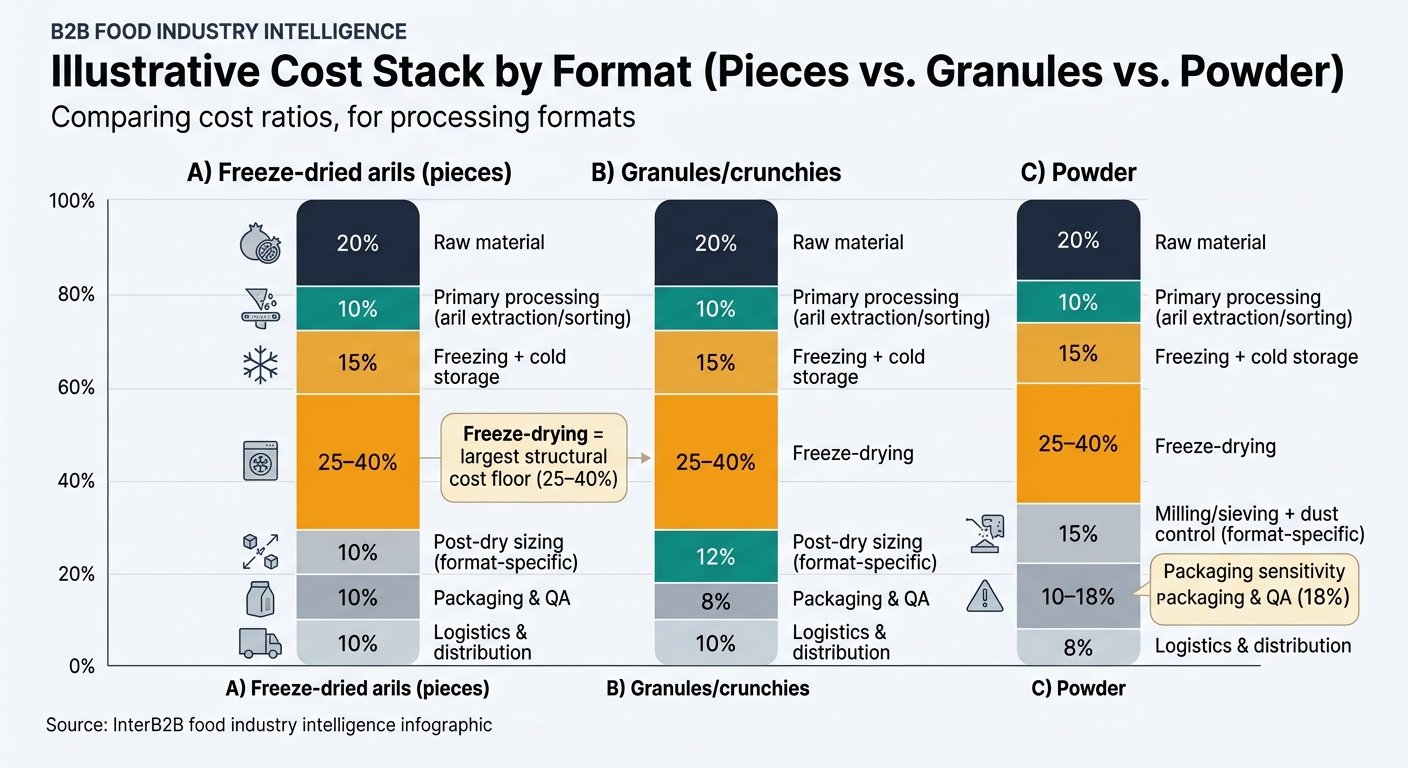
| Supply Chain Node | Cost Ratio (% of Final Cost) | Notes |
|---|---|---|
| Raw Material (whole fruit) | 20–30% | Seasonal orchard + harvest cost; quality drives usable yield. |
| Primary Processing (aril extraction/sorting) | 15–25% | Labor + yield loss + food safety controls. |
| Freezing + Cold Storage | 5–10% | Energy + freezer capacity to bridge seasonality. |
| Freeze-Drying | 25–40% | Capex utilization + energy + cycle time; dominant conversion cost. |
| Packaging & QA | 8–15% | High-barrier films, seal integrity, Aw testing, foreign matter controls. |
| Logistics & Distribution | 5–10% | Ambient outbound typically; humidity exposure risk in handling. |
| Supply Chain Node | Cost Ratio (% of Final Cost) | Notes |
|---|---|---|
| Raw Material (whole fruit) | 18–28% | Similar biology-driven yield limits as pieces. |
| Primary Processing (aril extraction/sorting) | 15–25% | Sorting intensity often higher to control fragments/fines. |
| Freezing + Cold Storage | 5–10% | Same seasonal buffering requirement. |
| Freeze-Drying | 25–40% | Similar to pieces; throughput depends on bed depth/loading. |
| Post-Dry Sizing (sieving) | 5–12% | Yield loss to fines/off-size; added QA checks. |
| Packaging & QA | 8–15% | Barrier packaging critical to keep crunch. |
| Logistics & Distribution | 5–10% | Handling damage can create fines in transit. |
| Supply Chain Node | Cost Ratio (% of Final Cost) | Notes |
|---|---|---|
| Raw Material (whole fruit) | 15–25% | Powder amplifies impact of input color/flavor variability. |
| Primary Processing (aril extraction/sorting) | 12–22% | Foreign matter control remains critical pre-mill. |
| Freezing + Cold Storage | 5–10% | Same seasonal buffer. |
| Freeze-Drying | 25–40% | Core conversion cost. |
| Milling/Sieving + Dust Control | 8–18% | Added energy, yield loss, and contamination control steps. |
| Packaging & QA | 10–18% | Powders are more hygroscopic; stronger barrier needs. |
| Logistics & Distribution | 5–10% | Humidity control in warehousing becomes more important. |
Insight: The fruit’s structure (peel + membrane + arils that are largely juice) puts a hard ceiling on dry output per kg of whole fruit.
Data: Scientific references commonly cite ~52% edible portion of whole fruit on average (with variability by cultivar), and describe the edible portion as largely juice with a kernel/seed fraction [1] [2].
Procurement Impact: Downstream availability of freeze-dried product is structurally sensitive to orchard yield and pack-out quality. Even with adequate fruit tonnage, usable aril yield can fall if defects rise.
Insight: Freeze-drying is slow and equipment-intensive; conversion cost is anchored by cycle time and utilization.
Data: Academic work on freeze-dried fruit systems highlights that secondary drying determines final moisture/Aw and commonly references final moisture targets around ~0.5–3% for stability [4].
Procurement Impact: When demand spikes or dryers go down, supply tightens quickly because capacity cannot be expanded rapidly without major capex.
Insight: Freeze-dried fruit fails primarily through moisture pickup (texture loss/caking) and oxygen exposure (color/aroma fade); packaging performance is the shelf-life engine.
Data: Public food safety guidance emphasizes moisture-proof, hermetically sealed packaging for freeze-dried foods; extension guidance ties stability to low Aw [7] [3].
Procurement Impact: If packaging specs are under-designed, the supply chain effectively “re-wets” the product in distribution—creating avoidable quality drift, caking, and write-offs.
Key Takeaways: The physical chain is constrained by (1) seasonal fruit supply, (2) aril extraction yield and sorting intensity, (3) freeze-dryer time, and (4) barrier packaging quality. If you understand those four constraints, most downstream availability and quality outcomes become explainable.
The Bottom Line for Your Next Contract (Analyzed at: Sep, 2026): Lock in freeze-dryer capacity and packaging performance in writing, not just a per‑kg price. In 2026, freeze-dried fruit remains structurally pulled by snack and inclusion demand, while energy costs still flow directly into freeze-drying conversion quotes—so suppliers will protect utilization first and price second when capacity tightens [8]. Write contracts that (a) reserve production windows tied to the harvest/freezing build, (b) define release criteria around Aw/moisture + seal integrity, and (c) include a pre-agreed rework/credit mechanism if post‑ship moisture pickup occurs. The stakes are not pennies in lab testing; it’s avoiding double-digit total-cost hits when you pay for expedited replacement, line stops, and write-offs from caking/softening lots.


