
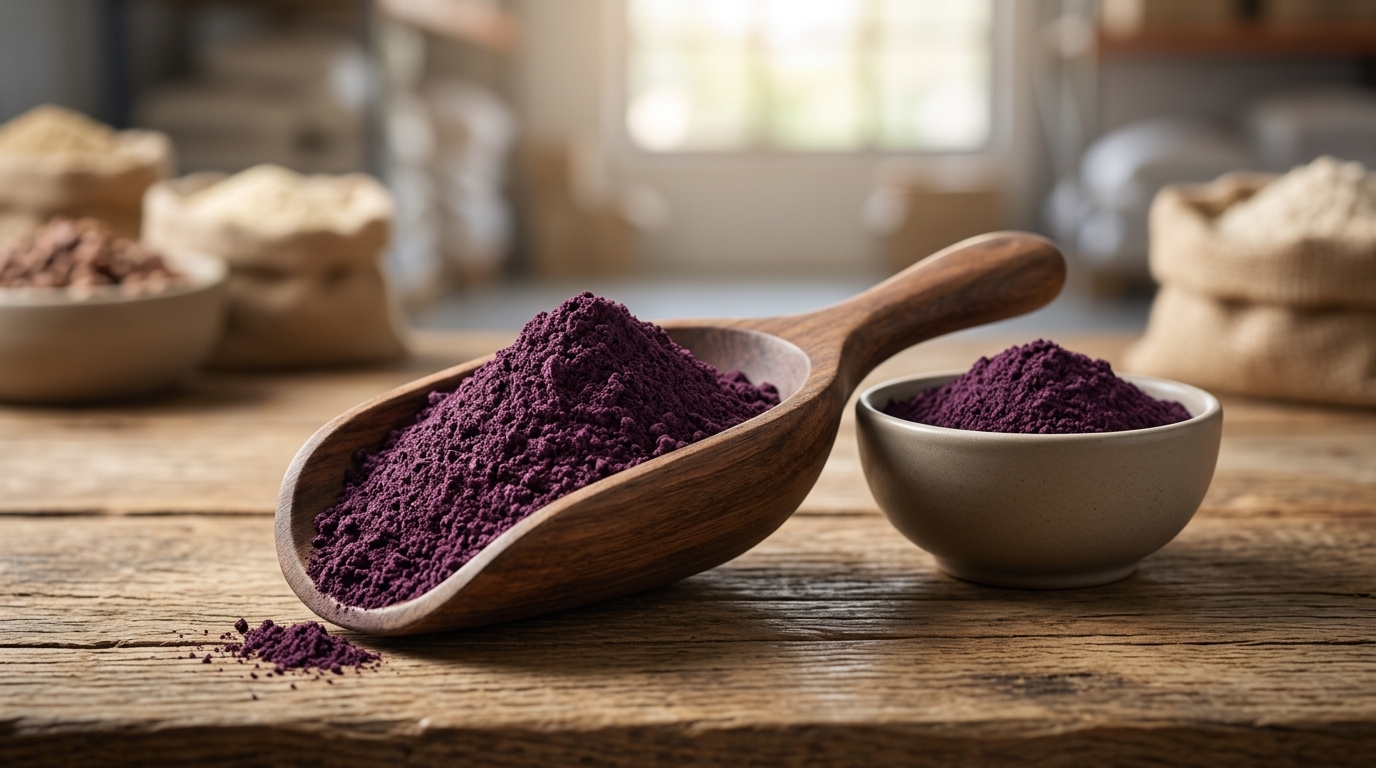
Freeze‑dried açaí is best sourced like a constrained, two‑step processed ingredient—not a simple fruit powder. The key procurement move is to separate what is structurally “locked in” by physics (time-to-pulp, cold chain, freeze‑dry cycle/energy) from what is commercially negotiable (terms, service levels, packaging configuration, testing scope).
Freeze‑dried açaí powder is not a single-step commodity. It’s a two‑stage stabilization chain: (1) berries must be converted into pulp near harvest because the fruit deteriorates quickly, then (2) that pulp is freeze‑dried and milled in facilities with reliable utilities, QA labs, and high‑barrier packaging.
Insight: The supply chain is physically constrained by time (post‑harvest perishability), cold chain (pulp stabilization), and energy (freeze‑drying).
Data: For quality, industry and technical sources commonly note açaí should be processed quickly after harvest (often cited within ~12–24 hours, depending on conditions and handling). [1]
Data: Freeze‑drying is structurally energy‑intensive; a food freeze‑drying review reports energy consumption ranges around 600–1000 kWh per kg of water removed (system/conditions dependent), far above conventional drying. [2]
Procurement impact: Even before “market dynamics,” the product’s landed cost is structurally shaped by (a) how fast pulp is made and frozen, (b) whether pulp moves in reefer, and (c) freeze‑dryer cycle time + electricity.

Insight: Freeze‑dried açaí cost is cumulative: upstream logistics and yield losses create a high‑cost input (pulp), then freeze‑drying converts that input into a low‑moisture, high‑value powder with heavy fixed costs (energy + capex + time).
Conversion ratios: Conversion ratios vary widely by starting material (fresh fruit vs. pulp), solids content, and whether carriers are used. Rather than relying on a single universal “kg fresh to kg powder” figure, treat conversion as a supplier‑specific yield KPI you must validate during qualification (mass balance on fruit → pulp → powder).
Procurement impact: The chain amplifies upstream variability: small shifts in pulp solids, loss rates, or cold‑chain performance translate into disproportionate $/kg changes in finished powder.
Note for procurement governance: These tables are directional “where money accumulates” maps (not market price benchmarks). Actual splits move with energy, freight, yield, and packaging configuration.
| Supply Chain Node | Cost Ratio (% of Final Cost) | Notes |
|---|---|---|
| Upstream raw material + aggregation | 35% | Harvest labor + aggregation losses + access constraints. |
| Primary processing (pulping/standardizing/pasteurizing) | 25% | Yield loss (seed removal), sanitation, QC, pasteurization decision. |
| Freezing + cold storage | 15% | Energy + inventory holding in freezer. |
| Packaging & QA | 8% | Food-contact liners, block packaging, COA testing. |
| Reefer logistics & export handling | 17% | Reefer freight, port handling, temperature-excursion risk. |
| Supply Chain Node | Cost Ratio (% of Final Cost) | Notes |
|---|---|---|
| Frozen pulp input (incl. upstream + primary processing) | 45% | Pulp solids consistency drives dryer efficiency and yield. |
| Secondary processing (freeze‑dry + mill/sieve) | 30% | Energy + cycle time + capex recovery; dominant fixed-cost node. [2] |
| Packaging & QA release | 10% | High-barrier films/liners, nitrogen flush (where used), micro/heavy-metal testing (program dependent). |
| Ambient logistics & warehousing | 7% | Moisture control, liners, handling discipline. |
| Distributor/processor margin & overhead | 8% | Working capital, shrink, compliance overhead. |
| Supply Chain Node | Cost Ratio (% of Final Cost) | Notes |
|---|---|---|
| Bulk freeze‑dried powder input | 25% | Ingredient is no longer the majority of shelf price. |
| Repack/packing operations | 15% | Small-pack line efficiency, labor, changeovers. |
| Packaging materials | 20% | Printed pouches/jars, seals, oxygen/moisture barriers. |
| QA, labeling, compliance | 8% | Lot traceability, label review, shelf-life verification. |
| Distribution + retail/wholesale margin | 32% | Channel margin dominates consumer pricing. |
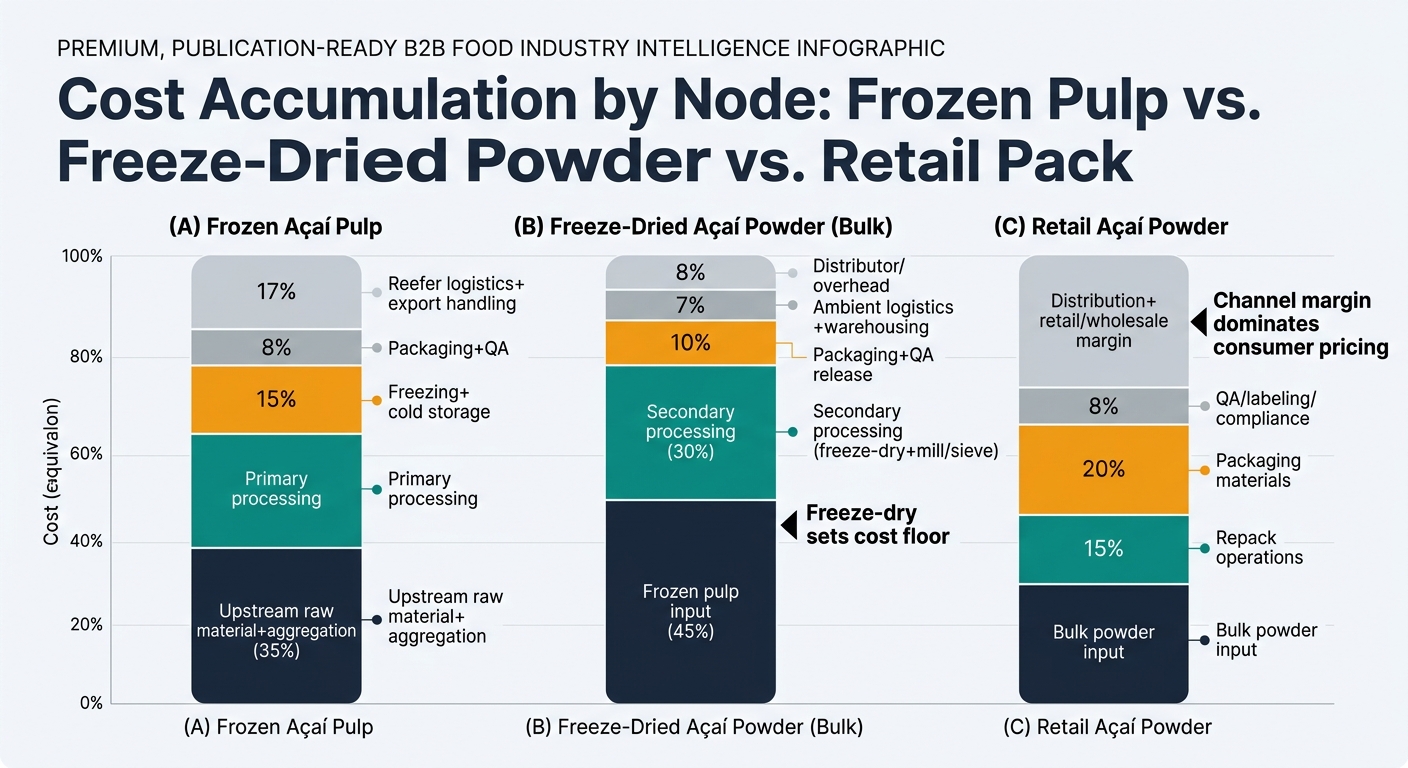
Insight: Açaí’s value chain is built around converting berries to frozen pulp fast, then converting pulp to powder slowly (freeze‑dry).
Data: Sources commonly cite tight windows to process after harvest (e.g., ~12–24 hours depending on handling), and freeze‑drying is widely documented as time/energy intensive. [1]
Procurement impact: Supplier evaluation must separate competencies: upstream pulp control (sanitation, solids, pasteurization discipline) vs. downstream drying/packaging control (moisture exposure, particle size, release testing discipline).
Insight: Freeze‑dried powders can be microbiologically stable at low water activity yet still degrade physically and sensorially when they absorb moisture (caking, color dulling, off-notes).
Data (concept): Food safety guidance and technical literature consistently treat water activity as central to stability/safety, and freeze‑dried products are widely recognized as hygroscopic and packaging‑sensitive. [5]
Procurement impact: Moisture/water activity should be treated as a packaging + storage system requirement, not only a manufacturing spec.
Insight: Across suppliers, the recurring technical control set is consistent: moisture, particle size/mesh, micro limits (Salmonella negative), and heavy metals (plus application-specific items like carriers, allergens, and oxidation markers).
Data (generalized): Many commercial freeze‑dried ingredient specs follow this control pattern, even if exact limits vary. [5]
Procurement impact: Standardizing internal specs around these shared controls reduces cross-functional friction (QA/R&D/Operations) and prevents “hidden” variability from being pushed downstream.
Insight: Açaí products can face adulteration or species substitution risk (economic or supply-driven), which can show up as unexpected color/potency performance or labeling exposure.
Data: Peer-reviewed work has demonstrated detection of adulteration in freeze‑dried açaí pulp using analytical methods (e.g., NIR), and research highlights species authentication/mislabeling signals in commercial products. [6]
Procurement impact: If your brand claims or formulation performance depend on “true açaí,” build an authenticity control into onboarding (method, frequency, retain samples), not just a COA check.
(Analyzed at: Sep, 2026) The highest‑leverage contract move right now is to buy “dry chain performance,” not just powder: require pack‑out moisture and water activity targets, specify the barrier packaging configuration (liner/film, seal integrity, desiccant use where appropriate), and add a lane‑specific humidity/temperature handling clause with clear claim mechanics.
This works because the chain’s biggest structural value-add (freeze‑drying) can be quietly erased by moisture pickup in transit or warehousing—especially as Brazil‑centric supply and long lanes keep lead times and dwell time elevated. Brazil’s 2026 crop is projected higher than 2025, but export flows remain meaningful, so service reliability and packaging discipline still separate “cheap” from “low TCO.” [1]


