
INDUSTRY TRENDS

Freeze-Dried Shallot Powder: Physical Supply Chain Map (Cost Lock-In, Safety Controls, and Contract Levers)

Author
Team Tridge
DATE
August 6, 2026
7 min read
freeze-dried-shallot-powder Cover
Unlock Full Data
Freeze Dried Shallot Powder Market Intelligence
Prices · Trends · Origins · Forecasts

Freeze-dried shallot powder looks like a “simple” dry ingredient, but for Purchase—Quality, Safety, and Compliance, it behaves more like a high-control material: value is created (and risk is introduced) at a few tight conversion points. This map explains where cost gets locked in, where safety/quality failures typically originate, and which contract levers actually hold up in audits.

Executive Summary

  • Cost lock-in happens at conversion: prep yield losses + freeze-dryer throughput/energy + milling/QA release are the structural cost centers.
  • Energy is a real constraint: freeze-drying is reported as highly energy-intensive (technical reviews cite ~600–1000 kWh per kg of water removed), so uptime and power stability matter as much as “price/kg.” [1]
  • Low-moisture ≠ low-risk: Salmonella can persist in low-water-activity foods/environments and may show increased heat resistance at low aw; prevention relies on hygienic design, zoning, and environmental control—not end-product testing alone. [2]
  • Foreign matter control is a system: screens/sieves, magnets, and metal detection are standard controls—but they require maintenance, verification, and documented checks to be defensible. [3]

1) How the Product Physically Moves—and Where Costs Get “Locked In”

Freeze-dried shallot powder is a premium low-moisture ingredient whose cost base is structurally set by (1) raw shallot yield and preprocessing losses, (2) freeze-dryer throughput and electricity intensity, and (3) post-dry handling that protects aroma while preventing moisture pickup and foreign matter.

  • Insight: The chain is short on paper but has two “high-friction” transformations: hygienic preparation (peel/wash/slice) and lyophilization + milling, where most fixed costs and quality losses occur.
  • Data: Freeze-drying is widely cited as energy-intensive versus other drying methods; published ranges for energy use can be on the order of 600–1000 kWh per kg of water removed, making electricity and uptime structural cost drivers rather than negotiable line items. [1]
  • Procurement Impact: The physical map tells you where suppliers will be capacity-constrained (freeze-dryers) and where compliance failures tend to originate (post-dry environment + milling/sieving). Even before any “strategy,” this is the foundation for realistic specs, shelf-life expectations, and audit focus.

Physical flow (ground truth):

farms/aggregators → primary prep (sorting/peeling/washing/slicing) → pre-freeze (optional) → freeze-drying (primary value-add) → milling/sieving → foreign matter controls (magnets/metal detection/screens) → barrier packaging (liners/foil) → ambient logistics with humidity protection → seasoning/blend manufacturer.

A left-to-right process map showing: Farms/Aggregators → Sorting/Peeling/Washing/Slicing → (Optional) Pre-freeze → Freeze-drying (Lyophilization) → Milling/Sieving → Foreign Matter Controls (Magnets + Metal Detector + Screens) → Barrier Packaging (foil/liner, seal integrity) → Ambient Logistics (humidity-protected) → Seasoning/Blend Manufacturer, with cost lock-in callouts at Prep Yield Loss, Freeze-dryer Throughput/Energy, and Milling/QA Release and safety/quality risk callouts at Post-dry Environment, Milling/Sieving, and Packaging/Seal Integrity, using simple icons for energy, water activity, hygiene zoning, and foreign matter controls.

2) Where Cost and Margin Accumulate (Node-by-Node)

Insight: In freeze-dried alliums, cost doesn’t accumulate evenly—it concentrates at the conversion steps (prep yield + freeze-dry energy + milling/QA release). Margins often sit at nodes that control capacity (freeze-drying) and compliance release (QA + documentation), because those nodes gate shipment.
1. Upstream / Raw Material (Shallot Farming + Aggregation)

  • Insight: Raw shallot cost is structurally driven by seasonal harvest windows, shrink/decay risk in storage, and variable bulb size/solids that affect finished yield.
  • Data: Shallots are high-water commodities; the “water you must remove” later is largely determined here (variety, maturity, post-harvest handling). Any quality sorting done upstream shifts cost from factory to farmgate via reject rates.
  • Procurement Impact: Expect origin-to-origin variability in flavor strength and dry matter to show up as conversion yield differences downstream—meaning two “same spec” offers can embed very different true manufacturing costs.

2. Primary Processing (Sorting, Peeling, Washing, Slicing/Dicing)

  • Insight: This is the most labor- and hygiene-sensitive node: peeling losses, wash water quality, and line sanitation determine both yield and microbial baseline entering freeze-dry.
  • Data: Multiple handling steps (trim/slice) create more surfaces and opportunities for contamination and foreign matter introduction (skins, stones, field debris). Water quality and hygienic zoning are the practical controls.
  • Procurement Impact: If a supplier is weak here, you will see it later as higher micro counts, more foreign matter complaints, and inconsistent color/aroma—problems that are expensive to “fix” after drying.

3. Secondary Processing (Freeze-Drying / Lyophilization)

  • Insight: Freeze-drying is the dominant fixed cost center because it is both capex-heavy and electricity-heavy, with throughput constrained by dryer capacity and cycle time.
  • Data: Published technical reviews report energy consumption ranges around 600–1000 kWh per kg of water removed for freeze-drying, far higher than conventional hot-air drying. [1]
  • Procurement Impact: Suppliers with older equipment, unstable power, or poor maintenance will face higher unit costs and higher risk of delivery slippage. This node also sets the “true” dryness baseline that later determines caking risk.

4. Finishing (Milling, Sieving, Blending Lots)

  • Insight: Milling converts a fragile, porous dried piece into powder—this is where foreign matter risk and spec variability (mesh/PSD) intensify.
  • Data: Reviews of foreign material control in foods highlight the role (and failure modes) of screens/sieves and the standard use of metal detection systems as key detection/segregation controls; effectiveness depends on maintenance and verification. [3]
  • Procurement Impact: Particle size distribution and fines content drive flowability, dusting, and blend uniformity for your seasoning lines. This node is also where shared-line cross-contact risk becomes operationally real.

5. Packaging, QA Release, and Documentation Control

  • Insight: For freeze-dried powders, packaging is not “just a box”—it is a moisture barrier system. QA release is a gating step that can hold inventory and cash.
  • Data: Industry practice for dried/freeze-dried vegetable powders commonly targets low moisture and low water activity; FDA’s water activity guidance underscores why aw control is a core stability and safety concept, not a cosmetic spec. [4]
  • Procurement Impact: Barrier liners/foil, desiccants (where appropriate), and correct sealing are structural—not optional—if you want stable water activity and aroma. Documentation (COA fields, methods, lot coding) becomes part of the physical control system because it governs release and traceability.

6. Logistics & Storage (Ambient, Humidity-Protected)

  • Insight: The finished powder is shelf-stable but humidity-fragile; logistics failures often present as quality defects (caking, loss of aroma) rather than obvious damage.
  • Data: Water activity fundamentals explain why dry products can shift quickly when exposed to humid conditions; once aw rises, quality assumptions and some safety assumptions can change. [4]
  • Procurement Impact: Container moisture management (liners, desiccants where used, dry warehousing) is a physical requirement to protect spec compliance at receipt—especially for ocean freight through humid ports.

Product-Level Cost Breakdown

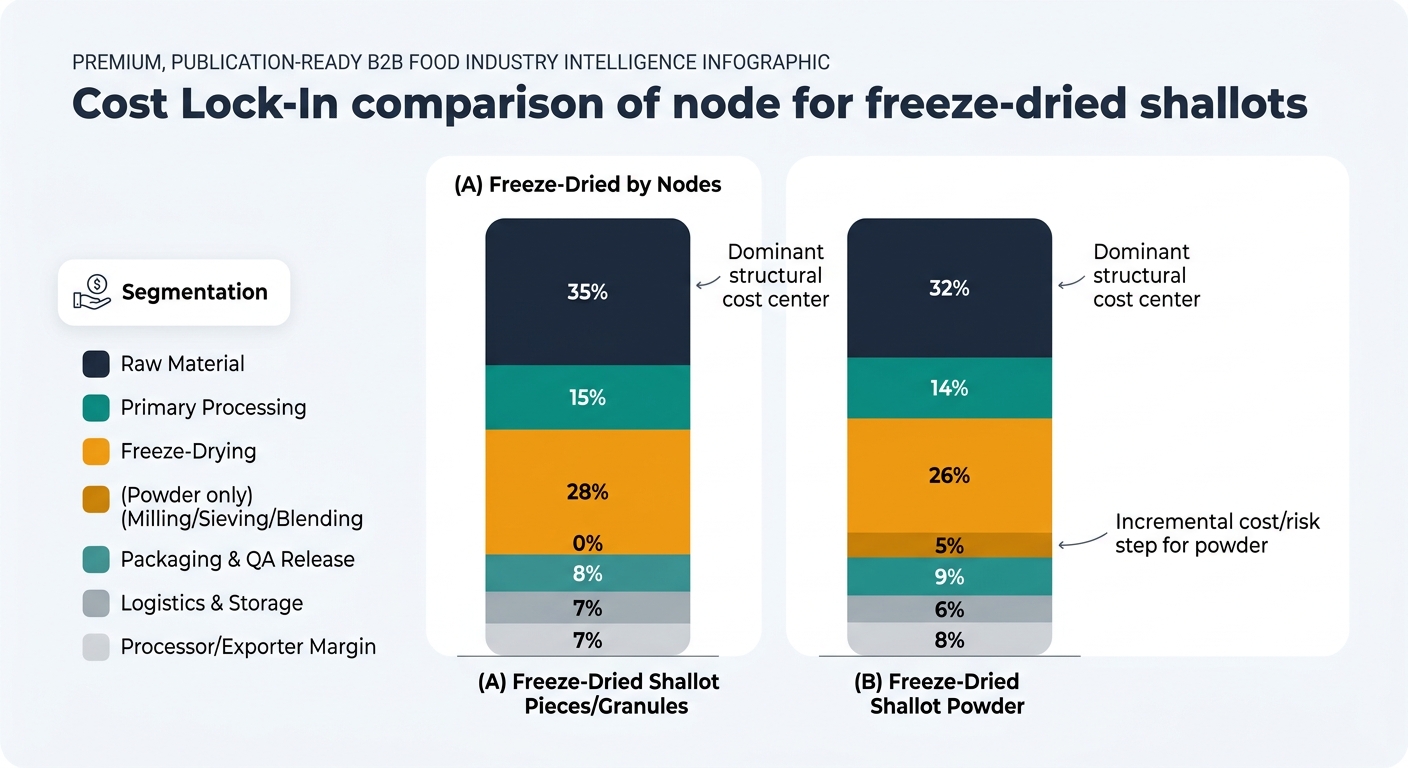
Two 100% stacked bars comparing cost ratios for freeze-dried shallot pieces/granules versus freeze-dried shallot powder, with consistent colored segments for Raw Material, Primary Processing, Freeze-Drying, Milling/Sieving/Blending (powder only), Packaging & QA Release, Logistics & Storage, and Processor/Exporter Margin; segment percentages labeled and annotations highlighting Freeze-Drying as the dominant structural cost center and Milling/Sieving/Blending as the incremental cost/risk step for powder.

A) Freeze-Dried Shallot Pieces/Granules (as a traded intermediate)

Supply Chain Node Cost Ratio (% of Final Cost) Notes
Raw Material (shallots) 18% Driven by seasonality, solids content, and sorting losses.
Primary Processing 17% Labor + sanitation + yield loss (peel/trim/slice).
Freeze-Drying 38% Dominant: energy + capex + throughput constraint.
Packaging & QA Release 10% Barrier materials + lab testing + hold time.
Logistics & Storage 7% Humidity protection is the key driver.
Processor/Exporter Margin 10% Capacity owners capture margin in tight markets.

B) Freeze-Dried Shallot Powder (milled, sieved, ready for blending)

Supply Chain Node Cost Ratio (% of Final Cost) Notes
Raw Material (shallots) 15% Similar drivers; conversion yield matters more than headline price.
Primary Processing 15% Hygiene and baseline micro load set downstream risk.
Freeze-Drying 34% Energy + uptime; sets dryness baseline.
Milling/Sieving/Blending 12% PSD control + foreign matter controls + rework risk.
Packaging & QA Release 12% Barrier packaging + COA release gating.
Logistics & Storage 6% Moisture ingress risk during ocean/warehouse.
Processor/Exporter Margin 6% Often lower than pieces if competition is higher.

C) Seasoning Blend Using Freeze-Dried Shallot Powder (downstream manufactured good)

Supply Chain Node Cost Ratio (% of Final Cost) Notes
Freeze-Dried Shallot Powder Input 8% Premium ingredient but diluted by other components.
Other Ingredients 32% Salt/spices/sugars/anti-caking agents, etc.
Blending/Processing 15% Mixing, sifting, in-process controls.
Packaging & QA 18% Pack formats, labeling, finished goods testing.
Logistics & Distribution 12% Warehousing + outbound freight.
Brand/Channel Margin 15% Trade and channel economics dominate.
Unlock Full Data
Freeze Dried Shallot Powder Market Intelligence
Prices · Trends · Origins · Forecasts

3) Structural Realities You Can’t “Spec Away”

Reality 1: Low-moisture does not mean low-risk for pathogens

  • Insight: Powders don’t support pathogen growth, but they can carry pathogens for long periods—and contamination can survive processing and storage.
  • Data: Guidance and research on low-moisture foods emphasize that Salmonella can persist in dry products/processing environments and can become more heat resistant at low water activity—meaning “dry” does not equal “safe.” [2]
  • Procurement Impact: The “safety control point” is often hygienic design + environmental control + validated lethality (if used) and not simply end-product micro testing.

Reality 2: Freeze-dryer capacity is the physical bottleneck—and it is energy-anchored

  • Insight: You can add shifts in prep and milling, but you can’t easily compress freeze-dry cycle time without changing equipment, loading, or process parameters.
  • Data: Freeze-drying’s reported energy intensity (hundreds of kWh per kg water removed) makes electricity price and reliability structural constraints on cost and throughput. [1]
  • Procurement Impact: Lead time variability often traces back to dryer availability (maintenance, power interruptions, queueing), not to “slow paperwork.”

Reality 3: Moisture pickup after drying is a one-way door for quality

  • Insight: Once porous freeze-dried material absorbs humidity, you may see caking, aroma loss, and flowability failures that are difficult to reverse without rework (and rework is itself a risk).
  • Data: Water activity measurement and control are foundational to shelf stability; once equilibrium shifts upward due to humidity exposure, returning to the original state is not a simple “dry it again” decision from a quality governance standpoint. [4]
  • Procurement Impact: Receiving issues that look like “handling damage” are often physics: packaging selection, seal integrity, and container humidity management determine whether the lot stays within spec.

Key Insights (What to Remember When You Read Any Spec Sheet)

  • Insight: Freeze-dried shallot powder is economically defined by conversion physics: yield losses in prep, energy in lyophilization, and moisture/foreign matter control in finishing.
  • Data: Freeze-drying’s energy intensity is structurally high (reported 600–1000 kWh/kg water removed), and low-moisture foods are documented as capable of harboring Salmonella despite not supporting growth. [1] [2]
  • Procurement Impact: The supplier that wins long-term is typically the one that controls (1) freeze-dryer uptime, (2) hygienic zoning and post-dry environment, and (3) barrier packaging + dry logistics discipline—because those are the nodes where cost, compliance, and customer complaints converge.

The Bottom Line for Your Next Contract

(Analyzed at: Aug, 2026)

Write the specification so it contractually binds moisture and/or water activity at pack to packaging + transit humidity controls (e.g., defined barrier liner, seal integrity expectations, and container moisture management), and require documented verification of foreign-material controls (screen integrity checks + metal detector verification). This works because the highest-probability “avoidable failures” in freeze-dried powders are post-dry moisture pickup and finishing-stage foreign matter—both are controlled more by packaging/handling discipline and validated detection systems than by end-product testing. What’s at stake is not a marginal unit price: a single caking-driven rejection or foreign-matter hold can cascade into line downtime and expedited replacement costs that often dwarf the annual savings from a small per-kg concession. [4]

Unlock Full Data
Freeze Dried Shallot Powder Market Intelligence
Prices · Trends · Origins · Forecasts

References

  1. pmc.ncbi.nlm.nih.gov
  2. pubs.ext.vt.edu
  3. pmc.ncbi.nlm.nih.gov
  4. fda.gov

Related Contents

Subscribe
→
By subscribing you agree to with our Privacy Policy and provide consent to receive updates from our company.
Thank you! Your submission has been received!
Oops! Something went wrong while submitting the form.
Subscribe to receive the latest blog posts, updates, promotions, and announcements from Tridge.
