
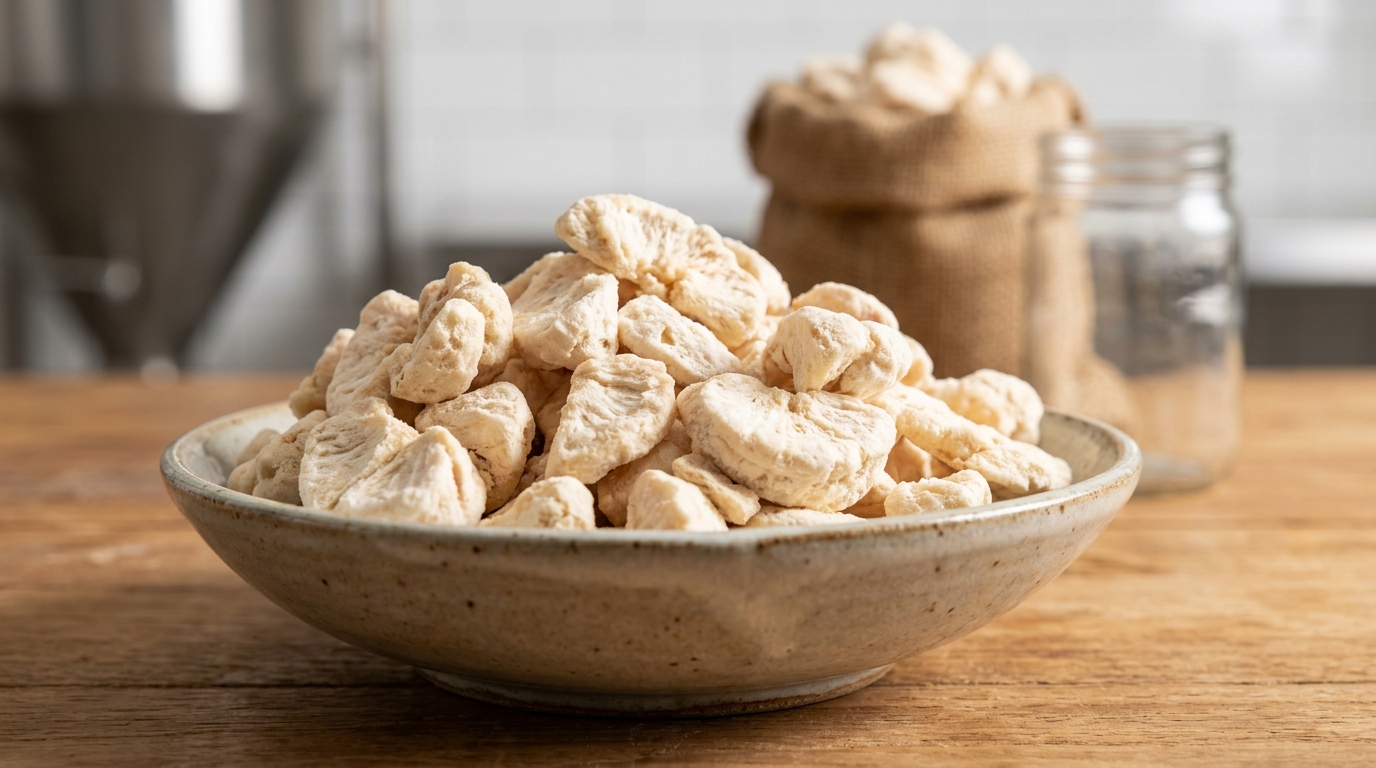
This guide maps the physical supply chain for freeze-dried mangosteen and highlights where procurement teams should expect cost, lead time, and quality risk to concentrate. The goal is to help sourcing managers compare suppliers on structural capability (yield discipline, freeze-drying throughput, and moisture-barrier execution) rather than on headline price alone.
Freeze-dried mangosteen is physically constrained by two hard realities: the fruit is seasonal and perishable, and the conversion step (peeling → freezing → freeze-drying) is energy- and time-intensive with limited scalable capacity. Most cost is not created by “handling”—it is created by yield loss (rind/seed removal), labor-heavy preparation, and long freeze-dry cycle time.
The chain is best understood as a seasonal raw-fruit spike that gets “smoothed” by frozen aril inventory, then “bottlenecked” by freeze-drying capacity and moisture-sensitive packaging.
Typical physical flow is (1) harvest and sorting of fresh fruit, (2) peeling/aril separation and sanitation, (3) freezing arils (IQF or block) to extend processing window, (4) vacuum freeze-drying, (5) sizing/milling and metal detection, (6) high-barrier packaging with moisture control, (7) ambient export with humidity-risk points at ports/warehouses.

If you don’t map where yield, energy, and humidity exposure occur, you’ll misread why two “similar” suppliers can have structurally different costs and lot-to-lot performance.
Insight: Freeze-dried mangosteen’s landed cost is dominated by conversion physics (water removal under vacuum) and preparation yield (how much edible aril becomes saleable finished product), not by downstream distribution.
Data: The highest fixed-cost drivers are (a) raw fruit selection and reject rate, (b) peeling/aril labor and trimming losses, (c) freezing + freeze-drying electricity and throughput, (d) barrier packaging that prevents moisture pickup (loss of crispness/caking).
Procurement Impact: Spec clarity (moisture/aw, micro limits, particle size, defect tolerance) is effectively a “cost setting” because it determines yield, rework, and how much packaging and QA is required.

| Supply Chain Node | Cost Ratio (% of Final Cost) | Notes |
|---|---|---|
| Raw Material Cost (fresh fruit) | 22% | Driven by seasonal intake quality and reject rate. |
| Primary Processing (peeling/aril prep) | 18% | Labor-heavy; defect tolerance drives minutes/kg. |
| Frozen Intermediate (freezing + storage) | 10% | Freezer capacity + storage duration + shrink. |
| Freeze-Drying + Sizing | 28% | Energy + throughput constraints; breakage control matters. |
| Packaging & QA | 12% | High-barrier packs; moisture/aw + micro testing. |
| Logistics & Distribution | 10% | Ambient freight but humidity risk at nodes. |
| Supply Chain Node | Cost Ratio (% of Final Cost) | Notes |
|---|---|---|
| Raw Material Cost (fresh fruit) | 18% | Input quality still matters, but powder tolerates more size variance. |
| Primary Processing (peeling/aril prep) | 16% | Foreign matter control is critical for powder. |
| Frozen Intermediate (freezing + storage) | 9% | Same buffering role; can be optimized by batch planning. |
| Freeze-Drying + Milling | 32% | Adds milling energy, dust control, and extra handling loss. |
| Packaging & QA | 15% | Higher sensitivity to moisture pickup and homogeneity; tighter sieving/metal detection. |
| Logistics & Distribution | 10% | Flowability/caking risk increases handling sensitivity. |
| Supply Chain Node | Cost Ratio (% of Final Cost) | Notes |
|---|---|---|
| Raw Material Cost (fresh fruit) | 20% | Similar to pieces; slightly more tolerance on appearance. |
| Primary Processing (peeling/aril prep) | 17% | Labor remains core driver. |
| Frozen Intermediate (freezing + storage) | 10% | Inventory bridge for continuous production. |
| Freeze-Drying + Size Classification | 29% | Classification/sieving adds yield split by size bands. |
| Packaging & QA | 12% | Barrier packaging + moisture/aw + micro. |
| Logistics & Distribution | 12% | More fines = more moisture sensitivity in transit. |
Insight: The industry’s physical workaround for seasonal harvest is frozen aril inventory; without it, production becomes a short-window scramble.
Data: Freezer space, freezing throughput, and storage discipline determine whether a processor can run freeze-dry lines steadily beyond peak harvest. Mangosteen seasonality is real in key origins (e.g., Thailand’s peak commonly falls around April–August / May–September depending on region and year). [4]
Procurement Impact: Expect more stable lot availability and tighter spec consistency from suppliers with robust frozen intermediate systems; capacity limitations show up as uneven particle size, moisture variability, and delivery gaps.
Insight: Freeze-dryers are capital-intensive and slow-cycle assets; when utilization spikes or downtime hits, you can’t “catch up” quickly.
Data: Throughput is constrained by batch cycle time, tray loading density, and vacuum/refrigeration performance; the process is energy-intensive and can run long cycles at industrial scale. [1]
Procurement Impact: When capacity is tight, the first quality failures often appear as higher residual moisture/aw and breakage—because the system is pushed for speed or overloaded.
Insight: The product’s biggest enemy is humidity, not temperature.
Data: Freeze-dried foods are commonly sealed under vacuum/inert gas and rely on high-barrier materials to keep water activity low; if barrier/seal integrity or handling discipline is weak, moisture uptake can undermine texture/flowability. [2]
Procurement Impact: Moisture/aw specs and packaging performance should be treated as structural requirements, not “nice-to-haves,” because failures create downstream rework, customer complaints, and write-offs.
(Analyzed at: Sep, 2026)
Write your contract so moisture protection is enforced as a system, not a COA line item: lock a moisture/aw acceptance window and specify the packaging barrier construction + seal verification expectations, then require evidence of in-transit humidity controls (e.g., desiccant/liner practice and documented loading SOPs). This works because, in 2026, ocean networks are broadly “adapted” to disruption but still exposed to variable transit time and port dwell—extra days are effectively extra humidity exposure time for hygroscopic powders and granules. [5]
What’s at stake is typically not pennies: one moisture-compromised container can cascade into downgraded inventory, rework, and customer claims that can easily outweigh any unit-price win you negotiated up front.


