

Freeze-dried goji berries look like a simple “country choice,” but for Strategic Planning & Analysis the real decision is which supply model best controls landed-cost volatility, spec consistency, and recovery speed when disruption hits. This briefing compares three common sourcing setups using the practical constraints that actually drive outcomes: seasonality, freeze-drying capacity, QA governance effort, and lead-time variability.
Insight: For freeze-dried goji berries, you are not just comparing “countries”—you’re choosing a supply model that determines your cost volatility, spec consistency, and how fast you can recover from disruption.
Data: Commercial goji supply is structurally China-centric (notably Ningxia and Xinjiang). Fieldwork-based value-chain research in China notes harvesting time stretching from June to October in major producing/trading centers, and local reporting in Ningxia shows harvest activity beginning mid-June in at least some areas; this creates a predictable annual buying window and a predictable annual tightness risk. [4] [1] Freeze-drying is energy- and time-intensive; published reviews cite energy consumption on the order of 600–1000 kWh per kg of water removed, far higher than conventional drying. [2]
Procurement Impact: If your category plan assumes “we can always buy more next month,” you will under-estimate both (a) capacity reservation value (freeze-dry slots) and (b) inventory coverage needs around harvest and peak export windows.
Insight: The best option depends on whether your binding constraint is unit cost, compliance confidence, lead-time stability, or switchability during a disruption.
Data: The three most common procurement “options” in practice are: (A) China direct (origin + freeze-dry + export), (B) Vietnam/SEA processing/repack corridor (often China-origin feedstock, processed or packed in SEA), (C) EU repack/re-export hub (Benelux/Central Europe) sourcing from global origins and holding inventory closer to EU customers. (This reflects how trade corridors typically form around processing capacity, packaging, QA, and inventory positioning.) EU dried-fruit traders commonly operate centralized warehousing and EU-cleared stock models that shorten replenishment cycles for buyers. [3]
Procurement Impact: You can use these options to deliberately manage your portfolio: one leg optimized for cost, one for continuity, and one for governance/compliance speed.

| Option (typical model) | Cost | Quality | Risk | Lead Time | Availability |
|---|---|---|---|---|---|
| A) China direct (Ningxia/Xinjiang → freeze-dried → export) | Low–Med | Med–High (if qualified) | Med–High | Long | High (structural) |
| B) Vietnam/SEA processing or repack corridor | Med | Med | Med | Med | Med |
| C) EU repack/re-export hub (inventory-forward) | High | High | Low–Med | Short | Med |
Insight: Freeze-dried goji cost is usually driven more by conversion economics (energy + cycle time + utilization + yield loss/breakage) than by the fruit alone—especially when demand spikes.
Data: Freeze-drying is energy intensive; published literature reports 600–1000 kWh per kg of water removed and highlights hybrid approaches that can reduce energy use (but those are not universal in commercial lines). [2] Also, goji harvesting is multi-pick and labor intensive over a long season; value-chain research in China notes harvesting from June to October across key regions, which affects grade distribution and sorting costs. [4]
Procurement Impact: Your negotiation leverage often sits in (a) capacity reservation vs spot conversion, (b) packaging spec (barrier film, nitrogen flush), and (c) breakage/fines allowances—not just “$/kg.”
Insight: Freeze-dried goji quality failures are often post-process (moisture pickup, oxidation/color shift, breakage) rather than “bad freeze-drying.”
Data: Research on Ningxia goji shows measurable differences across harvest periods; one study sampled multiple ripening/harvest points from June through September, illustrating why lots can vary even within one season. [5] Separately, value-chain research reports main production/trading centers including Ningxia and Xinjiang and a harvest window stretching June to October. [4]
Procurement Impact: You will get more consistency by tightening process-linked specs (moisture/aw at pack-out, oxygen in headspace, packaging WVTR/OTR targets, breakage handling) than by over-tightening cosmetic attributes that shrink the supplier pool.
Insight: The biggest structural risk is origin + processing concentration: China dominates commercial goji supply, and freeze-dry capacity is not infinitely elastic.
Data: Fieldwork-based value-chain analysis identifies major production/trading centers in China (including Ningxia and Xinjiang) and describes the structure of the chain and quality-control challenges across tiers. [4] Recent industry communications also continue to emphasize industrial upgrading and processing-line build-out narratives in Ningxia—directionally consistent with capacity being strategic rather than “unlimited.” [6]
Procurement Impact: Resilience comes from qualifying a second operational lane (alternate processor/exporter route), not just adding a “backup supplier” that still depends on the same constrained freeze-dry assets.
Insight: Even with ambient logistics, freeze-dried goji behaves like a fragile, humidity-sensitive product—lead time variability often shows up as quality variability.
Data: Harvest/processing seasonality (June–Oct) creates predictable export waves and inventory builds. [4] Freeze-drying’s long cycle times and high energy inputs increase the chance of allocation during demand spikes. [2]
Procurement Impact: If you buy direct from origin, assume longer and more variable lead times and mitigate with (a) packaging specs, (b) humidity controls in warehousing, and (c) safety stock rules tied to seasonality.
Insight: Scaling is limited by freeze-dry slots and grade availability (whole-berry yield), not by theoretical acreage.
Data: Industry narratives point to ongoing processing/industrial upgrading activity in Ningxia, implying capacity is improving but still a strategic constraint (and therefore allocates during surges). [6]
Procurement Impact: If your growth plan requires step-change volume, you need a capacity strategy: split awards, pre-booked production, and product-form flexibility (pieces/powder) to avoid paying “whole-berry scarcity premiums.”
Insight: Sustainability and compliance performance is primarily a function of traceability depth (farm/co-op → processor → packer) and testing discipline, not the country label alone.
Data: Value-chain work emphasizes multiple production/trading centers and the complexity of quality control across the chain. [4]
Procurement Impact: You can improve audit readiness by standardizing documentation (COA scope, residue panels, lot traceability) and by choosing supply models that match your governance bandwidth (EU hub often simplifies execution; direct origin often requires more supplier development).
Insight: A clean comparison requires separating unit price from total cost of ownership (TCO): rejects, breakage, testing, and expediting can erase a headline savings.
Data: Freeze-drying’s energy intensity (600–1000 kWh/kg water removed) makes conversion cost a major sensitivity, so regional energy and utilization differences can swing pricing. [2]
Procurement Impact: Use cost ratios and risk scores to build a portfolio award logic that finance and QA can sign off.
| Option | Landed cost index (China=100) | Typical hidden-cost exposure | Overall risk score | Notes on what usually drives variance |
|---|---|---|---|---|
| A) China direct | 100 | Medium | Medium–High | Conversion allocation + inspection delays + humidity handling |
| B) Vietnam/SEA corridor | 108–120 (+8% to +20%) | Medium | Medium | Extra handling/repack + traceability complexity |
| C) EU repack hub | 125–155 (+25% to +55%) | Low–Medium | Low–Medium | Paying for inventory positioning + governance + shorter lead time |
| Dimension | A) China direct | B) Vietnam/SEA corridor | C) EU repack hub |
|---|---|---|---|
| Supply concentration | High | Medium | Low–Medium |
| Quality consistency (out-of-box) | Medium | Medium | High |
| Lead time variability | High | Medium | Low |
| Compliance execution effort (buyer-side) | High | Medium | Low |
| Scalability (fast ramp) | Medium | Medium | Low–Medium |
Insight: The right choice depends on your penalty function: stockout cost, brand risk tolerance, and how much spec variance your formulation can absorb.
Data: Goji harvest spans months (June–Oct), and freeze-dry conversion is energy/capacity constrained—so supply tightness is seasonal and capacity-driven. [4] [2]
Procurement Impact: You can align option selection to business scenarios rather than treating all SKUs as equal.
| Your top priority | Recommended option | Why |
|---|---|---|
| Lowest landed cost | A) China direct | Structural cost advantage if you can plan and manage QA |
| Fastest replenishment | C) EU hub | Inventory-forward model reduces lead time variability |
| Reduce single point of failure | B) SEA + A) China (split) | Two operational lanes improves resilience |
| Tightest spec consistency | C) EU hub (or A with strict controls) | Better sorting/repack discipline; fewer in-transit quality shocks |
| Rapid volume ramp | A + B (dual) | Capacity reservation + alternate lane reduces allocation risk |
Insight: The highest ROI move is usually not switching origins—it’s building a two-lane supply model and contracting around the real constraints (seasonality + freeze-dry capacity).
Data: Harvest spans June–October in key China regions and freeze-drying is energy intensive (600–1000 kWh/kg water removed), making supply and price sensitive to seasonal raw material and conversion capacity economics. [4] [2]
Procurement Impact: A portfolio approach can reduce landed cost variance and stockout risk simultaneously, but only if you govern it with concentration metrics and pre-defined triggers.
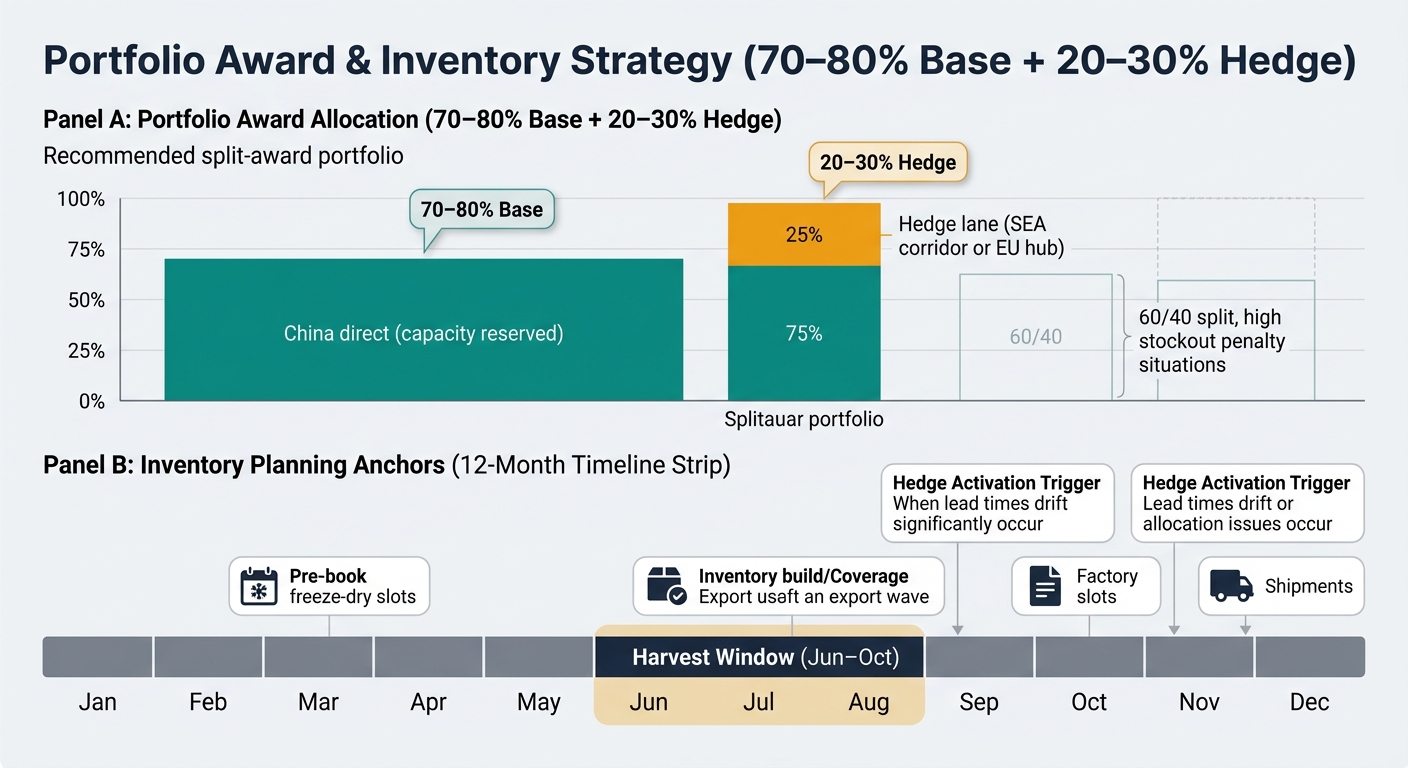
The hardest part to manage without real-time intelligence is timing: knowing when harvest quality/grade distribution is tightening, when freeze-dry capacity is being allocated, and when lead times are drifting due to inspections/logistics. Teams that can track those signals early can decide—weeks earlier—whether to (a) increase coverage, (b) shift volume to pieces/powder, or (c) activate the alternate lane before the market reprices.
(Analyzed at: Aug, 2026)
If you’re contracting for the next 6–12 months, treat Ningxia’s mid-year harvest start as your planning clock: lock your China-direct base volume early enough to reserve freeze-dry throughput, then keep a smaller “execution hedge” through a SEA lane or an EU inventory-forward partner for short-lead replenishment. Recent local reporting shows Ningxia’s harvest activity kicking off in mid-June, and published data confirms freeze-drying’s high energy intensity—exactly the two constraints that create allocation and price spikes. [1] [2] In practice, teams that don’t pre-book capacity often end up paying a double penalty—spot conversion premiums plus expediting—whereas a split award can more naturally contain that swing to a high-single-digit to low-double-digit percent range versus a reactive spot posture.


