
INDUSTRY TRENDS

Frankfurter Supply Chain Map (Ops View): Where Cost Locks In, Where Risk Breaks, and What to Contract Around

Author
Team Tridge
DATE
July 28, 2026
7 min read
frankfurter-sausage Cover
Frankfurter SausageHS 160100Beef · Cheese Filled · Chicken
Powered by Tridge Eye
🇧🇷 Brazil↑ 14.0%
$2.05/kg
🇺🇦 Ukraine↓ 3.2%
$4.05/kg
Wholesale reference prices across 142 markets

Frankfurters look simple at shelf, but the supply chain is a synchronized system: formulation/yield, validated cook + controlled cooling, and packaging + cold chain all have to work in sequence. This guide maps the physical flow and highlights where cost “locks in” and where disruptions (quality holds, downtime, short codes) actually originate—so Supply Chain & Ops teams can contract around the real constraints.

Executive Summary

  • Three hard gates drive output and service: formulation/yield, validated lethality + stabilization (cook/cool), and packaging performance under cold chain. [1]
  • Standards of identity and labeling rules constrain formulation flexibility (what you can change without triggering label/spec governance). [2]
  • Post-lethality handling + packaging is the shelf-life fault line: barrier and seal integrity issues often surface as claims/returns and QA holds, not “materials variance.”
  • 2026 context: pork production forecasts for 2H 2026 tightened after USDA inventory signals—expect procurement pressure on trim/fat availability and allocation risk during peaks. [3]
  • Cold storage is not a rounding error: refrigerated warehousing prices are measurable and trending (PPI series), so buffers and network decisions have real cost-to-serve impacts. [4]

1) How the Frankfurter Supply Chain Is Physically Built (and Where Costs “Lock In”)

Frankfurters are a high-throughput, formulation-driven cooked sausage. The physical chain is engineered to convert volatile raw proteins (lean/fat trims) into a microbiologically safe, ready-to-eat product—using tightly controlled thermal processing, rapid chilling, and high-barrier packaging. The fixed cost-drivers are not “nice-to-haves”: they’re structural requirements for lethality, stabilization (cooling control), QA release, and cold-chain integrity. FSIS guidance is widely used as scientific support for validating HACCP systems for cooking (Appendix A) and stabilization/cooling (Appendix B) of heat-treated meat and poultry products. [1]

Insight: The chain’s economics are dominated by (1) protein/fat input cost and yield, (2) plant throughput and downtime sensitivity, and (3) packaging barrier + cold chain that protect shelf life.

Data: U.S. standards of identity define frankfurters/hot dogs as comminuted cooked sausages (9 CFR 319.180), and FSIS Appendix A/B guidance is commonly used as scientific support for lethality/stabilization validation. [2]

Procurement Impact: Your “physical map” should treat meat/fat specs, casing/peel performance, smokehouse + chiller capacity, and packaging film lead times as first-order constraints—because they dictate what can be produced, how fast it can be released, and how much yield you actually ship.
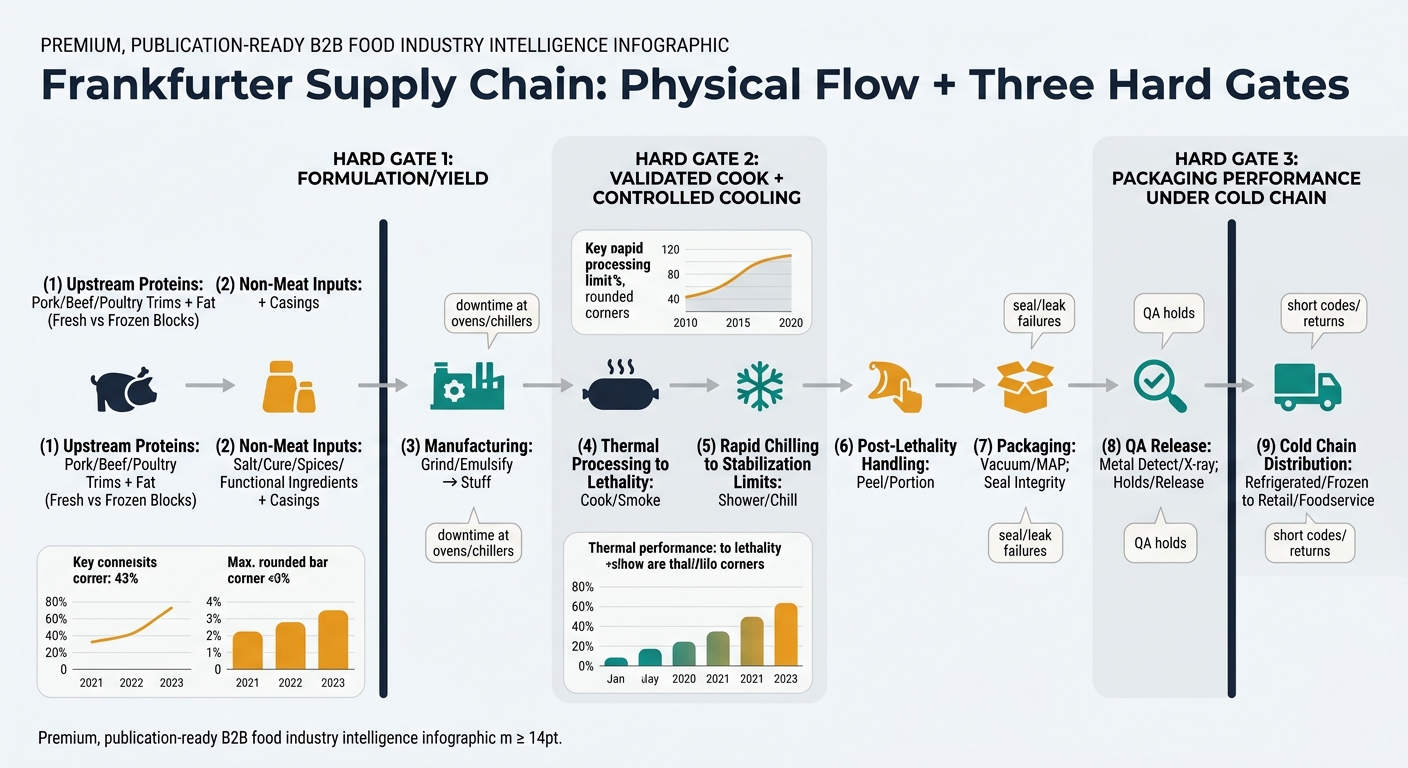
Typical physical flow (simplified)

  • Upstream proteins: pork/beef/poultry trims + fat (fresh chilled or frozen blocks)
  • Non-meat inputs: salt, cure, spices/functional ingredients; casings (cellulose/collagen/natural)
  • Manufacturing: grind/emulsify → stuff → cook/smoke to lethality → shower/chill to stabilization limits
  • Post-lethality handling: peel (skinless) → portion/pack → metal detect/X-ray → QA release
  • Distribution: refrigerated (0–4°C) or frozen (-18°C) → retail/foodservice
A left-to-right process flow diagram of the frankfurter supply chain with clearly labeled stages: (1) Upstream proteins (pork/beef/poultry trims + fat; fresh vs frozen blocks), (2) Non-meat inputs (salt/cure/spices/functional ingredients; casings), (3) Manufacturing (grind/emulsify → stuff), (4) Thermal processing to lethality (cook/smoke), (5) Rapid chilling to stabilization limits (shower/chill), (6) Post-lethality handling (peel/portion), (7) Packaging (vacuum/MAP; seal integrity), (8) QA release (metal detect/X-ray; holds/release), (9) Cold chain distribution (refrigerated/frozen) to retail/foodservice. Visually emphasize the ‘three hard gates’ as bold vertical checkpoints: Formulation/Yield, Validated Cook + Controlled Cooling, Packaging Performance Under Cold Chain. Add small callouts for common disruption points: downtime at ovens/chillers, QA holds, seal/leak failures, short codes/returns.

2) Where Cost and Margin Accumulate (Node-by-Node, Physical Reality)

Insight: Frankfurter cost is “built” by conversion efficiency: every node either protects yield (meat/fat balance, casing performance, shrink control) or protects sellable shelf life (post-lethality hygiene, packaging barrier, cold chain).

Data: High-barrier packaging performance is often discussed via oxygen transmission rate (OTR) and multilayer film structures (commonly including barrier layers such as EVOH or PVDC in some constructions) to limit oxygen ingress that accelerates oxidation and spoilage. [5]

Procurement Impact: When you evaluate “cost,” separate (a) commodity inputs, (b) conversion losses (shrink, peel loss, giveaway), and (c) fixed system costs (thermal process, chilling, QA, packaging barrier, cold chain). Those three buckets behave differently operationally.
1. Upstream / Raw Materials (Trims, Fat, and Functional Inputs)

  • Insight: The dominant physical variable is the lean/fat ratio and trim form (fresh vs frozen blocks), which drives emulsion stability, cook yield, and finished texture.
  • Data: Standards of identity for frankfurters/hot dogs are set in regulation (9 CFR 319.180), which anchors what the product is (comminuted cooked sausage) and constrains how far formulation can flex without governance. [2]
  • Procurement Impact: Raw material variability shows up downstream as yield loss (cook shrink), texture defects, and higher rework/sort—so “spec compliance” at receiving is a throughput protection mechanism, not just a QA checkbox.

2. Primary Conversion (Grinding/Emulsifying, Stuffing, and Casing Performance)

  • Insight: This node converts heterogeneous inputs into a stable batter and consistent link geometry; casing choice (cellulose vs collagen vs natural) sets peel loss risk and line speed.
  • Data: Labeling/identity constraints matter operationally: if you change meat source types or certain ingredient declarations, you can trigger label updates and customer/spec re-approval cycles (a real lead-time). 9 CFR 319.180 and FSIS hot dog/frankfurter guidance reflect these identity/labeling expectations. [2] [5]
  • Procurement Impact: Casing performance is an OEE lever: breakage, inconsistent caliber, or peel inefficiency creates micro-stoppages that cascade into missed smokehouse/chiller windows.

3. Thermal Processing + Rapid Chilling (The “Food Safety Throughput Gate”)

  • Insight: Smokehouse/oven capacity and chilling capacity are the hard gates of the system; they control both safety (lethality + stabilization) and maximum daily output.
  • Data: FSIS Appendix A (Cooking Guideline) and Appendix B (Stabilization Guideline) are accepted as scientific support for validating HACCP lethality and stabilization performance standards when properly applied. [1]
  • Procurement Impact: Any constraint here becomes “expensive fast”: overtime, schedule churn, and inventory imbalances start as minutes lost in ovens/chillers and end as missed ship windows.

4. Post-Lethality Handling + Packaging & QA Release (Shelf-Life Protection)

  • Insight: After cooking, the product is most vulnerable: post-lethality exposure, peeling/portioning, and packaging are where shelf-life is won or lost.
  • Data: FSIS consumer guidance emphasizes that hot dogs/frankfurters are cooked RTE products under standards of identity and rely on proper refrigeration for safety/quality; operationally, that translates to strict time/temperature discipline after lethality and through distribution. [5]
  • Procurement Impact: Packaging is a technical input, not a commodity: wrong barrier, seal integrity, or film stiffness can translate into oxidation, purge, seal failures, and early-code returns—costs that hit outside the plant P&L line you expect.

5. Cold Chain Logistics & Distribution (Cost-to-Serve Amplifier)

  • Insight: Refrigeration is a continuous cost and risk multiplier: every handoff adds temperature-abuse exposure and handling cost.
  • Data: FSIS consumer guidance anchors expectations for refrigerated (≤40°F / 4°C) and frozen storage (0°F / -18°C), reflecting the product’s reliance on cold chain after processing. [5]
  • Procurement Impact: The physical network (DC locations, lane length, cross-docks, cold storage availability) directly determines spoilage risk, claims, and delivered cost—especially for short-dated chilled programs.
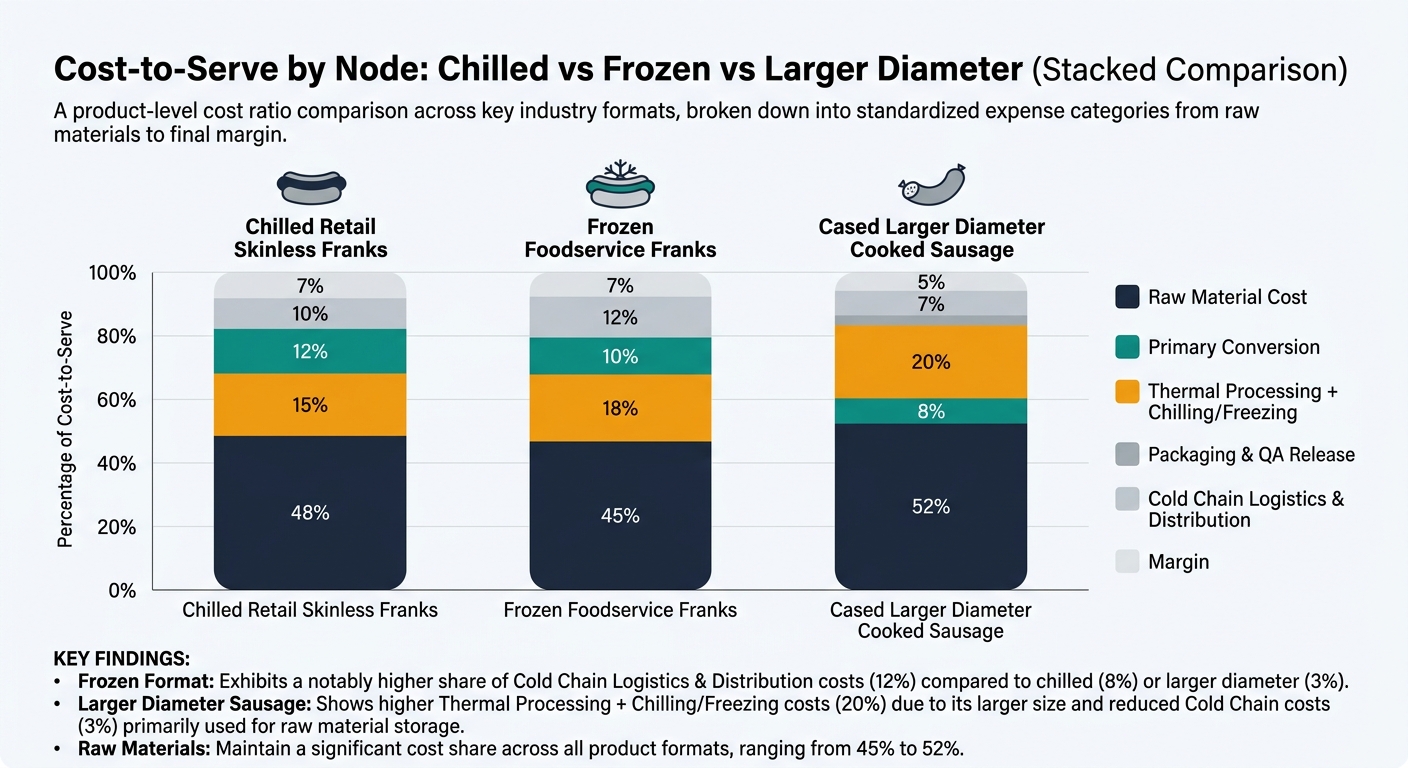
A 3-bar stacked chart comparing the product-level cost ratios for: (A) Chilled Retail Skinless Franks, (B) Frozen Foodservice Franks, (C) Cased Larger Diameter Cooked Sausage. Each bar is segmented into the same categories with consistent colors: Raw Material Cost, Primary Conversion, Thermal Processing + Chilling/Freezing, Packaging & QA Release, Cold Chain Logistics & Distribution, Margin. Use the exact percentages shown in the tables. Include a brief annotation highlighting the biggest differences across formats (e.g., higher cold-chain share in frozen; higher thermal share in larger diameter).

Product-Level Cost Breakdown

A) Chilled Retail Skinless Franks (Vacuum or MAP, high-barrier film)

Supply Chain Node Cost Ratio (% of Final Cost) Notes
Raw Material Cost (trims + fat + ingredients) 55% Protein/fat dominates; seasoning/cure is small but spec-critical.
Primary Conversion (grind/emulsify + stuffing/casing) 10% Labor + casing performance impacts speed and scrap.
Thermal Processing + Chilling 12% Smokehouse energy + chilling capacity; throughput gate.
Packaging & QA Release 10% High-barrier film, seal integrity, QA holds/testing.
Cold Chain Logistics & Distribution 8% Reefer freight + cold storage handling.
Wholesale/Retail Margin 5% Varies by channel and brand/private label model.

B) Frozen Foodservice Franks (bulk pack, longer shelf life)

Supply Chain Node Cost Ratio (% of Final Cost) Notes
Raw Material Cost 52% Similar protein dominance; formulation may differ by spec.
Primary Conversion 9% Bulk programs often optimize line speed and changeovers.
Thermal Processing + Chilling/Freezing 14% Added freezing load and freezer capacity/energy.
Packaging & QA 7% Bulk bags/cartons; still seal/label critical.
Cold Chain Logistics & Distribution 13% Frozen storage time + freezer/DC handling increases cost-to-serve.
Distributor Margin 5% Foodservice distribution economics vary by region.

C) Cased “Dinner Sausage” / Larger Diameter Cooked Sausage (sliced or chunked)

Supply Chain Node Cost Ratio (% of Final Cost) Notes
Raw Material Cost 50% Diameter/formulation affects cook profile and yield.
Primary Conversion 11% Casing type and diameter drive stuffing speed and defects.
Thermal Processing + Chilling 15% Larger diameter typically increases cook/chill time (capacity impact).
Packaging & QA 9% Often sliced/portion packed; post-lethality handling increases control needs.
Cold Chain Logistics & Distribution 10% Similar cold-chain dependency; slice formats can be more damage-prone.
Wholesale/Retail Margin 5% Channel mix dependent.
Sourcing Window Radar
Frankfurter Sausage — Global Harvest Calendar
UNITED STATES SEASON ACTIVE
🇺🇸 United St.
JAN — DEC
🇨🇷 Costa Rica
JAN — DEC
🇵🇭 Philippin.
JAN — DEC
🇷🇺 Russia
JAN — NOV
🇻🇳 Vietnam
JAN — DEC
JanFebMarAprMayJunJulAugSepOctNovDec

3) Structural Facts You Can’t “Optimize Away” (Know These Before You Model Anything)

Insight: Frankfurter supply is constrained less by “finding ingredients” and more by synchronized capacity across lethality, chilling, and packaging—because those steps are sequential and time-bound.

Data: FSIS Appendix A/B are framed as scientific support for HACCP validation of lethality and stabilization performance standards—underscoring time/temperature control as foundational, not optional. [6]

Procurement Impact: Capacity planning must treat ovens/smokehouses, chillers, and packaging lines as coupled constraints; adding a “cheap” upstream input doesn’t help if it can’t pass through these gates.

  • Insight: Post-lethality exposure is the shelf-life fault line.
  • Data: In RTE contexts, controls tied to post-lethality handling and sanitation are repeatedly emphasized by regulators and are central to preventing public health events and disruptive actions (holds, withdrawals, recalls). [5]
  • Procurement Impact: Sanitation, environmental monitoring, and hygienic design are structural cost centers that protect revenue (avoiding holds/withdrawals/returns), not discretionary overhead.
  • Insight: Packaging is a technical control system (oxygen + moisture + seal integrity), not just “materials spend.”
  • Data: Technical literature describes how vacuum/MAP relies on low oxygen environments and barrier films; OTR and multilayer structures are central to performance. [5]
  • Procurement Impact: Film spec changes can alter shelf life, purge, appearance, and code performance—creating downstream costs that are bigger than the line-item savings.

Key Insights (What to Remember When You Look at Any Frankfurter Program)

  • Insight: The chain is built around three hard gates: formulation/yield, validated cook + controlled cooling, and barrier packaging under cold chain.
  • Data: Standards of identity (9 CFR 319.180) define the product category, and FSIS Appendix A/B guidance anchors lethality/stabilization validation expectations used in practice. [2] [1]
  • Procurement Impact: The operational “cost of a disruption” is usually a throughput problem (lost oven/chiller/packaging time) plus a shelf-life problem (short codes, claims), not merely a higher input price.

Critical Risk Factors: post-lethality handling hygiene, packaging barrier/seal performance, chilling capacity, and cold-chain handoffs.

4) The Bottom Line for Your Next Contract

The most practical 2026 move is to contract packaging film and sealing performance like a process-critical control, not a “flexible materials line.” (Analyzed at: Jul, 2026) With polyethylene film markets still prone to price spikes and supply shocks, and cold-chain storage costs measurable in current price indexes, you don’t want to relearn shelf-life failures through claims and short-code write-offs. [7] [4]

Lock in a film spec + acceptance plan (OTR target, seal strength/leak testing, machinability windows, and change-control notice) and tie it to documented line performance; teams that do this typically avoid the 1–3% of sales equivalent that can quietly leak out through rework, holds, and customer credits when packaging drift hits at scale.

Frankfurter SausageSupply Chain Intelligence
142 countries tracked
10
Exporters
10
Importers
$962M
Top Export Value
Top Exporters (2024)
🇮🇹
Italy
$962M
🇺🇸
United States
$866M
🇪🇸
Spain
$729M
🇵🇱
Poland
$678M
🇩🇪
Germany
$676M
+137 more
Top Buyers
🇬🇧 United Kingdom $1.00B🇩🇪 Germany $619M🇧🇪 Belgium $372M🇨🇦 Canada $322M🇳🇱 Netherlands $315M

References

  1. fsistraining.fsis.usda.gov
  2. law.cornell.edu
  3. ers.usda.gov
  4. fred.stlouisfed.org
  5. fsis.usda.gov
  6. regulations.justia.com
  7. resintel.com

Related Contents

Subscribe
→
By subscribing you agree to with our Privacy Policy and provide consent to receive updates from our company.
Thank you! Your submission has been received!
Oops! Something went wrong while submitting the form.
Subscribe to receive the latest blog posts, updates, promotions, and announcements from Tridge.
