INDUSTRY TRENDS

Fine-Ground Pistachio Paste Supply Chain: Where Yield, Validation, and Lot Genealogy Lock In Your Cost

Author
Team Tridge
DATE
August 14, 2026
8 min read
fine-ground-pistachio-paste Cover
Unlock Full Data
Fine Ground Pistachio Paste Market Intelligence
Prices · Trends · Origins · Forecasts

Fine-ground pistachio paste looks like a simple ingredient line item, but for Purchase—Quality, Safety, and Compliance it behaves more like a “managed risk system”: once upstream yield is lost or safety/traceability evidence is weak, you rarely recover it downstream without paying in rework, holds, or lost inventory.

Executive Summary

  • Cost locks in early: hulling/drying + sorting/grading largely determine green yield, oxidation risk, and defect load—downstream steps can’t “fix” those economically.
  • Safety is a validation problem, not a testing problem: low-moisture Salmonella control depends on validated interventions and process conditions, not just end-lot COAs. [1]
  • Aflatoxin compliance is market- and product-specific: EU maximum levels explicitly cover pistachios and also apply to processed products ≥80% pistachio. [2]
  • 2026/27 tightness risk is real: multiple market sources point to a lower-supply cycle and firm premiums for bright-green kernel streams, increasing continuity and price volatility risk for paste users. [3]

1) The Physical Map: Where Pistachio Paste Cost Becomes “Fixed”

Fine-ground pistachio paste is not “one product”—it’s a chain of irreversible yield losses and quality gates. Once kernels are sorted, blanched, roasted, and milled, you can’t economically recover color, freshness, or microbiological safety with downstream fixes.

Insight: The supply chain is built around three hard constraints: (1) seasonal harvest and rapid drying, (2) defect removal and grade separation (especially “green kernel” streams), and (3) low-moisture food safety validation (pathogen control) plus mycotoxin compliance.

Data: Pistachios are a high-value tree nut with documented Salmonella risk context in low-moisture foods and established aflatoxin control frameworks (including U.S. programs and EU maximum levels that explicitly include pistachios). [1]

Procurement Impact: Most of the “landed” performance you care about (green color stability, oxidation, lot-to-lot sensory, and release readiness) is determined upstream—at hulling/drying, sorting/grading, and the kill-step/validation posture—before paste ever enters a drum.

Flowchart diagram of the pistachio paste supply chain from orchard/harvest through drying, sorting/grading, optional blanching and roasting/pasteurization, fine grinding, metal detection/sieving, packaging with liners and nitrogen/headspace control, logistics, and industrial user, with callouts for yield loss lock-in, validation evidence, and lot genealogy/traceability discipline.

Supply chain flow (typical):

Orchard/harvest → hulling & drying → shelling/sorting/grading → (optional) blanching & (optional) roasting/pasteurization → fine grinding (temperature-controlled) → metal detection/sieving → packaging (pails/drums, liners, nitrogen) → ambient/controlled logistics → industrial user (gelato, bakery, confectionery).

2) Cost & Margin Anatomy by Node (Where Each Step Adds Non-Reversible Cost)

Insight: Pistachio paste cost is dominated by kernel value and yield loss; processing adds “quality assurance cost” (sorting intensity, validation, testing, oxygen control) that scales with how tight your spec is.

Data: Low-moisture pathogen lethality is sensitive to process conditions (including product water activity/moisture and humidity/temperature profiles), which is why validated interventions and verification programs are emphasized in low-moisture guidance and industry practice. [4]

Procurement Impact: When you tighten specs (greener color, finer particle size, lower oxidation markers, stricter mycotoxins), you are mostly paying for (a) more aggressive sorting/grading, (b) more constrained processing windows and capacity, and (c) higher QA/testing intensity—not just “extra grinding.”
1. Upstream / Orchard Production & Harvest

  • Insight: The orchard node sets the ceiling for premium paste because kernel size distribution, defect rates, and baseline oxidation potential are largely determined by agronomy and harvest timing.
  • Data: Pistachio supply is seasonal and subject to strong year-to-year swings (including alternate-bearing dynamics), which is why downstream users experience periodic tightness and premium volatility. [5]
  • Procurement Impact: Expect the biggest “hidden cost” here to show up later as: lower green-grade yield, higher sorting loss, more aflatoxin screening failures, and more sensory drift (especially when lots are carried longer in storage).

2. Hulling, Drying & Raw Storage (First Quality Gate)

  • Insight: This node is where quality is either stabilized fast—or degradation becomes baked in. Moisture control is the foundation for both mycotoxin risk management and storage stability.
  • Data: EU contaminant rules and related enforcement pressure make aflatoxin control a practical market-access requirement for pistachios and high-pistachio-content processed products. [2]
  • Procurement Impact: Even if paste is later produced in a different facility/country, the “risk signature” of the lot (moisture history, storage dwell time, segregation discipline) is created here and drives the intensity of later testing and sorting.

3. Shelling, Optical Sorting, and Grade Separation (Where Yield Loss Becomes Permanent)

  • Insight: Sorting/grading is the economic engine of pistachio paste. Premium paste is effectively “made” by what you remove: defects, discolored kernels, foreign material, and non-target color fractions.
  • Data: While exact yield splits vary by origin/season and each processor’s grade program, the market reality is consistent: “bright green” kernel streams are constrained because they are a fraction created by sorting economics, not a guaranteed output of farming.
  • Procurement Impact: The tighter your color and defect tolerances, the more you are buying a constrained fraction of the crop. This node also drives traceability complexity (multiple reblends, regrades, and rework loops that must remain lot-controlled).

4. Blanching and/or Roasting/Pasteurization (Safety + Sensory Trade Space)

  • Insight: For many industrial uses, you’re balancing two competing objectives: validated pathogen reduction and preservation of green color/fresh flavor. Thermal history is a one-way door.
  • Data: FDA’s pistachio-focused guidance underscores the practical issue for buyers: if the pistachio-derived ingredient is not processed to ensure adequate Salmonella reduction, the finished-product process may or may not deliver that reduction depending on matrix and handling—so control must be designed, not assumed. [1]
  • Procurement Impact: If your finished product has no kill step, this node’s validation evidence (process authority, surrogate studies, verification approach) is a structural cost driver. It also explains why some suppliers price differently for “raw-style” vs “roasted” paste: they’re managing different safety and oxidation pathways.

5. Fine Grinding & Paste Standardization (Heat Management is the Real Cost)

  • Insight: “Fine-ground” is less about milling and more about controlling temperature, oxygen pickup, and particle-size distribution while keeping oil separation behavior within spec.
  • Data: In low-moisture, high-fat matrices, frictional heat and oxygen exposure accelerate oxidation; processors typically manage via staged grinding, cooling, inerting/headspace control, and residence-time discipline.
  • Procurement Impact: Very fine particle specs and tight color targets increase processing time, energy, and scrap/rework risk (e.g., off-color reblends). This node also determines whether your paste behaves consistently in downstream mixing (viscosity, pumpability, and phase separation).

6. QA, Testing, and Packaging (Release Readiness is a Cost Center)

  • Insight: For pistachio paste, packaging is part of the “process,” not an afterthought—because oxygen/light exposure directly drives rancidity and browning.
  • Data: EU Regulation 2023/915 sets maximum levels for certain contaminants (including aflatoxins) and explicitly includes pistachios; it also states that for processed products consisting at least 80% of the relevant tree nuts, the same maximum levels apply. [2]
  • Procurement Impact: Expect cost to scale with: (1) testing scope (mycotoxins + micro + oxidation markers), (2) packaging barrier performance (liners, headspace control), and (3) documentation workload (traceability statements, allergen declarations, lot coding discipline).
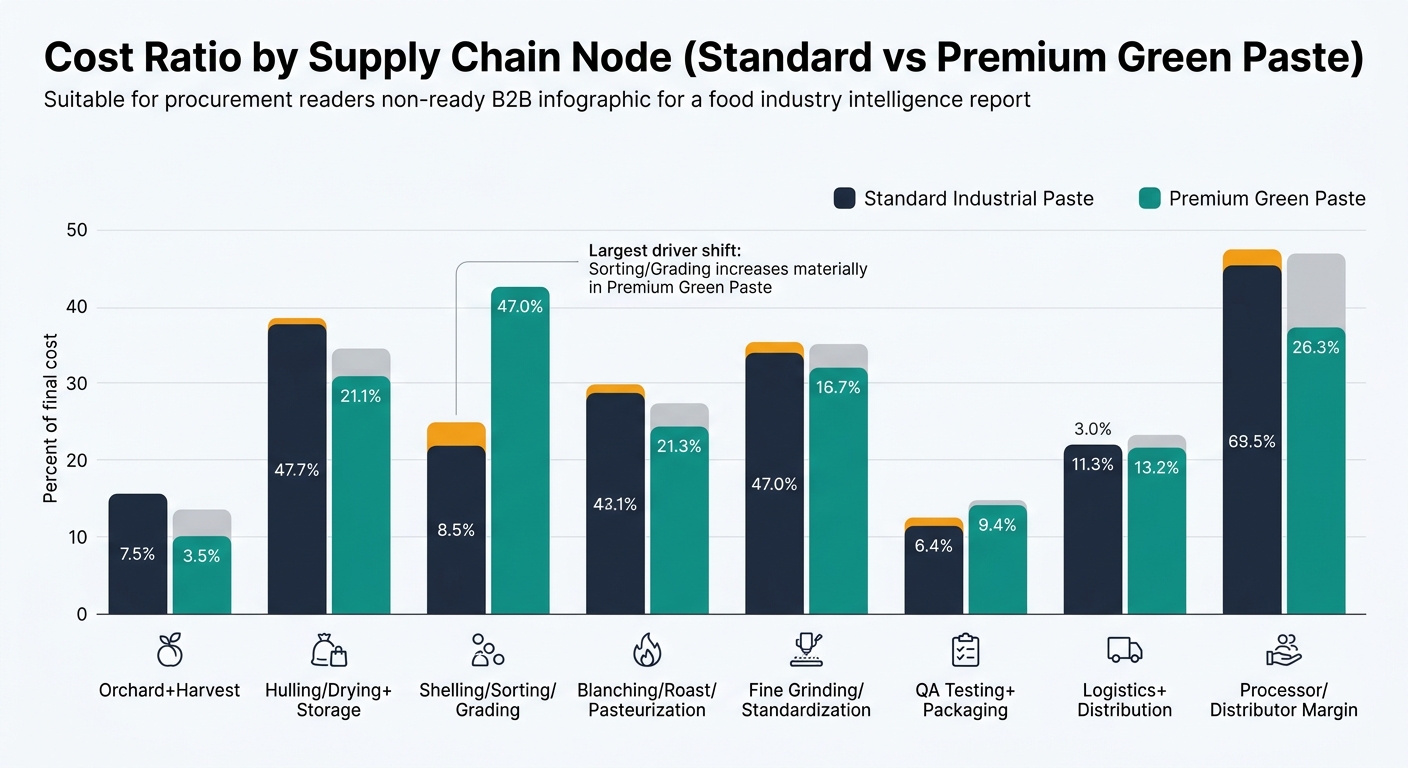
Grouped bar chart comparing cost ratio (%) by supply chain node for Standard Industrial Pistachio Paste versus Premium Green Paste, highlighting the material increase in Shelling/Sorting/Grading share for the premium product.

Product-Level Cost Breakdown

A) Standard Industrial Pistachio Paste (100% pistachio, ambient logistics)

Supply Chain Node Cost Ratio (% of Final Cost) Notes
Orchard + Harvest 25% Agronomy + harvest operations embedded into kernel cost.
Hulling/Drying + Storage 8% Energy + handling; moisture control reduces later losses.
Shelling/Sorting/Grading 22% Optical sorting, defect removal, grade separation; yield loss is monetized here.
Blanching/Roast/Pasteurization 7% Depends on whether a validated lethality step is applied.
Fine Grinding/Standardization 10% Energy + cooling/inerting + rework risk for particle size targets.
QA Testing + Packaging 12% COAs, mycotoxin/micro/oxidation testing, liners/drums, metal detection.
Logistics & Distribution 6% Heat exposure protection and insurance can matter seasonally.
Processor/Distributor Margin 10% Working capital on high-value inventory + service level.

B) Premium “Green” Paste (gelato/pastry grade, tighter color + oxidation control)

Supply Chain Node Cost Ratio (% of Final Cost) Notes
Orchard + Harvest 22% Same farm base, but premium fraction depends on defect/color distribution.
Hulling/Drying + Storage 7% Faster stabilization to protect color and freshness.
Shelling/Sorting/Grading 30% Higher reject/diversion rates to hold green intensity; constrained supply stream.
Blanching/Roast/Pasteurization 6% Often optimized to protect color; validation still required where applied.
Fine Grinding/Standardization 11% More temperature control and tighter PSD targets.
QA Testing + Packaging 14% More frequent oxidation monitoring and higher barrier packaging expectations.
Logistics & Distribution 5% More sensitivity to hot transit; sometimes insulated/controlled shipping.
Processor/Distributor Margin 5% Margin often compressed by competition but offset by higher working capital.

C) Sweetened/Compound Pistachio Paste (with sugar and/or added fat)

Supply Chain Node Cost Ratio (% of Final Cost) Notes
Pistachio Kernel Supply (embedded upstream) 45% Nut fraction drives most cost; grade may be lower than “green paste.”
Secondary Ingredient Inputs 18% Sugar, added fats/oils, emulsifiers (spec-dependent).
Processing (mixing + refining) 10% Refining time/energy to texture; heat management still matters.
QA Testing + Packaging 12% Allergen + composition + micro verification; packaging similar to paste.
Logistics & Distribution 5% Often more stable than pure paste but still heat sensitive.
Manufacturer/Distributor Margin 10% Formulation IP and service level are value drivers.
Unlock Full Data
Fine Ground Pistachio Paste Market Intelligence
Prices · Trends · Origins · Forecasts

3) Structural Realities Every Buyer Inherits (Whether You Like Them or Not)

Insight: Pistachio paste is structurally constrained by (1) seasonal raw material windows, (2) grade scarcity created by sorting economics, and (3) low-moisture food safety validation requirements.

Data: FDA and academic work on pistachios and Salmonella highlights that contamination can persist in low-moisture environments and that control relies on preventive programs and validated interventions rather than assuming low water activity is “safe by default.” [1]

Procurement Impact: These realities explain why suppliers with strong validation evidence, disciplined lot segregation, and high-end sorting capacity become “structurally sticky” in approved-supplier lists—because replacing them is not just a commercial swap; it’s a physical capability swap.

  • Reality 1 — Grade scarcity is manufactured by sorting, not farming alone. Premium green paste depends on how much of the crop can survive defect/color removal; this creates a hard capacity ceiling at the sorting node.
  • Reality 2 — Thermal history is a one-way door. Roast/pasteurization decisions lock in flavor and color outcomes while also anchoring the safety case; you cannot “test your way out” of weak validation.
  • Reality 3 — Compliance is market-specific and lot-specific. EU maximum levels apply to pistachios and (where relevant) processed products ≥80% pistachio, which can force additional holds, testing, or diversion—physically translating into longer lead time and higher working capital tied up in inventory. [2]

Key Insights (What to Remember When You Look at Any Supplier)

Insight: The pistachio paste supply chain is a yield-and-validation system: sorting intensity determines how much “premium” material exists, and validated pathogen/mycotoxin controls determine whether that material can ship.

Data: FDA’s pistachio-derived ingredient guidance and EU contaminant limits together explain why suppliers invest heavily in preventive controls, validated processes, and lot-by-lot documentation discipline—because market access and customer release depend on it. [1] [2]

Procurement Impact: When you see cost differences between suppliers, first map them to physical drivers: (1) grade yield at sorting, (2) kill-step/validation posture, (3) oxidation control in grinding and packaging, and (4) lot hold/release time driven by testing scope.

The Bottom Line for Your Next Contract

(Analyzed at: Aug, 2026)

With multiple sources pointing to a tighter 2026/27 supply balance and sustained premiums for bright-green kernels, your highest-ROI contract move is to buy “release discipline,” not just volume: lock in (a) explicit lot genealogy rules (no undocumented reblends/rework), (b) validated Salmonella control evidence for the specific paste form you receive, and (c) EU-aligned aflatoxin compliance language that covers high-pistachio-content processed products where applicable.

This works because sorting scarcity and validation/hold time are the two nodes that actually constrain shipment readiness. When those fail, teams routinely widen holds and lose usable inventory—turning a seemingly small spec exception into a mid-single-digit to low-double-digit effective cost increase per usable kg through retesting, downtime, and write-offs. [3]

Unlock Full Data
Fine Ground Pistachio Paste Market Intelligence
Prices · Trends · Origins · Forecasts

References

  1. fda.gov
  2. eur-lex.europa.eu
  3. freshplaza.com
  4. ucfoodsafety.ucdavis.edu
  5. apps.fas.usda.gov

Related Contents

Subscribe
→
By subscribing you agree to with our Privacy Policy and provide consent to receive updates from our company.
Thank you! Your submission has been received!
Oops! Something went wrong while submitting the form.
Subscribe to receive the latest blog posts, updates, promotions, and announcements from Tridge.
