
INDUSTRY TRENDS

Dual-Sourcing Spicy Falafel Mix: A Practical Playbook to Add Resilience Without Losing Spec Control

Author
Team Tridge
DATE
October 6, 2026
9 min read
spicy-falafel-mix Cover
Unlock Full Data
Spicy Falafel Mix Market Intelligence
Prices · Trends · Origins · Forecasts

This guide is written for procurement and sourcing managers who know strategic sourcing well, but don’t live in the day-to-day mechanics of spicy falafel mix. The goal is simple: dual-source in a way that actually works in a disruption—without creating brand drift, food safety exposure, or packaging chaos.

Executive Summary

  • Price “stickiness” is real: finished-mix pricing often lags input moves because suppliers price to inventory cycles, QA holds, and packaging commitments—not spot markets.
  • Low-moisture safety is a real constraint: spices are a known Salmonella risk in low-moisture foods, and treatment/validation capacity can become a bottleneck [1].
  • Dual-source by segment: start with bulk/foodservice formats (lowest switching friction), then expand to retail once packaging and label governance is ready.
  • Backups must be pre-qualified: “paper alternates” fail when allergen controls, micro programs, and packaging lead times aren’t validated.
  • What good looks like: faster time-to-switch (weeks, not quarters) and fewer expedite events—often worth more than a small unit-price win.

1) The Price Signals You’re Missing (and the Buying Windows They Create)

Insight: Spicy falafel mix prices often stay “sticky” even when chickpea and spice inputs move fast—because your supplier’s price is driven by inventory timing, pathogen-control program requirements (common in spices/low-moisture foods), and packaging commitments more than by today’s spot markets. Spices are a recognized risk area for pathogens (notably Salmonella) and filth, and control measures can materially affect lead time and cost [1].

Data (directionally realistic patterns): The most common disconnect patterns procurement teams see in dry mixes look like this:

  • Input down, finished mix flat: Chickpea base costs can soften over a quarter, but finished mix quotes don’t budge for 1–2 quarters because suppliers are still consuming higher-cost inventory and have pre-booked packaging runs (printed retail film/cartons) that lock conversion cost.
  • Input flat, finished mix up: A supplier pushes an increase during “flat” commodity conditions because their pathogen-control/treatment program tightens (treatment slots, extra micro holds, higher reject risk) or because lead times extend and they price in expediting. (This is consistent with the reality that low-moisture foods can carry Salmonella risk even without supporting growth, driving preventive controls and validation work.) [2]
  • Input up, finished mix up more: A spice basket increase can translate into a larger finished mix increase when the supplier is covering higher QA/testing frequency, longer quarantine/hold times, and higher working capital tied up in compliant inventory.

Procurement Impact: You can beat the “index” by negotiating around the lag—not arguing about today’s spot price.
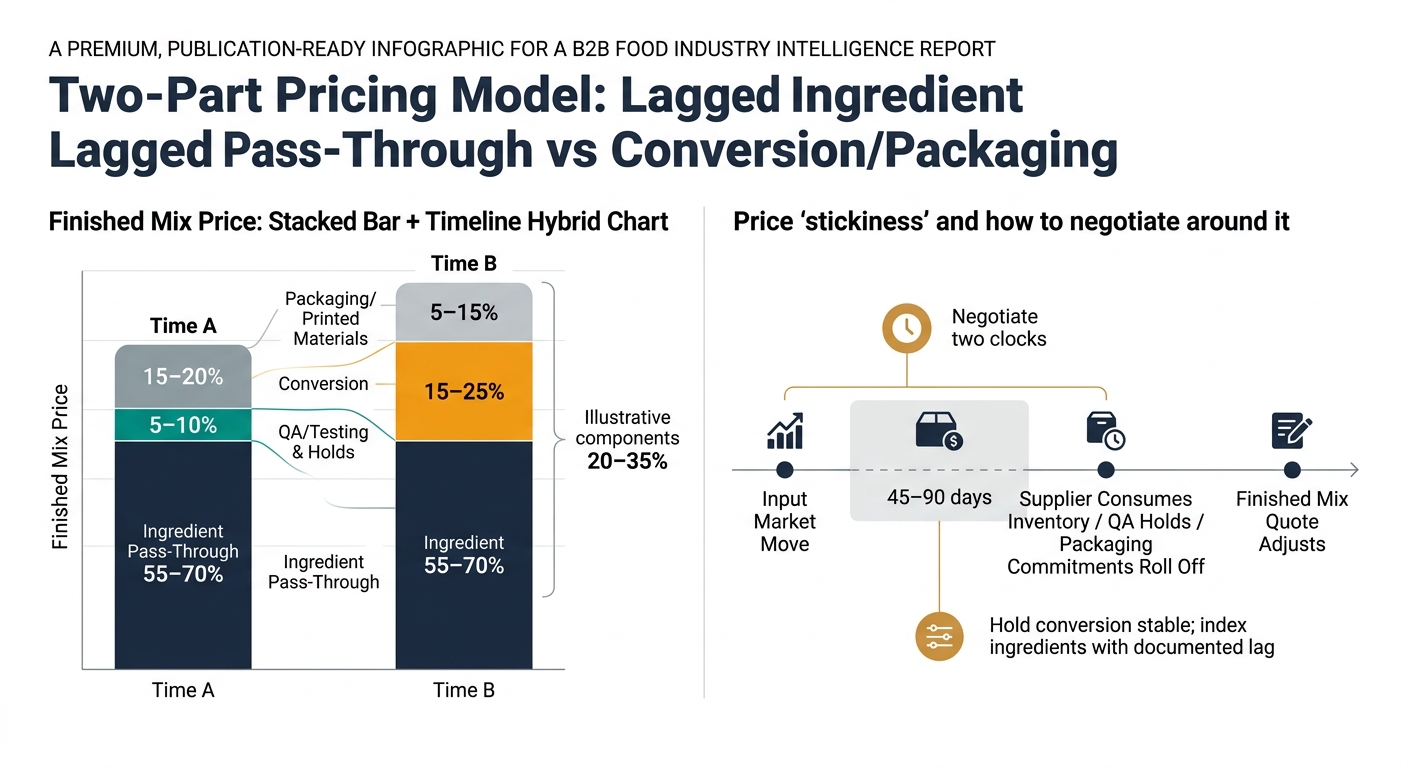
  • Quick Win: Split your negotiation into two clocks:
  • Ingredient pass-through with a documented lag (e.g., 45–90 days, aligned to your supplier’s buy-and-consume cycle), and
  • Conversion/packaging as a separately negotiated, more stable component.
  • When you force that separation, you reduce the chance you’re paying conversion margin disguised as commodity inflation.
Stacked bar and timeline hybrid chart explaining a two-part pricing model for spicy falafel mix: lagged ingredient pass-through versus conversion/QA and packaging, showing price stickiness and a 45–90 day lag window between input market moves and finished mix quote adjustments.

Insight: The biggest leverage window appears when suppliers cite “spice risk” broadly, but your product spec doesn’t actually require the highest-cost compliance pathway for every spice input.

Data (how this shows up in practice): Suppliers often apply a single conservative risk posture across the whole blend:

  • Uniform treatment assumption: They price as if all spices must be treated to control pathogens, even though your finished product may have a downstream kill step (or, in other cases, may not). Industry guidance recognizes different hazard-control responsibilities depending on whether further processing will control the hazard, and disclosure/assurance concepts exist in this area [3].
  • One-size micro hold time: They build longer quarantine time into pricing even when historical lot performance supports a risk-tiered approach—if QA agrees and validation/verification is sound.

Procurement Impact: You don’t need to relax food safety standards to lower cost—you need to align the spec to risk tiers and validate equivalency.

  • Quick Win: Ask for two quotes: (A) current program, (B) risk-tiered program (same finished product acceptance criteria, but differentiated treatment/testing by ingredient risk). Even a 1–2% reduction on conversion/QA load matters in a category where frequent buys compound small increases.

Insight: Dual-sourcing fails most often because procurement treats “falafel mix” as a single SKU, when it’s really a portfolio of risk profiles (heat level, allergen exposure, packaging format, and customer channel).

Data: Teams that succeed typically dual-source by segment:
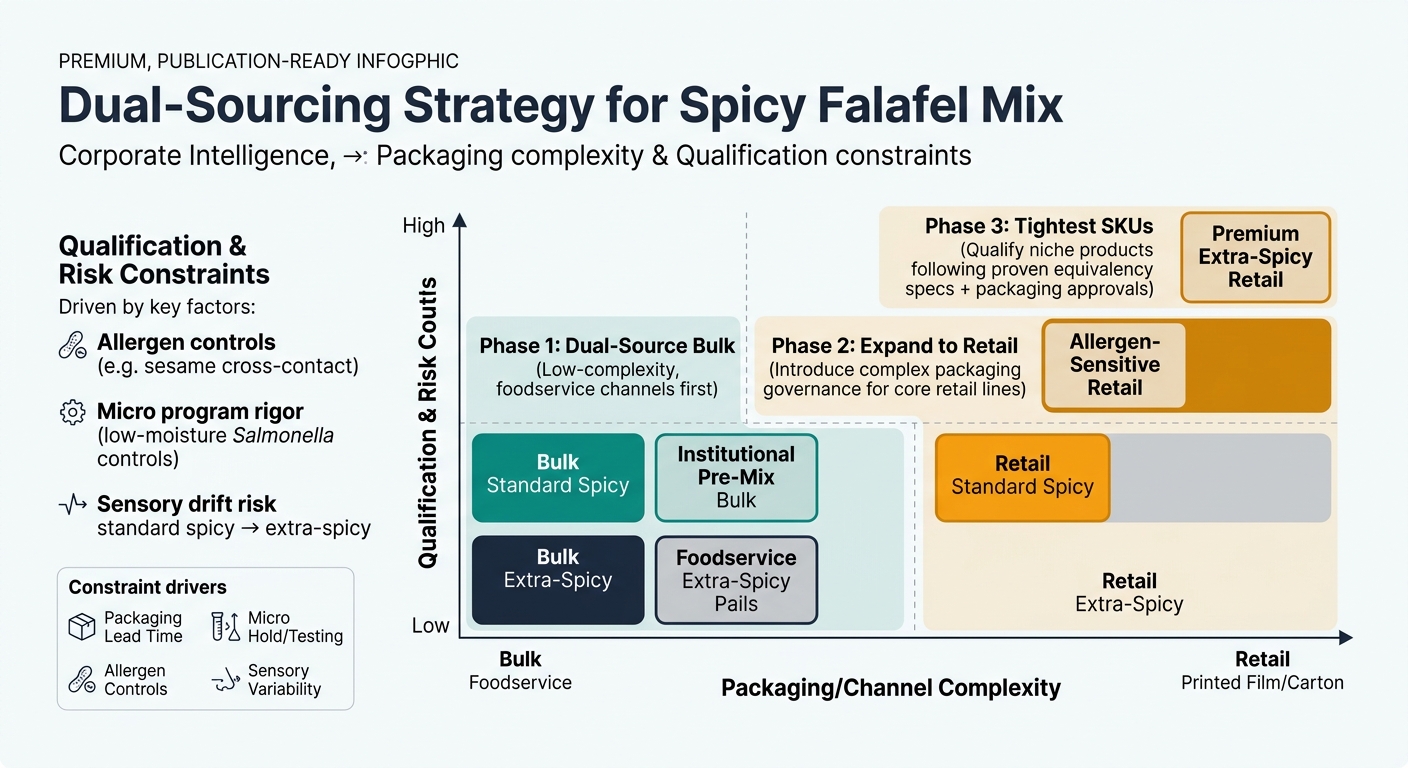
  • Foodservice bulk vs retail private label: Retail packs create packaging lead-time lock-in; bulk bags are faster to switch.
  • Standard spicy vs extra-spicy: Higher chili/paprika load increases variability and the chance of sensory drift.
  • Allergen-sensitive programs: Sesame cross-contact controls (and sometimes wheat/gluten depending on binder choices) can eliminate otherwise capable alternates.
2D segmentation matrix for dual-sourcing spicy falafel mix by segment. X-axis shows packaging/channel complexity from bulk foodservice to retail printed film/carton; Y-axis shows qualification and risk constraints from low to high driven by allergen controls, low-moisture Salmonella micro program rigor, and sensory drift risk. Includes labeled segment boxes and a phased rollout overlay: Phase 1 dual-source bulk, Phase 2 expand to retail once packaging governance is ready, Phase 3 address tightest SKUs after equivalency spec and packaging approvals, with a legend for constraint drivers.

Procurement Impact: Segmenting the award lets you dual-source where switching is cheapest and fastest, while keeping the most constrained SKUs on a tighter governance path.

  • Quick Win: Start dual-source with bulk format (lowest switching friction), then expand to retail once packaging and label governance is ready.

2) The Three Mistakes That Make Falafel Mix Sourcing More Expensive (and Riskier)

Mistake #1: Treating a Supplier “Backup” as a Spreadsheet Entry

  • What happens: Procurement names an alternate blender, but no one validates whether they can actually run your allergen controls, packaging format, and micro program at your required lead time.
  • Why it fails: In a disruption, your “backup” becomes an 8–16 week qualification project (samples, line trials, label approvals, packaging sourcing), so you still expedite or accept shortages.
  • The hidden cost: Teams often pay meaningful premium freight/expedite and absorb service penalties because the alternate was never pre-qualified for the exact format (retail vs bulk) and compliance pathway.

Mistake #2: Negotiating Only the Blend Price Instead of the Constraint

  • What happens: The supplier says “spices are up” and procurement pushes for a concession on the finished mix.
  • Why it fails: The supplier’s real constraint is frequently treatment capacity, QA hold time, or packaging scheduling. Price pressure alone just shifts risk back to you through longer lead times, substitutions, or less responsive service.
  • The hidden cost: You may “win” on paper, then lose it in missed promotions, fill-rate erosion, or quality claims tied to rushed production.

Mistake #3: Switching Suppliers Without Locking Sensory Guardrails

  • What happens: Procurement approves a second source based on price and certifications, but the spec is too broad on spice profile and heat perception.
  • Why it fails: Spices have natural potency variation; two compliant suppliers can deliver materially different consumer perception. The business then blames the new supplier and reverts—after paying switching costs.
  • The hidden cost: A small shift in perceived heat can trigger higher complaint rates, returns, or lost velocity—costs that don’t show up in procurement savings reports.
Unlock Full Data
Spicy Falafel Mix Market Intelligence
Prices · Trends · Origins · Forecasts

3) What Changes When You Run This Category Like an Intelligence Problem

Insight: The performance gap comes from maintaining an always-ready alternate set and tying risk signals to pre-approved actions—not from doing bigger RFPs.

Data (practical before/after, representative—not a guaranteed outcome): A realistic before/after for a mid-size North American buyer managing spicy falafel mix across retail + foodservice:

Before (traditional approach)

  • Sourcing: 1 incumbent blender + 1 “paper alternate” not fully qualified
  • Benchmarking: Annual RFP; limited comparables for conversion/QA adders
  • Risk assessment: Supplier reputation + last audit date
  • Result: Periodic disruptions; weeks of expedite/partial shipments; landed cost variance often driven by freight, overtime, and packaging workarounds

After (intelligence-driven approach)

  • Sourcing: 2 approved suppliers per segment (bulk first), alternates pre-mapped by region/certifications/capability constraints
  • Monitoring: Monthly signals tied to origins, ports, and recall/regulatory events; triggers for pre-buy or volume shift
  • Governance: Documented equivalency ranges for sensory + QA; switching playbook with pre-approved packaging options
  • Result: Faster time-to-switch (often weeks vs. a full re-qualification cycle), fewer expedite events, and reduced concentration risk

Procurement Impact: Your measurable win is not “lowest unit price”—it’s fewer surprise costs and a faster response curve when something breaks.

4) Three High-Probability Scenarios (and the Playbook That Works)

Scenario 1: Your incumbent announces a mid-contract increase “due to spices”

  • Insight: This is often a conversion/QA capacity issue presented as commodity inflation.
  • Data: Ask for a line-item split: spice basket pass-through vs conversion, QA/testing, and packaging. Request evidence of timing (when inputs were purchased) and whether the program assumes universal treatment.
  • Procurement Impact: Counter with a 60–90 day bridge: accept a documented pass-through on defined inputs, but hold conversion flat and add a reopen clause when the lagged index rolls off.

Scenario 2: A disruption hits (port delays, recall noise, or capacity outage) and service levels slip

  • Insight: The fastest recovery comes from switching format, not just switching supplier.
  • Data: Bulk bags can often be reallocated faster than retail packs because printed packaging is the gating item. Also, port transit delays do fluctuate and can worsen unexpectedly, so pre-approved format substitutions reduce reaction time [4].
  • Procurement Impact: Shift volume first to the alternate for bulk, then backfill retail once packaging catches up—reducing stockout probability without forcing a rushed retail repack.

Scenario 3: You need to dual-source but QA is worried about inconsistency

  • Insight: The spec is usually the problem, not the second supplier.
  • Data: Write a dual-source “equivalency spec” that defines acceptable sensory variance bands and critical-to-quality markers, then require retained samples and periodic cross-supplier sensory panels.
  • Procurement Impact: You get resilience without brand drift—and you avoid the common failure mode where the business abandons dual-source after the first perceived taste change.

5) How This Same Approach Protects Your Other Dry Categories

Insight: Spicy falafel mix behaves like other low-moisture, high-variability blends where compliance and conversion constraints create pricing lags.

Data: Similar disconnects show up in:

  • Seasoning blends: Treatment/QA capacity becomes the real bottleneck, not the spice spot price.
  • Breading/batter mixes: Packaging and changeover scheduling drive conversion cost stickiness.
  • Dry soup bases: Ingredient volatility shows up with a lag because suppliers price to inventory cycles and QA holds.

Procurement Impact: If you build a repeatable dual-source + risk-trigger playbook here, you can replicate it across adjacent dry-mix categories with minimal incremental effort.

6) Why This Falafel Mix Example Should Change How You Govern the Category

Insight: This category punishes “price-only” sourcing because the cost of failure is asymmetric: a small unit-price win can be wiped out by one continuity event, one quality drift episode, or one packaging bottleneck.

Data: The recurring pattern is that disruptions and price shocks don’t announce themselves at the finished-goods level first—they show up as upstream constraint signals (capacity, compliance, logistics) that procurement can monitor and translate into earlier actions. Spices are also a known fraud/adulteration risk category, which reinforces the need for disciplined supplier approval and verification (not just price shopping) [5].

Procurement Impact: The compelling proof point isn’t that intelligence finds cheaper suppliers—it’s that it makes dual-sourcing executable with governance: documented equivalency, pre-qualified alternates, and clear triggers for when to shift volume.

7) The Bottom Line for Your Next Move

Insight: Use the market’s built-in lag to your advantage by negotiating a dual-source award that starts with bulk formats and includes a time-lagged input pass-through mechanism.

Data: When chickpea/spice inputs move, finished mix pricing typically adjusts later because suppliers are consuming prior inventory and managing QA/packaging constraints; that lag creates a predictable window to lock conversion terms and force transparency on what’s truly changing.

Procurement Impact: Teams that structure the award this way usually reduce time-to-switch from months to weeks and avoid the “false savings” trap where a small unit-price win is erased by expedite, service failures, or sensory drift.

Key Insights

  • Lag is your leverage: Finished spicy falafel mix pricing often reflects prior inventory and packaging/QA constraints, not today’s input markets—separate pass-through from conversion to capture the lag.
  • Dual-source by segment, not SKU list: Start with bulk formats (lowest switching friction), then extend to retail once packaging governance is ready.
  • Don’t buy a backup—build one: Alternates must be pre-qualified for allergen controls, packaging formats, and the micro program you actually run.
  • Spec discipline prevents reversion: Define equivalency bands for sensory outcomes so the business doesn’t abandon dual-source after normal spice potency variation.
  • Risk monitoring must trigger actions: Tie upstream signals to pre-approved moves (pre-buy, volume shift, format shift) so you’re acting early, not reacting late.

The Bottom Line for Your Next Contract

Analyzed at: Oct, 2026

The most defensible move right now is to award dual-source by segment (bulk first) and hard-wire a two-part pricing model: lagged ingredient pass-through plus a fixed/transparent conversion-and-packaging adder. This works because today’s biggest “surprises” in this category are rarely chickpeas alone—they’re treatment/QA capacity and logistics variability in a low-moisture spice-containing supply chain where Salmonella controls are non-negotiable [1]. If you don’t separate those cost clocks, a single disruption can quickly turn a small unit-price win into a six-figure hit across expedite freight, packaging workarounds, and service penalties over a peak demand window.

Unlock Full Data
Spicy Falafel Mix Market Intelligence
Prices · Trends · Origins · Forecasts

References

  1. fda.gov
  2. foodprotection.org
  3. astaspice.org
  4. descartes.com
  5. astaspice.org

Related Contents

Subscribe
→
By subscribing you agree to with our Privacy Policy and provide consent to receive updates from our company.
Thank you! Your submission has been received!
Oops! Something went wrong while submitting the form.
Subscribe to receive the latest blog posts, updates, promotions, and announcements from Tridge.
