
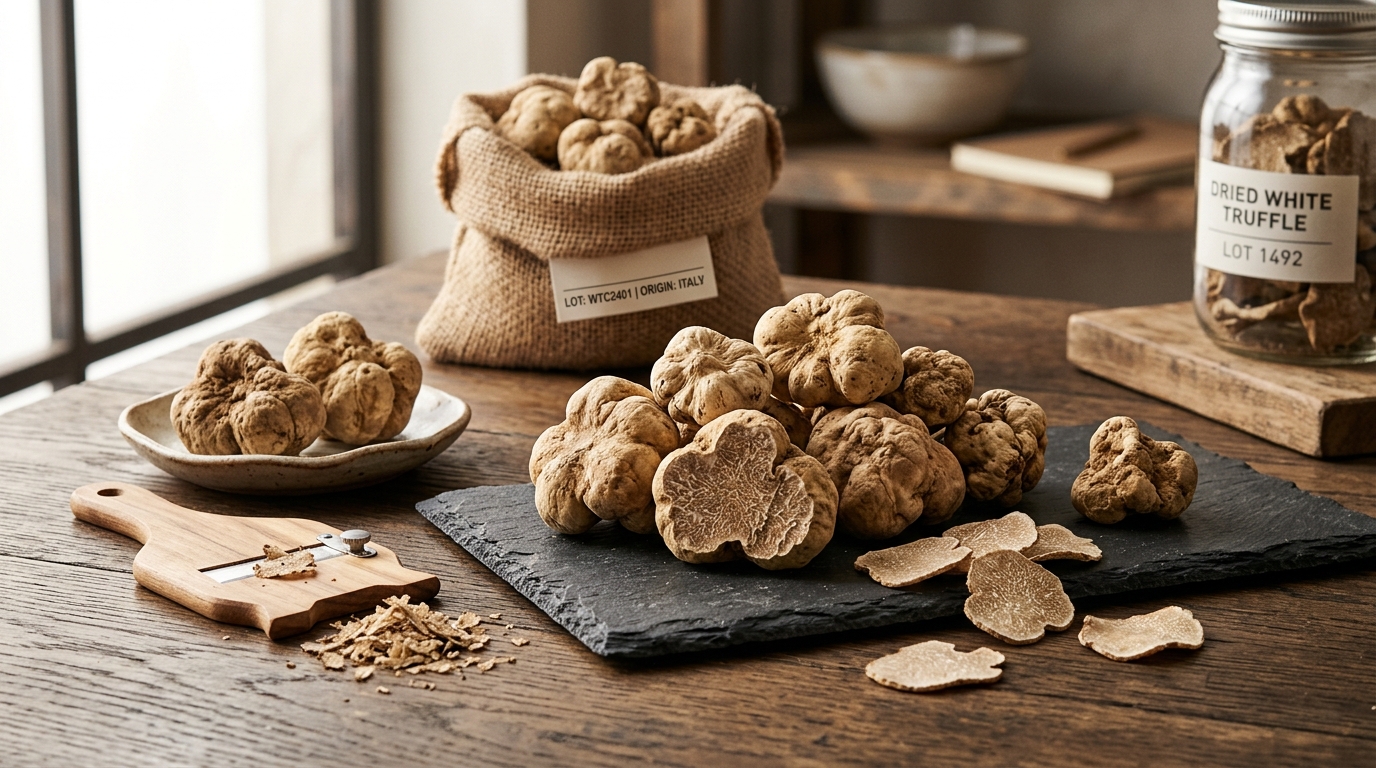
This guide maps the physical dried white truffle supply chain the way procurement leadership needs to see it: where cost and risk “lock in,” which specs actually control outcomes, and which nodes create avoidable variance. It’s written for sourcing teams who are strong operators in other food categories but need a defensible mental model for truffle’s seasonality, authenticity exposure, and conversion economics.
Dried white truffle is physically constrained by three realities: wild harvest (limited and seasonal), rapid post-harvest grading (quality dispersion), and aroma preservation (processing + packaging). Most downstream cost is “locked in” upstream because the usable input for drying is determined by freshness, maturity, defects, and trim loss—before any dehydration step happens.
Insight: Dried formats are not a separate commodity—they are a conversion of a short-season, high-variance raw material into a shelf-stable ingredient where aroma retention is the binding constraint.
Data (validated/nuanced): White truffle (Tuber magnatum Pico) harvest is regulated region-by-region in Italy; many calendars show an open season starting October 1, with end dates that can vary (often late December through January depending on region and year). For example, official regional acts include seasons such as Oct 1–Dec 31 in some regions and Oct 1–Jan (mid/late) in others. [2]
Procurement Impact: The physical chain concentrates risk and cost in a short window (harvest + early aggregation), while the value is realized later through drying, packaging, and distribution—making traceability, lot integrity, and moisture/oxygen control the non-negotiable technical levers.
Ground-truth flow (typical):

Insight: In dried white truffle, the biggest structural cost drivers are (1) upstream scarcity and defect-driven yield loss, (2) dehydration energy/capex and aroma losses, and (3) packaging that prevents oxidation and moisture pickup.
Data (corrected to avoid over-claiming on species): Multiple peer-reviewed studies (often on Tuber melanosporum and other Tuber spp.) show freeze-drying is among the best-performing methods for retaining key aroma-associated volatiles compared with other processing treatments; hot-air drying can retain some key compounds but typically with more sensory drift. This is directionally applicable to procurement decisions for dried truffle ingredients, but you should still validate by supplier method + finished sensory performance for your application. [3]
Procurement Impact: Even when the purchase spec says “dried truffle,” the true delivered value is driven by conversion yield + aroma retention + barrier packaging performance—so cost should be understood node-by-node, not as a single unit price.
Fixed cost drivers (what you can’t engineer away):
Fixed cost drivers:
Fixed cost drivers:
Fixed cost drivers:
Fixed cost drivers:

| Supply Chain Node | Cost Ratio (% of Final Cost) | Notes |
|---|---|---|
| Raw Material Cost (fresh truffle input) | 55% | Scarcity + grade dispersion dominate; usable yield is set here. |
| Primary Processing | 12% | Cleaning/trim + sorting; highest impact on slice-grade yield. |
| Secondary Processing (dehydration) | 15% | Freeze-dry/vacuum/air method drives cost and aroma retention. |
| Packaging & QA | 8% | High-barrier packs; moisture/aw control and sensory release. |
| Logistics & Distribution | 10% | Ambient shipping but quality-sensitive; distributor layers add margin. |
| Supply Chain Node | Cost Ratio (% of Final Cost) | Notes |
|---|---|---|
| Raw Material Cost | 45% | Often uses smaller pieces/trim; still constrained by seasonality. |
| Primary Processing | 10% | Sorting and rework routing matter more than aesthetics. |
| Secondary Processing | 18% | Size reduction + dehydration cycle time; more rework pathways. |
| Packaging & QA | 10% | Moisture pickup risk rises with surface area; tighter packaging control. |
| Logistics & Distribution | 17% | More industrial channels; distribution and repacking can add margin. |
| Supply Chain Node | Cost Ratio (% of Final Cost) | Notes |
|---|---|---|
| Raw Material Cost | 35% | Powder can absorb off-spec/breakage; lower aesthetic constraints. |
| Primary Processing | 8% | Routing of trim/breakage; foreign matter controls remain critical. |
| Secondary Processing | 22% | Milling + dehydration endpoint; heat management to protect volatiles. |
| Packaging & QA | 12% | Highest oxidation risk due to surface area; barrier + desiccant critical. |
| Logistics & Distribution | 23% | Often repacked/blended; more channel layers and handling steps. |
Insight: White truffle supply is structurally anchored to regulated harvest windows; drying only shifts shelf life, not availability of raw input.
Data (validated/nuanced): Many Italian calendars start Tuber magnatum on October 1, but end dates vary by region/year (e.g., Dec 31 in some regions; January extensions exist). Treat any single “Italy-wide” end date as a simplification and verify by origin region in your supplier’s chain-of-custody. [2]
Procurement Impact: Any dried supply program inherits this seasonality: inventories are built off-season, and the chain’s highest variability (quality dispersion) concentrates in a few months.
Insight: Once key volatiles are lost during dehydration or storage, they can’t be recovered by downstream handling.
Data: Sensory/olfactometric work shows freeze-drying—and to a lesser extent hot-air drying—can retain key aroma compounds more effectively than many other treatments, but outcomes depend on process parameters and storage/packaging. [3]
Procurement Impact: Physical process choices (drying method, endpoint, packaging barrier) are as determinative as raw material grade for finished performance in applications.
Insight: As particle size decreases, oxidation and moisture pickup risk increases because surface area increases.
Data (tightened): Processing research consistently links volatile loss and aroma changes to treatment intensity and storage exposure; finer particles generally equilibrate faster with ambient humidity if packaging integrity is imperfect. [4]
Procurement Impact: Powder formats structurally require stricter barrier packaging discipline and tighter storage controls to maintain sensory consistency lot-to-lot.
(Analyzed at: Oct, 2026)
In today’s market—where reported Italian benchmarks for fresh white truffle are again commonly cited in the ~€3,000–€4,000/kg range with meaningful spikes by size/quality—your biggest controllable lever is not “beating the market,” it’s preventing conversion and authenticity losses from showing up as downstream rejections. [1] Make your next contract explicitly pay for verified performance: require (i) declared drying method and packaging format, (ii) lot-level moisture/aw evidence plus packaging specs (oxygen/moisture barrier), and (iii) a practical authenticity/labeling safeguard (e.g., clear species/origin documentation and disclosure of any added flavourings). [6] The teams that don’t do this typically end up paying an invisible premium—often double-digit percentages in write-offs, reformulation work, or emergency spot buys—because aroma fade and misrepresentation aren’t fixable after receipt.


