
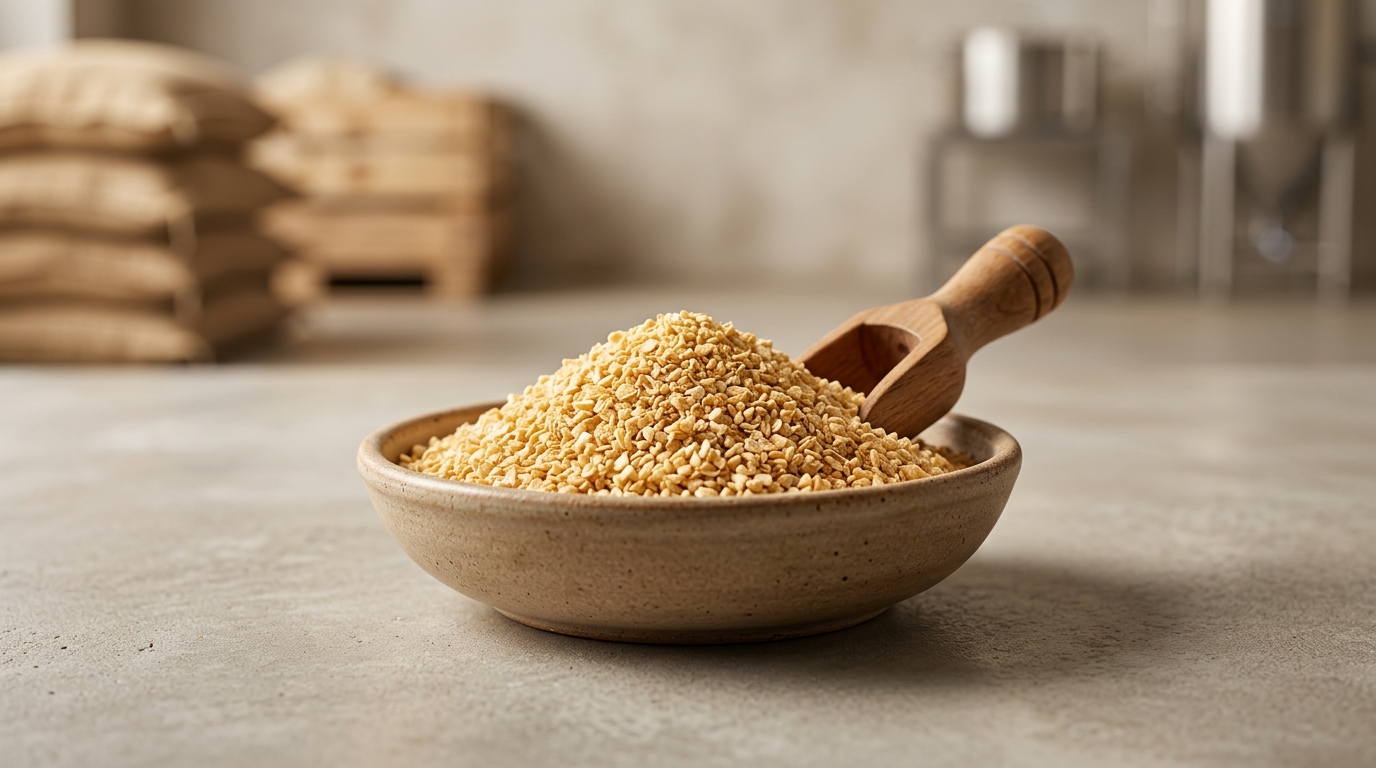
Dried garlic granules behave less like a “spice” and more like a dehydrated agricultural intermediate: cost, availability, and performance are set by crop/storage yield, dehydration energy and capacity, and the controls that keep a low‑moisture product safe and free‑flowing. This guide maps the physical chain and highlights where procurement can (and cannot) influence outcomes.
Dried-garlic-granules are not a “spice” in the casual sense—they’re a dehydrated, milled agricultural intermediate whose cost and availability are structurally set by (1) raw garlic crop + storage behavior, (2) dehydration energy and yield loss, and (3) post-dry controls that keep a low-moisture product safe, free-flowing, and on spec.
Physical flow (typical): Fresh bulbs → curing/storage → peeling/slicing → hot-air dehydration to low moisture → milling/granulation + sieving to mesh → foreign-matter controls → optional microbial reduction (steam/irradiation/EtO depending on market and buyer policy) → bulk moisture-barrier packaging (often 20–25 kg with liners) → ocean container → importer/distributor warehousing → repack/blend → manufacturer use. [4]

Insight: In dried garlic, “value add” is less about transformation complexity and more about controlling variability—yield, particle size distribution, and microbiological risk in a low-moisture environment.

| Supply Chain Node | Cost Ratio (% of Final Cost) | Notes |
|---|---|---|
| Raw Material (bulbs + curing/storage losses) | 35% | Crop quality and storage shrink drive usable solids. |
| Primary Processing (peel/slice/dehydrate) | 30% | Energy + yield loss are dominant structural drivers. |
| Secondary Processing (granulate/sieve/metal detect) | 10% | Mesh control creates rework and off-spec fractions. |
| Food Safety Treatment + QA | 8% | Treatment capacity + testing + documentation. |
| Packaging + Warehousing | 7% | Liners, bags/cartons, humidity control. |
| Logistics + Import Handling | 10% | Inland freight + ocean + clearance/handling. |
| Supply Chain Node | Cost Ratio (% of Final Cost) | Notes |
|---|---|---|
| Raw Material | 33% | Larger particle products still depend on crop solids. |
| Primary Processing | 28% | Same drying physics; slightly different milling energy. |
| Secondary Processing | 14% | Coarser cuts can require different screens; yield of target fraction varies. |
| Food Safety Treatment + QA | 8% | Often identical requirement set to other granules. |
| Packaging + Warehousing | 7% | Coarser particles still cake if moisture barrier fails. |
| Logistics + Import Handling | 10% | Similar freight/handling profile. |
| Supply Chain Node | Cost Ratio (% of Final Cost) | Notes |
|---|---|---|
| Raw Material | 32% | Same upstream dependence. |
| Primary Processing | 28% | Drying remains the cost engine. |
| Secondary Processing (fine milling) | 16% | Finer milling increases heat/oxidation risk and dust control needs. |
| Food Safety Treatment + QA | 8% | Same low-moisture pathogen logic; post-treatment hygiene critical. |
| Packaging + Warehousing | 8% | Higher caking risk; stronger moisture barrier often used. |
| Logistics + Import Handling | 8% | Similar, but powder damage/claims can rise with humidity exposure. |
(Analyzed at: Sep, 2026)
Lock your next dried-garlic-granules contract around two auditable gates—(1) moisture + packaging integrity at ship, and (2) micro-treatment method/documentation aligned to your market (steam/irradiation/EtO policy)—because those are the two nodes where “usable supply” most often breaks, not the headline price. FDA’s spice risk profile keeps pathogen control squarely in scope for buyers, while ongoing EtO regulatory pressure and border scrutiny make treatment declarations and residue governance a live commercial risk in 2026. [2] If you enforce liner specs, COA moisture limits (typically ≤6–6.5%), and treatment traceability up front, teams usually avoid the quiet 2–5% landed-cost bleed from clumping claims, extra sifting, and line disruptions—cost that never shows up in your supplier’s quote. [1]


