
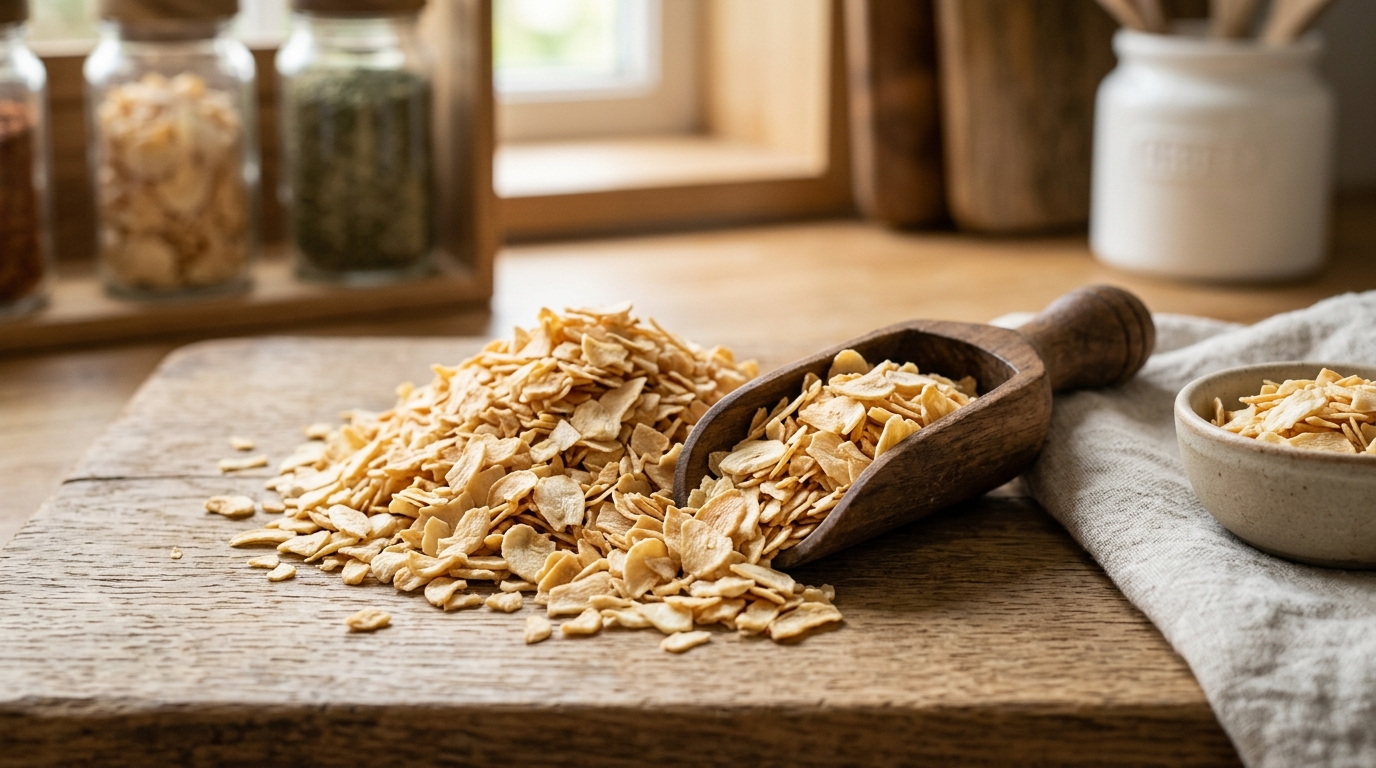
You can buy dried garlic flakes on price, but you manage them on physics: water removal, moisture re-absorption, and post-process contamination control. This map is written for Purchase—Quality, Safety, and Compliance teams who need to approve/monitor suppliers with audit-ready logic, even if dried garlic isn’t your home category.
Dried garlic flakes are a low-moisture spice ingredient built on a simple physical truth: you are buying garlic solids plus the cost of removing water, then protecting those solids from moisture pickup all the way to your plant. The chain is structurally constrained by (1) fresh-garlic harvest and storage quality, (2) peeling/slicing capacity, and (3) dehydration energy and throughput.
Insight: The supply chain is a mass-reduction system—most inbound weight is water, and the “real” product value is the retained solids and volatile flavor after dehydration.
Data (validated): Buyer-facing specs for dehydrated garlic flakes commonly call out ~6% max moisture (often 6.0–6.7% depending on grade and supplier). [1]
Procurement Impact: The fixed cost-drivers are not negotiable “soft costs”—they are physical: raw solids content, peeling yield loss, dryer energy, and packaging moisture barrier. If any one node is weak (e.g., humid logistics, weak sorting), the outcome shows up as caking, foreign material, or micro failures downstream.
Physical flow (typical):

Insight: Cost builds fastest where the process is (a) yield-destructive (peeling/trim), (b) energy-intensive (drying), and (c) quality-gating (sorting, detection, packaging).
Data (validated): Garlic products are highly hygroscopic; classic research shows garlic powder picks up moisture even at low RH and identifies a caking “critical point” around ~10.6% moisture (powder). While flakes behave differently than powder, the directionality is the same: moisture drift drives flowability failure. [2]
Procurement Impact: The “value-add” margin tends to sit in processing + QA gates (because that’s where defects are removed and specs are achieved), while your biggest hidden cost exposure sits in post-process moisture pickup and foreign material escapes.

| Supply Chain Node | Cost Ratio (% of Final Cost) | Notes |
|---|---|---|
| Upstream raw garlic (farm + storage shrink embedded) | 25% | Solids content and defect rate drive usable yield. |
| Primary processing (peel/slice/sort) | 18% | Yield loss + labor/capex for peeling and defect removal. |
| Secondary processing (dehydration + finish dry) | 22% | Energy + throughput constraints; moisture target achievement. |
| Post-process controls (sieving, metal detection, sorting/blending) | 8% | Cut-size spec and physical hazard reduction. |
| Packaging & QA release | 10% | Moisture barrier materials + testing/COA. |
| Logistics & distribution | 7% | Ambient freight; humidity mitigation and handling matter. |
| Importer/processor margin & overhead | 10% | Working capital, shrink, quality holds, admin. |
| Supply Chain Node | Cost Ratio (% of Final Cost) | Notes |
|---|---|---|
| Upstream raw garlic | 23% | Similar farm driver, sometimes tighter defect tolerance. |
| Primary processing | 18% | Same yield loss dynamics. |
| Secondary processing (drying) | 20% | Similar energy intensity. |
| Post-process controls (granulation, tighter sieving) | 12% | Narrower PSD targets increase screening losses/rework. |
| Packaging & QA release | 10% | Moisture barrier still critical. |
| Logistics & distribution | 7% | Humidity exposure still key. |
| Importer/processor margin & overhead | 10% | Higher spec management burden. |
| Supply Chain Node | Cost Ratio (% of Final Cost) | Notes |
|---|---|---|
| Upstream raw garlic | 22% | Solids and defect management still foundational. |
| Primary processing | 17% | Peeling/defect removal. |
| Secondary processing (drying) | 19% | Energy and moisture target. |
| Post-process controls (milling + sieving + metal detection) | 15% | Milling wear, heat management, tighter contamination control. |
| Packaging & QA release | 12% | Powder is more caking-prone; barrier requirements rise. |
| Logistics & distribution | 5% | Often more protected packs, but still humidity sensitive. |
| Importer/processor margin & overhead | 10% | Higher complaint risk and hold rates if moisture drifts. |
Insight: A few constants shape dried garlic flakes quality and availability regardless of supplier: yield destruction, pathogen risk in low-moisture foods when moisture is introduced in facilities, and moisture pickup after drying.
Data (validated): FDA’s spice risk profile discusses how sanitation and moisture management in low-moisture facilities matter because water can enable persistence/growth niches and cross-contamination risk (e.g., Salmonella), particularly in post-treatment areas. [3]
Procurement Impact: Your physical map should assume that risk concentrates at (a) post-lethality handling and (b) any humidity exposure point—not just at the farm.
(Analyzed at: Sep, 2026)
Lock in one contract-level control that prevents the most expensive, most common failure: require (1) ≤6.0% moisture at pack, (2) a defined moisture-barrier packaging system (inner liner spec + seal integrity expectation), and (3) shipment evidence that humidity was managed in transit (at minimum: container inspection + liner confirmation; ideally: a simple humidity indicator or logger on higher-risk lanes). This works because garlic products are demonstrably hygroscopic and caking risk accelerates as moisture drifts upward, creating re-sieving, line stoppages, and customer complaints that routinely outweigh small unit-price wins. [2] In current conditions, landed cost volatility for dehydrated garlic has been amplified by logistics and trade-cost pressure, so preventing a single caked container or hold can easily erase the “cheap supplier” savings for a quarter. [8]


