INDUSTRY TRENDS

Dried Coriander Leaf (Cilantro) Sourcing Guide: Turning Cost, Quality, and Compliance Signals into Better Buying Decisions

Author
Team Tridge
DATE
April 19, 2026
9 min read
dried-coriander-leaf Cover
Tridge Eye Data Intelligence Solution

This report is powered by Tridge Eye Data Intelligence.

Every data point, price signal, and supply risk insight in this analysis comes from the same platform that procurement and sourcing leaders worldwide rely on daily. As you read, consider what this level of market intelligence could do for your sourcing decisions.

Explore Tridge Eye →

This guide is written for Procurement & Sourcing Management teams who are strong buyers in other ingredient categories but want a practical, decision-led view of dried coriander leaf (dried cilantro) sourcing. The goal is to help you connect what’s happening upstream (agriculture + dehydration) to what you experience downstream (quote volatility, spec failures, micro/residue holds, and emergency switching). It also shows where procurement intelligence changes the decision—supplier strategy, contracting, and risk posture—without pretending it replaces QA testing, audits, or regulatory counsel.

Executive Summary

  • This is a dehydration supply chain, not a “commodity spice” chain. Drying and post-dry handling largely determine color, aroma, dust/fines, and foreign matter—and they also shape microbial risk.
  • Low moisture ≠ low risk. FDA materials on spice safety emphasize Salmonella as a key hazard and the role of FSMA-era preventive controls in the spice/herb supply chain. [1]
  • EU compliance can behave like a separate product. Ethylene oxide (EtO) scrutiny and residue definitions (EtO + 2-chloroethanol) have driven repeated disruptions in herbs/spices; EU MRLs for the relevant residue definition are commonly referenced at 0.1 mg/kg for the herbs/spices group. [2]
  • Your price and your risk don’t always move together. Crop tightness can raise price while quality falls (heat stress), while compliance events can remove supply even when farm economics are unchanged.
  • The cost tables in the original draft are directionally plausible but not “verifiable facts.” Treat them as illustrative allocation logic for where cost concentrates (drying energy/capacity; spec-driven yield loss; QA/testing; logistics/humidity), not as industry benchmarks.

Key Insights

(Analyzed at: Apr, 2026)

  • Strategy: Hold
  • Reliability: Medium
  • Potential Saving: 4% ~ 9%
  • Insight: For April (pre-peak summer risk), the best near-term value is usually not a pure “buy more volume” move—it’s a risk-priced renegotiation + dual-source activation. Lock 60–90 days of cover with the incumbent (to avoid forced spot buys if heat/logistics tighten), but immediately run a competitive benchmark for an alternate that matches your cut size + micro approach (including kill-step stance) and use that benchmark to reset conversion/packer margin and freight adders. This typically yields mid-single-digit savings while materially reducing disruption exposure (the bigger financial lever in dried herbs is avoiding holds/expedites and line downtime).

1) What You’re Actually Buying: The Ground Truth Supply Chain

Dried coriander leaf (often sold as coriander leaf flakes; sometimes labeled as dried cilantro in North America) is not a “spice” supply chain in the way coriander seed is. It is a dehydration supply chain built around converting a highly perishable green leaf into a shelf-stable ingredient.
Reality check that matters for procurement

  • Fresh leaf quality determines most of your downstream outcome (color, aroma, dust/fines, and even micro risk). Once the leaf is over-mature, heat-stressed, or poorly handled, no amount of downstream cleaning will fully restore it.
  • The most fragile value attributes are:
  • Green color retention (chlorophyll degradation accelerates with heat, poor drying control, and oxygen exposure)
  • Aroma/volatiles (lost with aggressive heat or long drying)
  • Particle integrity (flakes vs. fines; fines drive dust, blend segregation, and customer complaints)
  • Food safety risk is structurally higher than many buyers assume for “dry” ingredients:
  • Pathogens can survive in low-moisture foods and still cause illness when the ingredient is used without a kill step downstream.
  • FDA’s spice safety materials and risk-profile work highlight Salmonella as a central hazard and reinforce preventive controls expectations under FSMA for relevant facilities. [1]

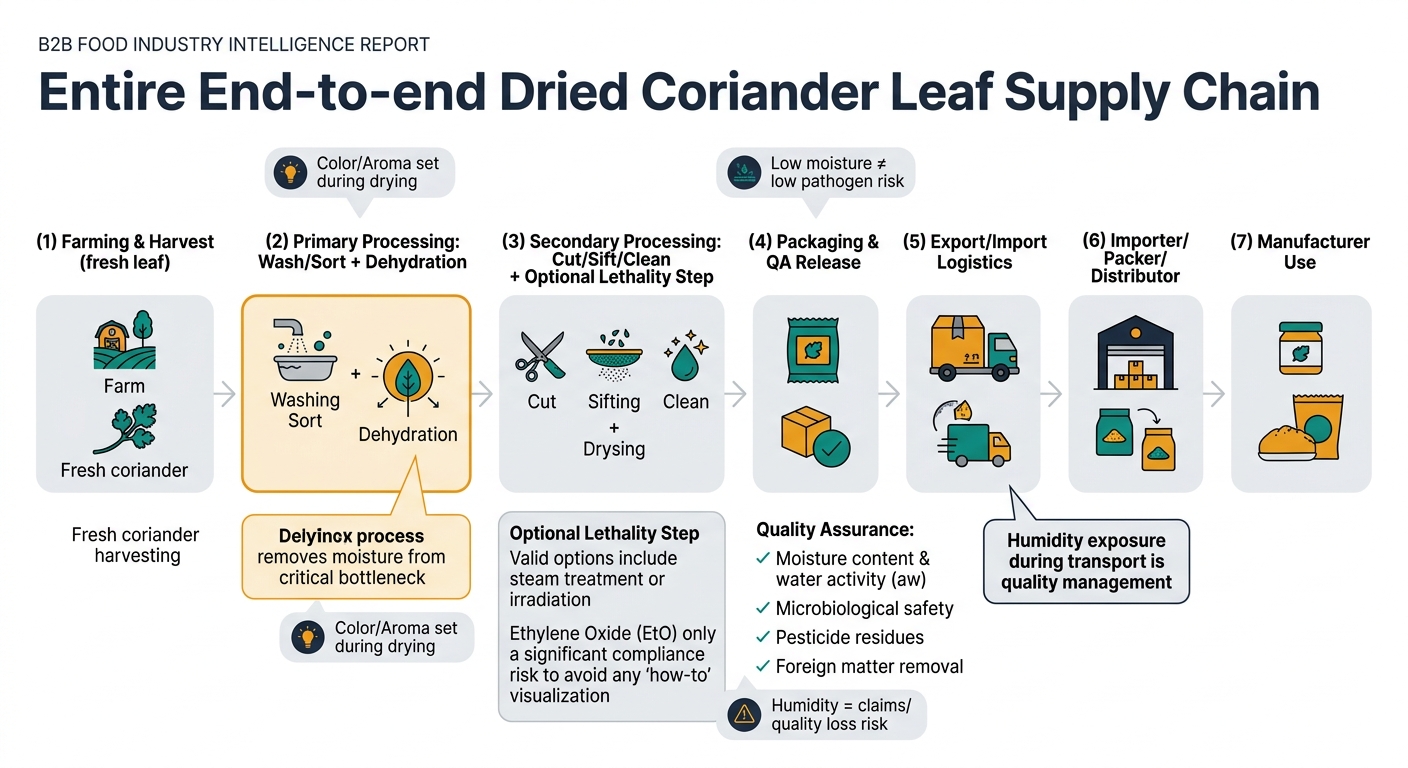
Typical end-to-end flow (industrial supply)

  1. Farming & harvest (fresh coriander leaves + tender stems)
  2. Primary processing (washing/sorting + dehydration)
  3. Secondary processing (cut/sift/clean, optional lethality step, metal detection)
  4. Packaging & QA release (moisture/aw, micro, residues, foreign matter)
  5. Export/import logistics (ambient, humidity-sensitive)
  6. Importer/packer/distributor → manufacturer (blends, ready meals, foodservice)
A left-to-right flow diagram showing the industrial path of dried coriander leaf, emphasizing dehydration as the central transformation step, with stages from farming and harvest through processing, QA release, logistics, importer/packer, and manufacturer use, plus callouts on color/aroma set during drying, low moisture pathogen risk, and humidity-driven claims/quality loss risk.

2) Where the Money Accumulates: Cost & Margin by Supply Chain Node

2.1 Upstream Farming & Harvest (fresh leaf supply)

Key insight: Dried coriander leaf cost starts as a fresh-leaf economics problem. Yield swings and harvest labor drive volatility more than many procurement teams model.

What drives cost here

  • Frequent harvest labor (leaf crops are labor-sensitive)
  • Irrigation and heat stress management (quality loss shows up later as “color failure”)
  • Crop protection intensity (pest pressure can increase pesticide use → residue risk)
  • Field handling speed (slow handling = wilting/blackening = lower dried grade)

Margin reality: Farmgate margins are often thin; volatility is mostly yield + labor.

2.2 Primary Processing: Washing/Sorting + Dehydration (the real bottleneck)

Key insight: Dehydration is where cost and risk concentrate because it is energy- and throughput-constrained and strongly determines whether the material can meet micro + color expectations.

What drives cost here

  • Energy for drying (fuel/electricity)
  • Throughput constraints (dryer capacity during peak season)
  • Yield loss (fresh-to-dry conversion + trim/sort losses)
  • Hygiene and microbial controls (sanitation, environmental monitoring where applicable)

Margin reality: Processors with reliable dehydration control and export-grade QA systems typically earn a premium.

2.3 Secondary Processing: Cut/Sift/Clean + Optional Kill Step

Key insight: This is where your spec language turns into real money. Tight cut-size distributions, low dust, low foreign matter, and validated lethality steps create measurable cost adders.

What drives cost here

  • Cut/sieve losses (to hit mesh distribution and reduce fines)
  • Foreign matter removal (optical sorting, aspiration, magnets/metal detection)
  • Lethality treatment choice:
  • Steam is widely used for spices/herbs and can reduce pathogen risk, but it can impact color/aroma if not controlled.
  • Ethylene oxide (EtO) is a special case: EU controls on EtO/ECH residues have created significant compliance risk and have driven repeated market withdrawals/alerts in the broader herbs/spices ecosystem. [2]

Margin reality: Secondary processors often capture margin via “spec compliance capability” (not just volume).

2.4 Packaging & QA Release (where claims become defensible)

Key insight: For dried coriander leaf, QA cost is not overhead—it is the price of market access and recall avoidance.

What drives cost here

  • Moisture-barrier packaging (liners, humidity protection)
  • Lab testing (micro + pesticide residues + sometimes heavy metals)
  • Documentation (traceability depth, treatment declarations)
  • Certification maintenance (GFSI schemes, organic where relevant)

Compliance detail procurement teams miss

  • It’s directionally correct that drying concentrates residues and can tighten MRL risk on dried herbs.
  • However, dehydration factors are product- and method-specific and should be validated with your regulatory/QA team and supplier residue data.

2.5 Logistics & Distribution (humidity is the hidden tax)

Key insight: The main logistics risk is not temperature—it is humidity exposure that drives caking, mold risk, aroma loss, and claims.

What drives cost here

  • Container freight + inland trucking
  • Consolidation/warehousing margin (importers/brokers)
  • Demurrage/detention during port disruptions
  • Shrink/claims from moisture ingress

2.6 End Market Margin (importer/packer → manufacturer)

Key insight: In many buying programs, the “supplier” is an importer/packer. Their margin often reflects risk absorption: inventory, QA release, and compliance liability.
What drives cost here

  • Working capital (inventory buffers)
  • Repacking and label compliance
  • Customer-specific QA holds and re-testing
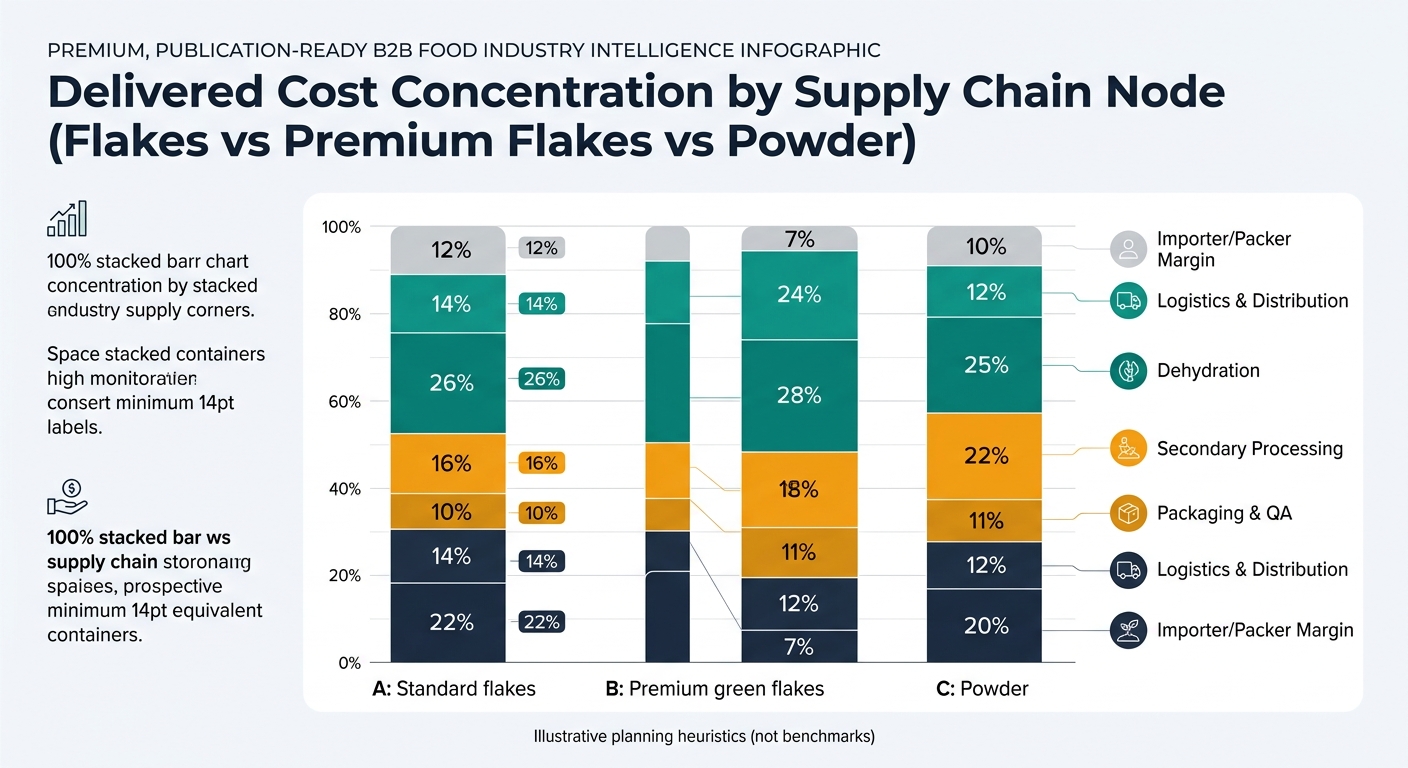
A 100% stacked bar chart comparing delivered cost concentration by supply chain node for standard flakes, premium green flakes, and powder, segmented into Farming/Harvest, Dehydration, Secondary Processing, Packaging & QA, Logistics & Distribution, and Importer/Packer Margin, using the exact percentages from the article tables and noting the figures are illustrative planning heuristics (not benchmarks).

Product-level cost breakdown (illustrative)

These ratios are modeled to show where cost concentrates by product form. Actual splits vary by origin, season, kill-step policy, and spec tightness. Treat as planning heuristics, not benchmarks.

A) Industrial coriander leaf flakes (standard cut, no validated kill step)

Supply Chain Node Cost Ratio (% of delivered cost) What moves it most
Farming/harvest 22% yield + labor
Dehydration (primary processing) 26% energy + capacity
Secondary processing (cut/sift/clean) 16% fines removal + foreign matter
Packaging & QA 10% testing + barrier packaging
Logistics & distribution 14% freight + consolidation
Importer/packer margin 12% inventory + QA release

B) Premium green flakes (tight mesh distribution, low dust, stronger sensory)

Supply Chain Node Cost Ratio (% of delivered cost) What moves it most
Farming/harvest 24% agronomy + harvest timing
Dehydration (primary processing) 28% controlled drying to protect color/aroma
Secondary processing (tight cut/low dust) 18% yield loss to meet spec
Packaging & QA 11% more frequent testing + tighter release
Logistics & distribution 12% humidity control practices
Importer/packer margin 7% less “trading” margin, more spec-driven

C) Coriander leaf powder (milled)

Supply Chain Node Cost Ratio (% of delivered cost) What moves it most
Farming/harvest 20% yield
Dehydration (primary processing) 25% energy
Secondary processing (milling + controls) 22% milling loss + metal control
Packaging & QA 11% micro + residues, more dust control
Logistics & distribution 12% freight
Importer/packer margin 10% inventory + QA release

3) The Structural Fact That Drives Most Surprises: “Drying Multiplies Everything”

For dried coriander leaf, drying doesn’t just remove water—it concentrates both value and risk:

  • Residues concentrate: pesticide residues present on fresh leaf can become more problematic after dehydration. (Practical procurement takeaway: you often need tighter upstream agronomy controls and/or higher residue testing cadence for dried herbs than teams expect.)
  • Micro risk persists: low moisture does not equal “no pathogens.” FDA’s spice safety materials and risk-profile work emphasize Salmonella as a key concern in spices/herbs programs. [1]
  • Quality defects become permanent: once green color and aroma are lost in drying, you can’t “spec it back” later.

Procurement implication: the best leverage point is upstream process capability selection, not late-stage inspection.

4) The Critical Insight: Why Your Price and Your Risk Don’t Move Together

In dried coriander leaf, buyers often expect a simple rule: “higher price = safer/better.” In practice:

  1. Raw leaf tightness can raise price while lowering quality
  2. Heat stress or water restriction can reduce yield and push prices up, but the leaf may be less green and more stemmy.
  3. Compliance events can remove supply without touching farm economics
  4. A residue or treatment compliance issue can suddenly make lots unsellable into certain markets, creating spot shortages and price spikes unrelated to crop size.
  5. EtO is a clear example of how enforcement and residue definitions can disrupt herbs/spices supply chains in the EU context. [2]
  6. Kill-step policy creates a separate price curve
  7. “Same origin, same season” product may price very differently depending on whether it is sold with a validated lethality step (steam, irradiation policies, etc.)—and whether the buyer requires it.

Procurement implication: you need two linked views—market price drivers and compliance/food-safety gating factors.

5) Where Procurement Teams Commonly Misstep (and Why It Happens)

  1. They buy dried coriander leaf like a commodity spice
  2. Outcome: awards to suppliers who can quote low but cannot hold green color, cut distribution, or documentation depth.
  3. They over-index on CoA and under-index on process capability
  4. Outcome: surprises on foreign matter, dust, or micro positives; more holds, re-tests, and line disruption.
  5. They lock specs too tightly without pricing the yield loss
  6. Example: “low dust + narrow mesh + very green” specs can force aggressive sifting and higher reject rates upstream—cost shows up as premiums and supply fragility.
  7. They don’t model EU vs US compliance as different products
  8. EU residue expectations and sensitivity to EtO/ECH residues can change what “acceptable supply” means; treat this as a separate lane in sourcing strategy and QA release design. [2]

6) What an Intelligence-Driven Approach Changes in the Decision (Not the Dashboard)

Below is how procurement intelligence changes specific management decisions in dried coriander leaf.

Decision A: “Do we renew the incumbent or split the award?”

Use supplier benchmarking & qualification intelligence to compare:

  • Process controls: drying method control, foreign matter removal, metal detection
  • Food-safety posture: validated lethality options, sanitation controls maturity (and environmental monitoring where applicable)
  • Documentation reliability: treatment declarations, traceability depth

Procurement action:

  • Move from single award to 70/30 or 60/40 split where the second source is qualified for the same spec.

Measurable outcomes:

  • Lower single-point-of-failure exposure
  • Fewer emergency buys at peak pricing

Decision B: “When do we negotiate and what contract structure fits?”

Use price intelligence & cost-driver analysis to separate:

  • Crop/energy-driven movement (dehydration energy, throughput)
  • Freight/FX-driven landed cost movement
  • Supplier-specific margin expansion

Procurement action:

  • Use staged buys or indexed components for freight/FX while holding conversion margin stable.

Measurable outcomes:

  • Reduced price variance vs budget
  • Better internal defensibility for forecast updates

Decision C: “When do we activate alternates?”

Use risk monitoring (early warning) tied to triggers:

  • Weather anomalies in key origins (heat waves, unseasonal rains)
  • Border/enforcement trends (increased testing intensity)
  • Logistics disruption (port congestion, container tightness)

Procurement action:

  • Pre-approve alternates and run small holding buys to keep them “warm” (docs current, QA familiarity).

Measurable outcomes:

  • Shorter time-to-switch during disruption
  • Lower expedite freight and downtime

7) Strategic Use Cases Procurement Leadership Can Operationalize

  1. Dual/tri-sourcing playbook for a spec-locked blend
  2. Define “equivalence” beyond price: mesh distribution, max stems, dust %, sensory minimums, micro policy.
  3. Pre-qualify alternates that match your kill-step stance.
  4. Spec-to-cost governance (stop accidental premium creep)
  5. Create a controlled change process: any tightening of green color, dust, or micro limits requires a cost impact note and supplier capability confirmation.
  6. Market-access risk segmentation (US vs EU vs GCC)
  7. Treat compliance as separate SKUs in your sourcing strategy: documentation, residue testing cadence, and treatment acceptability differ by destination.
  8. Quality incident prevention program (targeted, not blanket testing)
  9. Increase inspection/testing intensity when risk signals rise (weather stress, long transit, supplier capacity strain).

8) Why This Matters Beyond Coriander Leaf (Examples You Likely Also Buy)

The “drying multiplies everything” lesson applies across herbs, spices, and botanicals:

  • Dried parsley / basil / oregano: similar low-moisture pathogen risk profile; FDA’s spice risk work provides category context on Salmonella concerns. [1]
  • Sesame, cumin, pepper (and other dry ingredients): the EtO incident shows how a compliance shock can spread across adjacent categories and force urgent supplier requalification and increased testing. [3]
  • Dehydrated onion/garlic: similar energy-driven conversion economics; dryer capacity and energy costs can dominate pricing during tight periods.

Management takeaway: once you build a repeatable intelligence-to-action governance model for dried coriander leaf, you can reuse it across your broader dry ingredients portfolio.

9) Why This Category Makes a Strong Proof Point for Intelligence-Led Sourcing

Dried coriander leaf is a high-leverage example because it forces procurement to manage cost, continuity, and compliance simultaneously:

  • Cost is driven by energy + yield + spec-driven processing losses
  • Continuity is constrained by dehydration capacity and QA release throughput
  • Compliance is market-specific (MRLs, treatment acceptability, documentation)

If procurement leadership can make dried coriander leaf sourcing auditable and resilient—through benchmarking, alternate scenario planning, and risk triggers—then the same operating model scales to other botanicals where the cost of a single quality or compliance failure is far larger than the unit price premium.

Tridge Eye Data Intelligence Solution

Make Faster, Data-Driven Sourcing Decisions

The insights in this report are just the starting point. Tridge Eye is the data intelligence solution that gives procurement and sourcing leaders real-time market signals, price benchmarks, and supply risk alerts — so you can act before the market moves.
Explore Tridge Eye →

References

  1. fda.gov
  2. esa-spices.org
  3. europarl.europa.eu
Subscribe
By subscribing you agree to with our Privacy Policy and provide consent to receive updates from our company.
Thank you! Your submission has been received!
Oops! Something went wrong while submitting the form.
Subscribe to receive the latest blog posts, updates, promotions, and announcements from Tridge.