
This report is powered by Tridge Eye Data Intelligence.
Every data point, price signal, and supply risk insight in this analysis comes from the same platform that procurement and sourcing leaders worldwide rely on daily. As you read, consider what this level of market intelligence could do for your sourcing decisions.
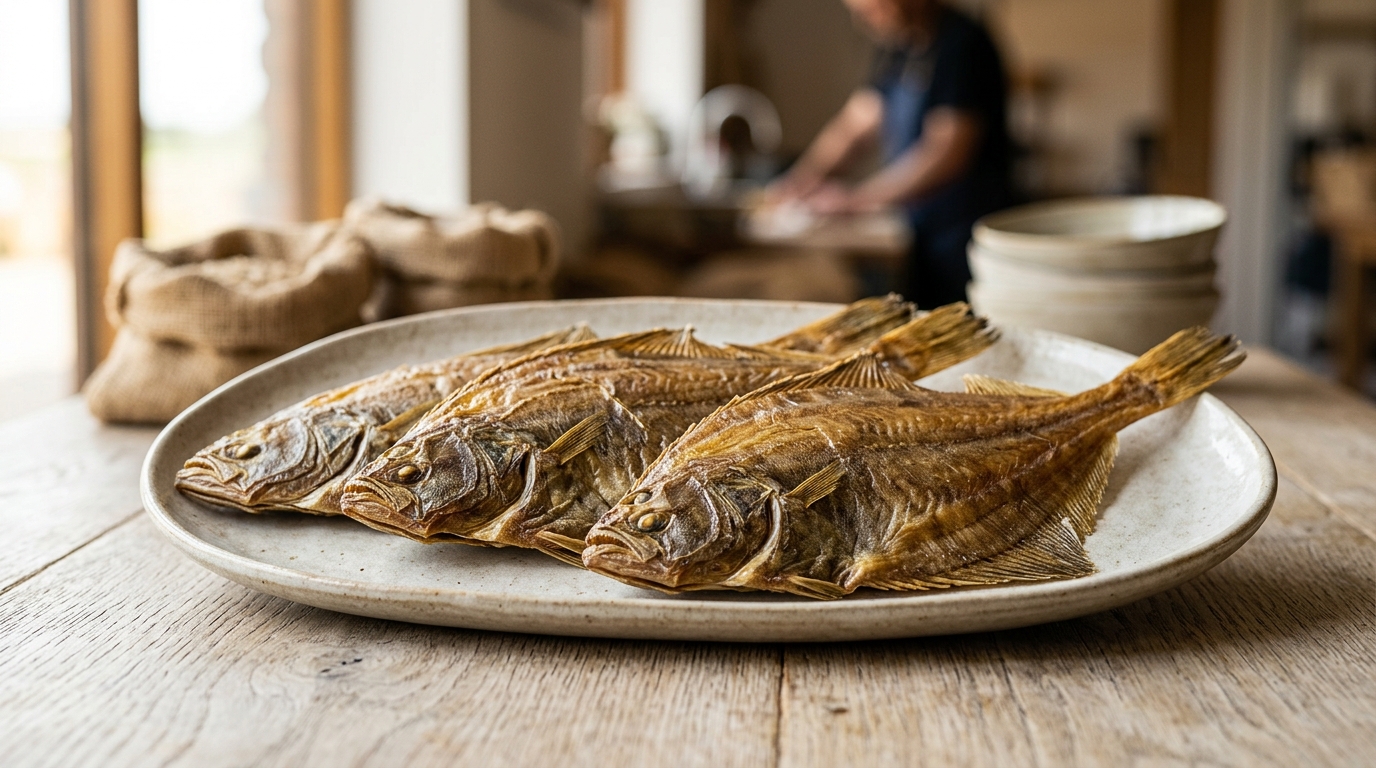
Procurement teams tend to treat dried common dab as a straightforward “dried seafood SKU.” In practice, it behaves like a yield- and batch-driven category where specs (especially moisture / water activity) and documentation discipline often explain more of your true delivered cost than the headline €/kg. This guide translates the product realities (mixed demersal supply, processing shrink, humidity sensitivity, and compliance expectations) into the decisions sourcing managers actually make: renew vs. rebid, dual-source design, and contract/spec governance.
(Analyzed at: Apr, 2026)
Most procurement teams approach dried common dab (Limanda limanda) as “just another dried seafood SKU.” In practice, it behaves like a mixed-fishery, batch-processed, yield-sensitive product where the real levers are:
Ground-truth flow (typical Europe-centric chain):

Procurement implication: your “unit price” is often the least stable number in the chain, because yield and shrink move underneath it, and those movements show up later as claims, OTIF misses, and surprise rework cost.
Dried common dab is economically dominated by (a) raw fish availability, (b) labor per kg (driven by size), and (c) dehydration shrink. The buyer-visible price often under-explains the true cost because suppliers can “hold” price while quietly changing:
Below is a node-by-node view of what typically drives cost, where margin is taken, and what procurement should measure.
Specify moisture/water activity in a way that’s fit-for-purpose, and align pricing to it (otherwise you’ll pay twice: once in price, again in claims and yield loss).
These are modeled shares of final delivered cost to a buyer (not retail shelf price). Actual ratios vary by origin, spec tightness, packaging format, and whether product is whole vs. fillet.

| Supply Chain Node | Cost Ratio (% of Final Cost) | What typically moves it |
|---|---|---|
| Upstream raw fish (landed) | 38% | fuel, weather downtime, landing tightness |
| Primary processing | 20% | labor/kg, size distribution, yield loss |
| Secondary processing (salt + drying) | 16% | energy, shrink, rework |
| Packaging & QA | 8% | barrier materials, testing cadence, COA workload |
| Logistics & distribution | 10% | cold-chain inbound, warehousing, lane volatility |
| Supplier/wholesale margin | 8% | inventory risk, financing, channel power |
| Supply Chain Node | Cost Ratio (% of Final Cost) | What typically moves it |
|---|---|---|
| Upstream raw fish (landed) | 34% | same as above |
| Primary processing | 19% | same as above |
| Secondary processing (salt + drying) | 20% | tighter moisture target, longer process time |
| Packaging & QA | 10% | salt/moisture verification, higher claim prevention |
| Logistics & distribution | 9% | humidity control emphasis |
| Supplier/wholesale margin | 8% | category risk premium |
| Supply Chain Node | Cost Ratio (% of Final Cost) | What typically moves it |
|---|---|---|
| Upstream raw fish (landed) | 30% | landing price |
| Primary processing | 18% | fillet/portioning labor |
| Secondary processing (salt + drying) | 16% | shrink + energy |
| Packaging & QA | 18% | packaging materials, labeling, lot coding, testing |
| Logistics & distribution | 8% | more handling steps |
| Supplier/wholesale margin | 10% | channel margin + retail program complexity |
In dried common dab, moisture target is effectively a pricing parameter.
Procurement takeaway: If your contract only prices “per kg” without tight, testable moisture/water-activity language and remedies, you’re exposed to a hidden trade: lower apparent price vs. higher downstream failure cost.
Procurement teams often expect a clean pass-through: landed fish price up → dried product price up. In reality, dried dab pricing disconnects because of three lags and two hidden buffers:
This is what changes when you connect market signals, supplier mapping, and performance governance to the actual decisions a sourcing manager makes.
If you source dried common dab, you likely also source categories with the same “hidden drivers” pattern:
The common procurement lesson: when quality specs directly affect sellable weight or claim probability, “unit price” is not the unit economics. Intelligence-driven sourcing helps you manage that gap systematically.
Dried common dab is a strong “teaching category” because it forces procurement to operate like a risk manager, not a price collector:
If you can build a defensible, auditable sourcing program here—linking supplier selection, spec discipline, early warning, and performance governance—you can replicate the operating model across other volatile food categories with fewer surprises and faster disruption response.
Make Faster, Data-Driven Sourcing Decisions
The insights in this report are just the starting point. Tridge Eye is the data intelligence solution that gives procurement and sourcing leaders real-time market signals, price benchmarks, and supply risk alerts — so you can act before the market moves.