
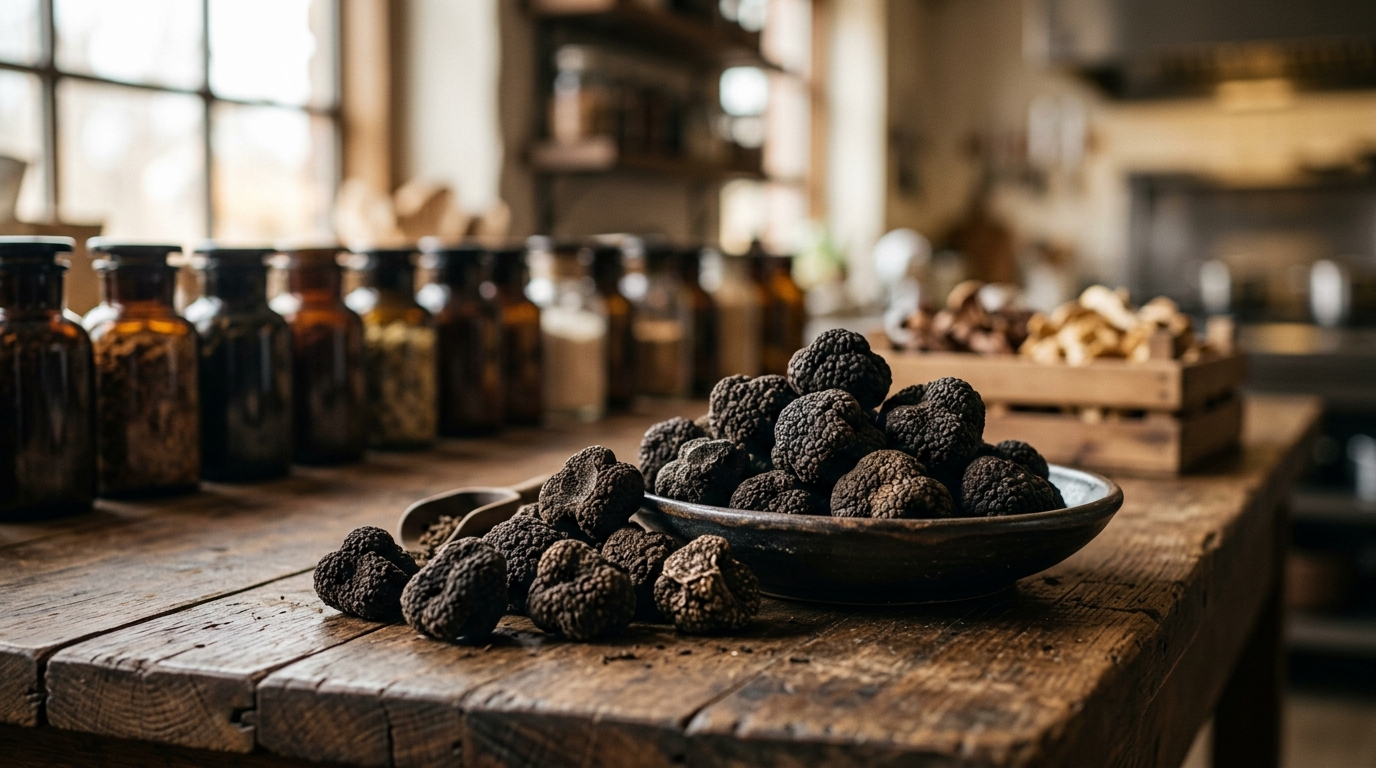
Dried black truffle procurement looks deceptively simple—“buy a dried ingredient.” In practice, it’s a short supply chain with steep value-add at each step, where small differences in drying endpoint, packaging barrier, and chain-of-custody discipline create big differences in aroma performance, shelf-life behavior, and dispute risk.
Dried black truffle is not a single, uniform ingredient—it’s a conversion chain that starts with highly perishable winter-harvested truffles and ends as an aroma-sensitive, shelf-stable product whose value depends on drying method, moisture control, and packaging barrier performance. The fixed cost-drivers “lock in” early (harvest labor, sorting losses, fresh-to-dry conversion yield) and then compound downstream through energy-intensive dehydration, QA/testing, and high-barrier packing.
Insight: The physical flow is short in number of steps but steep in value-add at each step because every handling event can reduce aroma and increase defects.
Data (validated): Research consistently shows that preservation method materially changes volatile profiles; freeze-drying is frequently reported as better at retaining volatile compounds than many thermal processes, while hot-air drying outcomes depend heavily on time/temperature and cut geometry. (Practical takeaway: treat “drying method” as a spec variable, not a footnote.) [2]
Procurement Impact: Even before any commercial discussion, teams need a “map” of where aroma is most likely to be lost (post-harvest handling → drying → packaging) because that’s where spec disputes and lot-to-lot variability originate.

Insight: In dried black truffle, the largest cost swings come from (1) raw truffle quality and conversion yield, and (2) the technical choices that preserve aroma (drying method + packaging barrier). Those two levers dominate downstream “true equivalence” between products.
Data (validated): Multiple market/standards references for dried edible fungi commonly differentiate moisture limits between freeze-dried and other dried products (often 6% vs 12% max moisture), reflecting materially different dehydration endpoints and stability expectations. [1]
Procurement Impact: If specs don’t explicitly anchor moisture endpoint (and ideally water activity), cut size, and drying method, offers that look comparable can be physically non-equivalent (different yield, aroma retention, and shelf-life behavior).
Insight: The chain’s economics start with a perishable, manually harvested input where “processing grade” availability depends on how much material is diverted to the fresh market.
Data (validated concept): Species-level identification is not reliably done by appearance alone once product is processed; DNA-based methods are widely used in the scientific literature for definitive checks in fungi and truffle contexts. [2]
Procurement Impact: Upstream variability shows up downstream as inconsistent aroma intensity and conversion yield. The more the input is mixed (species, maturity, defects), the more downstream standardization work (sorting, trimming, testing) is required.
Insight: This node is where processors “manufacture uniformity” for dehydration: dirt removal, defect trimming, and geometry control (slice thickness, dice size).
Data (validated concept): Analytical verification (DNA/species methods, spectroscopy with chemometrics) is feasible for truffle differentiation, but results depend on representative sampling and traceability—especially once lots are blended or repacked. [2]
Procurement Impact: Cut size and trim standard directly affect drying time, energy use, and final defect rate (brittle fragments, uneven dryness). If slice thickness varies, moisture can be non-uniform inside a lot—creating mold/quality risk in pockets.
Insight: Dehydration is the dominant technical value-add step: it determines aroma retention, conversion yield, and stability (moisture/water activity).
Data (validated concept): Truffle aroma relies heavily on sulfur-containing volatiles; processing and storage conditions measurably shift volatile profiles, and preservation methods differ in retention outcomes. [2]
Procurement Impact: Drying method is not “process trivia”—it’s a primary differentiator of product performance. It also determines packaging requirements: freeze-dried products are highly moisture-sensitive and typically require very high barrier packaging to prevent rehydration and quality loss.
Insight: Packaging is not a commodity step for dried truffle: oxygen and moisture ingress directly translate into aroma fade and shelf-life shrink.
Data (validated): “Truffle” flavored products in the market are often associated with a narrow set of aroma compounds (notably 2,4-dithiapentane in truffle oils), illustrating why buyers must separate true truffle content/species from “truffle flavor” claims and require evidence for authenticity when the form factor is highly processed. [3]
Procurement Impact: The more “processed” the format (granules → powder), the more you must rely on QA release controls (species verification, moisture checks, foreign matter) because visual inspection loses power.
Insight: Dried truffle is shelf-stable but not “quality-stable”: heat and oxygen exposure accelerate aroma degradation even without visible spoilage.
Data (validated concept): Studies on truffle aroma show volatile profiles change with processing and storage conditions; temperature/handling can shift aroma composition over time. [2]
Procurement Impact: Transit and warehousing conditions (hot containers, non-climate-controlled storage) can quietly downgrade sensory performance, which later appears as “supplier quality drift” even when the COA looks normal.

| Supply Chain Node | Cost Ratio (% of Final Cost) | Notes |
|---|---|---|
| Raw Material (fresh truffle input) | 45% | Driven by harvest labor, grade-out, and conversion yield. |
| Primary Processing | 10% | Cleaning/trim + slice geometry control. |
| Secondary Processing (Freeze-dry) | 20% | Highest capex/energy; aroma retention priority. |
| Packaging & QA | 10% | High-barrier packs + moisture/species checks. |
| Logistics & Distribution | 5% | Ambient, but quality sensitive to heat exposure. |
| Wholesale/Retail Margin | 10% | Channel-dependent markup. |
| Supply Chain Node | Cost Ratio (% of Final Cost) | Notes |
|---|---|---|
| Raw Material | 50% | Often uses smaller pieces; still yield-driven. |
| Primary Processing | 8% | Dicing + foreign matter control. |
| Secondary Processing | 12% | Lower than freeze-dry; endpoint control still critical. |
| Packaging & QA | 10% | Barrier needs moderate-to-high; lot uniformity checks. |
| Logistics & Distribution | 7% | More repacking into foodservice/industrial formats. |
| Wholesale/Retail Margin | 13% | Higher distribution complexity across pack sizes. |
| Supply Chain Node | Cost Ratio (% of Final Cost) | Notes |
|---|---|---|
| Raw Material | 40% | Can use trimmings; higher risk of mixed inputs. |
| Primary Processing | 8% | Pre-dry size reduction and sorting. |
| Secondary Processing (Drying + Milling) | 18% | Milling adds oxidation risk + process loss/dust control. |
| Packaging & QA | 14% | Highest QA reliance (species verification, moisture uniformity); strong oxygen barrier needed. |
| Logistics & Distribution | 8% | Often shipped in lined cartons/bulk bags. |
| Wholesale/Retail Margin | 12% | Ingredient distributors + brand owners. |
Insight: Moisture content (and practically, water activity) is the stability switch: too high risks microbial activity; too low can mean brittle texture and faster aroma loss due to processing severity.
Data (validated): Dried edible fungi references commonly cite different maximum moisture limits for freeze-dried vs other dried products (often 6% vs 12%), reflecting different dehydration endpoints and rehydration behavior. [1]
Procurement Impact: If moisture endpoint isn’t explicitly governed in specs, you’ll see inconsistent shelf-life behavior and higher risk of “hidden” quality failures (softening, clumping, aroma fade) in distribution.
Insight: Species substitution risk rises as visual cues disappear (pieces → granules → powder), making analytical verification more important.
Data (validated concept): Truffle-related research and broader fungi authentication literature support DNA-based approaches (PCR/qPCR) and instrumental screening (e.g., GC-MS for marker compounds; spectroscopy + chemometrics in some contexts) as viable tools—when sampling and traceability are controlled. [2]
Procurement Impact: The structural constraint is not “lack of science,” but chain-of-custody discipline: sampling plans, retain samples, and batch traceability must survive processing and repacking.
Insight: For aroma-driven ingredients, barrier packaging acts like a continuation of the manufacturing process—poor barrier effectively “keeps processing” the product via oxidation and moisture exchange.
Data (validated concept): Moisture/oxygen exposure is a known driver of aroma fade in volatile-rich foods; truffle aroma marker literature underscores how narrow compounds can dominate perceived aroma and how easily profiles can shift with handling. [2]
Procurement Impact: Shelf-life claims and sensory performance are structurally linked to packaging material and seal integrity, not just to the truffle input.
(Analyzed at: Oct, 2026)
Lock your next dried black truffle award around equivalence you can audit: require the supplier to declare (and keep constant through any repacker) the drying method, a moisture endpoint aligned to product type (freeze-dried vs other dried), and the barrier pack format—then tie acceptance to incoming moisture checks plus retain-sample traceability.
This works because “dried” products are structurally non-comparable without an endpoint definition (commonly referenced as ~6% vs ~12% moisture in dried edible fungi standards), and packaging is where aroma quietly bleeds out in transit. [1] If you don’t hard-code equivalence, you typically pay for premium performance but accept non-equivalent lots under the same SKU—showing up later as rejects, customer complaints, and expedited replacement buys that can easily wipe out a planned 3–8% cost-down.


