INDUSTRY TRENDS

Dongchimi Supply Chain Map: Where Landed Cost and Quality Risk Actually Accumulate

Author
Team Tridge
DATE
July 9, 2026
8 min read
dongchimi Cover
DongchimiHS 200599
Powered by Tridge Eye
🇰🇷 South Korea↓ 8.5%
$1.18/kg
Wholesale reference prices across 132 markets

For procurement leaders new to dongchimi, the fastest way to control landed cost and service risk is to follow the physics: a liquid-heavy, chilled, still-fermenting product turns small upstream variability into downstream leakage, short code life, and returns. This guide maps where cost “locks in,” so you can write better specs, qualify suppliers faster, and negotiate contracts that hold up in real cold-chain conditions.

Executive Summary

  • Dongchimi is typically managed as a refrigerated, time/temperature-controlled food; in U.S. retail/foodservice practice, ≤5°C / 41°F is the common cold-holding ceiling, so excursions matter commercially and operationally. [1]
  • Fermentation does not stop after pack-out; CO2 generation during refrigerated storage is a known driver of pack swelling/deformation and leakage in kimchi-type products. [2]
  • The biggest “mystery cost” drivers are usually packaging performance + cold-chain handling, not the seasoning BOM.
  • The cost ratios below are directional diagnostics (not universal benchmarks); validate with your own yield, claims, and freight lane data.
  • 2026 reality: expanding U.S. cold-chain capacity helps, but refrigerated transport/cold storage remains a structural cost center that procurement must contract and monitor, not assume. [3]

1) The Ground Truth Map: How Dongchimi Physically Moves (and Where Cost “Locks In”)

Dongchimi is a chilled, brined-fermented, high-water-activity product. That means the supply chain is built around three physical constraints that don’t change with the market: (1) variable fresh produce quality, (2) fermentation that continues (slowly) even in refrigeration, and (3) liquid-heavy packaging and cold-chain logistics.

Insight: The dongchimi chain is short on “processing steps,” but long on “control points” (raw veg cleanliness, salt %, time/temperature, and package integrity).

Data: Commercial dongchimi is typically managed under refrigerated distribution; in U.S. food handling practice, ≤5°C / 41°F is the common cold-holding ceiling, and temperature abuse increases quality drift and failure risk (souring, CO2-related swelling, leakage). [1]

Procurement Impact: Your fixed cost-drivers are set by physics: yield loss from trimming/purge, sanitation and wastewater load, fermentation space (cold rooms), packaging built for liquid + gas, and refrigerated freight for a heavy, low value-density SKU.

Physical flow (typical):

  • Farm/field harvest → wash/trim/cut → light salting + brine make-up → mixing + controlled fermentation/aging (often chilled) → cold-fill/pack → refrigerated storage → reefer transport → retail/foodservice cold chain
A left-to-right supply chain flow showing: Farm/Field Harvest → Wash/Trim/Cut → Light Salting + Brine Make-up → Mixing + Controlled Fermentation/Aging (often chilled) → Cold-Fill/Pack → Refrigerated Storage → Reefer Transport → Retail/Foodservice Cold Holding, with callouts for incoming radish variability, yield loss (trim + purge), time/temperature control, packaging integrity for liquid + CO2, and cold-chain handoffs; includes icons for ≤5°C/41°F, CO2/gas, liquid leakage, and returns/chargebacks.

Quick Win: When mapping cost, treat “cold chain + liquid packaging” as a single structural system; most avoidable losses show up as leakers, bloated packs, and short-coded product—not as ingredient line items.

2) Per-Node Cost & Margin Structure: What Each Step Adds (and Why)

Insight: Dongchimi cost is dominated by (a) fresh produce variability, (b) packaging engineered for liquid + ongoing fermentation, and (c) refrigerated logistics for a heavy SKU.

Data: Even when ingredient bills look modest, delivered cost inflates through yield loss (trim + purge), cold-room energy, QA testing, and reefer freight/cold storage—especially for retail-ready packs with strict leakage tolerances.

Procurement Impact: The “value add” at each node is less about transformation and more about defect prevention (micro risk, texture failure, leak failure). Margin tends to accrue where control reduces returns: sanitation/QA, packaging performance, and cold-chain reliability.
1. Upstream / Raw Material (Radish + Aromatics + Salt/Water)

  • Insight: Radish quality drives fermentation behavior and texture more than recipe tweaks; the chain’s biggest hidden cost is variability (hollowness/sponginess, high water content, inconsistent sweetness) that shows up later as soft texture or brine dilution.
  • Data: Typical acceptance specs in commercial buying include firmness/crispness, low internal hollowness, size range for cut yield, and cleanliness (soil load). High water content increases purge, diluting brine and shifting salt % and acidification rate.
  • Procurement Impact: The “raw material cost” line is only half the story—field quality determines downstream yield, rework, and shelf-life stability. Poor incoming lots often convert into higher QA holds, higher brine correction, and higher returns.

2. Primary Processing (Washing, Trimming, Cutting, Light Salting)

  • Insight: This node is where cost locks in through labor, yield loss, and sanitation. Dongchimi is water-intensive: wash steps + brine handling create wastewater load and slip hazards that demand disciplined SOPs.
  • Data: Yield loss comes from trim/peel (if used), defect removal, and purge during salting. The more aggressive the trim to meet visual specs, the higher the cost per finished kg.
  • Procurement Impact: If you see frequent texture complaints or brine dilution, the root cause is often here: cut geometry, salting time, and drain control. This node also sets microbial baseline—soil and equipment hygiene directly affect downstream yeast/mold and off-odors.

3. Secondary Processing (Brine Formulation + Fermentation/Aging Under Temperature Control)

  • Insight: Fermentation is a “time-and-space” cost, not a complex unit operation. You pay for tanks, cold-room footprint, working capital tied up during aging, and process controls that prevent runaway souring.
  • Data: Commercial operations commonly monitor salt %, pH, and sometimes titratable acidity to manage flavor trajectory and shelf life. Temperature control is the main lever: warmer conditions accelerate acidification and CO2 generation.
  • Procurement Impact: This node is where small upstream variability becomes expensive: inconsistent salt uptake or brine dilution forces adjustments, longer holds, or lot segregation. Capacity is often constrained by cold-room cubic meters, not mixing horsepower.

4. Packaging & QA (Retail Tubs/Jars/Pouches, Lids/Seals, Labels, Testing)

  • Insight: Packaging is engineered around two stresses: liquid containment and gas management (CO2). The wrong seal design or headspace behavior turns normal fermentation into leakers and swollen packs.
  • Data: CO2 accumulation during kimchi fermentation is a documented cause of package deformation/rupture; industry approaches include gas-management features (e.g., degassing concepts) and material choices to reduce swelling risk under real cold-chain temperature fluctuation. [2]
  • Procurement Impact: Packaging is a major fixed cost bucket because it must perform under cold, wet conditions and tolerate ongoing fermentation. QA cost (micro screens, pH/salt verification, foreign material control, label compliance) is the insurance premium against recalls and retailer chargebacks.

5. Cold-Chain Logistics & Distribution (Cold Storage + Reefer Transport + Handling)

  • Insight: Dongchimi is heavy (brine) and space-inefficient, so logistics cost scales fast. Every temperature excursion shortens code life and increases swelling risk—creating shrink that looks like “demand volatility” but is often physics.
  • Data: Refrigerated networks add cost at each handoff: pre-cool, cold storage dwell, reefer linehaul, and last-mile refrigerated handling. Longer dwell times in warm docks accelerate fermentation even if average transit temperature is acceptable.
  • Procurement Impact: This node converts operational variability into financial loss: expedited reefer, rejected loads, retailer penalties, and returns. Pallet pattern, secondary containment, and leak prevention materially affect damage claims.

Product-Level Cost Breakdown

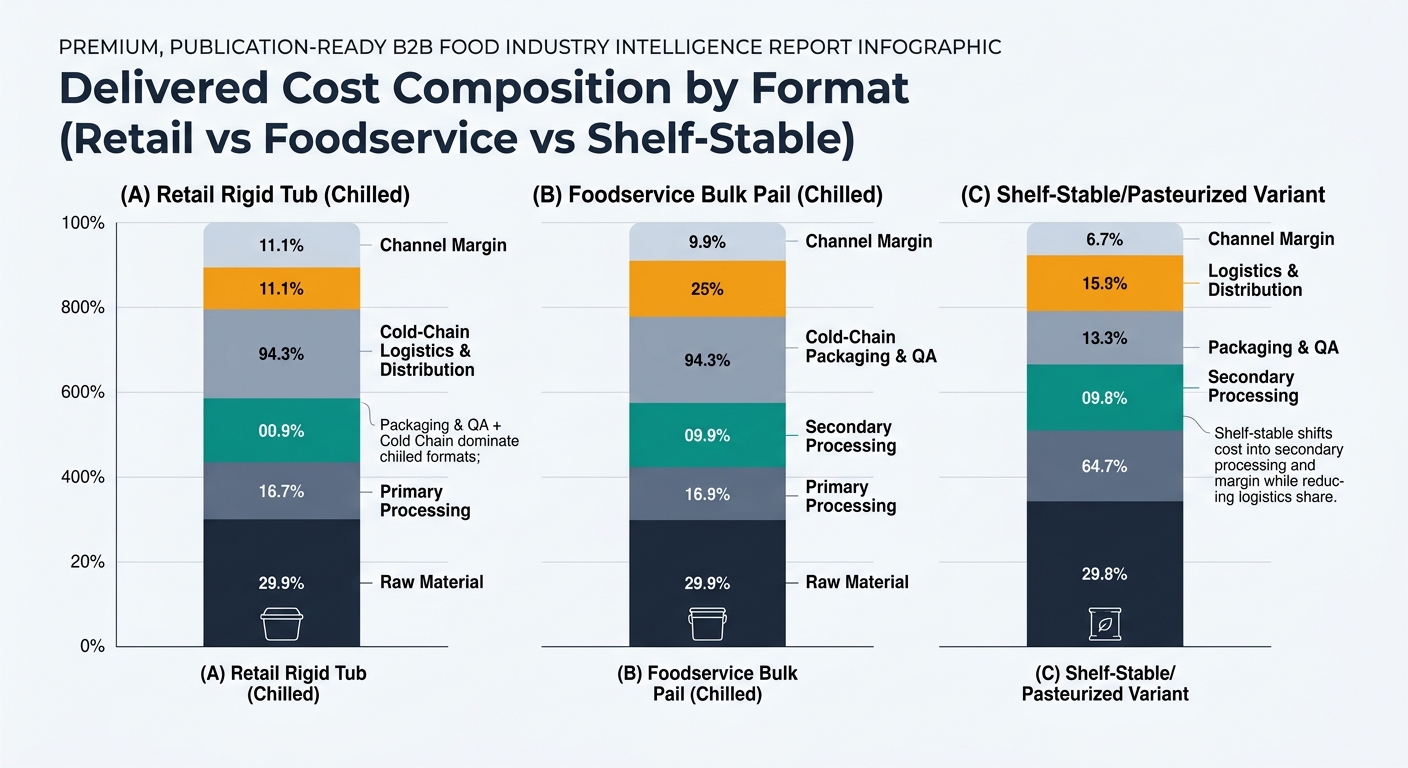
Three 100% stacked bars labeled (A) Retail Rigid Tub (Chilled), (B) Foodservice Bulk Pail (Chilled), and (C) Shelf-Stable/Pasteurized Variant, segmented by Raw Material, Primary Processing, Secondary Processing, Packaging & QA, Logistics (cold-chain for chilled), and Channel Margin using the percentages from the tables; includes a legend and brief annotations that packaging & QA plus cold chain dominate chilled formats while shelf-stable shifts cost into secondary processing and margin and reduces logistics share.

A) Retail Dongchimi (Rigid Tub, Chilled)

Supply Chain Node Cost Ratio (% of Final Cost) Notes
Raw Material Cost (produce + salt/seasoning) 25% Radish quality drives yield and stability more than BOM cost suggests.
Primary Processing 12% Labor + sanitation + yield loss from trim/purge.
Secondary Processing 10% Fermentation/aging space, cold-room energy, working capital.
Packaging & QA 23% Tub/lid/label plus testing; designed to prevent leaks under CO2 pressure.
Cold-Chain Logistics & Distribution 18% Reefer freight + cold storage; heavy liquid product inflates $/case.
Wholesale/Retail Margin 12% Channel margin varies by retailer and promo intensity.

B) Foodservice Dongchimi (Bulk Pail, Chilled)

Supply Chain Node Cost Ratio (% of Final Cost) Notes
Raw Material Cost 30% Less cosmetic trimming can improve yield economics.
Primary Processing 11% Similar sanitation needs; potentially lower cut/pack labor per kg.
Secondary Processing 11% Similar fermentation control; larger batches reduce per-unit overhead.
Packaging & QA 14% Pails are cheaper per kg than retail packs; QA still required.
Cold-Chain Logistics & Distribution 20% Heavier units; fewer packs but similar reefer dependence.
Distributor/Foodservice Margin 14% Distributor handling and cold storage add margin.

C) Shelf-Stable (Pasteurized) Dongchimi Variant (Niche)

Supply Chain Node Cost Ratio (% of Final Cost) Notes
Raw Material Cost 22% Inputs similar, but specs may shift for heat tolerance.
Primary Processing 10% Similar prep steps; sanitation remains critical.
Secondary Processing 18% Thermal processing + validation + energy; flavor/texture trade-offs.
Packaging & QA 20% Heat-stable packaging and process verification increase costs.
Logistics & Distribution 10% Ambient distribution reduces cold-chain spend.
Wholesale/Retail Margin 20% Often positioned as convenience; margin structure differs.

Quick Win: Use these ratios as a diagnostic: if your delivered cost is “mysteriously high,” it’s usually packaging+QA and cold-chain handling—not salt, garlic, or sugar.

Sourcing Window Radar
Dongchimi — Global Harvest Calendar
CHINA SEASON ACTIVE
🇨🇳 China
JAN — DEC
🇰🇷 South Kor.
JUL — OCT
JanFebMarAprMayJunJulAugSepOctNovDec

3) Structural Realities Every Procurement Manager Inherits (Whether They Want To or Not)

Insight: Dongchimi supply chains fail in predictable ways because fermentation continues after packing and because fresh produce variability is unavoidable.

Data: The dominant defect modes are (1) texture softening, (2) over-acidification, (3) yeast/off-odor development, and (4) package swelling/leakage—often triggered by temperature excursions or inconsistent brine/salt conditions.

Procurement Impact: The “real” specification is not just ingredient list—it’s a control system across raw material, process, packaging, and temperature history.

Reality 1: “Fermentation Doesn’t Stop at Pack-Out”—It Only Slows

  • Insight: Refrigeration reduces microbial activity but does not halt it; CO2 and acid can still build over time.
  • Data: CO2-driven pressure increase and package deformation during refrigerated storage is a known phenomenon in kimchi-type products; temperature fluctuation can amplify quality changes. [2]
  • Procurement Impact: Shelf-life risk is structurally tied to cold-chain discipline and packaging tolerance, not only to recipe.

Reality 2: Water Management Is a Hidden Cost Center

  • Insight: Dongchimi is a liquid product operationally: wash water, brine make-up, purge, and wastewater treatment are constant.
  • Data: High soil load on radish increases wash intensity and wastewater burden; purge and brine losses reduce finished yield and can shift salt %.
  • Procurement Impact: Plants with constrained wastewater capacity or weak CIP discipline often show higher micro holds and inconsistent flavor lots.

Reality 3: Packaging Is a Process Step, Not a Commodity

  • Insight: The pack must survive internal pressure, cold temperature cycling, and rough handling while staying leak-tight.
  • Data: Common failure drivers include seal design mismatch, resin brittleness at low temps, and headspace/closure performance under CO2.
  • Procurement Impact: Packaging performance determines returns and retailer claims; it’s structurally linked to fermentation kinetics and distribution dwell time.

Quick Win: When you audit a dongchimi supply chain map, treat packaging and cold-chain handling as “critical control infrastructure,” not downstream admin cost.

4) Key Insights to Carry Into Your Next Sourcing Cycle (Physical Map Only)

Insight: In dongchimi, the biggest cost and risk accumulation points are the ones that prevent defects: raw veg variability control, sanitation/water handling, packaging integrity under CO2, and cold-chain temperature history.

Data: The product’s high water activity and ongoing fermentation make it unusually sensitive to small deviations in salt %, temperature, and seal performance; those deviations show up as leakers, bloated packs, short code life, and inconsistent eating quality.

Procurement Impact: If you want predictable delivered performance, you need visibility into the physical control points: incoming radish specs and defect rates, yield loss (trim + purge), fermentation monitoring (salt/pH/acidity), packaging failure rates, and temperature excursions across handoffs.

Critical Risk Factors: leakage/swelling, temperature abuse at docks, raw radish hollowness/sponginess, brine dilution from purge, and sanitation gaps that elevate yeast/mold risk.

5) The Bottom Line for Your Next Contract

(Analyzed at: Jul, 2026)

Write your next dongchimi contract so it forces lane-by-lane temperature evidence plus packaging performance evidence—not just a finished-goods COA. It works because the biggest, most repeatable losses in this category come from the interaction of ongoing fermentation (CO2 pressure) with real cold-chain variability, which is exactly what drives swelling, leakers, and retailer returns. Kimchi-type packaging deformation from CO2 is a known failure mode, and U.S. cold-chain infrastructure is large but still handoff-heavy—so “average temp” isn’t a control plan. [2] What’s at stake is often a high-single-digit to low-teens percent swing in delivered cost once you include credits, disposal, rework, and premium freight—because one bad week of excursions can turn sellable inventory into waste.

DongchimiSupply Chain Intelligence
132 countries tracked
10
Exporters
10
Importers
$365M
Top Export Value
Top Exporters (2024)
🇳🇱
Netherlands
$365M
🇮🇹
Italy
$278M
🇪🇸
Spain
$232M
🇰🇷
South Korea
$178M
🇹🇷
Turkey
$156M
+127 more
Top Buyers
🇺🇸 United States $753M🇩🇪 Germany $471M🇯🇵 Japan $358M🇰🇷 South Korea $304M🇬🇧 United Kingdom $228M

References

  1. fda.gov
  2. pmc.ncbi.nlm.nih.gov
  3. esmis.nal.usda.gov

Related Contents

Subscribe
→
By subscribing you agree to with our Privacy Policy and provide consent to receive updates from our company.
Thank you! Your submission has been received!
Oops! Something went wrong while submitting the form.
Subscribe to receive the latest blog posts, updates, promotions, and announcements from Tridge.
