

Diced canned potatoes look like a straightforward shelf-stable item, but from a Quality/Safety/Compliance purchasing standpoint the supply chain is “short and dense”: a few steps where yield, container integrity, and retort execution rapidly determine both unit cost and recall exposure. This map highlights where cost becomes hard to recover, where the highest-severity hazards live, and what to verify when approving or monitoring suppliers.
Diced canned potato is a shelf-stable, retort-processed (commercially sterile) vegetable product. The physical chain is shorter than many foods, but it is capital- and compliance-dense: once potatoes enter a plant, cost is “locked in” quickly through yield loss (peel/trim), thermal processing capacity (retorts), and packaging integrity requirements.
Insight: The supply chain is built around three hard constraints: (1) agronomic variability managed via contracted processing potatoes and storage, (2) retort capacity and process control for low-acid canned foods, and (3) can/ends and liner/coating performance through high-heat sterilization.
Data (validated): U.S. requirements for thermally processed low-acid foods in hermetically sealed containers (LACF) define key concepts (e.g., retort, minimum thermal process, operating process) and the expectation that facilities and controls protect public health. [1]
Procurement Impact: The biggest structural cost drivers are not “optional”: potato quality/yield, retort throughput (OEE), and packaging system performance (double seam + coating/liner). Any disruption at these nodes shows up as scrap, holds, or missed ship windows.
Contracted processing potatoes → receiving/wash/grade → peel/trim/dice → blanch (texture set) → fill with brine/water (often salt + firming salt) → seam cans → retort sterilize → cool/dry/code → case-pack/palletize → ambient warehousing → truck/rail/ocean distribution.

Insight: Costs accumulate in “steps” that correlate to irreversible transformations: (a) yield loss from raw potatoes to diced solids, (b) energy + time in blanch/retort, and (c) metal packaging system (can/ends/coating) that must survive heat, salt, and long shelf life.
Data (validated framing): For LACF, container/closure integrity and retort execution are explicitly inspection focal points; FDA guidance addresses seam defects and their relationship to adulteration risk (especially leakage/swelling). [2]
Procurement Impact: When you compare suppliers or plants, the most meaningful structural differences often sit in (1) yield discipline and defect removal, (2) retort capacity utilization and record-control maturity, and (3) packaging system control (seam integrity + coating compatibility), not in “recipe.”
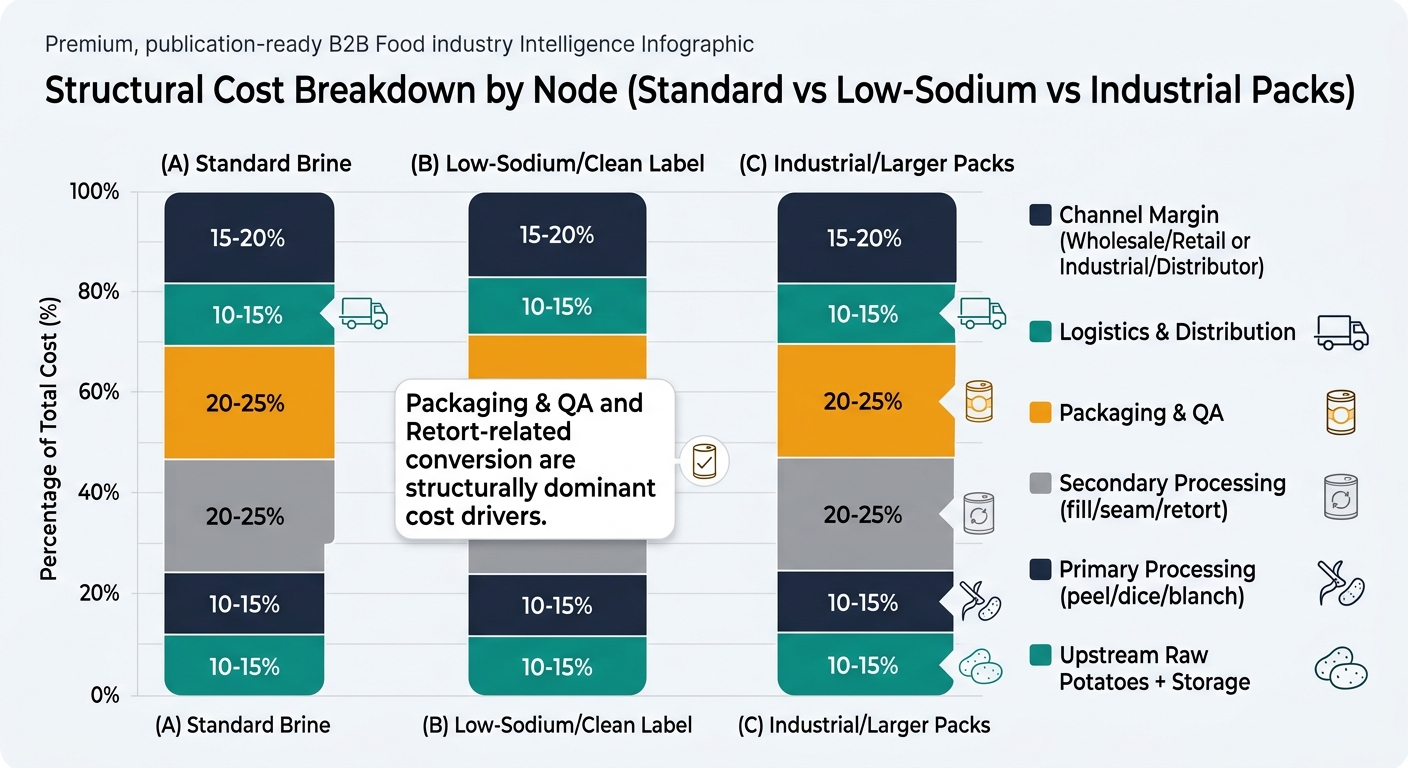
| Supply Chain Node | Cost Ratio (% of Final Cost) | Notes |
|---|---|---|
| Upstream Raw Potatoes + Storage | 18% | Contracted potatoes + shrink/defects embedded in effective cost. |
| Primary Processing (peel/dice/blanch) | 16% | Yield loss, labor, water/wastewater, line maintenance. |
| Secondary Processing (fill/seam/retort) | 20% | Retort energy/steam, downtime/OEE, process controls. |
| Packaging & QA | 26% | Tinplate can/ends, coatings/liners, labels, seam checks, coding. |
| Logistics & Distribution | 10% | Heavy freight; damage/handling sensitivity. |
| Wholesale/Retail Margin | 10% | Channel margin and service costs. |
| Supply Chain Node | Cost Ratio (% of Final Cost) | Notes |
|---|---|---|
| Upstream Raw Potatoes + Storage | 17% | Similar agronomics; tighter defect tolerances can raise effective cost. |
| Primary Processing | 16% | Similar mechanics; tighter texture/appearance specs can raise trim. |
| Secondary Processing (retort) | 20% | Same bottleneck; any texture sensitivity increases control burden. |
| Packaging & QA | 28% | More stringent organoleptic expectations; additional shelf-life validation is common when formulations/coatings change. |
| Logistics & Distribution | 9% | Similar weight dynamics. |
| Wholesale/Retail Margin | 10% | Similar channel structure. |
| Supply Chain Node | Cost Ratio (% of Final Cost) | Notes |
|---|---|---|
| Upstream Raw Potatoes + Storage | 19% | Higher solids/yield discipline often prioritized. |
| Primary Processing | 15% | Scale efficiencies; still yield-limited. |
| Secondary Processing (retort) | 19% | Larger cans can change thermal dynamics and cycle time. |
| Packaging & QA | 23% | Packaging still dominant, but per-kg packaging cost can be lower in larger formats. |
| Logistics & Distribution | 12% | Heavier units; different handling equipment and damage modes. |
| Industrial/Distributor Margin | 12% | Service model differs from retail. |
Insight: Retorts are specialized, high-capital assets; you can’t flex capacity quickly without adding shifts, maintenance risk, or new equipment.
Data (validated): LACF process control is documentation- and control-intensive by design (scheduled processes, instrumentation expectations, and inspection focus), not just mechanical throughput. [6]
Procurement Impact: Supply tightness can appear suddenly when a retort line goes down—because alternate plants may not have spare validated capacity in the same can size/formulation.
Insight: Can/ends + coating/liner performance is a system property; changes in coatings can require storage validation and heightened monitoring for corrosion/off-notes and container integrity.
Data (market + continuity, Aug 2026): U.S. metal can shipment trends and tinplate market dynamics continue to shift in 2026; buyers should treat packaging availability and pricing as a live risk variable, not a one-time assumption. [4]
Procurement Impact: A “simple” packaging change can become a long lead-time constraint, affecting shelf-life confidence, complaint risk (corrosion/off-notes), and continuity if a single can supplier is disrupted.
Insight: Storage conditions shift tuber chemistry and defect rates, changing peel loss and finished texture stability.
Data: Research shows cold-induced sweetening increases reducing sugars during cold storage, with cultivar-dependent behavior. [5]
Procurement Impact: The same “spec” can behave differently across seasons/regions because the plant is processing a biological material with storage history—raising the importance of incoming grading discipline and process windows.
(Analyzed at: Aug, 2026)
Write your next diced-canned-potato contract so packaging and retort controls are explicitly governed, not implied: lock the approved can/ends source(s), coating/liner family, seam inspection/defect limits, and the supplier’s change-notification obligations (including sub-tier can/ends changes). This works because, in practice, the highest-severity failures you’ll manage are container-integrity and LACF process-control linked—not “flavor”—and 2026 metal packaging availability/price dynamics make unplanned packaging substitutions more likely. [2]
If you prevent just one meaningful hold/withdrawal event or a season of elevated dents/leakers, the avoided credits, disposal, and expedited freight can easily outweigh a low-single-digit unit-price concession you might otherwise chase.


