INDUSTRY TRENDS

Dehydrated Pomegranate Supply Chain Map, Cost Drivers, and Contract Levers (Procurement View)

Author
Team Tridge
DATE
September 22, 2026
7 min read
dehydrated-pomegranate Cover
Unlock Full Data
Dehydrated Pomegranate Market Intelligence
Prices · Trends · Origins · Forecasts

This guide maps how dehydrated pomegranate (arils/pieces, granules, powders, and freeze-dried inclusions) is physically made and where cost and risk “lock in.” It is written for procurement leaders who know sourcing mechanics but need the category-specific levers—yield, water activity, packaging barrier, and channel transparency—to control landed cost, continuity, and auditability.

Executive Summary

  • Cost locks in early: fruit grade/yield, extraction losses, and drying energy dominate conversion economics before product ships.
  • Stability is aw + packaging, not “moisture %”: one technical review cites an optimal water activity for drying/storing arils around 0.3684 ± 0.03, reinforcing why aw should be specified and verified. [1]
  • Harvest seasonality still shapes quotes: Northern Hemisphere supply is commonly cited as Sep–Feb, with India often described as having extended availability relative to many origins. [2]
  • Humidity exposure is a real TCO driver: moisture uptake and shelf-life are strongly influenced by packaging permeability and storage conditions for dried arils. [3]

1) How the Physical Supply Chain Is Built (and Where Costs “Lock In”)

Dehydrated pomegranate (dried arils/pieces, granules, powders, and premium freeze-dried arils) is physically constrained by three realities: seasonal orchard fruit, aril extraction that is inherently handling-intensive, and energy-heavy dehydration. Once arils are separated from peel and dried to a stable moisture/water-activity range, the product becomes shelf-stable—but also highly humidity-sensitive, which shifts cost control to packaging barrier performance and warehousing discipline.

Insight: The chain’s fixed cost drivers are set upstream (fruit quality/yield), at extraction (labor/handling + foreign-matter control), and at dehydration (energy + throughput).

Data: Fresh arils are high-moisture; drying removes most water mass, so shrink/yield loss is structurally significant. Technical literature on dried arils references an “optimal” water activity for drying/storing arils around 0.3684 ± 0.03, underscoring how far aw must be pushed down to stabilize quality. [1]

Procurement Impact: Expect the largest, least-negotiable cost accumulation before the product ever ships: orchard grade → extraction yield → drying energy/time → packaging barrier. These are structural, not cyclical.

Physical flow (typical):

Orchard harvest → fruit receiving & grading → washing/sanitation → aril extraction (manual/mechanical) → sorting/foreign-matter removal → pre-treatment (optional: sulfite/acid dip, blanching, osmotic step depending on product) → dehydration (hot-air/tunnel/belt; or freeze-dry) → post-dry conditioning & final sort → milling/sieving (if granules/powder) → metal detection/X-ray → high-barrier packaging (bulk) → ambient export logistics → humidity-controlled warehousing → industrial use.

A left-to-right process map showing the physical flow from Orchard Harvest through grading, washing, aril extraction, sorting, optional pre-treatments, dehydration or freeze-drying, conditioning, milling/sieving branches, metal detection, high-barrier packaging, export logistics, humidity-controlled warehousing, and industrial use, with callouts marking where cost and risk lock in (fruit grade/yield, extraction losses and foreign-matter controls, drying energy/time and water activity target, packaging barrier/seal integrity, and port/warehouse humidity exposure).

2) Where Cost and Margin Accumulate (Node-by-Node)

Insight: Dehydrated pomegranate is a yield-and-spec business: small changes in fruit grade, aril damage, moisture/aw target, or foreign-matter tolerance cascade into real cost at multiple nodes.

Data: Pomegranate supply is broadly Northern Hemisphere seasonal (commonly cited Sept–Feb), with India often described as having extended availability relative to many origins. [2]

Procurement Impact: Cost structure is best understood as a sequence of “conversion tolls” (extraction + drying + protection from humidity), not as a simple farm-to-factory markup.
1. Upstream / Raw Material (Orchards + Harvest)

  • Insight: Fruit quality determines downstream yield: cracked, sunburned, moldy, or low-color fruit drives higher sorting losses and lower usable aril recovery.
  • Data: India-focused export strategy work explicitly frames India’s year-round harvesting/availability as a strategic advantage, while also noting quality constraints in certain periods (e.g., colour variation) that can affect export readiness. [2]
  • Procurement Impact: Farmgate variability shows up later as extraction yield loss and higher defect/foreign-matter risk. This is where “cost locks in” via raw material quality, not later logistics.

2. Primary Processing (Receiving, Washing, Aril Extraction, Sorting)

  • Insight: Aril extraction is the chain’s labor and hygiene bottleneck; it also sets foreign-matter risk (peel fragments, membrane, stones, metal) and microbial load.
  • Data: Commercial aril lines commonly describe staged washing/sanitation, extraction using air/water assistance, and multiple separation/sorting steps prior to packaging—illustrating how much of the control plan lives “pre-dry.” [4]
  • Procurement Impact: This node drives both cost (labor + rework) and “spec credibility” (traceability, hygiene, and foreign-matter controls). Weak controls here force heavier downstream inspection and higher rejection risk.

3. Secondary Processing (Dehydration + Conditioning)

  • Insight: Dehydration is energy-intensive and throughput-limited; the tighter the moisture/aw target, the longer the drying time and the higher the energy per kg finished.
  • Data: A technical review on dried pomegranate arils cites an optimal aw for drying/storing arils around 0.3684 ± 0.03. [1]
  • Procurement Impact: Moisture/aw specs are not “nice-to-haves”—they are direct cost levers. Over-drying can increase breakage/fines (hurting appearance specs), while under-drying increases caking/quality failures in storage and transit.

4. Value-Add Conversion (Milling/Sieving, Blending, Sweetening/Infusion, Freeze-Drying)

  • Insight: Product form multiplies cost paths: powder/granules add milling yield loss and dust control; sweetened/infused arils add ingredient inputs and sticky handling; freeze-dried arils add major capex/opex.
  • Data: Literature comparing drying techniques commonly shows freeze-drying can better preserve certain quality attributes than many thermal methods, but it is inherently more resource- and time-intensive. [1]
  • Procurement Impact: “Same ingredient, different form” is effectively a different manufacturing route. Cost and failure modes change (dusting vs. caking vs. breakage), so technical specs must align to the form factor.

5. Packaging, QA, and Release (Barrier Protection + Testing)

  • Insight: Dried arils are hygroscopic; packaging barrier performance (film, liner integrity, seal quality) and oxygen/light management are structural quality determinants.
  • Data: Under accelerated storage, research on dried pomegranate arils in flexible packaging highlights that moisture uptake depends on the water vapor permeability of the packaging material, and that keeping quality is influenced by water activity. [3]
  • Procurement Impact: Packaging is not a commodity cost line: it is a functional control against caking, browning, and quality drift. Weak packaging shifts cost into claims, rework, and accelerated shelf-life loss.

6. Logistics & Distribution (Ambient Export, Humidity Exposure, Warehousing)

  • Insight: The product ships ambient, but humidity and heat exposure are the real enemies—especially during port dwell time and in non-conditioned warehouses.
  • Data: Even in fresh-fruit handling guidance, pomegranates are managed with high relative humidity to prevent water loss; for dried arils the risk direction is reversed (moisture gain), making barrier packaging and storage discipline critical. [5]
  • Procurement Impact: Transit/warehousing discipline becomes part of product quality. Even if the processor hits spec at pack-out, moisture ingress can create caking and shorten usable shelf life downstream.

Product-Level Cost Breakdown

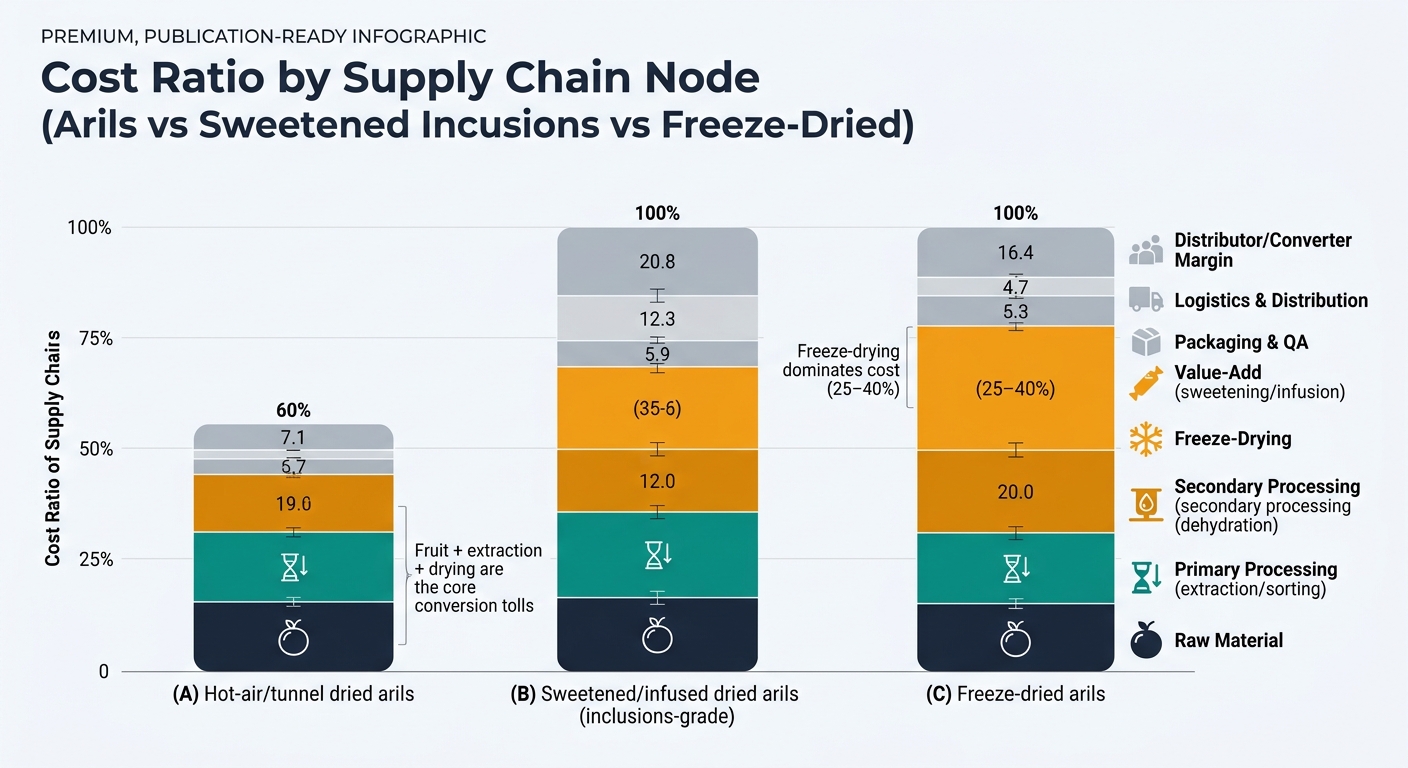
Grouped stacked bar chart comparing cost ratios by supply chain node across three product forms: hot-air/tunnel dried arils, sweetened/infused dried arils (inclusions-grade), and freeze-dried arils, segmented into raw material, primary processing, secondary processing and/or freeze-drying, value-add where applicable, packaging & QA, logistics & distribution, and distributor/converter margin, with annotations noting freeze-drying dominates cost and that fruit plus extraction plus drying are core conversion tolls.

A) Dried Pomegranate Arils (Unsweetened, hot-air/tunnel dried)

Supply Chain Node Cost Ratio (% of Final Cost) Notes
Raw Material Cost (fruit) 30–40% Quality grade drives usable aril recovery and defect losses.
Primary Processing (extraction/sorting) 18–28% Labor/handling + sanitation + foreign-matter control are structural.
Secondary Processing (dehydration/conditioning) 12–22% Energy + drying time + yield loss to reach stable moisture/aw.
Packaging & QA 8–14% High-barrier liners/films; micro/residue/foreign-matter verification.
Logistics & Distribution 6–12% Inland + ocean + humidity protection + warehousing handling.
Distributor/Converter Margin 8–15% Depends on channel (ingredient distributor vs direct).

B) Sweetened/Infused Dried Pomegranate Arils (inclusions-grade)

Supply Chain Node Cost Ratio (% of Final Cost) Notes
Raw Material Cost (fruit) 22–32% Fruit quality still matters, but infusion can mask some visual variance.
Primary Processing (extraction/sorting) 16–26% Hygiene and foreign-matter control remain critical.
Secondary Processing (dehydration) 10–18% Drying still energy-driven; sticky handling increases downtime risk.
Value-Add (sweetening/infusion) 8–18% Sugar/juice inputs + additional process steps + yield changes.
Packaging & QA 10–16% Higher stickiness raises packaging performance requirements.
Logistics & Distribution 6–12% Moisture control remains key; stickiness worsens with humidity.
Distributor/Converter Margin 8–15% Often higher where repacking/blending is involved.

C) Freeze-Dried Pomegranate Arils (premium inclusions)

Supply Chain Node Cost Ratio (% of Final Cost) Notes
Raw Material Cost (fruit) 18–28% High-grade fruit needed for appearance and flavor.
Primary Processing (extraction/sorting) 15–25% Tight foreign-matter and breakage control.
Freeze-Drying (capex/energy/time) 25–40% Dominant cost: long cycle times, high energy, equipment utilization.
Packaging & QA 10–18% Very moisture-sensitive; barrier and seal integrity are decisive.
Logistics & Distribution 6–12% Crush damage + humidity exposure risks; careful handling needed.
Distributor/Converter Margin 8–15% Premium channels typically carry higher margin.
Unlock Full Data
Dehydrated Pomegranate Market Intelligence
Prices · Trends · Origins · Forecasts

3) Structural Facts You Should Treat as “Constants”

Reality 1: India’s longer supply window changes how the physical system runs

Insight: Unlike many origins with concentrated harvest windows, India is often described as having extended availability, which affects processor utilization and inventory profiles.

Data: An India export strategy report describes year-round availability as an advantage, while also documenting constraints that can affect consistency (e.g., seasonal quality variation). [2]

Procurement Impact: Extended availability can support steadier processing and replenishment, but it also increases the importance of consistent QA across lots because production is less “one-crop, one-packout.”

Reality 2: Water activity (aw) is the real stability spec—not just “% moisture”

Insight: Moisture % alone doesn’t fully predict microbial and caking behavior; aw is the better indicator of shelf stability and moisture migration risk.

Data: Technical reviews on dried arils explicitly reference target/optimal aw for drying and storage (~0.37 ± 0.03 in one cited review). [1]

Procurement Impact: If aw is not controlled and verified, downstream failures show up as clumping/caking and shortened usable shelf-life—even when COAs show “acceptable moisture.”

Reality 3: Extraction and sorting are the traceability and foreign-matter “point of no return”

Insight: Once arils are extracted, the product’s risk profile is set by sanitation design, foreign-matter controls, and segregation discipline.

Data: Commercial aril line descriptions emphasize staged disinfection/handling and extraction/separation steps as the core of delivering “clean arils” downstream. [4]

Procurement Impact: If this node is weak, downstream mitigation is expensive (more inspection, more rework, more rejections). Strong upstream controls reduce total system cost even if they raise processing tolls.

Key Insights (What to Remember When Reading Specs and COAs)

  • Key Takeaways: Dehydrated pomegranate cost is structurally dominated by yield (fruit grade → usable arils), conversion tolls (extraction handling + dehydration energy), and protection from humidity (packaging + warehousing).
  • Key Takeaways: Product form is a different physical route: hot-air dried arils, sweetened inclusions, powders, and freeze-dried arils have distinct failure modes (caking vs dusting vs breakage) and therefore distinct “must-have” specs.
  • Key Takeaways: Seasonality still matters even for a shelf-stable ingredient; it shapes processor utilization, inventory age, and lot-to-lot variability—especially outside origins with extended availability. [2]

4) The Bottom Line for Your Next Contract

Treat water activity (aw) and packaging barrier performance as non-negotiable release gates, and write them into your commercial terms—not just your QA appendix. As of Sep, 2026, teams are still operating in a logistics environment where lead times and port dwell uncertainty can extend exposure windows, which amplifies the penalty for moisture-permeable packaging and “COA-only” release.

In practical terms: require aw at pack-out (not just % moisture), define the test method/frequency, and pair it with a barrier/WVTR spec plus seal-integrity verification, because moisture uptake is packaging-dependent and hard to remediate once it happens. Evidence from dried-aril packaging studies under high humidity shows shelf-life and moisture uptake materially depend on the packaging material—so getting this wrong typically shows up as write-offs, rework, and expedited rebuys that can easily cost low-to-mid single digits of annual spend in this subcategory. [3]

Unlock Full Data
Dehydrated Pomegranate Market Intelligence
Prices · Trends · Origins · Forecasts

References

  1. maxapress.com
  2. icrier.org
  3. sciencedirect.com
  4. arilsystem.com
  5. postharvest.ucdavis.edu

Related Contents

Subscribe
→
By subscribing you agree to with our Privacy Policy and provide consent to receive updates from our company.
Thank you! Your submission has been received!
Oops! Something went wrong while submitting the form.
Subscribe to receive the latest blog posts, updates, promotions, and announcements from Tridge.
